Author: james

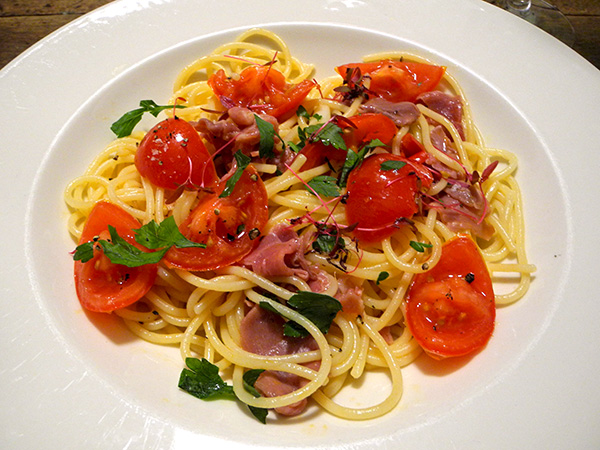
spaghetti, leek, tomato, prosciutto, red pepper

spaghetti_leaks_prosciutto_tomatoes

Lately it looks more and more like I’m trying to break ethnic cooking traditions.  At least until recently, I seemed to be entertained enough by (mostly) observing formulas which had been honored by generations immersed in a single tradition. I’m not sure what, if anything my loosening up might portend, but I’m going to be watching any developments.

I have always liked working with restraints in areas in which I have never had formal instruction, partly because I’m a perfectionist. Along those lines, I’ve never designed or built a new house, but I know the huge pleasure which comes from carefully and fully restoring one.

In the kitchen, I’ve very slowly become more confident about some very modest talents, and I’ve always done some improvising, so maybe my cooking is just becoming a little more free-range than it has been until now.

First it was about fooling around with a fine fish fillet and its contorni; then it was about playing with most of a classic German plate; this time it’s about tampering with spaghetti, an particularly iconic element of Italian cooking.


It was to be a simple pasta dish which would be assembled from some ingredients I had lying around the kitchen.  Normally it would be a simple Italian-ish dish, meaning the list of separate ingredients, if not the ‘recipe’, would at least sound Italian, but I ended up slipping out of the tradition, just a bit.

I included the small amount of red amaranth microgreens I still had sitting on the counter, and also a drizzle of an aromatic seasoning blend with the proprietary name, L’eKama, which would be pretty exotic in any Italian kitchen.  The amaranth got in largely because it was there, but also because it would work as another finishing herb, and because it’s so beautiful.  The oil and spice mix was added because the fresh red Italian pepper I included turned out to be so mild it had almost had almost disappeared when I tasted the finished dish; it gave a depth to the taste of the dish way out of proportion to the amount I added.

  • three small leeks from Ryder Farm, sliced into half-inch sections, sautéed in olive oil until softened, one chopped fresh red Italian ‘roaster pepper’ from from Oak Grove Plantation added near the end, the mix combined, when partially cooled, with sectioned ripe Maine cherry ‘cocktail’ tomatoes from Whole Foods and shopped slices of Colameco’s prosciutto, additional olive oil added, the sauce then tossed with spaghetti, and a little warm cooking water, placed in bowls, and sprinkled with parsley from Paffenroth Farms and a tiny amount of amaranth microgreens from Radicle Farm (the last drops from a tiny jar of L’eKama aromatic seasoning was added to the bowls when they were on the table)
  • the wine was an Italian (Umbria) white, Melini Orvieto Classico 2014
  • the music was streamed from Q2 music, and it included Huang Ruo’s Violin Concerto No. 1, ‘Omnipresence’
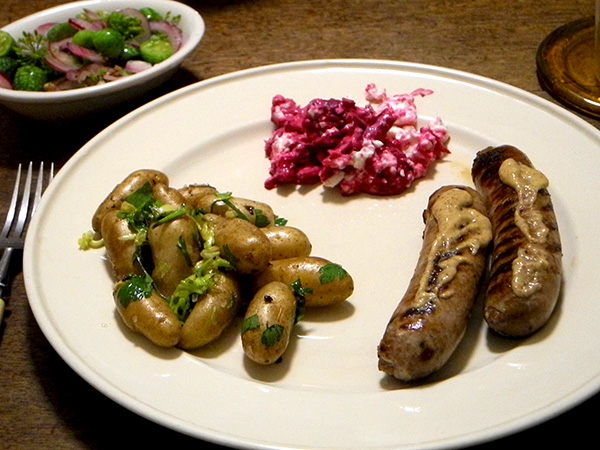
bratwurst; potatoes; beets; cucumber salad; beer

bratwurst_potato_beet_cucumber

I tweaked my German.

Meaning the cookery.  I bought some frozen Vermont ‘beer brats’ on a whim while I was at the Greenmarket on Wednesday.  My enormous family is from Sheboygan and Calumet Counties in Wisconsin, where ‘brats‘ are an obsession, and the sausages played a huge role in our enormous annual family reunions.  For perspective, note that I have approximately 100 first cousins alone, and at the last reunion of my Mother’s Franconia-rooted family, when we signed in, each branch of the Woelfels was given a name tag with a different color code (I did say my family was German).

I know brats.  And I know Bratwürste.

I like German food, and I take enormous pleasure in it on visits to central Europe, and occasionally at home.  Most of the time the plates don’t stray far from tradition, if at all, but this time I found myself moving beyond it just a little.  The occasion was both necessity (the ingredients on hand and not on hand, the time available, and the summer heat of a kitchen).

  • beer brats from Tamarack Hollow Farm, whose ingredients are pork, Vermont Harpoon IPA, salt, black pepper, sugar, garlic, and spices, pan-grilled (traditionally they would grilled on charcoal in the open, smoky air), and served with a real German mustard

Now the real tweaking begins.

  • La Ratte potatoes from Berried Treasures (a small buttery and nutty tuber, more French than German), boiled until barely tender, drained, dried, rolled in a little butter, tossed with parsley and celery tops (the latter bit probably not very German)
  • baby beets (‘baby beets’ doesn’t sound very German) from Tamarack Hollow Farm, whose tops we had enjoyed a few days earlier), steamed until tender, which is also not very German but I wanted to avoid the oven, then halved, mixed with a marinade of yoghurt, white wine vinegar, crushed caraway seeds, a pinch of sugar, red onion (not German) from John D. Madura Farm, and some amazing parsley [yeah, amazing parsley!] from Paffenroth Farms, and some lovage (not traditional) from Keith’s Farm, the salad allowed to chill for an hour or so before some French Valbreso sheep feta cheese from Whole Foods was turned into it
  • tiny Mexican gherkins or ‘Sandita’, from Norwich Meadows Farm (not the ‘cukes’ my Mother used all her life), halved, then tossed with thinly-sliced red onion (un-German) from John D. Madura Farm, ground white pepper, a little sugar, and some salt, dill flowers from from Crock & Jar/Rise & Root, covered with a mixture of half water-half white organic vinegar, chilled for an hour
  • the bottles of beer (truly German), each of which we shared, were, in succession, Spaten Münchner Hell, Weihenstephaner Vitus [damn good beer], Schneider Weisse; they are all from Munich, although the Weihenstephaner (established in 1040) is actually brewed a few miles north of that city, in Freising, one of the oldest settlements, or towns, in Bayern, and the seat of a bishop from 739, no doubt explaining the high quality of its beer
  • the music was Ravel’s ‘Gaspard de la nuit‘, and Beethoven’s third piano sonata, both played by Arturo Benedetti Michelangeli

hake, amaranth microgreens; grilled eggplant; salad

hake_amaranth_eggplant_salad

Note to self:  This was beyond any doubt, the most delicious hake I have ever eaten.


It was the chance assemblage of some very fine ingredients that made this terrific meal possible; that, and one very fine muse.

The hake was extraordinarily fresh, and although I have prepared slightly different versions of this dish in the past, none of them had involved amaranth microgreens, whose flavor seemed to have a special affinity with the sage leaves and lemon which were a part of the basic recipe.  In fact, it was my first outing with these beauties, which also provided a spectacular visual, both on the table and in the image on this blog post.

So, am I still in Italy?

The Mario Batali eggplant treatment brought me back to the boot, but the small salad which shared the plate as a third element still made it iffy. As with the hake, the grilled Japanese melanzane recipe was an old favorite of mine, but these three small fruits were juicier than any I’d had before, and seemed to have more flavor as well.

The single small orange heirloom tomato we shared was perfectly ripe, and was perfectly at home on a small collection of baby lettuce.

I just noticed that there are a lot of “baby”s and “small”s in my discussion of this dinner.  I hope it doesn’t make the meal sound too precious, because it certainly was not.

The plate was also a subtle rainbow of color;  the picture I’m using shows so much of the area above the food itself only because I wanted to include a bit of the color of the wine we enjoyed with it.

  • hake fillets from Pura Vida Fisheries, dredged in seasoned flour and dipped in a beaten egg from Millport Dairy, sautéed in butter along with a handful of sage leaves from Norwich Meadows Farm, drizzled with lemon juice and the pan juices that remained, sprinkled with gorgeous Amaranth microgreens from Radicle Farm
  • Japanese eggplant from Norwich Meadows Farm, split lengthwise, scored, brushed with a mixture of olive oil, finely-chopped garlic from Phillips Farm, and fresh oregano from Lani’s Farm, seasoned with salt and pepper, pan-grilled, turning once
  • one orange heirloom tomato from Berried Treasures, sliced, placed on a bed of baby lettuce from Radicle Farm in the Union Square Greenmarket, drizzled with a small amount of some very good olive oil, lightly seasoned with Maldon salt and black pepper
  • the wine with the main course was a delightful French rosé, Côtes du Rhone Parallèle 45 Rosé 2014
  • the music was from the album, ‘Birds On Fire – Jewish Music For Viols’, performed by Fretwork


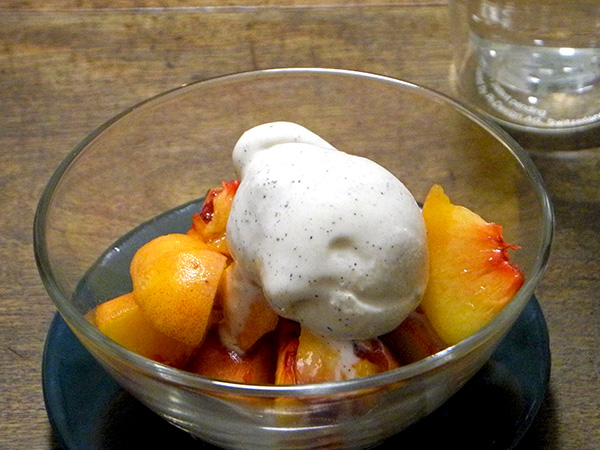
peaches_vanilla_gelato

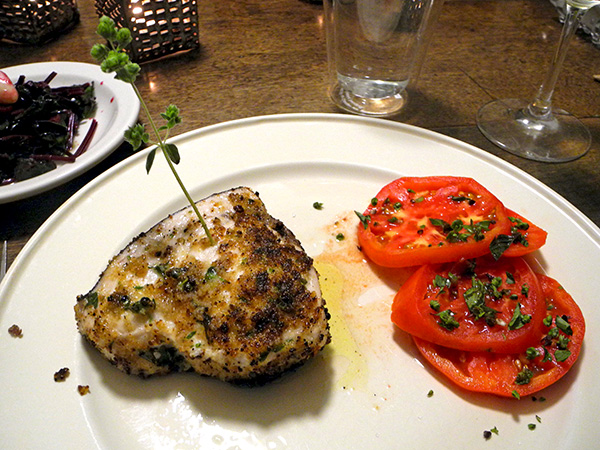
breaded swordfish steak; tomato; beet greens

swordfish_tomato_beet_greens

Yes, that’s a branch of oregano sticking out of the steak.  The idea of a garnish is generally alien to Italian cooking, but I’m not entirely strict about following cooking traditions, and I did have these two beautiful stems left over after preparing enough herbs to cover the two steaks.

We’re both very fond of Swordfish, and we appreciate the many ways it can be prepared, some of which I have worked with myself. This particular method relates to the Sicilian style (Trancia di Pesce Spada alla Siciliana), as described by Kyle Phillips, although lately I have taken the liberty of adding a very American ingredient, ramp fruit.

It’s a terrific dish.

  • a one pound swordfish steak, more than an inch thick, from P.E. & D.D. Seafood, cut into two pieces, briefly marinated in a mixture of olive oil, crushed ramp fruit from Berried Treasures and chopped fresh oregano leaves from Stokes Farm, then drained well and rolled in dried homemade bread crumbs, fried in a hot cast iron pan for about 4-5 minutes on each side, salted, sprinkled with a little lemon juice and drizzled with olive oil before serving
  • one ripe heirloom tomato from Berried Treasures, sliced, sprinkled with Thai basil from a friend’s garden in Garrison, New York, then drizzled with the rich savory juices which remained from a salsa prepared the day before
  • beet greens from Tamarack Hollow Farm, wilted with a halved garlic clove from Berried Treasures, which had been been able to sweat in olive oil, seasoned with salt, and pepper, and drizzled with fresh olive oil


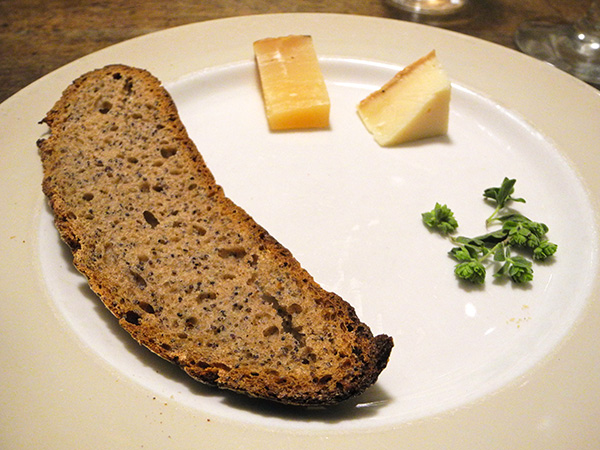
cheese_Tourte_de_Seigle

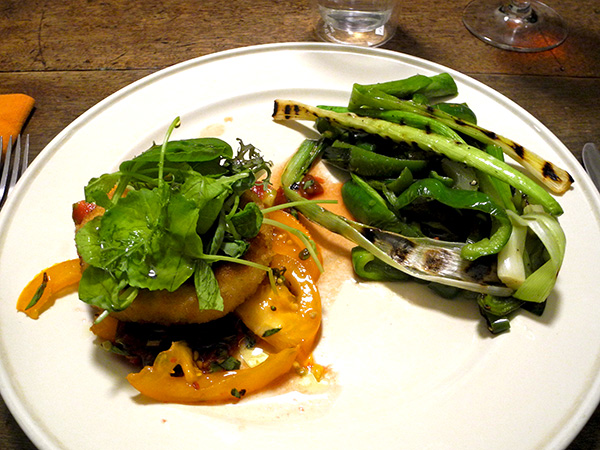
crab cake, tomato, greens; peppers, leeks; + Quebec

crab_cakes_tomatoes_green_peppers

Fast food (the crab cakes; the rest was slow).

This may have been my favorite treatment to date for my favorite Greenmarket crab cakes.  It involved placing them on a bed of very ripe heirloom tomatoes and some Thai basil, and adding a ‘topping’ of a peppery melange of baby greens.  I decided on the green side entirely because the only suitable vegetables I had in the crisper were green bell peppers (the last of the bounty a friend recently shared with us from her upstate garden), and some very neat small leeks I had picked up from the Greenmarket the day before preparing this meal.

  1. crab cakes from P.E. & D.D. Seafood, sautéed in a little olive oil for about 4 minutes on each side, arranged on a bed of roughly-chopped heirloom tomatoes (a friend’s dark red, from her garden in Garrison, New York, and one Berried Treasures orange), mixed with Thai basil (leaves and blossoms), salt, and pepper, each serving topped with a small amount of ‘Living Japanese Peppergrass’ (pak choi/red mustard/green mizuna/leaf broccoli) from Radicle Farm, then drizzled with a bit of good olive oil
  2. leeks from Ryder Farm, split and pan-grilled, combined with strips of green bell peppers from a friend’s garden in Garrison, sautéed, celery from Whole Foods, also sautéed, some briefly-sautéed leek green stems, and garlic chive flowers
  3. a simple cheese course with Consider Bardwell’s goat milk ‘Danby’ (made with a surprise end-of-season batch), which produced a great taste and a very long  finish, accompanied by thin toasts made from slices of one of Eataly’s ‘Integrale’ loaves
  4. the wine was a remarkable sturdy Quebec rosé, Le Charlevoyou Rosé 2014, vinifié chez Maurice Dufour; I know it’s from a very limited production (we bought it à la maison, just outside Baie-Saint-Paul), and it’s not available in the U.S., but, if it were possible, I would buy a case of this wine today
  5. the music was Mozart’s ‘Don Giovanni’, conducted by Carlo Maria Giulini, with Eberhardt Wächter, Elisabeth Schwarzkop, and Cesare Valletti, et al.

poblano and feta; spinach-ricotta agnolotti, tomato

poblano_feta_bread

It was summer, and the vegetables were easy.

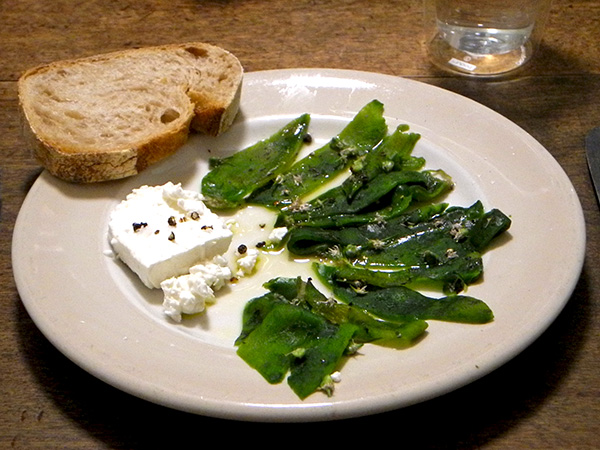
  • feta cheese, an excellent ‘Valbreso’ from Roquefort-sur-Soulzon, in the Aveyron department in the south of France from Whole Foods, served with strips of poblano peppers from a friend’s rural Garrison garden upstate, which had been charred over an open flame on my 1931 Magic Chef while being turned on an expanded metal grate, placed in a bag for 20 minutes, the skin, the seeds, and the veins then removed, covered with some good olive oil and garlic chive flowers from Paffenroth Farms, served with slices of ‘rustic classic’ bread from Eataly


Demi-lune_spinach_ricotta_tomato

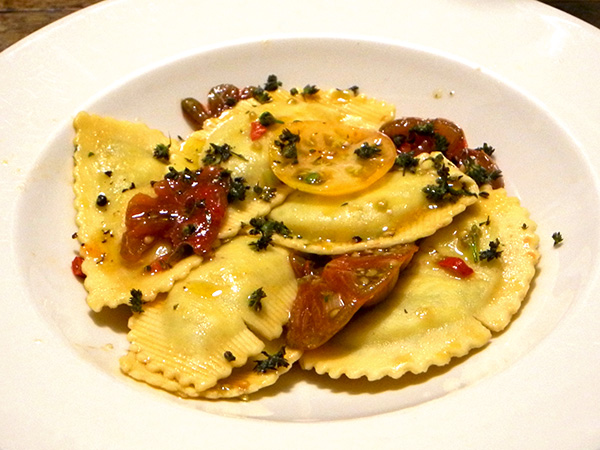
  • spinach and ricotta-filled demi-lunes from Eataly, served with a sliced dark red heirloom tomato from our friend’s Garrison garden, and a small yellow tomato from Berried Treasures, also sliced, scattered with ramp fruit from Berried Treasures, and summer savory from Keith’s Farm, drizzled with olive oil
  • the wine was a Catalan white, Domaine Lafage Côté Est Catalan 2014
  • the music was various works by the Neapolitan composer, Nicola Porpora (1686-1768), and some of his contemporaries

Schnitzel Milanese; Blattsalat; Tomatensalat

Cotoletta_alla_Milanese_Blattsalat

I think what I prepared here was a hybrid of a dish enjoyed in several cultures, and claimed by at least two.

Wiener schnitzel is the national dish of Austria, even though, by European standards, its history there doesn’t seem to go back very far. Austria, and especially Vienna, may not like being reminded of this, but documentary evidence indicates that its iconic thin, breaded and pan fried veal cutlet was apparently known as “Lumbolos cum panitio“, or ‘Milanese cutlet’, almost 700 years earlier than its first association with the Habsburg capital, where it became known as ‘Wiener Schnitzel“, and remains a star today.  In fact, and as usual, I’m inclined to agree with the antiquarians, who point out that a recipe of its description appeared in the late Roman cookbook, ‘Apicius‘, a work which remains in print today (partly, I like to imagine, for giving the world the breaded veal cutlet, even if its author might have himself borrowed it from another).

Cotoletta alla Milanese, the Milan version of this dish, which may have been the source for the Viennese, includes the rib bone; Palermo apparently brushes it with lard, then pan grills it, flavoring it along the way with oregano and/or parmesan cheese. Okay, I’ve now given up on trying to achieve anybody’s idea of authenticity, and will forevermore just aim for great pleasure.

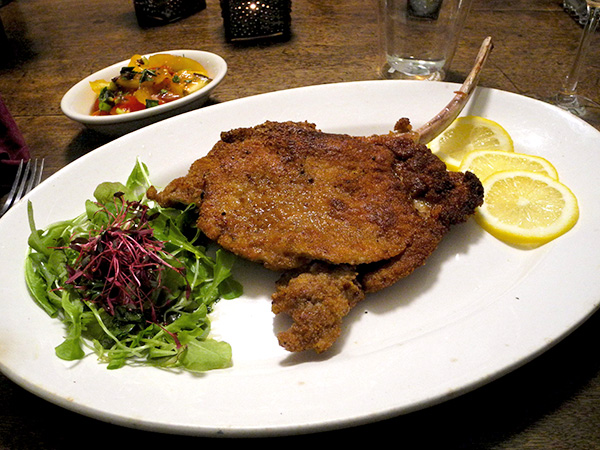
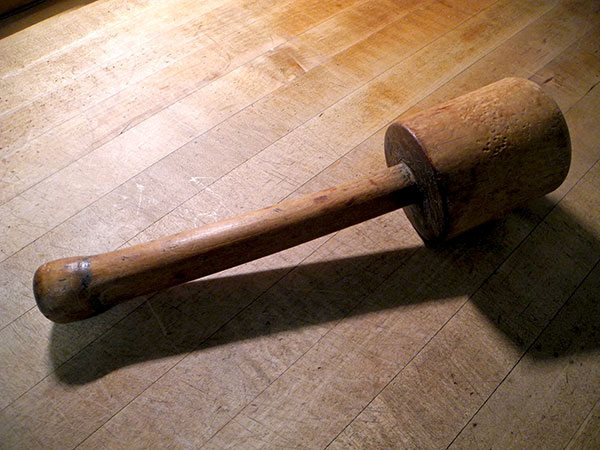
  • two reasonably-thick bone-in veal rib chops from Eataly (from milk-fed calves, humanely raised, group-housed, from Amish and Mennonite farms in Lancaster, Pennsylvania), hammered with a mallet, by the butcher and later continued further by me, using an antique wooden kitchen mallet I don’t get to work with often enough (see image below), until the veal was reduced to a thickness of about a quarter of an inch, sprinkled with a little lemon juice, and salted, on both sides, dipped in whole wheat flour first, then in a bowl of whipped egg, and finally in homemade bread crumbs, then chilled for a half hour before being placed in hot lard (labelled ‘Morrell Snow Cap Manteca’, from Eataly, which I later strained and placed the fat in the refrigerator for further duty) inside two large cast iron enameled pans, cooked for about 2-3 minutes on each side, removed and dabbed dry on paper towels, served on two oval platters with thin slices of lemon
  • a small Kopfsalat, or Blattsalat of ‘Living Baby Lettuce’ topped with red amaranth sprouts, both from Radicle Farm, simply dressed with a white vinegar, an equal amount of good olive oil, a pinch of turbinado sugar, salt, pepper. and a little chopped parsley from Paffenroth Farms
  • a Tomatensalat, as a side dish, of red and yellow heirloom tomatoes from Berried Treasures, sectioned, mixed with good olive oil, salt, pepper, Thai basil from a Friend’s garden in Garrison, slices of tiny scallions from Tamarack Hollow Farm, and garlic chive flowers from Paffenroth Farms, then let sit for about 30 minutes to mix the flavors
  • the large oval plate was early Homer Laughlin, from a huge stash of antique American and English ironstone, in many forms, which I’ve had – and used – for almost 50 years
  • the wine was an Austrian rosé, Walter Buchegger Rose Pinot & Co Niederösterreich 2014
  • we finished the meal with a bowl of Mars grapes from Troncillito Farm
  • the music was Mozart’s ‘Die Zauberflöte’, performed by René Jaco


treen_kitchen_mallet

yeah.

speck; grilled tuna, sautéed okra; cheese; gelato

tuna_okra_cherry_tomatoes

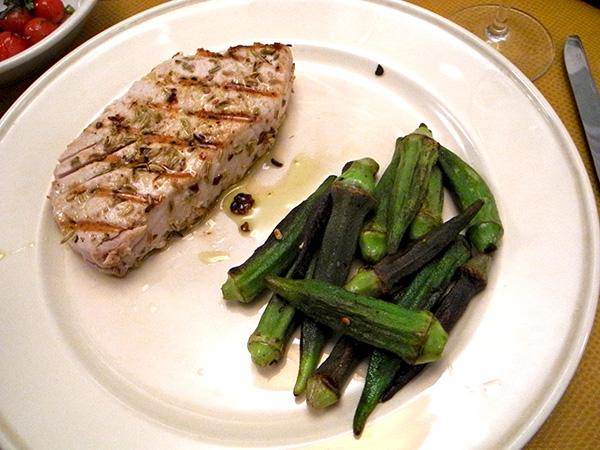
It was to be four of us for dinner. There would be the same number of courses, but only one of them required any real cooking, and very little cooking at that.  The kitchen therefore never had the chance to heat up (although, since we ate in the dining room/gallery, I suppose it wouldn’t have mattered much anyway).  Also, while normally I have difficulty interacting with guests as I would like to while cooking, I really knew my way around each of these four plates, so I was able to invite everyone into the kitchen area while I was still working on them.  Yay!

I really recommend these ‘recipes’ to anyone who might have the same entertaining parameters.

Also, the meal was delicious; the main course featured two of my favorite things, they were both incredibly fresh (probably caught and picked the day before), and they were prepared in just about the simplest way possible.

The tuna, which followed a serving of Speck and greens, was prepared using Rose Gray and Ruth Rogers‘s simple recipe; the very basic treatment of the okra was a suggestion I had come across somewhere long ago; and the intentionally un-spicy cherry tomato salsa was another simple treatment, my own invention.

  • three tuna steaks from P.E. & D.D. Seafood (they totaled about 28 ounces, to feed four), small sections of each removed to make up a fourth serving, tops and bottoms of the steaks rubbed with a mixture of fennel seed and crushed dried peperoncino peppers which had been ground together, seasoned with salt, and pepper, then pan-grilled for only a minute or so on each side, and finished with a good squeeze of lemon and a drizzle of olive oil
  • a combination of small green and purple okra (about a pound) from Ryder Farm, sautéed in olive oil with additional crushed dried pepperoncini in an iron pan over a high flame, then seasoned with salt (the purple ends up more or less a darker green when cooked)
  • really tiny red cherry tomatoes from Berried Treasures (Franca could not remember at the moment I asked her exactly what they were called), which I sliced most of the way through so they wouldn’t explode when picked up with a fork, tossed with good olive oil, salt, pepper, Thai basil from a friend’s garden in Garrison, New York, and some garlic chive flowers from Paffenroth Farms, then left to sit for about an hour before being served in bowls to the side of the dinner plates

speck_arugula_celery_rustica

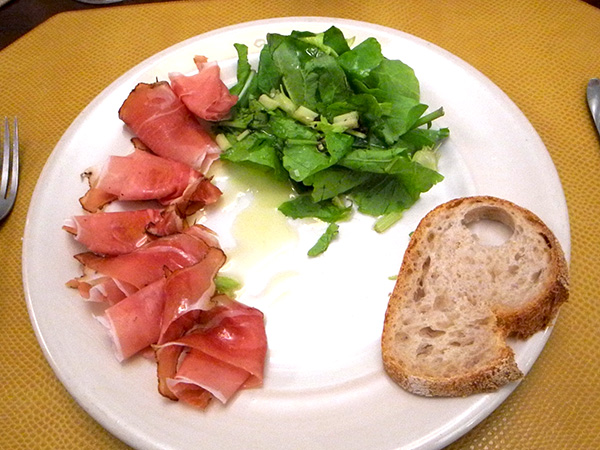
Speck has become one of our favorite antipasti.  For some reason it always makes me feel it’s part of a festive occasion, and this time it genuinely was, since we were sharing it with good friends, and they had thoughtfully brought along a bottle of an excellent Austrian sparkling wine (this is probably not the right time for me to bring up the historical connection between the Südtiroler Speck and the country in which the Grüner Veltlinger Sekt was produced).  I served the salumi with a very good bread and a bit of arugula (as it turned out, too small of a bit, so I added some celery leaves I had on hand).

  • thinly-sliced Alto Adige Speck from Eataly, each piece rolled around a fork’s tines and put on a plate where it was drizzled with some very good olive oil, and accompanied by arugula from Keith’s Farm which I had mixed with a smaller amount of roughly-chopped celery leaves from Whole Foods, the greens seasoned and dressed with the same good oil and drops of lemon
  • the antipasto was accompanied by slices of a loaf of ‘rustic classic’ from Eataly

After the tuna, there were three regional cheeses (‘Manchester’ and a special late-season ‘Danby’, both goat cheeses from Consider Bardwell Farm; and ‘Brebis Blanche’, a sheep cheese with a coating of ground mixed pepper, from 3-Corner Field Farm), served with thinly-sliced ‘Rustic Classic’ from Eataly, toasted.

The dessert was some of Berried Treasures’s celebrated strawberries (the breed a mix of domestic and wild), topped with a scoop of Madagascar Vanilla Ciao Bello gelato, with a sauce composed of a few of the berries which had been macerated a bit with Toschi Orzata Orgeat syrup spread over the ice cream and garnished with chopped hazelnuts.

kale-chorizo-onion-celery-pimentón frittata

kale-choriso_frittata

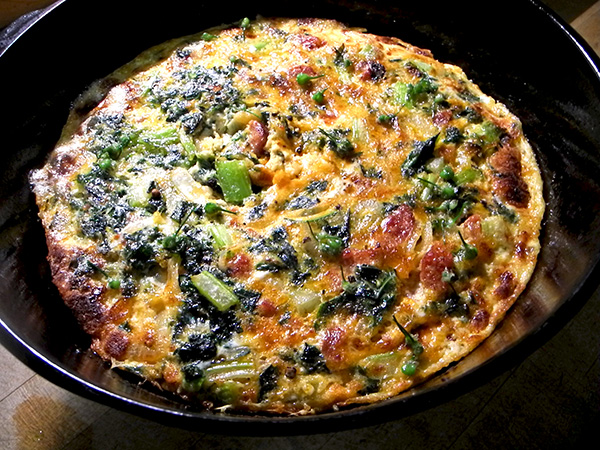
The idea was to put something together which would use some of the vegetables accumulating in the refrigerator, and whose preparation wouldn’t be to complicated.  A frittata would fit the bill.

  • about half a pound of smoked chorizo from Millport Dairy, skinned and chopped into small pieces, and one thinly-sliced large yellow onion from the farm of friends in Garrison, cooked together in olive oil until the chorizo was brown and the onion tender, the mixture allowed to cool a bit before being removed and added, along with two kinds of cooked kale from the Garrison farm, a few pieces of chopped jalapeño peppers from the previous day, and half a teaspoon of Spanish pimentón, to a bowl of eight eggs from Millport Dairy which had been whipped, mixed with a little milk, flour, salt and freshly-ground pepper, the egg and vegetable mixture subsequently cooked in a little olive oil in a covered pan over medium heat until the eggs were nearly set, then uncovered and browned under a broiler, and sprinkled with some fresh garlic chive flowers from Norwich Meadows Farm which had been warmed in olive oil
  • the wine was an American sparkling, Gruet Brut, from New Mexico
  • the music was Mozart’s ‘Lucio Silla’, performed by Adam Fisher and the Danish Radio Sinfonietta

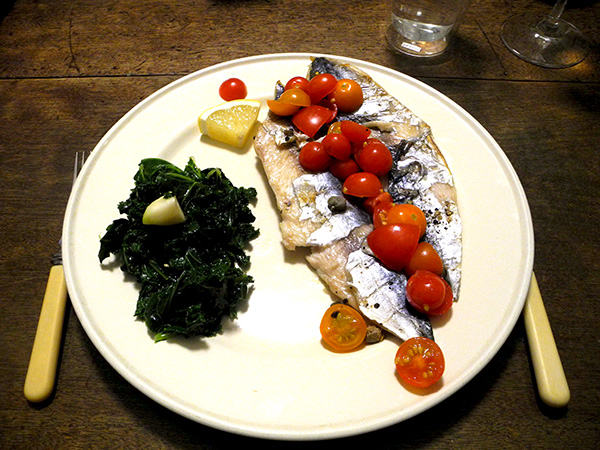
jalapeño; mackerel with caper-tomato sauce; kale

jalapeno_sauteed

Well, that was invigorating.

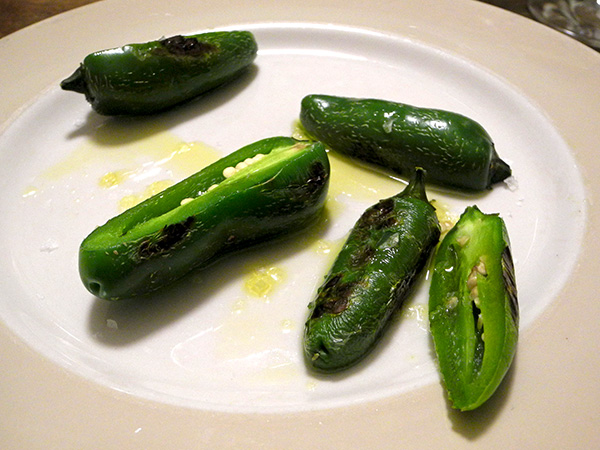
I had been told that these Jalapeños could be safely consumed alone after they had been sautéed until they blistered, something in the manner of Shishitos or Pimientos de Padrón, but without the gamble.  They were given to us by our gentlefolk weekend farmer friends, who assured us that they weren’t actually hot (maybe it was something about the strong yanqui ‘microclimate’ of the area north of New York where they were grown).

Barry and I aren’t wimps when it comes to the hotter representatives of the capsicum family, but these peppers upstaged our experiences with the most unforgiving batch of their cousins, the ones which you can count on being hot only ten to fifteen percent of the time. It was [almost] fun while it lasted, and, as I said at the top, they did get our attention.  In the end however we couldn’t finish them, especially as we were worried we wouldn’t be able to taste the main course.


HOUSEHOLD HINT: How to cool your mouth after a pepper assault?  I know this is totally anecdotal, but I got almost nothing else to give:  Try putting a little salt on your tongue, following up with some cold water.  It worked for us this time, even before we reached into the freezer for some cold sorbetto (which worked as more of a palate cleanser than ever on this occasion).


mackerel_caper-tomato_kale

The entrée, served about twenty minutes later, was soothing, and without incident.  It was a recipe which I have come to depend on (perhaps too much however; I’m going to have to do some thinking about alternatives).

  • four three and a half ounce Spanish mackerel fillets from Blue Moon Fish Company, washed, dried, brushed with olive oil, seasoned with salt and pepper, pan grilled over high heat for six or so minutes, turning once, transferred to plates and completed with a salsa of halved small red and orange cherry tomatoes, also from Garrison, which were tossed with olive oil, salted capers which had been rinsed and drained, some finely-sliced fresh garlic from Phillips Farm, lemon juice, salt, and pepper
  • some excellent, very sweet curly kale (I think it was Russian kale) from the same friends’ up rivergarden, torn form its stems and cut in a rough chiffonade, braised in a heavy pot in which slightly-crushed garlic from Phillips Farm had previously been heated in some olive oil, then finished with salt, pepper, and a drizzle of more olive oil
  • the wine was a French white, Anne Pichon Sauvage Vermentino Vaucluse 2014
  • the music was Monteverdi’s ‘L’Orfeo’ performed by Concerto Italiano