Author: james

dolphinfish; minutina; tomato and cucumber salsa

Dorado_Schlaff650

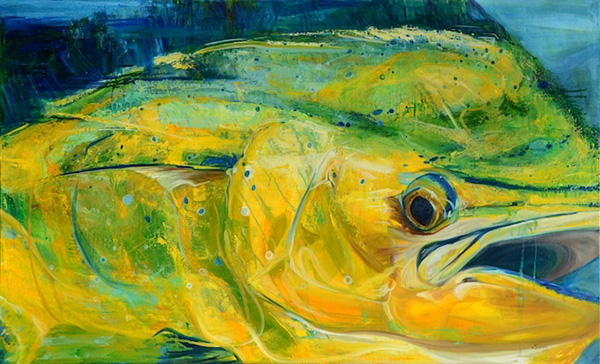
Becca Schlaff Dorade oil on canvas 36″ x 60″


I forgot to put the SD card back in the camera after uploading the last batch of my pictures to the computer, so unfortunately there are no photo images of his meal.  Instead I’ve located the painting above as a stand-in for the main focus of the meal, and I managed to save some phone images of some of the vegetables while they were still at the Greenmarket.

Dolphinfish, perhaps the males especially, with their prominent square foreheads, are among the most spectacular-looking finned creatures in the sea.  In addition, they are apparently among the most plentiful, at least among fish of their size.  They are also absolutely delicious, which brings them to this blog.

Maybe it’s the New England in me, but I don’t like using the name, ‘mahi-mahi’ on this side of the continent, so I will continue to refer to this creature as a ‘dolphinfish’, or ‘dolphin’ (or, in cookery, as ‘dorade’, or ‘dorado’, the name by which online sources say Europeans have come to know it, at least in their kitchens and on their dining tables).

After writing all of that, I will confess that I remain confused about the freedom with which the name ‘dorade’ seems to be thrown about on the other side of the Atlantic, at least according to the Wikipedia entry for ‘mahi-mahi’.  In Europe, Dorade actually seems to be a form of bream, and not the ‘common dogfish‘.

All of which reflects the fact that, like most fish species, dolphinfish are both blessed with, and easily confused through, the use of many names.  Today most people in the western hemisphere know it as mahi-mahi, a rather cute-sounding Hawaiian name (meaning ‘strong-strong’, possibly an allusion to the fish’s sturdy appearance as much as its fighting spirit when hooked). That tag was apparently broadcast beyond the central Pacific by merchandisers who wished to avoid the common confusion of the sport and commercial fish with a beloved mammal [yeah, you’d thnk..].   They share the name because, it is said, both creatures have a habit of swimming alongside boats.

Finally, when it comes to the word, ‘dolphin’, my imagination is never very far from the graceful creatures that appear so frequently in classical design and architecture. I mentioned this in my first Food Blog post about preparing dolphinfish.  But of course I would love them for that alone.

  • exactly one pound of dorade fillet from Pura Vida Fisheries, dry-marinated with more than half a tablespoon of lemon zest, an equal amount of thyme leaves from Keith’s Farm, salt, and pepper, set aside for 20 minutes or so, then seared in a hot pan for about 3 minutes, carefully turned over and that side seared for 3-4 minutes, the heat lowered and the pan loosely covered for a few minutes (depending on thickness), with aluminum foil if no other cover is available, during which time some bruised fresh ramp fruit from Berried Treasures and thinly-sliced shallots from Keith’s Farm were introduced and briefly sautéed with the fish before it was removed and put onto two plates, and the pan juices poured over
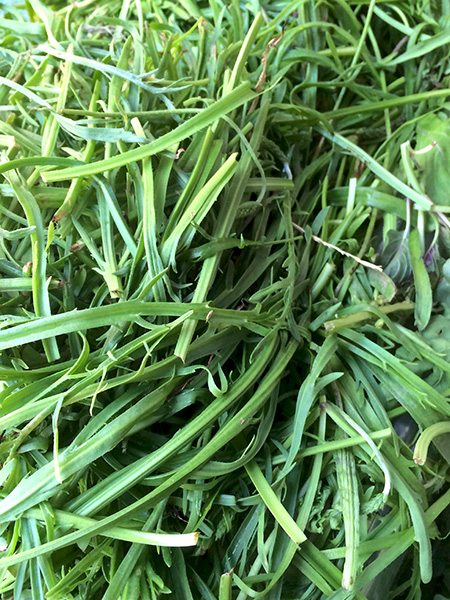
minutina

  • minutina from Norwich Meadows Farm, washed, drained, then wilted very slightly in low-to-medium-hot olive oil, seasoned with salt and pepper
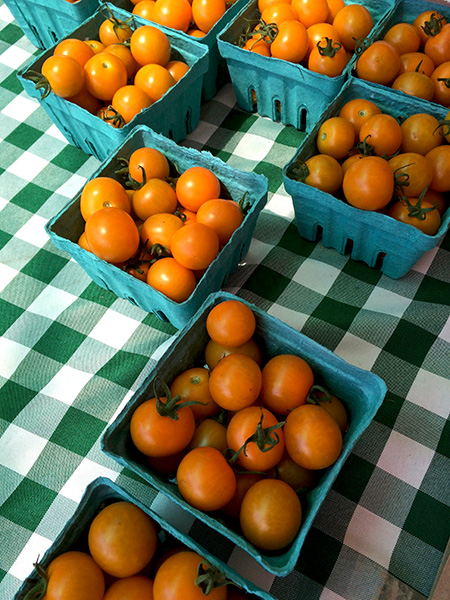
golden_cherry_tomatoes

  • a salsa of halved tiny golden cherry tomatoes from Norwich Meadows Farm and a smaller amount of delicious little [about an inch-and-a-half-round] lemon cucumbers from Berried Treasures, sliced, together dressed with olive oil, salt, pepper, a bit of white balsamic vinegar, and chopped copper fennel from Berried Treasures
  • The wine was an Argentinian white, Jelu Estate Torrontes 2014, from San Juan
  • the music was Lully’s ‘Amadis’, Clavecin et direction par Christophe Rousset


[image at the top is from the website of Becca Schlaff]
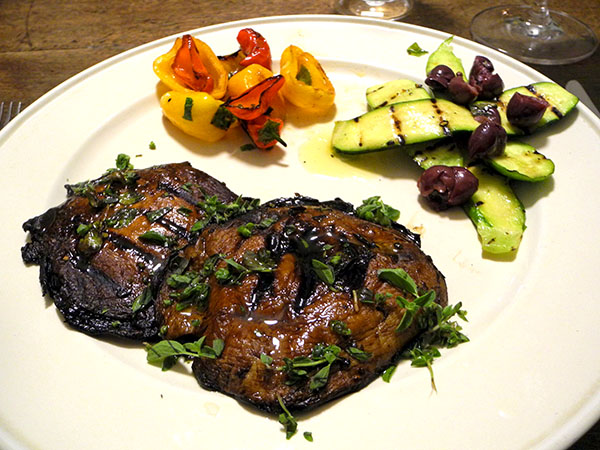
grilled portobello; sautéed peppers; grilled zucchini

portabello_peppers_zucchini

It’s not red, and it’s not even meat, but it sure is scrumptious.


I’m not really trying to engage specific food categories with these dinners; I actually just like variety. This time the meal wasn’t just vegetarian, but genuinely vegan, although, had a carnivore not been informed in advance of the nature of its components, a guest might have easily been oblivious of that fact.

Regular visitors to this blog know that it’s not about meat, so when I talk about meat substitutes it’s not so much about me.

I’ve always laughed at the idea that vegetarianism may too often involve the fabrication of dishes which imitate animal flesh, as in so many boring tofu configurations.  If you can’t get to a good South Indian restaurant, or if the objective is Western-like food with the suggestion of meat rather than the real thing, grilled portobello mushrooms would do it, and there is absolutely no nonsense or fakery, or a strain on the environment.

I always knew that mushrooms, and these mushrooms in particular, can easily evoke both the appearance and the taste of meat, but without the mess, or the perhaps a bad conscience, but I really haven’t done much to demonstrate it to myself, or anyone else – until now.  This was a delicious, totally satisfying dinner on every level.

Additionally, there is real convenience for the cook, because each of the elements of this meal is equally as tasty whether served at room temperature or warm, making it a perfect summer prescription.

Now if I could just find a mushroom to evoke the appearance and the taste of seafood…  Oh, wait, there’s the Oyster mushroom.  That will just have to be another Food Blog outing.

Last night’s meal also invited some thoughts about wine pairing.

The wine with which we accompanied it was a very special discovery we made during our Québec trip two months back.  ‘Special’, also, for still being totally invisible on line.

We had tasted Maurice Dufour’s surprisingly good white (surprising only because of the far northern latitude of its origin), a Muscat, while we were in Charlevoix in June, but we had not enjoyed his newest offering, a red, until Barry suggested we try it with this meal. The Le Charlevoyou was an excellent companion to the slightly quirky seductions of the vegetable plate.  If we were asked to describe the wine in the most general terms, we would both probably say something about it’s resemblance to a Bordeaux.

This is a link to a beautiful short video from ‘La Famille Migneron de Charlevoix’, whose first and primary occupation is the production of some excellent cheeses; there are images of the vineyards beginning almost half of the way through.

Yes, I know Norway has vineyards too, and it’s much closer to the North Pole, but the Gulfstream doesn’t come even close to Baie-Saint-Paul.

We’re now looking forward to Dufour’s rosé, one bottle of which we had also brought back from our visit to that beautiful province.

  • four portobello mushrooms from John D, Madera Farm (weighing just under a pound when first brought home on Wednesday), stems removed, wiped free of soil, and their ‘gills’ scraped off, allowed to rest for half an hour in a pan just large enough to hold them, with a couple of tablespoons of olive oil and almost as much lemon juice, plus half a dozen sprigs of oregano from Stokes Farm, turning once, then removed from the marinade and pan grilled for about 5 minutes per side, put onto two plates, squeezed with fresh lemon juice, scattered with more oregano, now chopped, and drizzled with olive oil
  • tiny red and yellow bell peppers  from Bodhitree Farm, each halved or quartered and sautéed over high heat until slightly caramelized, finished with torn basil from a Full Bloom Market Garden plant from Whole Foods, and a light splash of balsamic vinegar
  • baby zucchini from Berried Treasures, sliced to about a quarter inch thick, dipped in olive oil mixed with salt and pepper, pan grilled, then tossed with Gaeta olives from Buon Italia and torn spearmint from Eataly
  • the wine was a red, au QuébecMaurice Dufour‘s Le Charlevoyou (Radisson 80%, et Sainte-Croix 20%) 2014
  • the music was Huang Ruo, Drama Theater Nos. 2-4

tuna, fennel; Rattlesnake beans, lovage; tomato

Rattlesnake_Beans_Franca

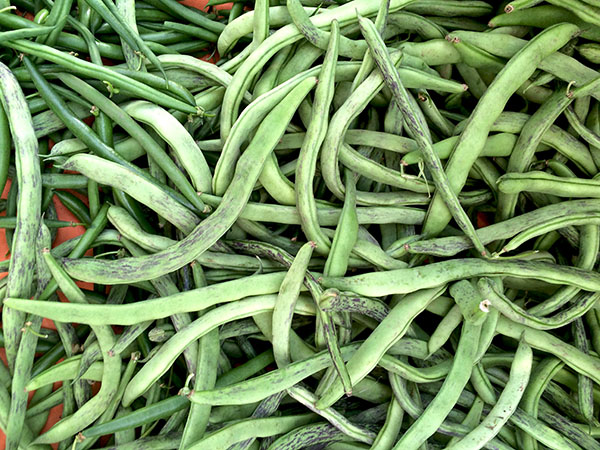
the beans


Franca steered me toward these outsize, slightly homely beans shortly after I had stopped by her stall in the Greenmarket on Wednesday.  Her knowing look, her nod, and my follow through to her enjoiner, “taste one”, were all I needed to scoop up enough of these Rattlesnake beans for dinner.  They were terrific even raw (always an indication of a good bean), and they more than lived up to that promise after a little parboil and the addition of lemon and one of my favorite herbs;  they had so much flavor however that neither would actually have been missed.


tuna_rattlesnake_beans

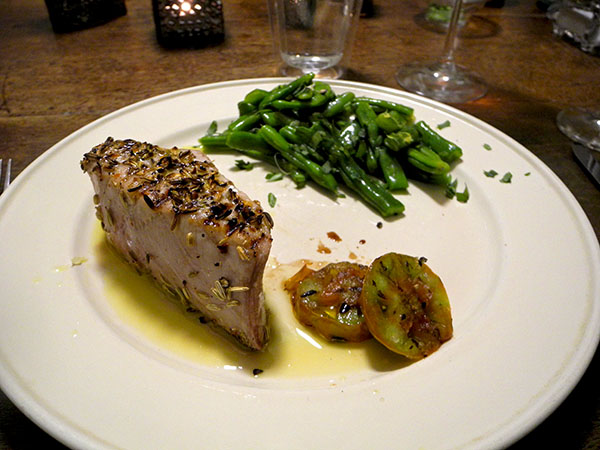
The tuna was unusually high at the fish monger’s on that same day; when I cut a very thick 11-ounce steak into two pieces, they each ended up looking more like ship’s prows than representatives of the undersea aristocracy that they were.

  • two five-and-a-half-ounce sections of tuna loin from Blue Moon Fish Company, rubbed on both top and bottom with a mixture of fennel seed and dried peperoncini, ground together, plus salt and pepper, then pan-grilled for a minute or so on each side, finished with a good squeeze of lemon and a drizzle of olive oil
  • Rattlesnake beans from Berried Treasures, strings removed and the beans ‘snapped’, parboiled for a few minutes, then dried inside the same pan while shaking it over a brisk flame, and later reheated with oil, tossed in a bowl with lemon zest and a little lemon juice, seasoned with salt and pepper, and, finally, chopped lovage, also from Berried Treasures, cast over the top of each portion
  • one small heirloom tomato from Norwich Meadows Farm, sliced into four horizontal layers, briefly placed in the grill pan next to the tuna, then removed, distributed onto two plates, seasoned, drizzled with a tiny bit of balsamic vinegar and some olive oil
  • the wine was a California rosé, David Akiyoshi Sangiovese Rosé Lodi California 2014
  • the music was Huang Ruo Chamber Concertos, performed by ICE

lamb with ramp fruit; artichoke-olive-tomato sauté

artichoke_olive_tomato_saute

artichoke_saute_2

lamb_chop_artichoke_saute

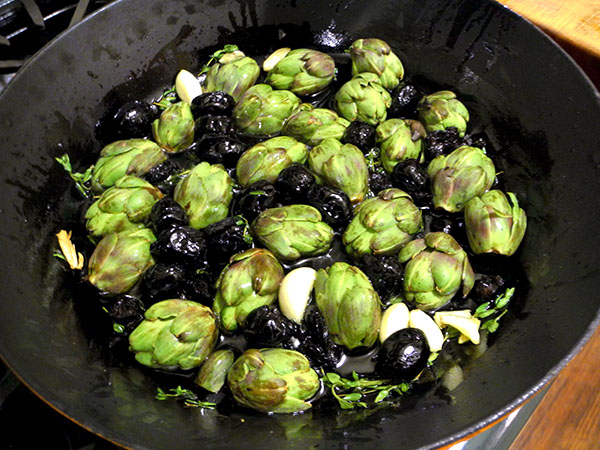
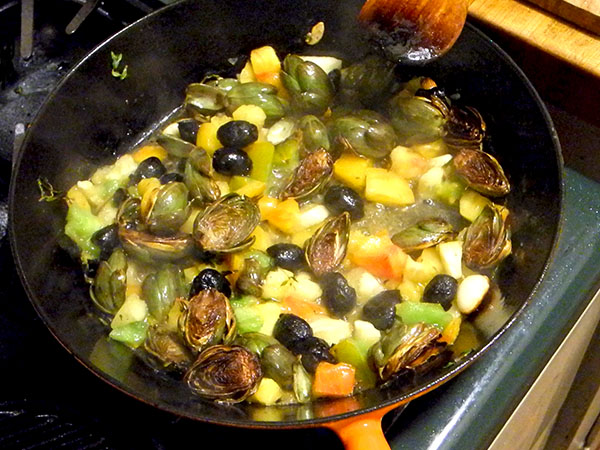
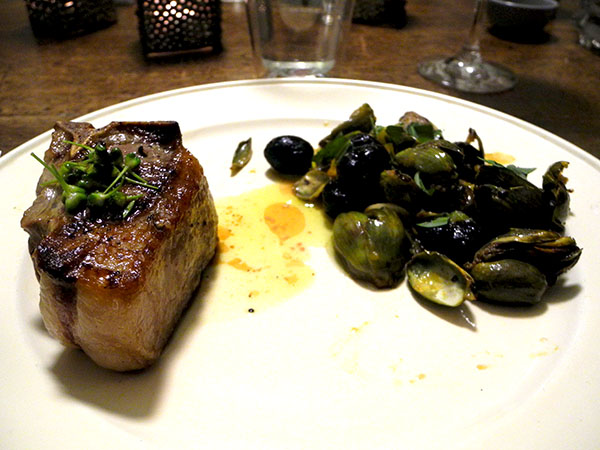
The images above show two stages of the vegetable sauté process, and as it was served with the lamb.


Better than ever, thanks to ramp fruit.

The two lamb chops we had last night were the second of two pairs inside a single package I had brought home frozen from the Greenmarket over two weeks back.  I defrosted the first two overnight and prepared them the next day, finishing with a little sliced shallot and some sorrel butter. At the time I thought lamb chops do not come any better, but the treatment I gave the second pair yesterday (again, defrosted overnight) may have excelled them.

The reason lies in one simple ingredient: ramp fruit, my favorite new thing, and one which is making its appearance just when I had decided the spring ramp craze had gotten totally out of hand.

The fruit were displayed on long stems in Franca’s Berried Treasures stall at the Greenmarket this past Friday;  they were new, and I had no idea what they were.  Her hand-lettered sign didn’t help much , since someone on the farm had put the wrong one in the truck that day.  There was still a good chance I was going to take some home, even before Franca said something about ramp buds, or maybe it was ramp capers, adding, when someone else asked what to do with them, that we should think of them as garlic.

I was now sold. totally.

On Tuesday I still had some ‘buds’ remaining from that same bunch (‘bouquet’), even though I had been using some in virtually every meal I’d prepared since.  Last night I snipped off another small amount of fruit from the end of their long dry stems and I did little more than gently heat them in a small tin-lined copper pan (recently acquired from a sidewalk vender, and becoming increasingly indispensable to my kitchen operations.  The tiny fruits gave up a terrific aroma and ended up on top of the pan-grilled chops. The meat had been seasoned with salt and pepper, but I did noting else to it squeeze a bit of lemon and a drizzle some olive oil over it.  It was terrific, the taste of the excellent lamb had grown a little garlicky and subtly floral.

I picked the superb vegetable recipe [from Mark Bittman] that accompanied the lamb as a way to use 12 of the smallest of artichokes which I could fine in the Greenmarket on Monday.  I had selected them from a basket containing both them and some a bit larger, because I had thought a diminutive size would make it unnecessary to perform any serious operations involving pulling off petals, slicing off ends and tops, or removing hairy chokes.

The au naturel route worked for me, but then I’m someone who always eats grape pits, usually skins of all kinds, and occasionally even peanut shells. Barry preferred to remove the outermost leaves before consuming the rest of the artichoke and its companion vegetables, so next time I really should bring home more artichokes, and allow myself a few more minutes of preparation time.

  • two thick loin lamb chops from 3-Corner Field Farm, thoroughly dried, cooked on a very hot grill pan for about 4 minutes on each side, seasoned after both had been seared, removed from the pan and each topped with about 8 slightly-crushed ramp fruit from Berried Treasures, the ‘buds’ having been heated earlier in a bit of olive oil, the chops finished with a squeeze of lemon and a drizzle of olive oil
  • I followed the vegetable sauté recipe, which appears on the Times site here, pretty closely, using thyme from Keith’s Farm for one of Bittman’s alternatives in its first stage (rosemary being the other), but I substituted tarragon from Stokes Farm for the parsley he specifies for the garnish at the very end (because I love tarragon, and because it seemed Provençal, although mint would also have worked very well);  the walnut-size artichokes were from Norwich Meadows Farm; the garlic was from Phillips Farm; the oil-cured black olives were from Buon Italia; the heirloom tomatoes were from Norwich Meadows Farm; and the tarragon came from Stokes Farm
  • the wine was a French red, Château Valcombe Les Hauts de Valcombe Rouge Ventoux 2013
  • the music was the magnificent ‘Iphigénie en Tauride‘, by Christoph Willibald Ritter von Gluck, performed [here the full-length recording] by Marc Minkowski and Les Musiciens du Louvre

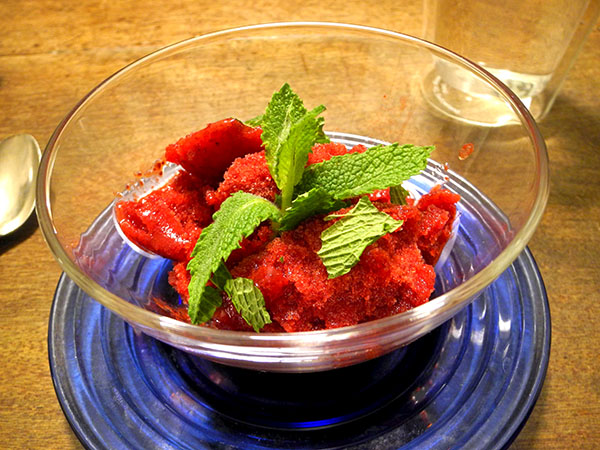
And, speaking of fruit, we enjoyed a dessert of a fine homemade sorbetto, made by a friend.


sorbetto_Tim_Evans

  • the sorbetto incorporated several varieties of plums, blackberries, lemon, sugar, and gelatin), and after I had placed it on a deep blue saucer and garnished it with spearmint leaves from Eataly, it managed to look more than a little holiday-ish

cod with ramp fruit, golden oyster mushrooms; okra

cod_oyster_mushrooms_okra

Golden_Oysters_Blue_Oyster

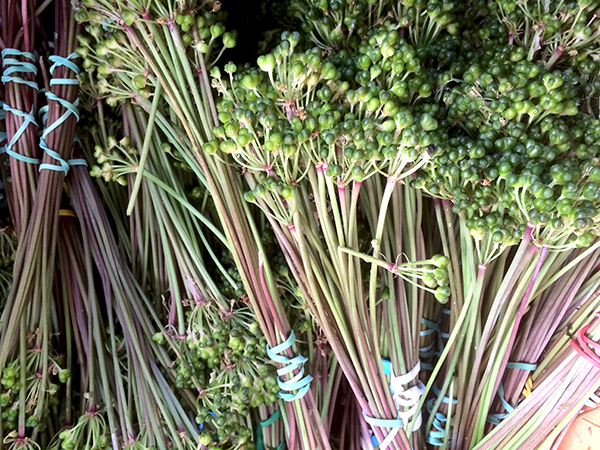
ramp_fruit

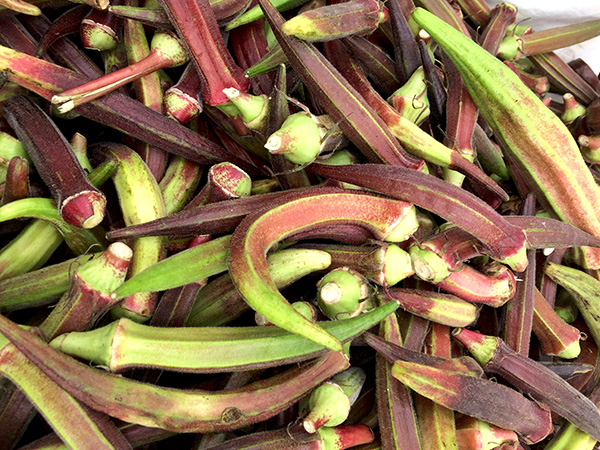
purple_okra

I’m getting used to incorporating mushrooms into meals, and I no longer fear taking on the responsibility.  I love them, they can alter any dish with a minimum of fuss, are close to foolproof, can often be prepared at least slightly in advance of joining other food ingredients, and most varieties will be easy on your wallet.  With the help of supplies from our local farmers and foragers at the Greenmarket, I’m learning to have fun with them.

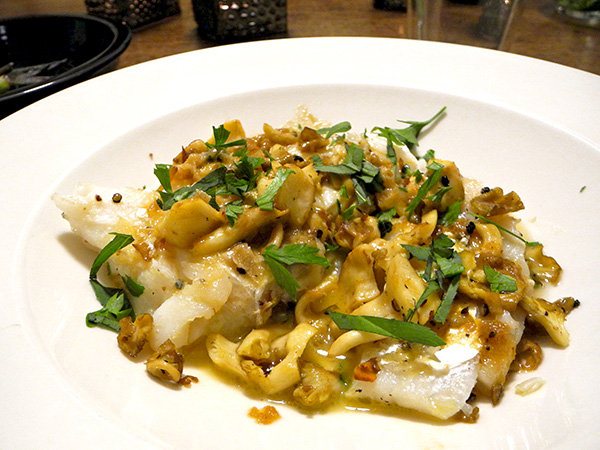
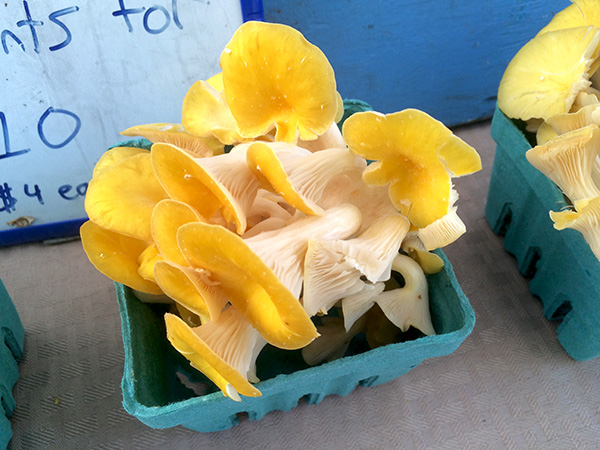
The preparation of this meal with cod involved some Golden Oyster mushrooms; it was based, roughly, on a recipe from “I’ll Have Seconds!“.  The most significant change was my introduction of some ramp fruit (the seed blossoms of the woodland ramp) to the olive oil just after it had heated, and just before adding the mushrooms.  Also, and pretty noteworthy, the mushrooms I had weighed less than a fourth of the amount specified in the recipe, but these Goldens still did themselves proud (and the flavor of the cod remained undiminished).

The dish was delicious. I’m certain to revisit the formula, probably using more mushrooms, but next time I’m also going to be more careful about the amount of salt I bring to the dish.  It was only late the next morning that I realized the reason for the saltiness was my reduction of a cup of stock made from an excellent prepared vegetable base, but one which appears not to have been low-sodium (just found out they now have both ‘reduced sodium’ and ‘organic’ versions).  Without intending to, I had boiled it down too far while I had been escaping from a hot kitchen.

That would also explain why the picture at the top of this post shows a bowl with a sauce rather than the broth which appears in the image on Emily’s blog.

The okra can (almost) be spotted inside a black bowl on the upper left.

  • the cod came from P.E. & D.D. Seafood, the ramp fruits from Berried treasures, and the Golden Oyster mushrooms from Blue Oyster Cultivation; for the herbs I used a combination of chopped parsley from Lani’s Farm and tarragon from Stokes Farm
  • purple okra from Lani’s Farm, sautéed in olive oil with crushed dried chiles in an iron pan over a high flame, then seasoned with salt
  • the wine was a California white, Scott McCleod Chardonnay 2014 Russian River Valley Sonoma County
  • the music was a number of works being streamed on Q2 Music WQXR

crab cake, tomato salsa; agretti; grilled young onion

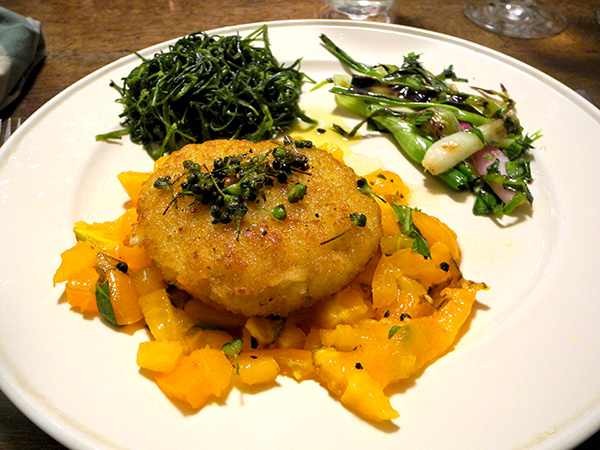
crab_cake_ramp_buds_tomato_agretti_onions

I won’t make extravagant claims about its visual aesthetic, but I will say that this was an incredibly delicious meal, and that was something of a surprise, since while I was preparing it I thought I was merely emptying the ice box and the cupboards prior to our leaving the city for five days.

I’ve already written about both the quality and the elegant utility of these superb crab cakes.

I also always think of these small, lightly-breaded savory patties as a perfect excuse for serving two or three interesting vegetables, and at least as many fresh herbs, especially since they require absolutely no preparation themselves.

  • crab cakes from PE & DD Seafood (ingredients: crab, egg, flour, red & green peppers, garlic, salt, pepper, breadcrumbs, mayonnaise, milk, celery, parsley), heated in a heavy iron pan, 3 to 4 minutes to each side, sprinkled with ramp fruit (yup, ramp fruit, or maybe ‘seed pods’, or ‘bud heads’) from Berried Treasures which had been sautéed in the small cast iron pan along with the crab, served on a bed of a fresh tomato sauce composed of a single large golden heirloom tomato from Stokes Farm, chopped and combined with salt, pepper, and basil leaves torn off of a plant (Full Bloom Market Garden, Whately, Ma.) brought home from Whole Foods
  • one bunch of agretti (which grows along the sea, and is a great accompaniment for seafood) from Tamarack Hollow Farm, washed, trimmed, the larger stems removed (although, as it happened, not sufficiently, stems, as Barry has observed, being the bones of good vegetables) then boiled for about 15 minutes, drained, set aside, later heated in olive oil and arranged on plates, where it was squeezed with lemon juice and given a drizzle of olive oil
  • early red onions from Tamarack Hollow Farm, washed, halved lengthwise, rolled in seasoned olive oil, pan grilled, then dusted with torn tarragon leaves from Stokes Farm
  • the music was  streamed from Q2, and it included works by Donnacha Dennehy, Magnus Lindberg, Peteris Vasks, and Peter Schroeder

calamari in padella con limone e pangrattato

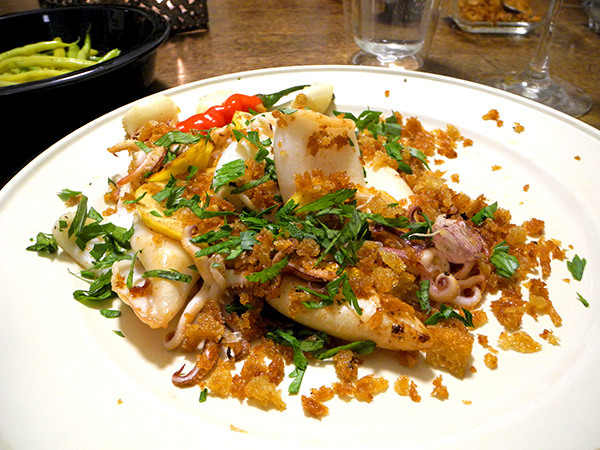
calamari_limone_pangrattato

I’m surprised:  I never thought the full Italian name for this meal would fit in my subject line.  The dish, ‘calamari in padella con limone e pangrattato’ translates as ‘squid sautéed with lemon and breadcrumbs’ (which would also fit on that line), and all of that fit on the table last night.

Four months ago, after being seduced by the beautiful photograph of the dish placed on the page facing the instructions, I had pulled the recipe out of Jamie Oliver’s ‘Jamie’s Italy‘ (no, Jamie himself wasn’t in the picture).

In its first outing I had added a bed of potatoes under these delicious cephalopods.  This time I skipped the potatoes, and instead of February’s brussels sprouts, the contorno was a small bowl of thin yellow beans [fagioli gialli], also picked up at the Greenmarket yesterday.

  • a pangrattato made with crumbs of four-day-old whole wheat bread from Eataly, six unpeeled fairly-fresh garlic cloves from Phillips Farm, and one extremely hot cayenne pepper from Oak Grove Plantation, stirred in a large enameled cast iron pan with olive oil until the crumbs were crisp and golden, removed from and spread onto paper toweling, the pan then wiped with paper towels and baby squid from Blue Moon Fish, dried and seasoned, placed inside and sautéed, along with very thin slices of lemon, over high heat, all turned once, the squid and lemon removed and distributed on plates, the pangrattato scattered on top, everything sprinkled with a mix of chopped parsley from Lani’s Farm and chopped lovage from Keith’s Farm
  • thin yellow beans (haricots jaune/fagioli gialli), boiled until softened somewhat, drained, heated in the same pan to dry, set aside, later warmed up in a cast iron pan, along with some ‘rubbed’ ramp blossoms (for a mild, complex, garlic-like effect) from Berried Treasures, seasoned with salt and pepper, sprinkled with fresh oregano from Stokes Farm
  • since there were two white peaches left from the night before, there was also dessert, a return of the dish which had ended the previous meal
  • the wine was an Argentinian white, Jelu Estate Torrontes 2014, from San Juan
  • the music was a number of short pieces streamed from Yle Klassinen

shishito; tomato and herb frittata; peaches, gelato

shishito_peppers_sautéed

All of these three [very different] courses were entirely vegetarian.

I’d call each of them a succès d’estime (there were only the two of us to bear witness, so I can’t make say there was any more general acclaim).  Most of the credit goes to the freshness and quality of the ingredients, and the simplicity of the treatments.

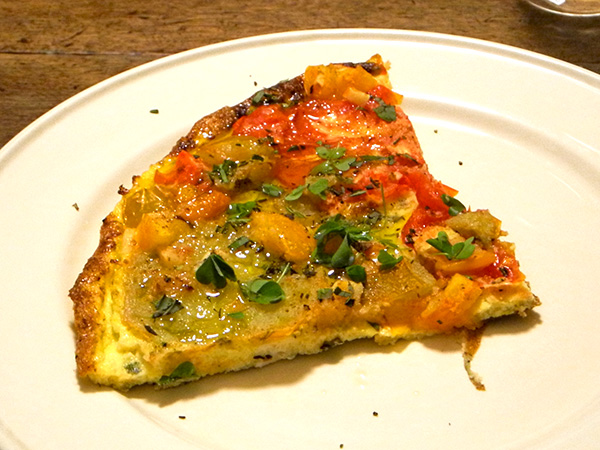
The frittata involved a little more procedure than the other two courses, which helps to explain how I slipped up at one point, failing to execute one step at the point when it was indicated. I think however that I made a recovery which might have actually improved a recipe with which I was already taking some liberties with its prescribed herbs;.  It certainly made it appear more complex – and more colorful as well:  The instructions were to introduce into the bowl of whipped eggs, just before they were poured into the pan, the portion (half) of the tomatoes which had been chopped and mixed with garlic, but I missed my cue.  I had no choice at that moment but to spread them on top of the large slices of tomato which I had already spread on top of the eggs once they had begun to cook.

Thinking that the hot broiler might do terrible things to the small pieces of tomato and garlic lying on top of the frittata-to-be, I reached for my container of homemade breadcrumbs and sprinkled some on top, just before slipping the pan under the broiler.

It seemed to work, although I’m not sure the breading precaution was at all necessary.

The frittata was incredibly juicy and delicious; I think it might well have been the best one I’ve ever made.

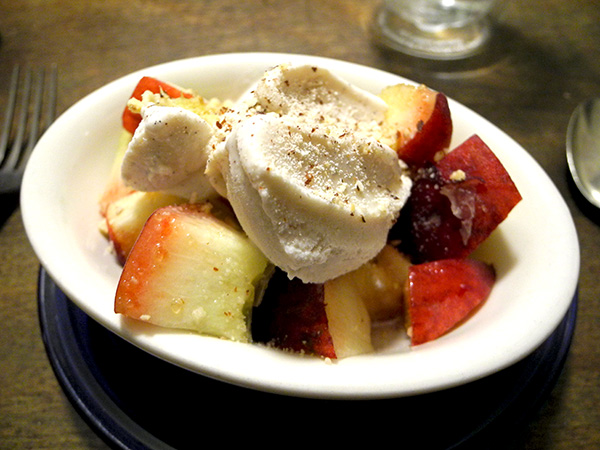
The dessert was determined pretty much by the perfect ripeness of some white peaches (my favorite) which I had kept on the windowsill for two days, and some additional tasty delights I had on hand.  I hadn’t thought of it as quite as Spanish-ish as the rest of the meal, but, looking back at the ingredients, I think I might be allowed to push the attribution


tomato_herb_frittata

white_peaches_gelato

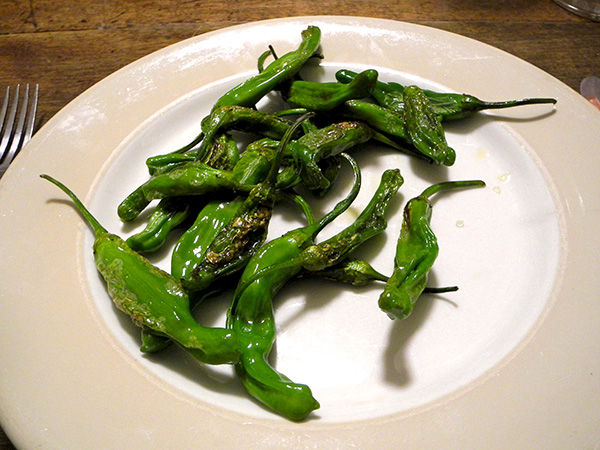
  • two handfuls of Shishito peppers from Lani’s Farm, washed, drained, dried, then sautéed over medium high heat in a cast iron pan for a few minutes, stirring, then salted and served on plates
  • a tomato and herb frittata, modeled pretty much on this Martha Rose Shulman recipe, incorporating 8 jumbo eggs from Millport Dairy (three of them with double yolks this time!), 3 different colors of large heirloom tomatoes from Norwich Meadows Farm, a mix of chopped fresh herbs (tarragon from from Stokes Farm, and thyme and lovage from Keith’s Farm), finishing with an unauthorized sprinkling of the last of the wood sorrel from Bodhitree Farm
  • white peaches from Troncillito Farms, sliced into eighths, drizzledwith Toschi Orzata Orgeat syrup, and sprinkled with a bit of turbinado sugar, topped with a dollopof Madagascar Vanilla Ciao Bello gelato, and sprinkled with some ground hazelnuts I keep tightly-sealed in a jar in the freezer
  • the wine with the first two courses was a California rosé, F. Stephen Millier Angel’s Reserves Rosé Lodi 2014
  • the music was from Counterstream, Gloria Coates, String Quartet No. 3, the first two movements here, the final movement here

wild boar sausage, fresh black beans; grilled quash

wild_boar_sausage_beans_squash3

Not vegan.  But very good, and the vegetables were much more than just supporting stars.


I had gone to Eataly to pick up a loaf of bread, and some mint.  The night before that, Friday, we had enjoyed fish, and the Saturday night I found myself at Eataly there would be a totally vegetarian pasta on the table.  I knew I wouldn’t be able to pick up fresh seafood for Sunday’s dinner, so I had been thinking of defrosting a small amount of meat, either a duck breast or two lamb chops, for the two of us.  I hadn’t committed myself to either, and I suppose I had left myself open to being distracted by the bounty I knew awaited at our almost embarrassingly-blue-ribbon local Italian food outlet.

I bought some sausage.

Barry had recently mentioned that locally-sourced sausage might be an attractive alternative to our more usual entrées, so when I spotted the little sign inside the meat display case which read, ‘wild boar sausage’, which also included information on its origin, it felt like it was a natural.

My next assignment was to figure how to combine it with the very specific supply of vegetables I had available.  I was still improvising up to the moment I plated the sausage and the vegetables, but I think I did myself proud, and I was surprised that I was able to come up with what seemed like a fairly Italian meal in the end.

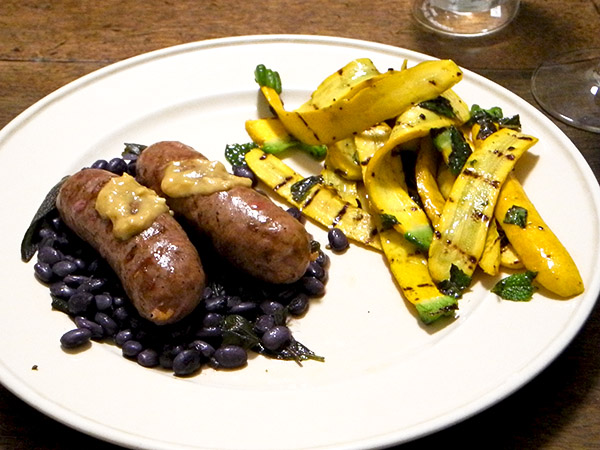
  • four links (12 ounces) of wild South Texas boar sausage from Toro Ranch, of Broken Bow, Texas, found at Eataly, pan-grilled for about 20-25 minutes
  • Black Turtle beans from Norwich Meadows Farm, washed, shelled, added to a pot in which sliced shallots from John C. Madura Farms and sliced fresh garlic from Lucky Dog Organic had been sautéed in olive oil for about 3 minutes, water then added to cover, the mix cooked for about 15 minutes, and a generous handful of sage (whole leaves) from Norwich Meadows Farm added to the beans in the now-reduced liquid before the legumes were put on plates, the sausage placed on top and painted with a modified mustard
  • the sauce for the rich boar links was thrown together at the last-minute, a mix of roughly equal parts, Edmond Fallot Dijon Mustard, Holly Schmitt’s Homemade Horseradish, and Berkshire Berries’ Horseradish Jelly [the last two found in the Union Square Greenmarket, both within recent weeks]
  • baby yellow squash from Berried Treasures, brushed with olive oil, seasoned with salt an pepper, grilled on a large cast iron pan, finished with torn leaves of mint from Eataly, and a drizzle of olive oil
  • the wine was a California red, F. Stephen Millier Black Label Reserve Petite Sirah Calaveras County 2013
  • the music was Francesco Maria Veracini’s, ‘Sonate Accademiche

penne rigate, grilled eggplant, chiles, lemon, mint

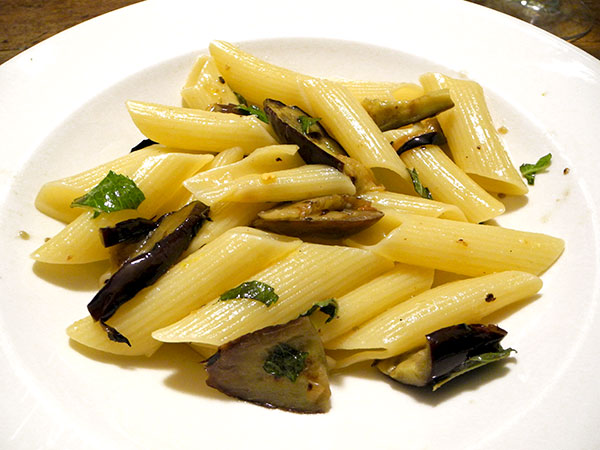
penne_grilled_eggplant_mint

Vegan, by happenstance.  And also very good.

As with most meals, and especially the most simple, it’s absolutely essential to have great ingredients. Here that meant ‘artisanal’ (although, in fact, not made by hand), bronze die pasta from Southern Italy, the kind whose surface looks like it’s been very roughly sanded.   There were also the Japanese eggplant, the best I’ve ever had, and I was introduced to them by Nevia, of Bodhitree Farm.  The garlic was so fresh it was actually somewhat juicy.  Finally, I had forgotten to pick up mint at the Greenmarket, but Eataly’s vegetables are generally pretty super, often pretty local, and one of the best things about that food and restaurant emporium.

The first paragraph below is long, and heavy with my usual running sentence instructions (here, for a change, using two running sentences), but the cooking process is actually pretty simple.

  • three medium Japanese eggplant from Bodhitree Farm, hand-sliced to about 1/4 inch in thickness, coated with olive oil and grilled on top of a cast iron, double-burner pan, seasoned with salt and black pepper, cut into smaller portions (I used a good kitchen shears this time), and set aside in a bowl while the rest of the sauce was prepared:  Two sliced fresh garlic cloves from Lucky Dog Organic introduced into a deep enameled pan, cooking them in olive oil over low-to-medium heat until golden, adding some good crushed chile peppers and the bowl of eggplant which had been set aside, mixing everything, still over a flame, checking the seasoning, then 12 ounces from a package of Setaro Penne Rigate from Buon Italia which had been cooked al dente (some of the water reserved near the end) and drained, tossed into the pan, before about a tablespoon of lemon zest and a tablespoon of lemon juice were added, and some of the reserved pasta water as well (enough to keep everything moist), the pasta mix finally removed from the heat and nearly half of a cup of mint from Eataly, torn into pieces, stirred in
  • the wine was a white Italian, Le Salse Verdicchio di Matelica 2014
  • the music was Giovanni Paisiello’s, ‘Le finte contesse’