Year: 2016

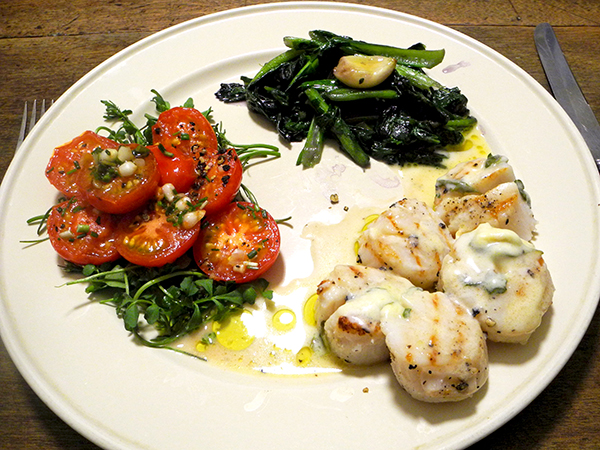
scallops with herb butter; tomatoes, cress; mustard greens

scallops_tomato_mustard_greens

almost over the top, at least by my measure


I rarely include a cream sauce in any of my cooking, and in fact the finishing touch on these scallops was not actually a cream sauce, but a ‘composed butter’ which included fish juices, herbs and wild garlic, a small remainder from this earlier meal, kept frozen in a ramekin until now.

The picture above is very unlike the usual images of pan-grilled scallops found on this blog (this one is my favorite), which are frankly more to my taste, but I couldn’t resist pursuing the experiment this time.

I’ve had the small ramekin on my mind for two weeks, hoping to arrange a perfect [second] marriage for it.  I’m more familiar with composed butters as a final touch for grilled steaks, a device I’ve only encountered in Julia Childs books; I was afraid that matching this one up with shellfish might be too much of a stretch, but the result was delicious.

The plans for virtually every element of this meal came together only at the last moment – in fact only while I was actually already cooking – and that included the treatment of the scallops.

Mildly-aromatic ‘wild garlic’ came into play twice during the preparation of this dinner, as a finish for the tomatoes, and as an important element in the herb butter spread on top of the scallops. I’ll think of this tiny (actually, at least partially domesticated) plant as my first 2016 ‘find’ in the Greenmarket.  It’s tasty, attractive, pretty versatile, and keeps pretty well. It’s also the harbinger of a growing season which is actually heralded by the first appearance of ramps, which, while definitely wild, have become a fixture, a tradition, for both the farmers and their happy city customers.
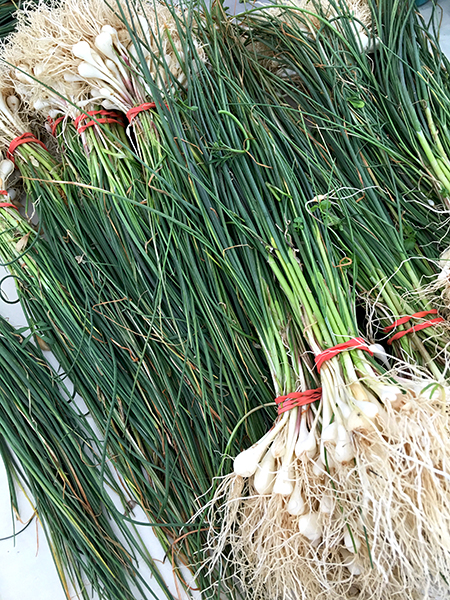
wild_garlic

  • ten sea scallops from P.E. & D. D. Seafood, washed, rinsed and dried very thoroughly, generously seasoned with salt and pepper, pan grilled a minute or so on each side, finished on the plates with a squeeze of juice from a local lemon grown by Fantastic Gardens of Long Island, drizzled with a little olive oil, and spread with a preserved butter which included tilefish juices combined wild garlic from Lani’s Farm, fresh parsley (Eataly), thyme (Forager’s), lovage (Two Guys from Woodbridge), sage (Eataly), and oregano (Stoke’s Farm)
  • eight Backyard Farms Maine ‘cocktail tomatoes’ from Whole Foods, halved, sautéed in a little olive oil until beginning to soften, seasoned with salt and pepper, removed and placed on a bed of tiny, only slightly-peppery cress, “a basal rosette of baby-arugula-like winter cress”, according to the grower/seller, Lani’s Farm (and in fact also basically ‘wild’?), then 8 or 10 finely-chopped wild garlic plants, also from Lani’s Farm (including bulbs, white and green stems) immediately tossed into the still-warm pan in which the tomatoes had cooked, stirred a few seconds, the garlic and tomato juices poured on top of the tomatoes themselves
  • red mustard greens from Norwich Meadows Farm, wilted in a little oil which had already warmed 1 halved clove of bruised garlic from John D. Madura Farm, seasoned with salt and pepper, finished with a drizzle of oil
  • the wine was a California (Clarksburg) white, Akiyoshi Reserve Chardonnay Clarksburg 2014
  • the music was a number of works by Sir Peter Maxwell Davies, beginning with his ‘Mavis in Las Vegas‘, and the other entertaining pieces on this recording, and ending with his very serious last symphony, Symphony No. 10 (“Alla ricerca di Borromini”), which includes a sonnet to and text of by Francesco Borromini, and poetry by Giacomo Leopardi
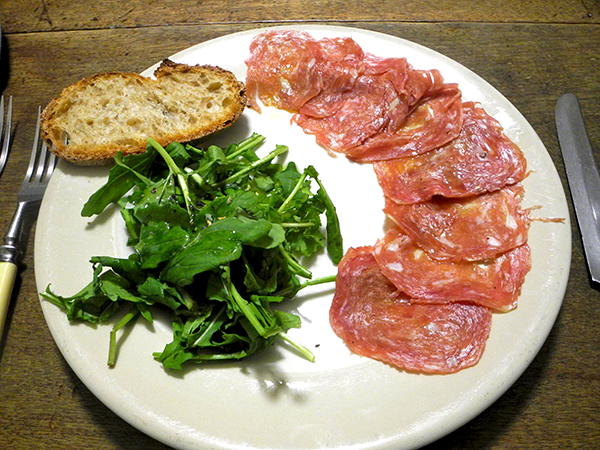
salame, arugula; fiore di zucca ravioli with sage butter

salume_arugula_bread

Sweet.


There were two courses, first, a salumi with greens…

  • Two ounces of La Quercia Salame Americano, from Eataly, arranged on plates, drizzled with with a little Casa Gola olive oil, accompanied by small leaves of arugula from Norwich Meadows Farm, which had been dressed with the same oil, juice from a local hot house Lisbon lemon (Fantastic Gardens of Long Island), salt, and pepper
  • slices of a Bien Cuit ‘campagna’ from Forager’s

…followed by a fresh pasta.

fiore_di_zucca_sage

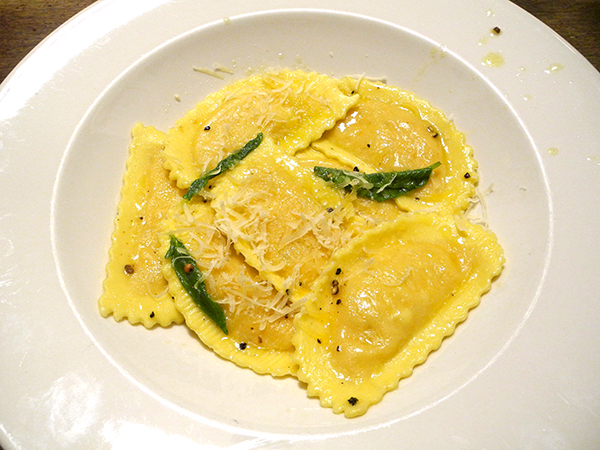
  • twelve ounces of Fiore di Zucca crescent ravioli from Eataly (a filling of butternut squash, ricotta, grana padano, and breadcrumbs), with a sauce of  6  or 8 fresh sage leaves from Eataly warmed in several tablespoons of ‘Kerrygold Pure Irish Butter‘, with some grated ‘Organic Parmigiana Reggiani Hombre’ from Whole Foods sprinkled on the top of the pasta once it had been placed in bowls


chorizo-onion-serrano-kale-pimentón-lovage frittata

frittata_chorizo_onion_etc_2

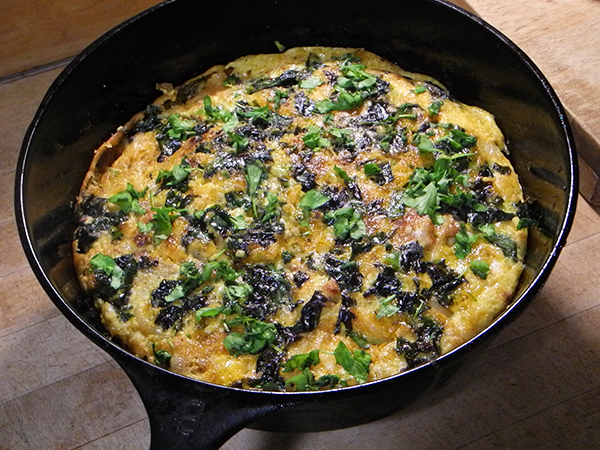
I was a very simple thing, and it welcomed a certain number of ingredients I already had sitting around in the kitchen, but it tasted delicious.  Surprisingly, it also boasted the texture of a soufflé, and who does soufflés any more?

The basic recipe comes from Joyce Goldstein, and is described in detail here, but, just as when I had prepared the dish before, I took some liberties, including changing the half pound of kale she prescribes to the mere handful I had on hand (scattering it all on the top near the end, for visibility). I also added one green serrano pepper to the sausage and onion mix near the end of their cooking, and, after the frittata had come out of the oven, while it was still hot, I sprinkled it with my current favorite herb.

roasted herb-marinated white sea perch; wilted cavalo nero

white_sea_perch

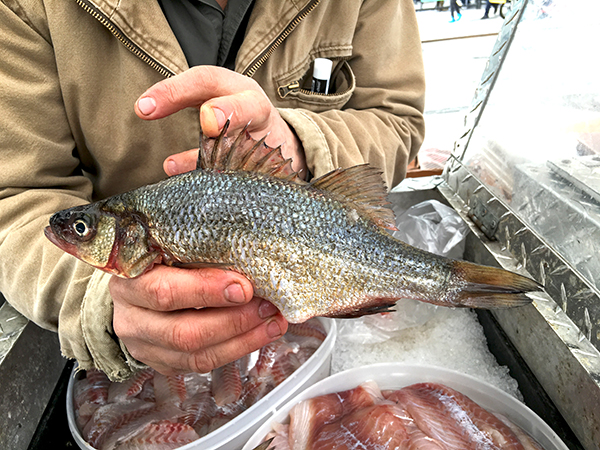
before (Paul displaying his own purchase)..


white_sea_perch_cavalo_nero

..and after (my display of our dinner)


I was introduced to this terrific fish today on one of my regular visits to one of the fish stalls in the Union Square Greenmarket, Pura Vida Seafood.  I’ve learned to pay attention to what Paul tells me, and this is another of the proofs.  I had never cooked white sea perch before, but the taste is superb, and the texture is more firm than that of other perch or similar fish.  The price is modest by today’s standards, and, for those who dwell on such things, the fillets have very few bones.

The recipe I used had the advantage of simplicity and it could be divided into two periods of a cook’s attention, both virtues especially appreciated on a night when I would not be returning to the apartment from a concert until almost 10 o’clock.

I was able to prepare a marinade and arrange six small fillets in it before I left for Avery Fisher Hall and Esa_Pekka Salonen’s performance of Messiaen’s ‘Turangalîla Symphony’.  Soon after arriving home at 10 o’clock I lit the oven and, once it had heated to 500º, place the fish in it, still in the pan with the marinade.  Less than 10 minutes later I was arranging it on the plates.

The recipe is found in Mark Bittman’s “Fish: The Complete Guide to Buying and Cooking“.

  • six white perch fillets from Pura Vida Seafood (about 15 ounces total) arranged in an oven pan with a marinade consisting of 2 tablespoons of chopped herbs (in this case, parsley from Eataly, rosemary from Phillips Farm, thyme from Forager’s, and lovage from Two Guys from Woodbridge), salt and pepper, left covered in the refrigerator for 3 hours (although the recipe suggests, alternatively, periods as brief as 15 minutes), then roasted with the marinade in a pre-heated 500º oven for about 8 minutes, and served
  • small, young Cavolo Nero (Black, or Tuscan kale) from Bodhitree Farm, briefly wilted with olive oil and two cloves of garlic from John D. Madura Farm which had first been heated in the oil
  • slices from a loaf of ‘El Bario Sourdough’ from Hot Bread Kitchen in the Greenmarket
  • the wine was a French (Savoie) white, Domaine Demeure-Pinet Jacquère Savoie 2013, from Chelsea Wine Vault
  • the music was first that of works by Esa Pekka-Salonen, from the album, ‘Meet the Composer-Conductor‘, and later, the really terrific piece, ‘So it feels… Trumpet Concerto No. 2’, by Leif Segerstam, from the same album

crab cake, salsa, orpine; potato, wild garlic, lovage, cress

crab_cake_salsa_potato

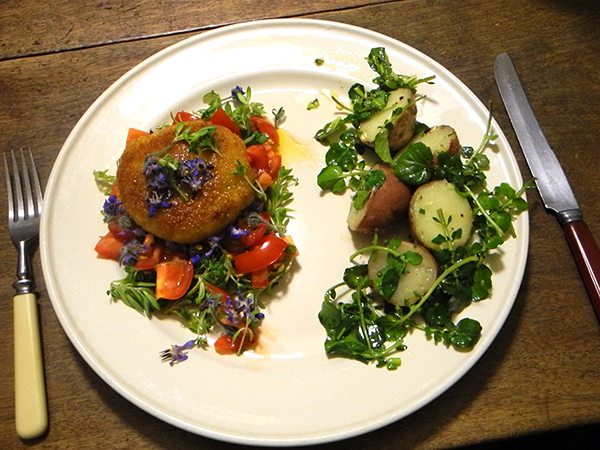
looks like a flattened bouquet


Yes, it definitely looks like I had a lot of greenery on hand, but I think I managed to disguise some of its volumes with a little judicious mixing with other elements of the meal.

And this wasn’t just ordinary greenery, as it included upland cress, wild garlic (bulb and green), stone crop, lovage, fresh oregano (ordinary, except that it’s a survivor from last fall), and borage flowers!

  • two crab cakes from PE & DD Seafood (ingredients: crab, egg, flour, red & green peppers, garlic, salt, pepper, breadcrumbs, mayonnaise, milk, celery, parsley), heated in a small heavy cast iron pan, 3 to 4 minutes on each side, and served on a salsa composed of 6 Backyard Farms Maine ‘cocktail tomatoes’ from Whole Foods, which had been chopped and combined with salt, freshly-ground black pepper, a bit of homemade French Basque piment d’Espellate purchased in a small town north of Baie-Comeau, Quebec last year from the producer’s daughter, some crushed dried pepperoncini, and some chopped fresh oregano leaves from Stoke’s Farm (which I have been husbanding for months in the refrigerator!), the salsa covering much of a bed of undressed stone crop (a succulent, aka orpine, aka sedum) from Lani’s Farm, the dish finished with a few drops of olive oil, some of the liquid remaining from the salsa, and some gorgeous blue borage flowers from Two Guys from Woodbridge
  • five red Norland potatoes from John D. Madura Farm (these potatoes have grown especially sweet over the winter), scrubbed, boiled in salted water unpeeled, halved, tossed with olive oil and chopped tiny wild garlic bulbs and stems from Lani’s Farm, sprinkled with chopped lovage from Two Guys from Woodbridge, and mixed, still in the pan in which they were boiled, with cultivated upland cress from Alewife Farm

There was a cheese course included 3 cheeses and thin toasts of potato bread.

  • the cheeses were Consider Bardwell’s ‘Experience’, a pasteurized cow cheese still in the developing stage; their ‘Manchester’ goat cheese; and an adaged goat cheese from Vermont Creamery, ‘Coupole
  • with the cheese there were very thin slices of potato bread (Balthazar’s ‘Potato Fendu’) from Whole Foods, toasted


fennel/chili-grilled tuna; potato, wild garlic, lovage; kale

tuna_potato_kale

We hadn’t seen our friends in years; they were visiting from London and Norfolk, and they were coming to dinner. I wanted to serve something fine, but I didn’t want to spend all of my time in the kitchen once they arrived.

The solution seemed obvious: To start there’d be a good salumi on plates with some excellent greens, and we would end with some very good cheeses. The main course would almost certainly have to be fish (to show off our local bounty and its quality, and because I wanted it to require little heat, because the weather was so very mild), and it would also have to be very simple and quickly assembled.

Grilled tuna, of course.

My plans were confounded early in the day by the fact that I arrived too late at the Greenmarket: the tuna was already gone.  Seeing nothing that would be a good substitute, I headed south, because of the logistics, to Citarella rather than The Lobster Place, while knowing that if need be, I would have the latter as a fallback.

All of which is to say is that, while the tuna was delicious, and from the northwest Atlantic waters, it was not purchased at the Greenmarket, directly from the fisherman or his colleague. I had to tell that to our friends, while extolling the otherwise locavore character (except for the Speck) of the the meal we were sharing.

The meal began, after a taste of whole wheat Mario Fongo grissini stirati and mixed black olives from Buon Italia, with a light course of salumi.

  • thinly-sliced Alto Adige Speck from Eataly, each piece rolled around the tines of a fork and put on a plate, drizzled with some very good olive oil, accompanied by upland cress from Alewife Farm, seasoned and dressed with some good oil and drops of local hot house Lisbon lemon from Fantastic Gardens of Long Island
  • to accompany the Speck and greens we had an Eric Kayser ‘baguette monge’ to tear into
  • the wine was a New Mexico (Sierra County) sparkling, Gruet Blanc de Noirs 

The main course was assembled pretty quickly after we had finished the salumi and cress, because I had started boiling the potatoes the moment before we sat down to the first.

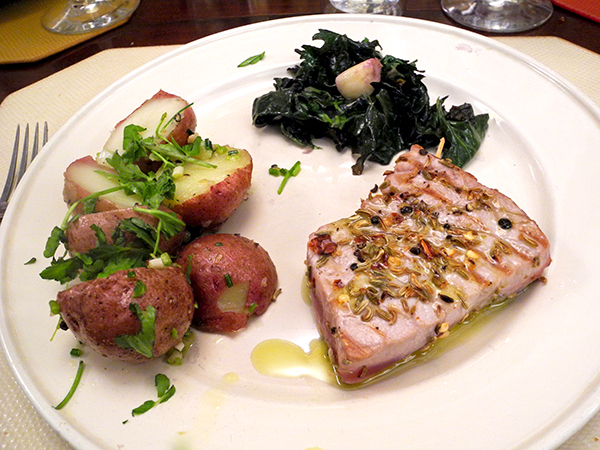
  • two 10 or 11-ounce tuna steaks from the Village Citarella, each halved, their tops an bottoms rubbed with a mix of a generous amount of dry fennel seed and one crushed medium-to-large dried Itria-Sirissi chili, peperoncino di Sardegna intero from Buon Italia, ground together, additionally seasoned with salt and pepper, then pan-grilled for only a little more than a minute and a half on each side, finished with a good squeeze of a Lemon grown locally by Fantastic Gardens of Long Island, and a drizzle of olive oil [the recipe is from Rose Gray and Ruth Rogers, found in ‘Italian Easy’; Recipes from the London River Cafe‘]
  • red Norland potatoes from Lucky Dog Organic Farm and John D. Madura Farm (these potatoes are especially sweet by March), scrubbed, boiled in salted water unpeeled, halved, tossed with olive oil and chopped wild garlic from Lani’s Farm, sprinkled with chopped lovage from Two Guys from Woodbridge
  • a few handfuls of delicious green and purple-colored flat-leaf Winterbor kale from Tamarack Hollow Farm, sautéed in olive oil in which 4 medium cloves of garlic from John D. Madura Farm had first been allowed to sweat and begun to brown, seasoned with salt, pepper, and a dash of olive oil
  • the wine with the tuna, potatoes, and kale was a Portuguese (Dão) white, Casa de Mouraz, Dão Blanco ‘Encruzado’ 2013, from Flatiron Wines & Spirits

The cheese course followed after we had lingered a bit following the main.

  • the cheeses were Consider Bardwell’s ‘Experience’, a pasteurized cow cheese; their ‘Manchester’ goat cheese; and an adaged goat cheese from Vermont Creamery, ‘Coupole‘, purchased at Citarella while I was there for the tuna
  • the breads with the cheeses were thin slices of potato bread (Balthazar’s ‘Potato Fendu’) from Whole Foods, toasted; and slices of Eric Kayser’s ‘Baguette Monge’ which remained from the first and second courses
  • the wine with the cheese was a Spanish (Valladolid) white, Martinsancho Rueda Verdejo 2014


  • the music throughout the meal was our own conversation

octopus, oregano; potato, wild garlic, purple micro greens

octopus_boiled_potato

hello old friends


It had been almost 5 years since I had cooked octopus. It had been an occasional treat for a number of years before that; it was probably my enthusiasm for local ingredients that has caused me to neglect it since.

Yesterday my enthusiasm for octopus overcame the locavore in me.

I had been unable to purchase or enjoy any seafood yesterday because of our schedule; today (Tuesday), because there is no greenmarket offering fish anywhere in Manhattan at least, I headed for The Lobster Place in Chelsea Market, hoping to find something which not available from the fishers who sell their catch in Union Square.

I bought 4 small Spanish octopuses (yes, they had been previously frozen, but so is all the wild salmon available to us on the east coast, and that doesn’t stop me). Unfortunately the rich ocean life of the northwestern Atlantic does not include octopus, and I’m very fond of octopus.

I prepared them much as I always had in the past.  They were delicious, as always.

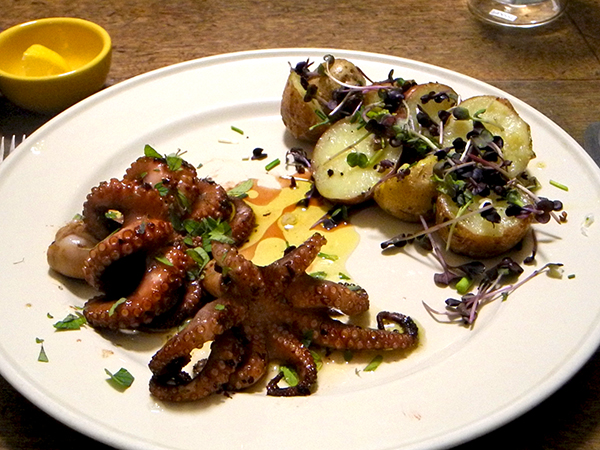
  • four baby octopuses (in 2 sizes, totaling 12 ounces) from The Lobster Place in Chelsea Market, marinated for about an hour and a half in chopped garlic from John D. Madura Farm, oil, local lemon zest and juice from Fantastic Gardens of Long Island, crushed dried red pepper, dried Italian oregano and sea salt, then drained, pan-grilled whole on high heat for an average of 4 minutes on each side, finished with a squeeze of the same lemon, olive oil and fresh chopped oregano from Stokes Farm
  • red Norland potatoes from Lucky Dog Organic Farm (very sweet at this time of the year), scrubbed, boiled in salted water unpeeled, halved, tossed with olive oil and chopped wild garlic from Lani’s Farm, sprinkled with purple radish micro greens from Two Guys from Woodbridge
  • the wine was an Italian (Umbria) white, Santa Cristina Umbria 2012 [the link is to the 2014 vintage] from Philippe Liquors
  • the music was works by Esa Pekka-Salonen, from the album, ‘Meet the Composer-Conductor

orzo, tongue stock, lovage, parmesan, micro radish greens

orzo_tongue_broth_lovage_parmesan

Note to self: This was a wonderful, wonderful dish, and I would not hesitate to serve it, or some version of it, to any guest, even as a main course; also, it was a beautiful convergence of necessity and availability.


This is when cooking gets pretty exciting. I wanted to find something which would demonstrate the tastiness of a pretty special ‘leftover’, and make it a full meal, and I knew I would not have much time to prepare a late supper after returning from a concert in Brooklyn.

The ingredient I had on hand amounted to 2 cups of a very savory broth which remained from the preparation of veal tongue in a dinner enjoyed last week.  My idea was to turn it into a hearty soup, with the addition of one of the tiny pasta shapes I’ve often seen, but have never used, like ditalini, tubetti, or acini di pepe.  I wanted the pasta to have been made in Italy, and artisanal, but I was at Whole Foods, and didn’t have time to go to either of the shops where I usually find the imported dry pasta I use. I was about to give up when I saw a neat little box with a cellophane window displaying beautiful rice-like shapes. It was orzo. I was charmed, and I was certain I could work with it.

I had no idea it would be so easy, and fun, requiring even less attention than its more common rival, risotto made with rice.

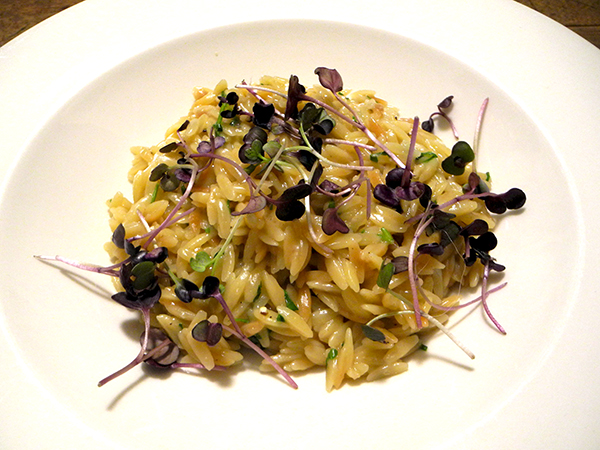
Both before and after cooking it looks very much like rice (specifically, long-grain rice, which isn’t really suitable for risotto), and it’s cooked very much the same as risotto, yet with virtually no stirring.  But it tastes like good pasta.

I love pasta, and rice, and now I love orzo, and I’m looking forward to the next time I have some good homemade stock on hand (I only used half of the box last night).

  • two tablespoons of rich ‘Kerrygold Pure Irish Butter‘ melted in a heavy, enameled cast iron pan (with a cover) over medium-high heat, 1 cup of Whole Foods brand Italian pastificio organic orzo stirred in, sautéed until lightly browned (some of the pasta will be more brown than the others, which only makes the finished dish more attractive), 2 cups of strained tongue stock (remaining after a veal tongue had simmered in onion, parsley root, celery root, carrot, bay leaf, peppercorns, and spice cloves) stirred in and brought to a boil, the pan covered and the flame reduced to a simmer, the stock absorbed (about 15 minutes), checking at the beginning to be certain the pasta has not stuck to the bottom of the pan, half of a cup of good Parmesan cheese, grated, and about a fourth of a cup of chopped lovage from Two Guys from Woodbridge added and stirred in, seasoned with salt and freshly-ground pepper, transferred to bowls and sprinkled with ‘Hong Vit‘ micro Asian purple radish greens, also from Windfall Farms
  • the wine was an Oregon (Willamette) red, Montinore Estate Pinot Noir 2013, from Appellation Wine & Spirits [both of those links are to a 2014 vintage]
  • after a concert of music by Olivier Messiaen, Pierre Boulez, George Benjamin, and Oliver Knussen, it seemed right that the table music was from a recording of the 2008 Musica Viva Festival; the box set includes work by Karlheinz Stockhausen, Karl Amadeus Hartmann, Jörg Widmann, Matthias Pintscher, Iannis Xenakis, James Dillon, Beat Furrer, Giacinto Scelsi, Rebecca Saunders, and Kaija Saariaho

Great night.


pork tenderloin, sage; roast potato, herbs; tomato; collards

tenderloin_potato_tomato_collards

The entrée was unanticipated: I had gone to the Greenmarket stand of our friendly Vermont cheese makers to buy one of their new ‘experimental’ cheeses, but when I arrived Peter showed me some quite small frozen pork tenderloins, and I couldn’t pass them up.

Consider Bardwell produces absolutely wonderful goat and cow cheeses, and a certain amount of meat from the farm has become increasingly visible at the market. It’s all been first rate, but this was the first time I had taken home any of their pork, and it was equally delicious.

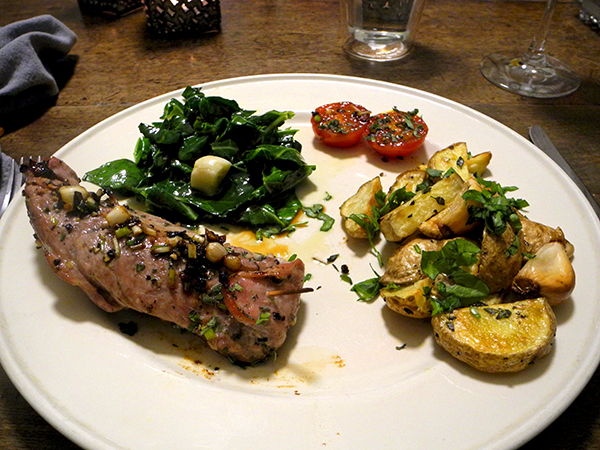
  • two 6 or 7-ounce pork tenderloins from Consider Bardwell Farm, dried, rubbed all over with a mixture of chopped garlic from John D. Madura Farm, chopped sage from Eataly, salt, and pepper, very quickly sealed over a medium-high flame in a copper au gratin pan, placed in a 450º oven for about 6 minutes, the pan removed to the top of the range, the pork put onto warm plates, some scissored wild garlic from Lani’s Farm scattered into the pan over medium heat, along with 2 halved Backyard Farms Maine ‘cocktail tomatoes’ from Whole Foods, all quickly stirred around a bit in the juices with a small flat-end wooden spatula, the tomatoes then arranged on the plates and sprinkled with chopped oregano from Stokes Farm and the pan juices drizzled over the roasted pork [that’s a very old flat wooden toothpick in the picture; it held down the thin end flap of the tenderloin while it was cooking]
  • Yukon Gold Potatoes from Norwich Meadows Farm, scrubbed, cut (unpeeled) into half-moon shapes, tossed in a little olive oil, chopped thyme from Forager’s, 5 garlic cloves, unpeeled (to prevent them from buring) from John D. Madura Farm, salt, and pepper, then roasted, uncrowded, in an unglazed ceramic pan at 425º for about 25 minutes, potatoes and garlic removed and tossed with chopped lovage from Two Guys from Woodbridge
  • the remainder of the small store of tender collard greens I had picked up from Norwich Meadows Farm a few day ago and used with the duck breast, washed, drained, then braised very lightly (they were very tender) in a heavy pot in which one halved garlic clove from Norwich Meadows Farm had been allowed to sweat in some olive oil, the dish finished with salt, pepper, and a drizzle of olive oil
  • the wine was a Spanish (Valladolid) red, Bodegas Rejadorada Reja Toro 2014
  • the music was, during the earlier part of the meal, that of a tragic (dead at 18, in 1715) collector, commissioner and composer of music, Johann Ernst Prinz von Sachsen-Weimar, his ‘Complete Violin Concertos’, and, later, a work completely unrelated, Nathan Davis’ magnificent 21-minute piece, ‘On The Nature of Thingness’ (2011), played by the International Contemporary Ensemble [ICE] 

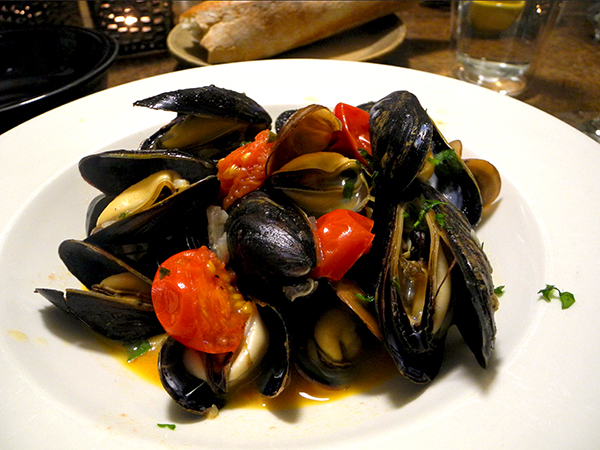
steamed mussels with lovage, wine, tomatoes, shallot

mussels_steamed_lovage_tomatoes

an extraordinary dish, also one of the simplest, and least expensive to make


I came across this recipe some time ago, and have enjoyed it a number of times since.  I found it in the New York Times, where it was described as adapted by Sara Dickerman from “The Herbal Kitchen,” by Jerry Traunfeld.  The biggest challenge for most home cooks may be locating the fresh lovage, but it’s worth it, wherever that hunt may take you.

It’s a brilliant formula, and extraordinarily delicious.

The easy part: There’s very little preparation necessary for any of the (few) ingredients, and everything goes into the pot at once, after which dinner is ready in little over 5 minutes.

  • two pounds of mussels purchased that day in the Union Square Greenmarket from Pura Vida Seafood, lightly-scrubbed and de-bearded where necessary, then combined in a large heavy enameled cast iron pot with two cups of Backyard Farms Maine ‘cocktail tomatoes’ from Whole Foods, halved, half of a cup of good white wine (a South African, specifically, Western Cape/Constantia, white, Klein Steenberg Sauvignon Blanc 2015 from our local shop, Phillippe Wines), a few tablespoons of chopped shallot from John D. Madura Farm, three tablespoons of rich ‘Kerrygold Pure Irish Butter‘, a generous amount of freshly-ground black pepper, and 2 or 3 tablespoons of coarsely-chopped lovage from Two Guys from Woodbridge, everything steamed over high heat for a few minutes, served in shallow bowls with a sprinkling of more chopped lovage, accompanied by an Eric Kayser ‘baguette monge’
  • the table wine was a Portuguese (Bairrada) white, FP Bical & Arinto Vinho Branco, a 2013, from Chelsea Wine Vault
  • the music was Mozart, ‘Le Nozze Di Figaro’, Nikolaus Harnoncourt conducting the Vienna Philharmonic Orchestra, with Dorothea Röschmann, Anna Netrebko, Ildebrando D’Arcangelo