Author: james

sunday brunch: egg/pancetta/tomato/parmesan

eggs_pancetta_tomato

Once again it was a Sunday morning, or rather a Sunday afternoon, and we knew, because of other commitments, we would not be able to enjoy a lunch, however late, because of other commitments.  Also once again, the solution looked pretty much like ‘brunch’, very much like the one I had come up with four months ago.  I had some of the same parameters then, including a discovery in the refrigerator of an opened package of some cured meat, but this time I also had a little bit of ‘salad’ on hand.

The description which follows largely repeats the one I published last February.

  • I started by lightly buttering a large-ish, cured steel pan and placing in it a layer of a few ounces of thinly-sliced Colameco’s pancetta from Whole Foods. I broke 6 eggs from (3 from Millport Dairy, and 3 from Tamarack Hollow Farm) on top of the meat, fried them slowly until the whites had not quite become solid, seasoned them and poured over them a bit of improvised tomato sauce (quartered cherry tomatoes from Norwich Meadows Farm, softened in a bit of olive oil where I had warmed some thinly-sliced organic garlic from Trader Joe’s, then seasoned and sprinkled with chopped rosemary from Phillips Farm).   The eggs were sprinkled with chopped herbs, lovage from Keith’s Farm, parsley from Tamarack Hollow Farm, and thyme from Eckerton Hill. I finished them with a sprinkling of grated Parmesan cheese and served them on a plate with arugula from Eataly (dressed with good olive oil, white balsamic vinegar, salt, and pepper), and toasted slices of whole wheat (‘Integrale’) bread from Eataly.
  • the music was various anonymous early Gregorian chants, sung by the canons regular of the Praemonstratensian order of St. Michael’s Abbey in Silverado, California, whose cantor, talking about their latest album, describes them as  “the most Catholic things I could get my hands on.” (this old atheist has both a significant family connection to the Norbertines in De Pere, Wisconsin, and a personal tender-age performance history which included Gregorian chant)
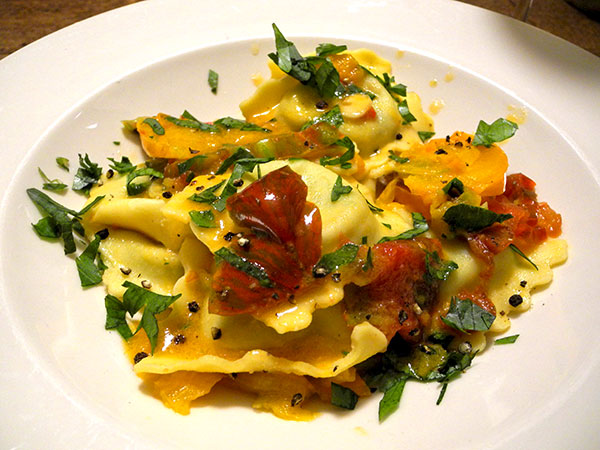
spinach and ricotta ravioli, heirloom tomato, lovage

spinach_pasta_heirlooms_lovage

This dinner represents one incredibly simple formula for preparing a good meal with a minimum of time and fuss, a good filled pasta combined with some appropriate fixings already on hand.

  • fresh Rana spinach-and-ricotta-filled ravioli from Eataly, stirred with sections of early yellow and maroon heirloom tomatoes from S. & S.O. Produce in a pan in which a sliced garlic clove had been heated with olive oil, then mixed with crushed chiles, black pepper, and a generous amount of chopped lovage from Keith’s Farm
  • the wine was a French rosé, Devois de Perret Languedoc 2014
  • the music was that of the somewhat underappreciated Ottorino Respighi, his charming orchestral suites, ‘Antiche arie e danze’ [Ancient Airs and Dances], 1-3

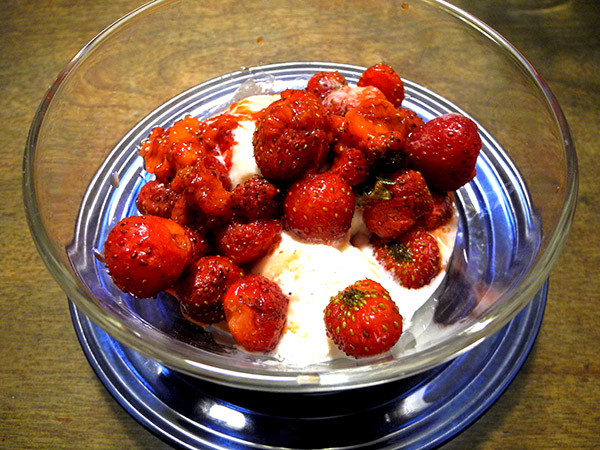
The even more simple desert, a course which incidentally appears pretty rarely in our home, was the happy marriage of some fantastic tiny early strawberries (half-wild) from Berried Treasures, a portion macerated in some Turbinato sugar, and a container of Ciao Bello gelato which had been waiting in the freezer for a while.

strawberries_gelato


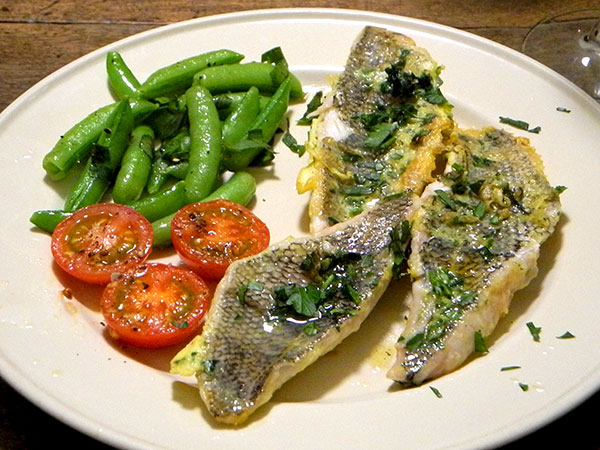
sautéed sea bass, parsley; pea pods, lovage; tomato

sea_bass_pea_pods_toms

We returned from Quebec on Sunday, where I had been frustrated, being without a kitchen, while confronted by the rich bounty of the farms and markets (I mean, as in wild asparagus!).  On my first day back at our own Greenmarket I brought home six 3-ounce sea bass fillets from Blue Moon Fish.  I was overwhelmed by the vegetable choices, but I zeroed in on the first pea pods I had seen this spring, and some red spring onions.  In the end, because of considerations of both time and the amount of food, I decided to save the onions for another meal and use a few of the tomatoes instead, partly for the color.

  • I rolled the bass fillets in a light coating of seasoned flower, and dipped them in an egg which had been beaten with a couple tablespoons of chopped parsley from Tamarack Hollow Farm.   After a quick sauté in a mixture of oil and butter, I removed them from the pan, sprinkled them with a bit of lemon, and finished them with pan juices I had mixed with some more parsley.
  • I placed three halved Maine cherry ‘cocktail’ tomatoes from Whole Foods in the pan, cut side down, shortly before the fish was finished
  • After parboiling the sugar snap peas (from Keith’s Farm) for a little over one minute, I drained them and rolled them in a little butter, added salt and pepper, and finished them with chopped lovage, also from Keith’s Farm
  • the wine was a California white, Jim Olsen Manton Valley Chardonnay 2014
  • the music was, at least later in the meal, Gesualdo

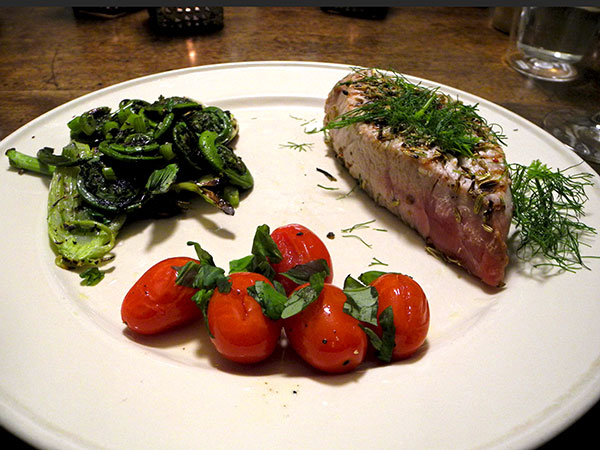
tuna and fiddleheads (each with fennel); tomato

tuna_fiddleheads_tomato

This was a slightly different version of a favorite recipe.  I had already bought a tuna steak at the Greenmarket and was about to head home when I spotted what turned out to be the last young fennel bulb on a table at Bodhitree Farm.  I usually ‘pave’ tuna steaks with crushed fennel seed and dried chiles, and I thought that this time I might find a way to serve it with fennel two ways.

I hadn’t really brought home enough fiddleheads, and I wanted to use them as soon as possible, so most of the fresh fennel material went toward filling out the portion of green vegetable on the plate.

After we had sat down and begun the meal I decided that the basic tuna recipe doesn’t really need any gilding, but the combination of young fennel bulb, fiddleheads, and spring garlic was pretty good, and subtly complex.

  • a 12-ounce section of tuna loin from Blue Moon Fish Company, cut into two pieces, rubbed on both sides with a mixture of fennel seed and dried peperoncini, ground together, seasoned with salt, and pepper, then pan-grilled for only a minute or so on each side, finished with a good squeeze of lemon, a drizzle of olive oil, and a sprinkling of fresh fennel fronds, chopped
  • a few fiddleheads from Tamarack Hollow Farm, one thinly-sliced spring fennel bulb, and one spring garlic from Keith’s Farm, sliced lengthwise into two halves, all three vegetables pan-grilled for a few minutes, then combined with sliced stems from the fennel bulb and some chopped green parts from the garlic, after they had been lightly cooked with olive oil in a separate pan, the mix then seasoned and tossed with more olive oil
  • small ripe grape tomatoes from Kernan Farms, halved and then briefly heated in oil, seasoned, and finished with some torn leaves of fresh New York rooftop basil from Gotham Greens
  • the wine was a Spanish white, Abadía de San Campio Albariño Rías Baixas 2013
  • the music was Handel Concerti Grossi, played by Tafelmusik

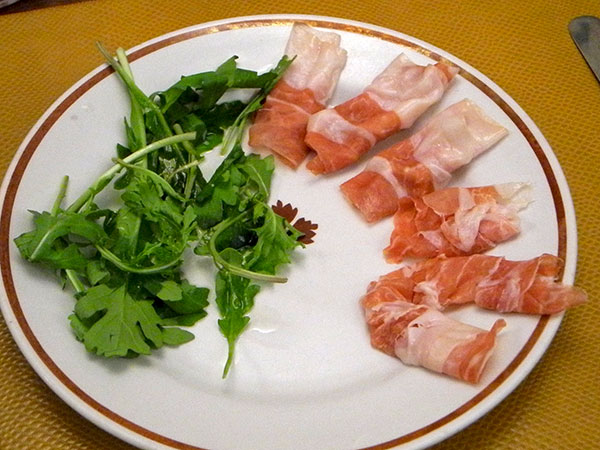
prosciutto, arugula, bread; fusilli mediterranei

prosciuto_wild_arugulafusilli_mediterranei

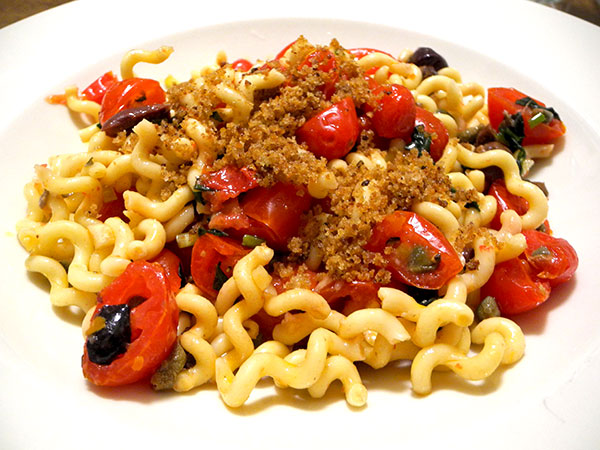
This is my favorite warm-weather-prepare-in-advance-to-be-free-for-talking-to-guests-and-still-serve-an-elegant-pasta dish, and it happens to be even more delicious than it looks or the list of ingredients might suggest.  It’s also pretty fool-proof, and in fact, except for the boiling of the pasta, requires no real cooking skill. [One, at his request, I emailed the recipe to a friend who had enjoyed it at our home;  he likes to entertain, but, by his own admission, has no interest in or talent for things ‘kitchen’; he told me it was a great success.]

It’s a great summer meal, and although it’s a pasta dish, and technically a salad, it easily stars as an entrée, balanced before and after with an antipasto, also room-temperature, and a cheese or fruit course.  It should serve at least 6 under those circumstances, but since it really is just as good as a leftover, and this time we were only 4 (and had seconds), the two of us were able to enjoy it again three days later.

[After that introduction, I can admit that the picture of the pasta dish was taken just as we sat down when we were having the leftovers (I had forgotten to snap the entrée on the first night, when we had two guests); the picture of the antipasto, was taken the first night.]

The dish is ‘Fusilli Mediterranei’, the recipe I use is included in Anna Tasca Lanza‘s treasure, ‘The Flavors of Sicily: Stories, Traditions, and Recipes for Warm-Weather Cooking’, one of my favorite Italian food sources.  Tasca prescribes over two pounds of ripe tomatoes, peeled, seeded, and cubed, but the first time I used the recipe it wasn’t yet tomato season, so I substituted some excellent ripe grape tomatoes, halved each of them, and used a tiny spoon to press out the seeds and juice.  It’s the way I prepare the dish each time.

You should have a large bowl on hand, and allow about three hours time to prepare the dish.  Only one hour involves actual work (mostly dealing with the tomatoes and pitting the olives); the remaining two are for letting the ingredients rest at room temperature at two points during the preparation.

  • we began the meal with an antipasto of DOK Dall’Ava prosciutto di San Daniele D.O.P. from Eatlay; served with ‘wild arugula’ from S. & S.O. Produce, the greens drizzled with good olive oil and drops of lemon; and slices of ‘Rustic Classic’ bread from Eataly
  • when the tomatoes [this time, somewhat more than 3 baskets of grape tomatoes from Kernan Farms] have been prepared as described above, put them in a colander, sprinkle with salt, a bit of sugar, hot pepper flakes, and turn to coat; add 2 cloves of minced garlic, 4 salted anchovies, rinsed, filleted, and chopped, 1 1/2 cups of basil [from Gotham Greens], torn; a cup of good black olives pitted and cut in half, and half a cup of salted capers, rinsed; toss all to mix and let stand at room temperature for an hour; start to boil the pasta [I used ‘Fusilli con Buco’ from Il Pastaio di Gragnano] about half of the way through that time (so it will be ready when the tomato mix is) until almost al dente, run cold water over the pasta to cool it down, and after transferring the tomato mixture to a large serving bowl and stirring in 1/2 cup of olive oil, add the drained pasta to it, toss everything together and let stand at room temperature, again for one hour; when ready to serve, sprinkle the serving bowls with sturdy (ideally, homemade) breadcrumbs which have meanwhile been toasted with a little olive oil until lightly browned and set aside to cool
  • the wine was an excellent California rosé, Akiyoshi Sangiovese Rosé 2013
  • the music was Leonard Bernstein performing Charles Ive’s Symphony No. 2

fiddlehead fern, spring allium, and tomato frittata

fiddlehead_frittata

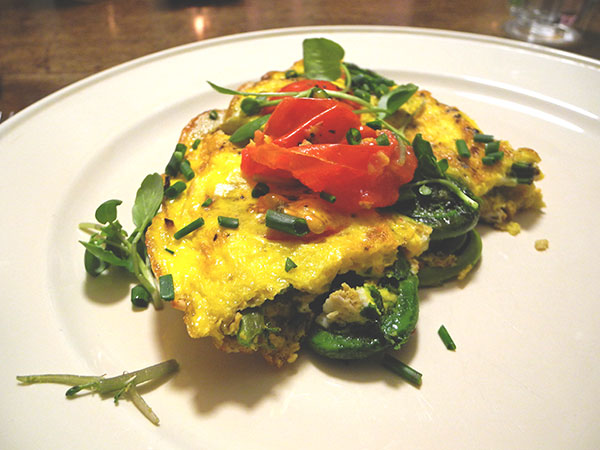
This supper was totally improvised.  We arrived home fairly late from the Wagmag Benefit, and we both had to be up early the next day, so time was important.  I had some fiddlehead ferns in the refrigerator, already rinsed, which had not been included in the meal the night before, plus seven eggs, all kinds of spring allium (allia, alliums?), and a few little bitty green things which would help make a good picture.

  • fiddlehead ferns from Tamarack Hollow Farm, added to a seasoned steel pan in which spring garlic from Norwich Meadows Farm and baby leeks from Rogowski Farm had already been softened in a mixture of olive oil and butter, 7 lightly-whipped eggs from Millport Dairy poured into the mixture then cooked slowly over a low-to-moderate flame until the eggs were almost cooked, continuing with Maine cherry ‘cocktail’ tomatoes from Whole Foods, sliced into four disks, arranged on the top of the mixture before it was placed in a pre-heated broiler, finished with scissored chives from Mountain Sweet Berry Farm and a sprinkling of cress from Stokes Farm
  • slices from a bâtard from Amy’s Bread, with some olive oil drizzled onto the plate with the frittata
  • the wine was a South African white, Nederburg Foundation Lyric 2014, a combination of Sauvignon Blanc, Chenin Blanc, and Chardonnay
  • the music was streamed from Yle Klassinen

bluefish with tomatoes, baby leeks; fiddleheads

bluefish_roasted_with_tomatoes_fiddleheads

While I was still gathering the ingredients at the Greenmarket today, I began to think of this meal as something of a miniature model of the New England I love. The bluefish represents the Southeast coast (Rhode Island waters, for me), while the fiddleheads seem very much a treasure of the green north.

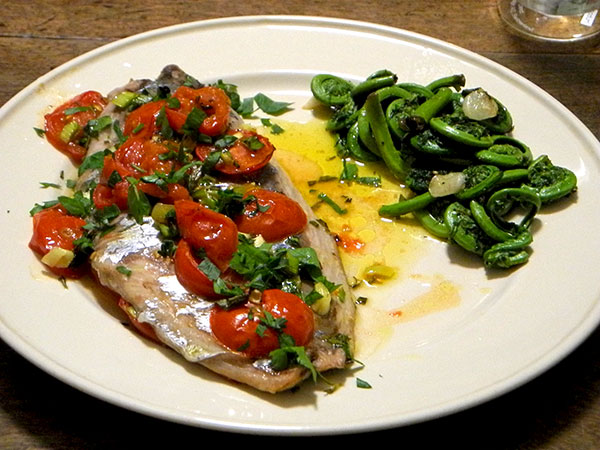
  • two nine-ounce fillets of bluefish from Blue Moon Fish, cooked along the lines described in a recipe which we had enjoyed several times in the past;  it’s from Mark Bittman’s “Fish: The Complete Guide to Buying and Cooking“; my other ingredients included Maine cherry ‘cocktail’ tomatoes from Whole Foods; two baby leeks from Rogowski Farm; chopped rosemary from Phillips Farm; and chopped parsley from Rogowski Farm
  • fiddlehead ferns from Tamarack Hollow Farm, blanched for about 3-4 minutes, drained, dried, added to a pan in which a sliced garlic clove had been allowed to begin to color and some chopped thyme had been introduced and warmed, the ferns briefly sautéed, removed and drizzled with lemon juice
  • the wine was a Spanish white, Naia D.O. Rueda 2014, from Verdejo old vines
  • the music was Joan Tower’s ‘Stroke’


orecchiette with radishes and radish greens

orecchiette_with_radish_radish_greens

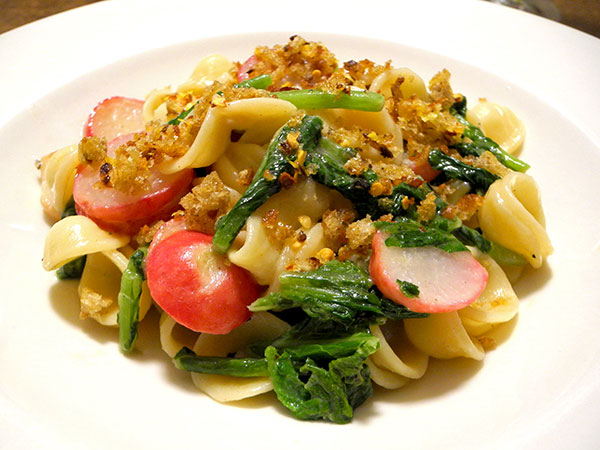
Barry: “I’d be quite happy to have this in a restaurant.”


When I was starting out, I didn’t have much of an emotional investment in the success of this pretty simple meal, even though I was thinking of how much I loved cooking with both radishes and radish greens (not always as part of the same entrée), but, in the end, it was actually pretty terrific.  The basic structure of the entrée was described in this ‘bon appétit’ recipe, although I took some liberties here, some out of personal preference, some prescribed by necessity, because of what I had available on hand.

Tautog with olives, spring garlic, thyme; collards

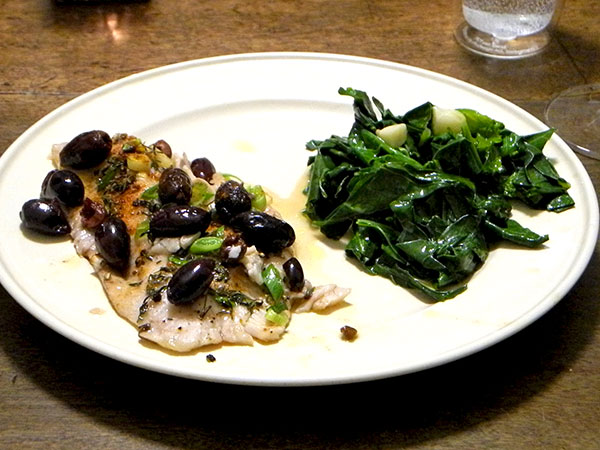
Tautog_olives_collards

Tautoga onitis‘.  In New York it’s called ‘Blackfish’, but in Rhode Island and elsewhere along the New England coast it’s know as ‘Tautog‘, a name which originated with the Narragansetts.  Surprisingly, none of this knowledge seems to have been enough to get this delicious fish onto our table, in spite of my passion for both New York and Rhode Island – until now.

I was at the Greenmarket today, mulling over the choices offered by P.E. & D. D. Seafood, when Wade asked me whether I had ever cooked Blackfish.  I told him that I thought not, and asked what other names it might go by.  “Tautog’ came the answer, and my ears perked up; I had remembered hearing the name during the time I lived in Rhode Island (from the mid-60s to the mid-80s).  I immediately got a terrific sales pitch describing the virtues of this fish, but I think I had already been sold as soon as I heard the word, “Tautog”.

It turned out I had made a great choice.  The Blackfish/Tautog was absolutely delicious, and it seems it would accommodate any number of preparations. I understand that it rarely appears in any market, but I will definitely be looking for it.

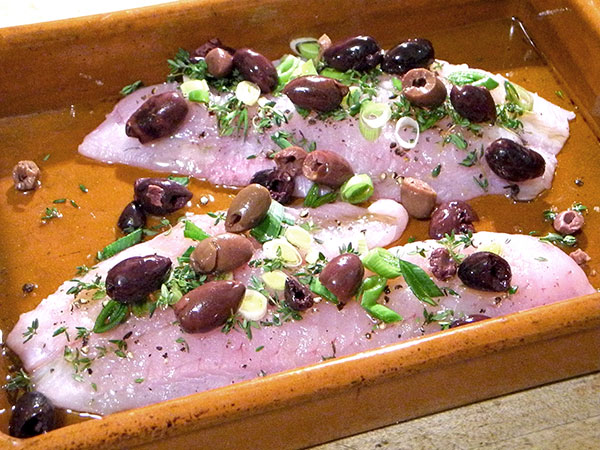
  • two eight-ounce fillets of Blackfish from P.E. & D.D. Seafood, prepared pretty much along the lines of this recipe by Melissa Clark, but substituting thyme leaves for the sage she suggests, and a mix of cayenne pepper and Spanish paprika (dolce) for the Aleppo Syrian red pepper which is no longer available here (for obvious, and very sad reasons); I also added some sliced spring garlic from Norwich Meadows Farm; my other sources included thyme from Eataly, and Kalamata olives from Buon Italia
  • sweet baby collard greens from Central Valley Farm, sautéed lightly in a pan in which two halved garlic cloves had briefly sweated, seasoned, and drizzled with olive oil

Tautog_ready_for_the_oven

This is a glimpse of the pan just before it went into a 425º oven for about eight minutes.

monkfish Dijon style (Lotte Pierre Franey); rapini

monkfish_mushroom_ramps_kale

I don’t cook with mushrooms nearly enough.  I’ve promised myself I’d do better this year.

  • monkfish from P.E. & D.D. Seafood, prepared ‘Dijon Style’ using my spring allium variation of this vintage Pierre Franey recipe; my ingredients included Shiitake mushrooms from Bulich Mushroom Farm, one stem of spring garlic from Norwich Meadows Farm, ramps from Lucky Dog Organic, and parsley from Rogowski Farm
  • the young rapini from Lani’s Farm, remaining from the previous day’s salmon dinner, wilted with two garlic halves from Whole Foods which had previously sweated a bit in olive oil, all then seasoned with salt and pepper
  • the wine was a French rosé, Devois de Perret Languedoc 2014
  • the music was Antonio Bertali, chamber works (gorgeous)