Year: 2016

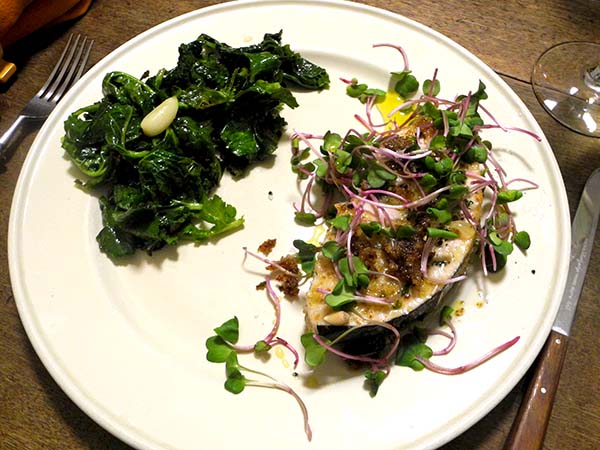
oregano-marinated swordfish, radish micro greens; kale

swordfish_oregano_radish_greens_kale

This was actually a very simple meal, put on the table very quickly, even allowing for some time with an incredibly minimal marinade.

  • two  very fresh inch-and-a-quarter-thick swordfish steaks (off of the F/V Bookie, out of the Hamptons) from Blue Moon Seafood in the Union Square Greenmarket, marinated for less than a half hour in a mixture of olive oil and fresh oregano from Stokes Farm (the last of a bunch which I had been able to keep fresh in the refrigerator since last fall), then drained well, covered with a coating of dried homemade bread crumbs, pan-fried over medium-high heat  for 4 to 5 minutes on each side, removed, salted, sprinkled with a little lemon juice and some colorful  ‘Hong Vit‘ micro Asian purple radish greens from Windfall Farms, fish and ‘greens’ finished with a drizzle of olive oil before serving
  • kale from Alewife Farm, sautéed in olive oil in which 2 small cloves of garlic from Whole Foods had first been allowed to sweat and begin to brown, seasoned with salt, pepper, and a dash of more olive oil
  • the wine was an Italian (Sicily) white, Corvo Insolia 2013, from Philippe Wine in Chelsea, located about 50 yards from our front door, and therefore sort of ‘local’
  • the music was the entire album. ‘Frederick The Great – Music For The Berlin Court’, performed by the Academy for Ancient Music Berlin (only moments before we had finally determined the exact dates of our May and June idyll in Berlin, der Hauptstadt des alten Fritz.

We enjoyed a simple and leisurely cheese course, with thin slices of a Balthazar rye boule, and the remainder of the wine.

  • the music was from a beautiful album of works by Johann Gottlieb Graun (1702–1771), a Brandenburg-born composer appointed to the court of the young Prussian prince years before Frederick became king, where he remained throughout his reign, as concertmaster, chamber musician, and director of the strings of the royal opera orchestra; Graun wrote 60 concertos for the violin alone, his own instrument as a virtuoso, over 100 symphonies, other concertos, and a great deal of chamber music

spicy salmon, potatoes with lovage, red cabbage, cress

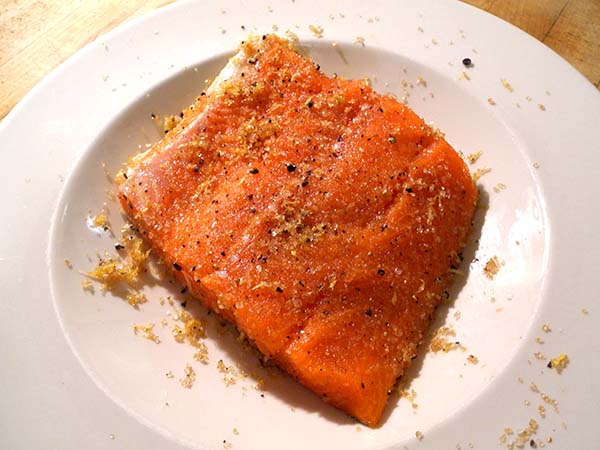
salmon_curing

filet after being rubbed with the sugar and spices, before it was refrigerated


Thinking of the arguable thesis that an artist’s best work may often arise from working with constraints, I will make the modest proposal that the same thing can work for the creative output of an ordinary cook.

I was unable to get to the Greenmarket on Monday to pick up some fish, so we enjoyed a pasta that night. The next day, not wanting to cook meat or another pasta, I decided to check out the wild salmon selection at Whole Foods. I would have to cook it on the top of the stove, since our oven is ailing, but I knew that was unlikely to present much of a problem, especially since I had just come across a very interesting Melissa Clark recipe which described pan-grilling the fish after it had rested in a spicy brown-sugar marinade. The salmon was not on sale, as it often is, but the wild Coho filets were being offered at what I would call a pretty reasonable price.

I still had a small amount of the red cabbage we had been enjoying for a week or so, and there was a generous amount of upland cress in the crisper waiting to be summoned to embellish a worthy plate.

Finally, still worried that what I had in mind wouldn’t quite add up to a complete meal, I decided to boil a very few potatoes as a foil for the other flavors I had gathered. Because of my introducing the potatoes, the excellent small Balthazar rye boule, which I had bought that day to fill out what I had earlier anticipated would be a pretty sparse course, stayed in the breadbox instead.

The meal turned out to be far more satisfying than I had hoped it might be.

If it had a geographic character, I would say that it lay somewhere between the German-speaking lands of Central Europe and the Pacific Northwest of the North American continent. Maybe New York City.

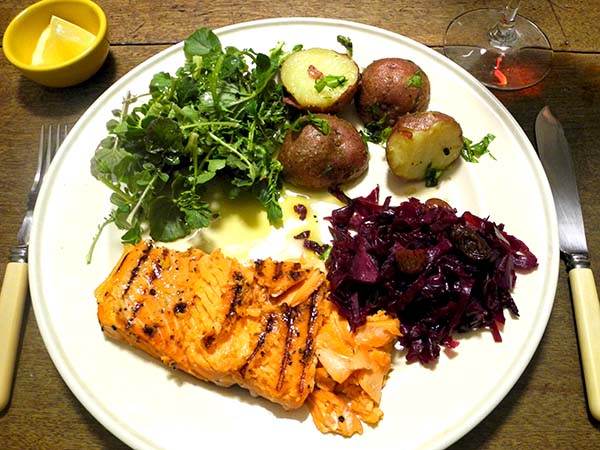
salmon_red_cabbage_cress_potato

  • one section of a Coho salmon filet (13.2 oz) from Whole Foods, marinated for about 6 hours in a mix of turbinado sugar, sea salt, freshly ground tellicherry pepper, freshly ground allspice, freshly ground nutmeg in lieu of the mace Clark had specified (the only mace in the kitchen had already been ground, probably over 30 yearsa ago, and had sat inside an antique tin container ever since, through 2 removes from since its purchase in Rhode Island), and the zest of half of an organic lemon from Whole Foods
  • red cabbage remaining from being prepared earlier 5 days before for an earlier meal and one one which had succeeded it
  • upland cress from Alewife Farm, dressed with some good Umbrian olive oil, a little white balsamic vinegar, salt, and pepper
  • four sweet Norland red potatoes from Lucky Dog Organic Farm, scrubbed and boiled unpeeled, then halved, tossed with sweet butter, salt, pepper, and chopped lovage from Two Guys from Woodbridge
  • the wine was an Oregon (Willamette) red, Argyle Pinot Noir 2013
  • the music was Kalevi Aho’s Symphony No. 8, and his ‘Pergamon’, the Lahti Symphony Orchestra conducted by Osmo Vänskä, Hans-Ola Ericsson, organ

‘midnight pasta’, with garlic, anchovy, capers, chiles, herbs

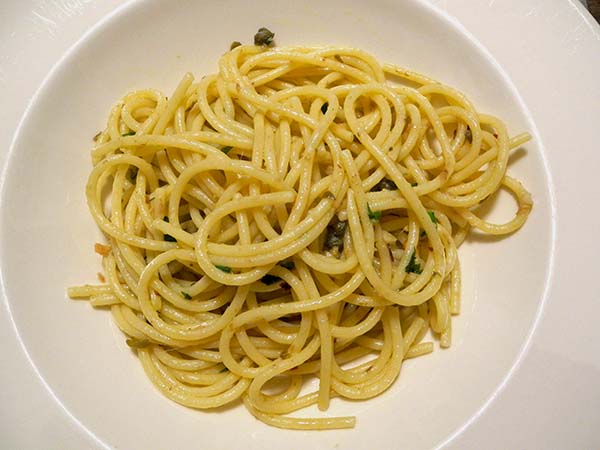
midnight_spaghettone

I’ve cooked this simple dish many times, and it’s shown up on this blog three times before. It never fails to satisfy whatever either of us was looking for in a meal at the moment; usually it was when we didn’t have the time or patience to come up with something more complicated.

  • approximately 8 ounces of Afeltra spaghettone, from Eataly, boiled, but only until still pretty firmly al dente, tossed inside the same pot in which it had cooked with a very savory sauce (created with 4 plump garlic cloves from Whole Foods, roughly chopped, cooked in about a third of a cup of olive oil over low-medium heat until softened and beginning to brown, 3 salted anchovies, well-rinsed, added to the pan and mashed with a wooden spoon, a tablespoon of Mediterranean organic wild capers in brine (from a Providence, RI distributor), rinsed and drained, half of one dried Itria-Sirissi chili, peperoncino di Sardegna intero from Buon Italia), along with several tablespoons of chopped parsley from Eataly, an equal amount of chopped lovage from Two Guys from Woodbridge, and a little of the reserved pasta water, then simmered for another minute or so while the sauce was both emulsified and slightly reduced, the mix distributed in two bowls and sprinkled with another few tablespoons of parsley and lovage
  • the wine was an Italian (Sardinia) white, La Cala Vermentino di Sardegna 2013
  • the music was the remaining part of Aulis Sallinen’s, ‘The King Goes Forth To France’, the scenes which we were unable to hear during dinner the night before.

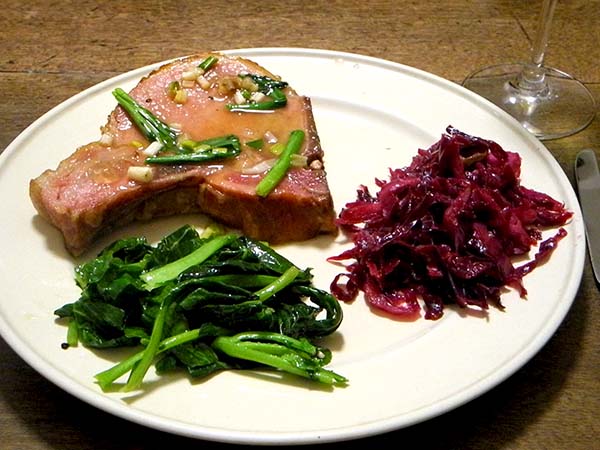
pork chops with lemon, red cabbage, sautéed cucumber

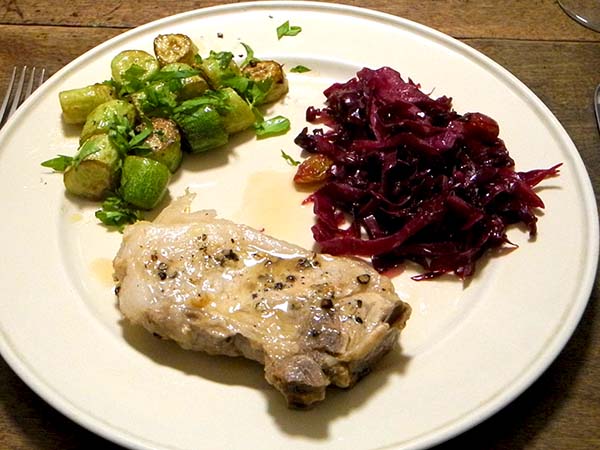
pork_celtuce_red_cabbage

I love cucumbers. And thanks to Martha Stewart I’ve now discovered the sautéed cucumber. I took some liberties with her recipe however, in consideration of the vegetable materials I had on hand, and my own taste: I had 3 small Korean cucumbers, I cooked the chunks until they had begun to brown, and I finished them with lovage.

The cabbage was left over from an earlier meal, and tasted even better than it had the first time.

The pork was from a new Greenmarket source, one which happened to have the smaller-size chops I’ve had difficulty finding lately. I used the same recipe I’ve used for years, but since my oven is currently unavailable, I cooked them on top of the stove in a heavy enameled cast iron pot. I think I should have seared them a little longer before squeezing the half lemon over them and covering it: They turned out less than brown, but the flavor was terrific.

Since I’ve just pointed to the recipes or procedures, now I only have to list the ingredients:

  • the pork chops, from Sawkill Farm, weighed just under 14 ounces altogether
  • the cabbage ingredients were described here
  • the 3 Korean cucumbers (totally 8.5 ounces) were from Lani’s Farm, and they were sprinkled with chopped lovage from Two Guys from Woodbridge
  • the wine was a California (Sonoma) white, Jacqueline Bahue Carte Blanche Sauvignon Blanc Sonoma Valley 2015, from Naked Wines
  • the music was roughly the firsthalf of an 1984 opera of Aulis Sallinen, ‘The King Goes Forth To France’, which begins, topically but with an entirely fantastical story, with the English royal court heading south to escape a future ice age (read the album notes!), Okko Kamu conducting the Helsinki Philharmonic Orchestra, the Tapiola Chamber Choir, and the Finnish Philharmonic Choir, with the soloists Riikka Rantanen, Jyrki Korhonen, Lilli Paasikivi,
    Mari Palo, Laura Nykänen, Herman Wallen, and Tommi Hakala

spicy copa, cress, crusty bread; spaghetti (after the clams)

copa_cress_bread

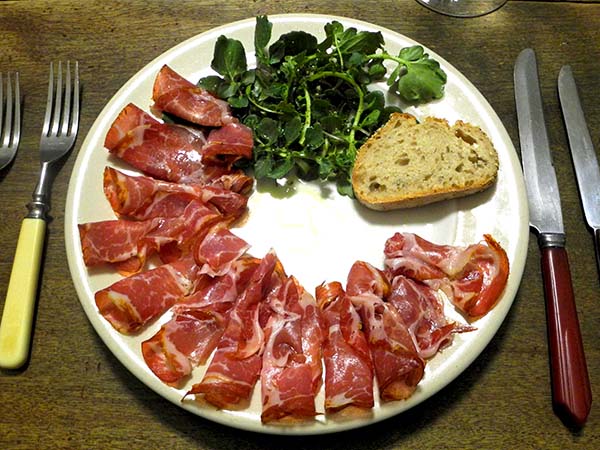
At first I thought I wouldn’t do a post of this meal, since the main course was simply a matter of re-heating a pasta we’d had a few days earlier (even if these leftovers always present their own pleasures), but the antipasta was new, and so delicious, I decided that I should ‘memorialize’ it, at least for the sake of my own files (that is, this blog).

The total amount of salumi used in both servings was less than 4 ounces (2 ounces on each plate), even though the image makes it look like quite a large portion. The copa was sliced very thin.

  • the ‘copa spicy giorgio’ was from Eataly, and it may have ultimately come from Salumi Artisan Cured Meats, the company and meat shop/restaurant co-founded by Mario Batali’s father, Armandino
  • it was accompanied by a little upland cress from Alewife Farm, dressed with some good Umbrian olive oil, a squeeze of lemon juice, salt, and pepper
  • the bread was ‘Commune’, from Sullivan Street Bakery

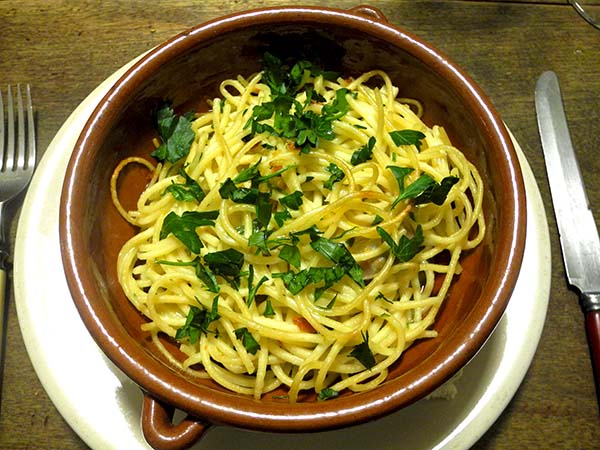
leftover_clam_spaghetti

  • the pasta was what had been left from a dinner of a few day before, spaghetti alle vongole in bianco (spaghetti with clams), although we had finished the clams themselves on the first night; it was divided into two ceramic oven dishes and heated at 350º for less than 15 minutes (I usually try to get it to the point where the more exposed pieces of pasta have become a little brown and crunchy), sprinkled with chopped parsley from Eataly


artichoke pasta; tilefish with ramps, herbs, lemon; collards

artichoke_foglie

Green, very green this meal was.

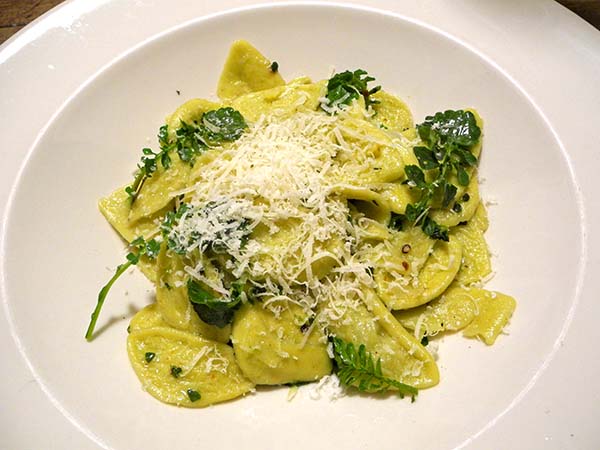
  • it began with a revisit with an Italian artisanal pasta, Foglie al Carciofo (artichoke leaves), from Maestri Pastai Selection, this time using 5 ounces, dry, served with a simple sauce of chopped spring garlic from Lani’s Farm which had been heated for a couple minutes in a little olive oil along with some dried Itria-Sirissi chili (peperoncino di Sardegna intero) from Buon Italia, the sauced pasta briefly emulsified with some of the reserved pasta water and sprinkled with freshly-ground Tellicherry pepper, then tossed with a little cultivated upland cress from Alewife Farm, served in shallow bowls with grated ‘Parmigiano Reggiano Bonat 3’ from Buon Italia

tilefish_collards

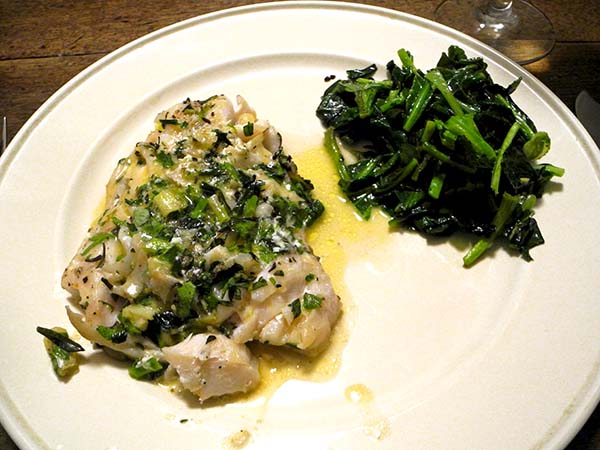
  • the secondo was an 18-ounce tilefish filet from Pura Vida Seafood, prepared something like this Melissa Clark recipe, but I replaced the scallions with ramps from Mountain Sweet Berry Farm (bulbs and stems), and, for the chopped herbs I used over 3 tablespoons in a combination of finely-chopped lovage from Two Guys from Woodbridge, winter savory and thyme from Stokes Farm, oregano and mint from Phillips Farm; the fish was cooked on top of the stove in a magnificent 5-and-a-half-pound new [old] oval copper pan, briefly using aluminum foil for a cover, and both a small brush and a wooden spoon to repeatedly spread/ladle the ramp-herb butter over the fish
  • the contorno was some very tender collard greens from Migliorelli Farm, washed, drained, and braised very lightly in a heavy pot, finished with salt, pepper, and a drizzle of olive oil
  • the wine through both courses was a South African (Western Cape/Constantia) white, Klein Constantia Sauvignon Blanc 2014
  • the music was Philip Glass, String Quartets No. 1, 2, and 3, performed by the Smith Quartet

Kassler, ramps, garlic-oregano jelly; cabbage; collards

smoked_pork_chops

We’re almost in German lands here.

  • six or eight ramps from Mountain Sweet Berry Farm, their white portions only (the green leaves reserved), chopped and swirled around for a minute in a small amount of equal parts of bacon fat, duck fat, and butter which had been heated inside an oval copper au gratin, two smoked loin pork chops [‘Kassler‘] from the Amish farm in Pennsylvania which offers their excellent produce at the Union Square Greenmarket under the name Millport Dairy, added to the pan, which was then covered with tin foil and kept above a very low flame (just enough to warm the chops, as of course they were already fully-cooked), turning the meat once, and, near the end of the cooking time, the green parts of the ramps which had been set aside earlier, added and stirred about, the pork removed, plated, brushed with a garlic oregano jelly from Berkshire Berries, then covered with both the white and green ramp segments
  • the same fats as described above in the preparation of the pork, heated above a medium-high heat in a large enameled cast iron pan, then about 28 ounces of red cabbage from Eataly, finely-sliced, and one medium roughly-chopped ’Picasso’ shallot (very strong) from Mountain Sweet Berry Farm added, cooked, stirred occasionally, until the cabbage had softened slightly (about 10 minutes), water added throughout, after which some salt was introduced and a little lemon juice, local apple cider vinegar from Race Farm, and a sprinkling of freshly-ground black pepper, before the heat was reduced and the mixture cooked 5 or 10 minutes more (or until the cabbage was wilted and the shallots softened), and a few tablespoons of raisins and some red current jelly added and stirred into the pan
  • very tender collard greens from Migliorelli Farm, washed, drained, and braised very lightly in a heavy pot, finished with salt, pepper, and a drizzle of olive oil
  • the wine was an Austrian (Lower Austria/Niederösterreich) white, Landhaus Mayer Grüner Veltliner 2014
  • the music was Franz Josef Haydn, Symphonies Nos. 97, 98, and 99, performed by the Orchestra of the 18th Century, conducted by Franz Brüggen

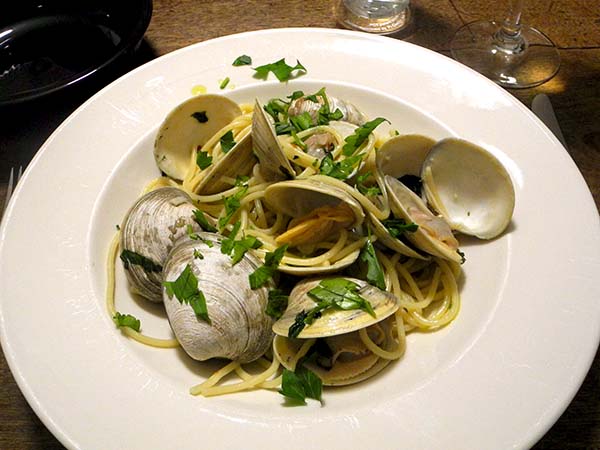
spaghetti alle vongole in bianco (spaghetti, clams), again

spaghetti_clams2

It’s almost impossible for me to go too long without craving a repeat of some version of this dish; last night it was again time for spaghetti and clams. Barry calls it comfort food.

  • Italian-grain Afeltra spaghetti from Eataly, cooked al dente, then tossed in a large, enameled cast iron pot in which two garlic cloves from Whole Foods, minced, and one dried Itria-Sirissi chili (peperoncino di Sardegna intero) from Buon Italia were heated in some olive oil before they were joined by [lots of] clams from Blue Moon Fish, along with their cooking juices, which had just been steamed with a little water in a separate pot until they had opened), the entire mix sprinkled with a bunch of parsley from Eataly and lovage from Windfall Farms, both chopped, then served in shallow bowls with an Eric Kayser ‘baguette monge’ on the table
  • the wine was an Italian (Campania) white, Taburno Falanghina del Sannio 2014
  • the music was Sir Edward Elgar, Symphony No 2, Barenboim conducting the Staatskapelle Berlin

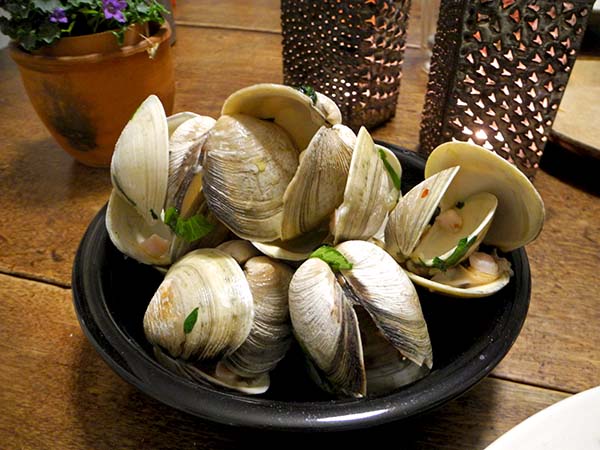
clam_shells_black_bowl

the black bowl barely visible in the first image, cradling the clam shells

celeriac soup; elk, cress, horseradish potatoes, celtuce

celeriac_soup_spiced_maple_vinegar

celery root soup with spiced maple vinegar
elk

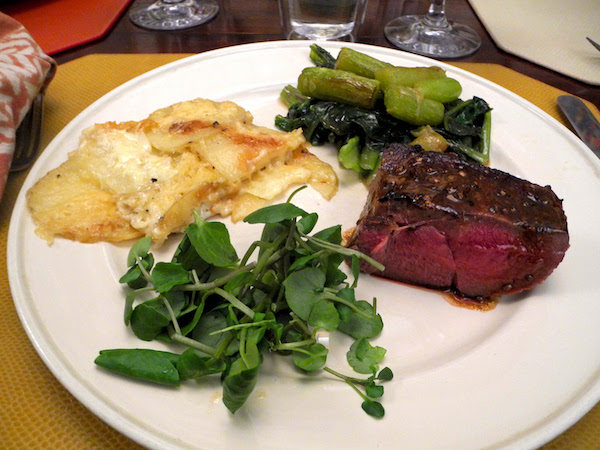
elk steak, cress, horseradish potatoes, braised celtuce, stems and leaves


I don’t often get a chance to enjoy a meal like this, either at home or out. This is America, where ordinary folk can only enjoy genuine game if they import it from another country, and that means paying a serious premium (it’s a long story, and not one which makes our food regulations look good).

The elk sirloin steak I prepared Tuesday evening was a gift of a friend who has a cousin who hunts, in Kansas. Actually we were given two packages of elk, the other was a flank steak. Each package weighed around 20 ounces. We decided we would share each of them with two different people whom we know are interested in the kind of meals we like to put together (sometimes with good success).

I panicked a little bit the day before our guests arrived last night, when I started to think that 20 ounces meant there would be only 5 ounces of meat per person; that amount seemed just a bit mean, but eventually I persuaded myself that what I had available was pretty much what most knowledgable sources I came across suggested was a proper portion size for a meat this rich.

Besides, I had seen to it that some equally uncommon vegetables would be sharing the billing.


We began by nibbling on some long whole wheat rustic breadsticks from Buon Italia, while sipping sparkling wine.


I found the recipe for the celery root soup, one of our favorite starters, and usually reserved for a late fall or winter holiday meal, years ago in a ‘Pairing’ piece in the New York Times. It’s much easier to make than it sounds, and, except for the final assembly, can be prepared ahead of time.


Putting together the potato and horseradish dish could hardly be simpler (I kept thinking, shouldn’t I be adding something to these very few ingredients?), and it too was assembled and cooked before the guests arrived. I simply thinly sliced 3 large Yukon Gold potatoes from Whole Foods, and arranged them in layers shared with almost a cup of shredded horseradish, also from Whole Foods, and two cups of heavy cream. The casserole went into a 400º oven, uncovered, for about 15 minutes, then covered with aluminum foil and baked for another 30. I placed it in the refrigerator for a while, later removed it, let it come close to room temperature and then warmed it for 12 minutes or so in advance of serving.

The celtuce, which I had gotten from Lani’s Farm in the Greenmarket, was also largely prepared ahead of time, and only needed to be sautéed, the stalks and the leaves in succession, then drizzled with some of their juices. This link will give you much of what you need to know about this vegetable, as well as the basic recipe I used yesterday. My adjustments included parboiling the stalks in a much smaller volume of stock, and using far less butter than Foragerchef seems to indicate.

The excellent local cress, from Stokes Farm, needed absolutely nothing after it was rinsed and drained.

The elk, especially because I didn’t want to overwhelm the elk with a major marinade or a sauce, could hardly have been easier to prepare. I took my cue from an almost-30-year-old Daily News clipping which described how Brendan Walsh (we loved Arizona 206) treats a venison steak. After rubbing softened butter into the steak and pressing some strong freshly-cracked pepper into, I let it sit for about an hour, I simply sautéed it for a few minutes on each side, waiting to turn it until juices began accumulating on the surface, removed it to a wooden carving board and cut it into four sections, poured a bit of cognac into the pan, stirred it over hight heat for 1 or 2 minutes, while scraping the drippings, seasoned it with sea salt, and then, off heat, I added a little butter, pouring it over the meat which was now resting on warm plates.  After the photo was taken I remembered that I wanted to scatter some chopped parsley, from Eataly, over the elk.


I was prepared to serve a cheese course assembled from a selection of Consider Bardwell Farm goat and cow cheeses, but we agreed to pass on it, perhaps because of the hour and a certain satiety after second helpings of the potato-horseradish-cream casserole.  As a consolation, I brought out a package of some special Italian dried figs, Colavolpe Fioroni Classici, from Eataly, which I had expected to serve with the cheese.

  • the beverage enjoyed with the figs was a very good Venezuelan rum, one I would describe as the sipping rum I had always believed existed somewhere; it was from Cacique, and it was a gift of an artist friend of ours from Caracas
crab cakes on a spicy tomato salsa; bicolored ‘kalettes’

crabcakes_tomato_Kale_Brussels_sprouts

The crabcakes and their tomato ‘bed’ were both pretty familiar, but the greens stripped from a hybrid stalk of Brussels sprouts and kale was new. The verdict – for both the farmer and the cook – is still out on these particular greens.

  • two crab cakes from PE & DD Seafood (the ingredients are crab, egg, flour, red & green peppers, garlic, salt, pepper, breadcrumbs, mayonnaise, milk, celery, and parsley), heated in a heavy iron pan, 3 to 4 minutes to each side, drizzled with juices retained,and frozen, from an earlier meal of broiled perch, and sprinkled with chopped oregano from Stokes Farm, served on a bed of a salsa of chopped Backyard Farms Maine ‘cocktail tomatoes’ from Whole Foods, which had been combined with salt, pepper, one chopped sierra pepper from Whole Foods, and more of the chopped fresh oregano leaves from Stokes Farm
  • a couple of handfuls of bicolored ‘kalettes‘ from Stokes Farm, stripped from their Brussels sprouts-like stalk, wilted with olive oil in which one slightly-crushed garlic clove from Whole Foods had been allowed to heat until pungent, seasoned with salt, pepper, and a drizzle of fresh olive oil
  • the wine was a California (Clarksburg) white, David Akiyoshi Chardonnay Clarksburg 2014from Naked Wines
  • the music was orchestral music by Johann Friedrich Fasch, performed by the Cappella Coloniensis