Author: james

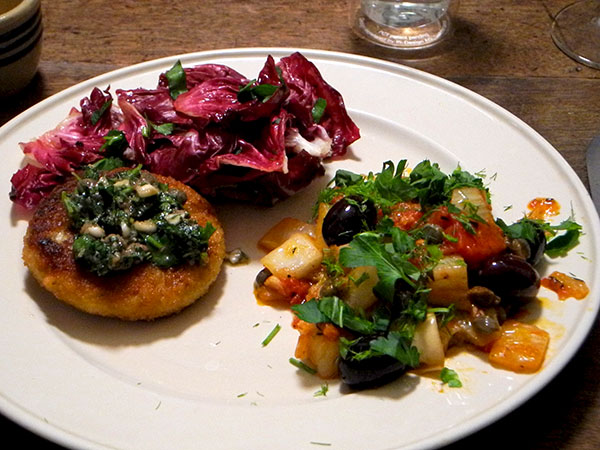
crab cakes; radicchio; fennel/tomato/olive compote

crab_cake_radicchio_fennel

Note to self:  This was surprisingly good, especially for a meal that was heavily improvised.

Except for the fresh mint, which I picked up when I stopped by the Eataly Wine Shop to pick up a bottle of Varnelli this afternoon, this dinner was assembled entirely from ingredients I already had in the kitchen.  The idea was to not go out for anything, but to use what I already had on hand (I defrosted the crab cakes the night before), largely items I preferred not to hang onto any longer.  There was another self-imposed stipulation:  Because of our decision to watch the last two hours of ‘Die Meistersinger’ beforehand, the meal be put on the table as quickly as reasonably possible.  I managed to be successful in incorporating my existing stock, and  but I think I went a little overtime in preparing it.

  • crab cakes from PE & DD Seafood (ingredients: crab, egg, flour, red & green peppers, garlic, salt, pepper, breadcrumbs, mayonnaise, milk, celery, parsley), heated in a heavy iron pan, four minutes to each side, then topped with a little salsa verde, assembled with parsley and mint from Eataly, rinsed and filleted salted anchovies, rinsed salted capers, chopped garlic from Samascott Orchards, dijon mustard, olive oil, and good red wine vinegar
  • a small amount of radicchio from from S.&S.O. Produce Farms and chopped parsley from Eataly, dressed with good olive oil and the same red wine vinegar, salt, and pepper
  • a compote composed of a fennel bulb I had brought home from Eataly a little while back but which had nevertheless totally maintained its freshness, with good canned plum tomatoes from Eataly, Kalamata olives, unpitted, from Buon Italia, thyme from Manhattan Fruit Exchange, Rocambole garlic from Keith’s Farm, more capers, and parsley from Eataly, the dish finished with chopped fennel fronds and more chopped parsley
  • the wine was a Portuguese white, Quinta do Alqueve Fernão Peres 2010
  • the music was Mahler’s Fourth, with Haitink conducting the Berlin Philharmonic
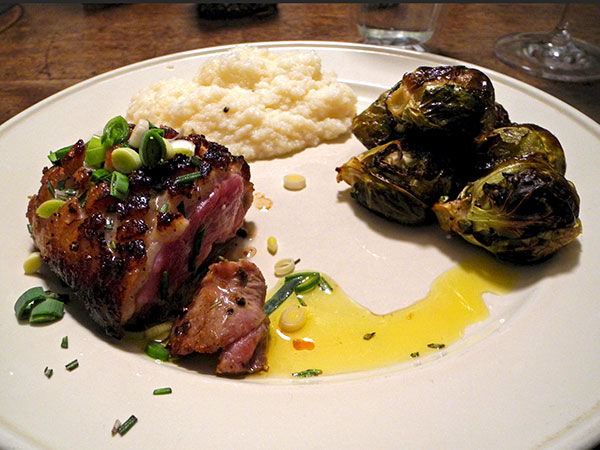
pear/speck lasagna; duck; polenta; Brussels sprouts

duck_breast_polenta_Brussels_sprouts

Note to self:  This was really, really good.

Once again the weather had shut out the Union Square Greenmarket fish sellers today. I had no other plan for dinner; not having defrosted anything the night before. I was very much conscious of the continuing cold weather, so I decided that we might be excused if we enjoyed a meat entrée two days in a row.  I was going to be near Eataly today anyway, so I popped in and picked up a small-ish Pat La Frieda duck breast, one of our favorite game-like meats.

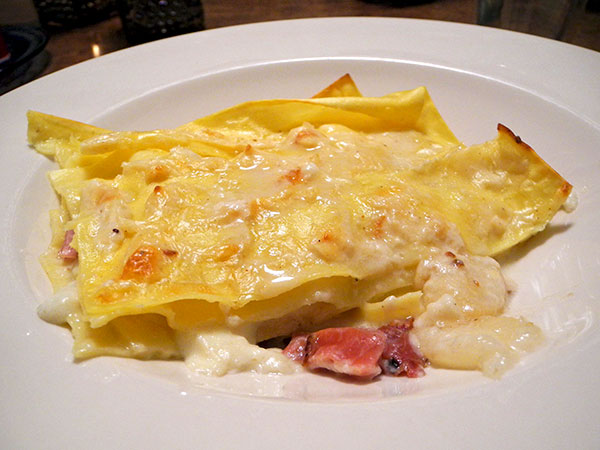
We had a bit of the speck and pear lasagna left over from Valentine’s Day;  it made a delicious primi to introduce the rich duck.  I also had some white polenta remaining from a meal of Venetian lambs liver last Wednesday.  A dozen or so what I was told were finally the very last Brussels sprouts of the season became the contorno.

  • one three-quarter pound Pat La Frieda duck breast from Eataly, brushed with salt, pepper, and a bit of sugar, allowed to rest for half an hour before pan-fried, allowed to sit again for a few minutes, cut into two pieces, and finished with a squeeze of lemon, some chopped rosemary from John D, Maderna Farm, one sliced baby leek from Rogowski Farm, a squeeze of lemon and a dribble of olive oil (in the picture above, the small piece at the edge of the breast itself is half of the tenderloin)
  • Brussels sprouts form John D. Maderna Farm, tossed with salt, pepper, and some olive oil, and roasted in a 400º oven for about half an hour
  • polenta left from an earlier meal, heated and refreshed with the addition of a bit of water, and the addition of a couple knobs of butter
  • the wine was a California red, Akiyoshi Merlot, Clarksburg 2013,  from Naked Wines
  • the music was Bruckner, Symphony No. 4, performed by Eugen Jochum and the Dresden Staatskapelle


pear_lasagna_leftover

  •  the primi was a serving of a leftover lasagna of speck, pear, Bechamel sauce,mozzarella di bufala, and cayenne pepper, reheated for about twelve minutes at 350º

lamb chops, baby leek; cress; tomato; parsley root

lamb_tomato_parsley_root

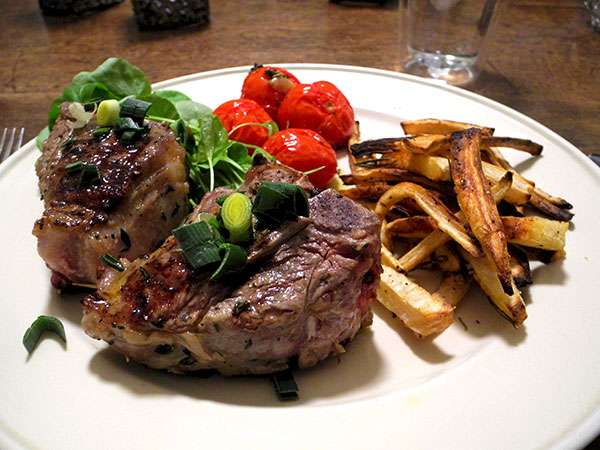
This was a pretty conventional, or at least straightforward, meal, with the possible exception of the appearance of a baby leek, and the treatment of parsley root as pommes frites.  I chose the cress and the tomato almost as much for the color and freshness which they could add to a mid-winter meal as for their taste and their qualities as compliments to the meat and ‘potato’.

  • two lamb chops form 3-Corner Field Farm, marinated for about half an hour in olive oil, smashed garlic from Lucky Dog Organic, roughly-chopped thyme from Manhattan Fruit Exchange, then cooked on a very hot grill pan, finished with a squeeze of lemon, sliced baby leek from Rogowski Farm, and a drizzle of olive oil
  • Maine Backyard Farms cocktail tomatoes from Eataly, slow roasted with olive oil, dried Italian oregano, garlic, salt, and pepper
  • Upland Cress from Two Guys from Woodbridge, squeezed with a bit of lemon and drizzled with a little olive oil
  • medium size parsley roots from S.&S.O. Produce Farms, scraped, cut as for French fries, tossed with olive oil, salt, pepper, and rosemary leaves from John D. Maderna Farm, roasted in a ceramic pan for about 35 minutes at 400º
  • the wine was a very good Spanish red, Nocedal Rioja Reserva, Bodgas Fuenmajor 2001
  • the music was Dvořák’s Symphony No. 3

lasagna with speck, anjou pears, cayenne pepper

lasagna_with_speck_pears

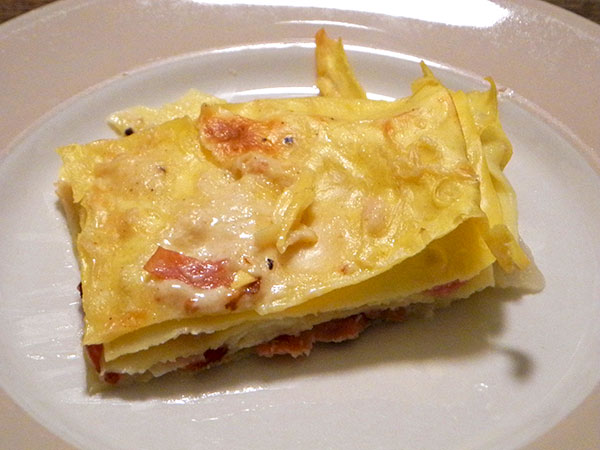
Valentine’s day.  I was thinking that the occasion naturally suggested a pink sparkling wine, so I immediately moved on to the most obvious pairing, a luscious lasagne which features speck and pears.  Actually, it was the other way around.  I first came across this wonderful recipe years ago, on the Italian Food sight hosted at the time by Kyle Phillips.  Tragically, our guide died several years ago, and I’m certain that we are not the only ones who feel the loss, almost daily.  Many of my favorite recipes and boldest forays into Italian  cuisine I owe to Kyle.

The somewhat lasagna recipe which incorporates speck and pears has become an annual tradition, the centerpiece for every Valentine’s day, mostly because Kyle had suggested it long ago.  The pink sparkling wine is usually also a part of the tradition.  The Nigerian cayenne only arrived in the mix this year.

I can highly recommend the dish, on a number of counts.  Yes, it’s absolutely delicious, and it’s feel light (perhaps deceptively so), but the clincher for a special evening, may be the fact that all the preparation materials can be washed and put away before the baking dish is placed in the oven, giving two (or more) randy valentines, including the cook, at least a full half hour to play together before it has to be put on the table.

  • the recipe can be found here, so I don’t have to repeat it, but my own ingredients included fresh Rana pasta sheets, Südtiroler Speck from Eataly, two red Anjou pears from Eataly, eight ounces of Luigi Guffanti mozzarella di bufala from Eataly, and far more Nigerian cayenne (purchased from Balducci’s five years ago!) than I could ever have imagined using in one dish (its enduring flavor and gentle, measured kick were both wonderful, perfect accompaniments to the rest of the ingredients)
  • the wine was a Spanish sparkling rosé, Raventós i Blanc Conca del Riu Anoia Barcelona de Nit 2012 from Chelsea Wine Vault
  • the Valentine’s Day music was ‘Tristan und Isolde’ (Furtwängler/Flagstad/Ludwig/Suthaus/F-Dieskau 1952)
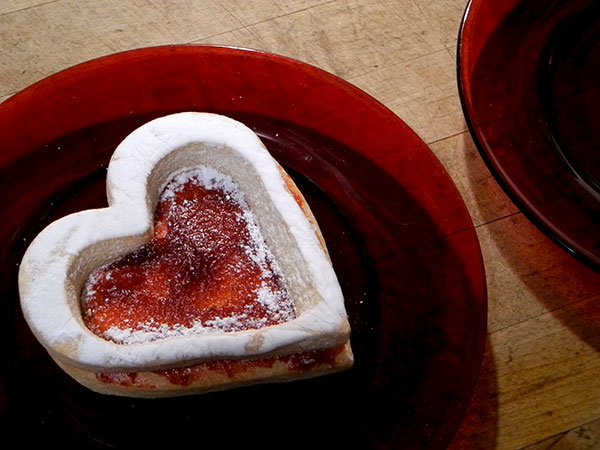
  • the dessert (noting right now that any Dolce is rare for us) was one Linzer cookie, from Baker’s Bounty in the Union Square Greenmarket, split straight down the middle

Valentine_linzer_cookie

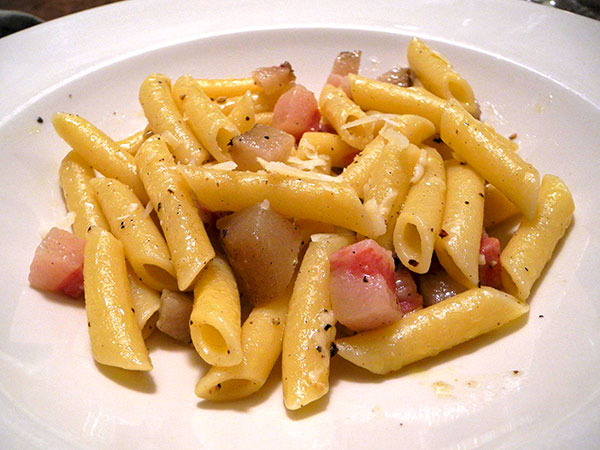
La Gricia, ”la cucina de na vorta’

La-Gricia

We never tire of this recipe .  It’s ‘La Gricia’, generally described as a traditional dish of the shepherds in the hills of Lazio, the province of which Rome is the center.   The name comes from the name of a valley which is no longer inhabited, perhaps by either sheep or shepherds.  I first came across this regional classic when the amazing inimitable Fred Plotkin once described it in the New York Times many years ago (in fact almost 26 years to the day before I prepared it last night).  In 1989, fascinated by its simplicity and apparent authenticity, I immediately cut the recipe out of the page and put it into my file, but I don’t think that I actually used it until years later, after we found ourselves dining at the Trastevere restaurant featured in Fred’s article.

That means that we first enjoyed it in 1996, in the form of Spaghetti alla Gricia, although we did not know its association with the clipping back at home, while sitting at a table in the little street outside Piccola Trattoria da Lucia.  We went back to the address in the Vicolo del Mattonato two days later, and at least once again the next time we were in Rome a year after that.  The founder, Lucia Antonangeli, had served ”la cucina de na vorta” [the cooking of once upon a time] at her eponymous trattoria from 1939 until she died in 1967.  Her grandson, Renato Bizzarri, who had himself succeeded his mother Silvana Cestier in running the restaurant, recognized us as soon as we sat down.  Now that’s a civilization!

Some time after we had returned to New York I found the old clipping in my ‘pasta’ file, amazed at the coincidence of our two encounters with La Gricia.  The recipe had come home to stay.

Since then the dish has become a standard – and a great favorite – in our own kitchen; I make sure that I always have the ingredients on hand, including, most essentially, a chunk of guanciale in the freezer.  If you don’t have access to guanciale, pancetta is almost as good, but it must be in chunk form.  I also prefer to use penne rigate, although a reasonably thick long pasta is probably just as correct, and perhaps as good, as the short, ridged form.

  • the Afeltra Pasta di Gragnano penne liscia from Eatlay was boiled until barely al dente, some of the liquid reserved and the pasta drained and mixed into a large pot in which 8 ounces of guanciale from Buon Italia, cut in 1/2 to 1 inch square pieces, had been heated with 4 tablespoons of olive oil for about a minute, a bit of pasta water then added to the pot, everything stirred for a minute to emulsify the sauce; several tablespoons of freshly-ground black pepper added and stirred into the mix, which was then removed from the heat and about 3 or 4 tablespoons of roughly-shredded pecorino, also from Buon Italia, tossed in, the pot left standing for 30 seconds or so, the dish then served in shallow bowls, with more cheese and black pepper on the side
  • the wine was an Italian white, Le Salse Verdicchio di Matelica 2013

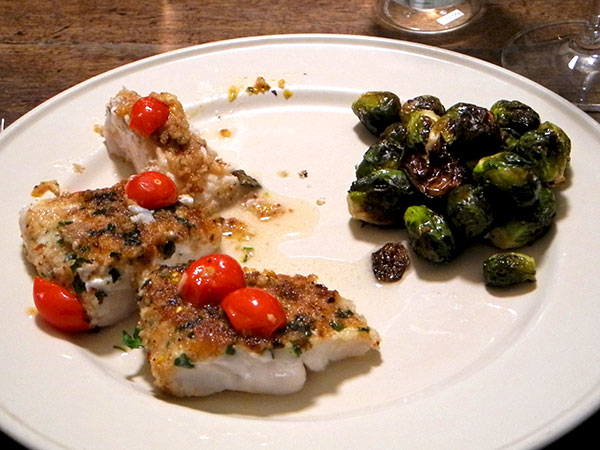
parslied cod with tomato; roasted Brussels sprouts

cod_en_Persillade_Brussels_sprouts

The recipe is basically a (very basic) Thomas Keller formula.  I added some halved cherry tomatoes, both to introduce a bit of color, and to save the fruit from advancing beyond its prime sweetness.

  • cod fillets from American Seafood (two, which I cut into two and one half pieces for each portion), brought to room temperature and seasoned with salt, the top of each piece brushed with dijon mustard mixed with a little water, dipped in a mixture of homemade breadcrumbs and finely-chopped parsley from Eataly, browned briefly, crumb side down, in a heavy iron pan with olive oil, then transferred to a 325º oven and cooked until the fish begins to flake; near the end of the cooking time I added halved cherry tomatoes from Shushan Hydro Farm, arranging them on the fish sections after they were plated
  • small Brussels sprouts from from John D. Maderna Farms (yes, in January!), tossed with salt, pepper, and some olive oil, roasted in a 400º oven for twenty minutes or so
  • the wine was a French white, Vin Passion Château du Champ des Treilles Sainte-Foy Bordeaux 2012

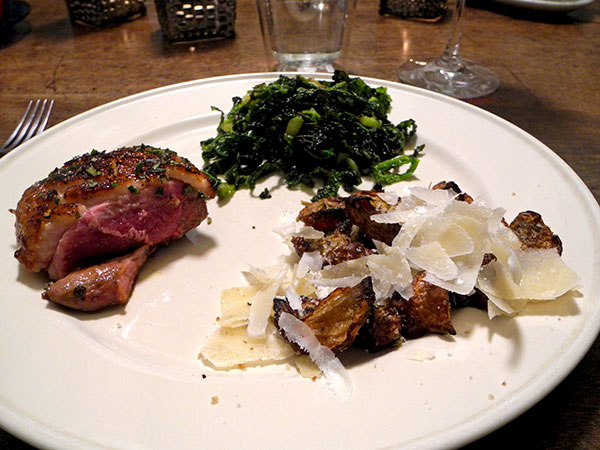
duck; golden beets with fennel, parmesan; cabbage

duck_breast_golden_beets_cabbage

Still trying to address my stash of root vegetables,  I feel that I made some progress with this meal, whose whole was even greater than the sum of its parts, even as the parts were pretty terrific.  I would be happy to take credit any day of the year for a dinner that tasted this good, but certainly much of its success was purely chance.  The three major elements and the treatment of each, except perhaps for the duck breast, to which I was committed as soon as I decided to defrost it last night, were pretty much cobbled together at the last minute.

  • a small (11 ounces for the two of us) duck breast from Pat laFrieda, purchased at Eataly, its fatty side scored with hash marks and brushed with a mix of salt, pepper, and a bit of sugar, and allowed to rest for about half an hour before being pan-fried, finished (four minutes or so on each side) with a squeeze of lemon, some chopped rosemary from Queens County Farm, and a drizzle of olive oil
  • small golden beets from Eataly, trimmed and scrubbed, the stem end then peeled, the roots cut into thirds (yeah, ‘thirds’, just to make it difficult, but mostly because of their middling size), tossed with olive oil and fennel, then spread, rounded side down, onto an oven pan on a surface of kosher salt, and roasted at 450º for about 45 minutes, sprinkled with freshly-ground black pepper, served with shavings of a good Parmesan cheese
  • Savoy cabbage  from Hoeffner Farms, outer leaves only (in order to preserve the remainder of the cabbage for another day), sliced very thinly, seasoned with salt and pepper and sautéed in butter over medium high heat for about 25 minutes, stirring occasionally, or until tender and the leaves had begun to brown and crisp slightly at the edges
  • the wine was a Spanish red, Vivanco Crianza Rioja 2010
  • the happy, generous music was Mozart and Da Ponte’s ‘Le Nozze di Figaro’, with René Jacobs conducting Concerto Köln and Collegium Vocale Köln

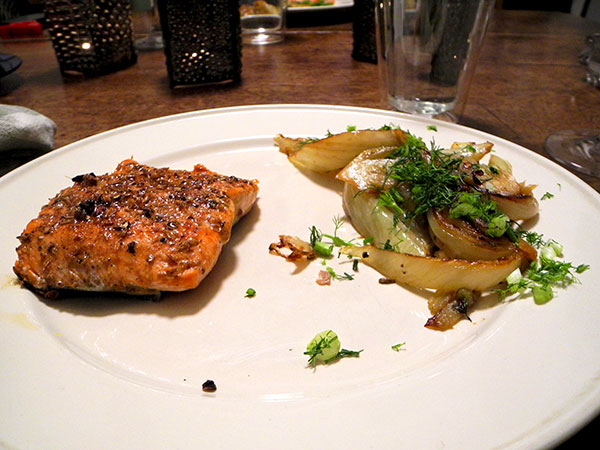
spicy-crusted salmon; slow-roasted fennel

spicy_salmon_slow-roasted_fennel

Although they start out in in the northeastern part of the great “Southern Sea”, and not the Atlantic, Salmon fillets, (usually previously-frozen, from Whole Foods) are a reliable alternative when I’m unable to bring home fresh local seafood from the Greenmarket.  I missed my fish monger both on Saturday and today, presumably because the weather over the last few days meant fishing was pretty much out of the question, at least if you weren’t operating from large trawlers.

In picking salmon, I had also decided that it would offer one of the best excuses for serving some of the sturdy root vegetables I’ve been accumulating lately.  Unfortunately there’s a limit to how many I can incorporate in one dish, and tonight I was more interested in using whatever vegetable I had in the crisper that was most likely to spoil soonest.  The pairing of salmon, with a spicy coating, and fennel (which is not even a root), roasted slowly with nothing more than garlic, turned out to be inspired even if it had been determined largely by necessity.

  • a five-ounce fillet of wild Sockeye salmon from Whole Foods, seasoned with salt and pepper, rubbed with a mixture of ground coriander seeds, ground cloves, ground cumin, and grated nutmeg, fried over medium-high heat for a few minutes on each side in an enameled, cast iron pan
  • a generous-sized bulb of fennel from Manhattan Fruit Exchange, split into twelve wedges, sautéed in a large iron pan over medium high heat with chiles and fennel seeds until the fennel began to color, then, with garlic added, the heat lowered and the pan covered, cooked for about ten minutes more, stirring occasionally, a generous amount of chopped fennel fronds added at the end [recipe from “Italian Easy: Recipes from the London River Cafe”]
  • the wine was a California red, Meiomi Pinot Noir 2012 Santa Barbara/Sonoma/Monterey

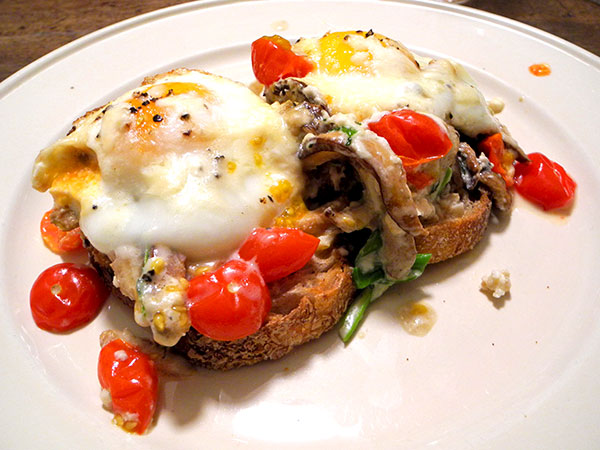
baked eggs, mushrooms, Gruyère, scallions, tomato

baked_eggs_mushrooms_scallions_gruyere

I had put this dish together before, early on New Years’ Day, as a lunch.  I revisited it as a dinner, with a few enhancements, tonight.

  •  shiitake mushrooms from Bulich Mushroom, sautéed for a few minutes over medium high heat before the addition of garlic from Migliorelli Farm, minced, thyme from Manhattan Fruit Exchange, chopped, and one scallion, also from Manhattan Fruit Exchange, julienned, the mix lifted into a buttered baking dish, followed by six eggs from Knoll Krest Farm cracked over the top, seasoned with salt and pepper and dotted with halved cherry tomatoes from Shushan Hydro Farm, sprinkled with shredded cheese (Swiss Le Gruyère) from Trader Joe’s, the surface drizzled with a bit of heavy cream, the dish then baked in the oven for about 15 minutes, or until the whites were set and the yolks were still barely runny
  • the cooked eggs were served on toasted slices of Trucio bread from Sullivan Street Bakery
  • the wine was a Spanish red, Flavium Premium Bierzo 2008

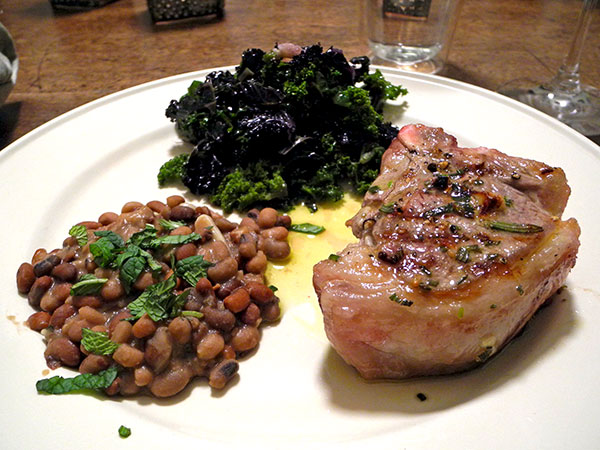
lamb chop with garlic, rosemary; Fagiolini; kale

lamb_chop_Fagiolini_kales

The meal was pretty Italian, except that here the Bietole is kale, not chard, and the lamb chop was definitely more than 1/4 inch thick.  Also not Italian was the fact that I bought prepared Fagiolini, which I had never done before, but I was curious, and fresh beans certainly can’t be found in January. They were delicious, but of course I couldn’t just serve them as they came out of the jar.

  • one thick juicy lamb chop from 3-Corner Field farm, seasoned with salt and pepper and brushed with a mixture of olive oil, minced garlic from Migliorelli Farm, and chopped rosemary from Queens County Farm, pan-grilled and finished with lemon and olive oil
  • cooked tiny Italian beans (‘Fagiolina del Trasimeno’) from Eataly, warmed with olive oil in which thinly-sliced garlic from Migliorelli Farm had been heated until it began to brown, served with chopped minced mint from Manhattan Fruit Exchange in the Chelsea Market
  • a mix of green and purple kale, along with a few leaves of Tuscan kale, from from Tamarack Hollow Farm, wilted with olive oil in which thinly-sliced garlic from Migliorelli Farm had been heated
  • the wine was an American red, Waterbridge Syrah 2012 Columbia Valley