Author: james

grey sole with tomato butter; beet greens with garlic

grey_sole_beet_greens


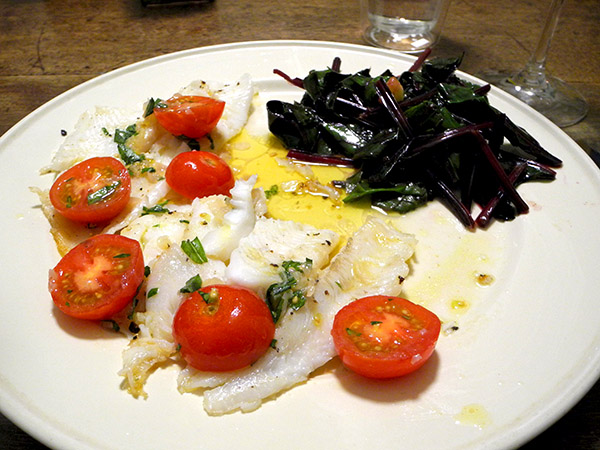
The grey sole is a magnificent fish to set on a table, not least for its perfect texture.  The flavor is mild, and when very fresh, ethereally mild. It responds best to the most delicate of treatments.  This recipe, which adds a ‘tomato butter’ to the plate after it has been sautéed, stole none of that delicacy, and, in addition to its gentle tastiness, introduced two additional textures to the dish, that of the virtually-raw, very ripe tomatoes, and the liquidness of the subtly-aromatic sauce.  I had worked with the recipe in the past, but always with substitutions; this was the first time I happened to have the designated tarragon on hand, and it was definitely the best version.

As far as the contorno was concerned, the beet greens were virtually the only vegetable I had in the kitchen that day, and I didn’t want to keep them longer.  I really love beet greens, but I’ve decided their astringency does not make them the best compliment to a delicate fish.

  • seven small Long Island grey sole fillets (a total of 13 ounces) from Pura Vida Fisheries, cooked in a pan over medium high heat for a very few minutes, turning once, then placed on plates, a couple of spoons of ‘tomato butter’ [see the next bullet point] placed on top
  • tomato butter, made by cooking in butter a tiny amount of shallot from John D. Madura Farm, letting the flavored butter cool slightly before being poured over halved fresh large Maine cherry ‘Cocktail Tomatoes’ from Whole Foods which had earlier been combined with chopped tarragon from Stokes Farm, the butter then seasoned with salt and drops of red wine vinegar
  • the wine was a French white, Château Perron Graves 2014
  • the music was that of Gaspard Fritz
pork chops with lemon, lovage; tomato; flat beans

pork_chop_tom_Romano

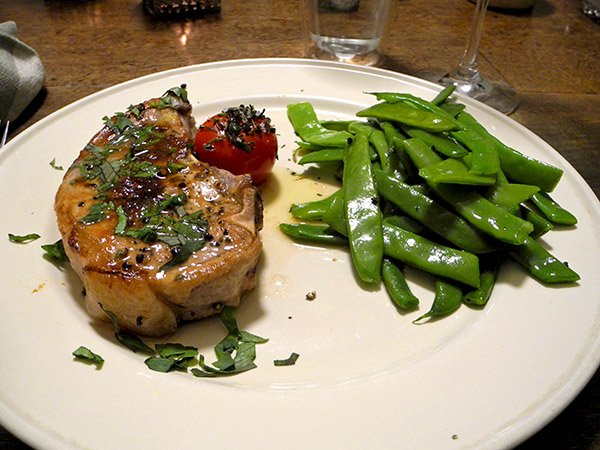
This approach to an excellent pork chop has almost become formulaic in my kitchen;  it’s the changing details and accompaniments that keep it fresh, as well as the variety of good wines pair well with it.

  • two bone-in loin pork chops from Flying Pig Farms, thoroughly dried, seasoned with salt and pepper, seared in a heavy enameled cast-iron pan, half of a small, almost-sweet organic lemon squeezed over them, then left in the pan, roasted in a 400º oven for about 14 minutes (flipped halfway through and the lemon squeezed over them once again), removed from the oven, sprinkled with chopped lovage from Mountain Sweet Berry Farm, and the pan juices spooned over the top
  • two large-ish Maine cherry, ‘cocktail’ tomatoes from Whole Foods, added to the pan with the chops near the end of their time in the oven, removed, and sprinkled with savory from Berried Treasures
  • flat green or Romano beans from Norwich Meadows Farm, par-boiled, drained, dried (shaking over a flame the pan in which they had cooked), reheated in a bit of olive oil, seasoned with salt and pepper
  • the wine was a New Zealand white, Whitehaven Marlborough Sauvignon Blanc 2014
  • the music was that of George Tsontakis [it was the night before the Greek referendum, and although the composer was born in Queens, we enjoyed the appositeness of a choice which had been entirely unconscious]

uova fritte con scalogni; puntarelle con acciughe

eggs_and_puntarelle

It may not have been a typical American Fourth of July breakfast, but what passes for ‘typical’ in America these days?

It was a holiday, and I had some excellent fresh eggs on hand, a small amount of puntarelle left over from an earlier meal (also a bit of the anchovy dressing I had used), half of a small shallot (also remaining from an earlier meal), and part of a loaf of excellent sourdough bread, now two-days old.  I didn’t want to spend too much time putting together the first meal on a day we had decided to revisit the Whitney Museum;  we were also getting pretty hungry, and this improvisation looked like it wouldn’t take much time.

It was very good, and it hadn’t really taken much time at all.

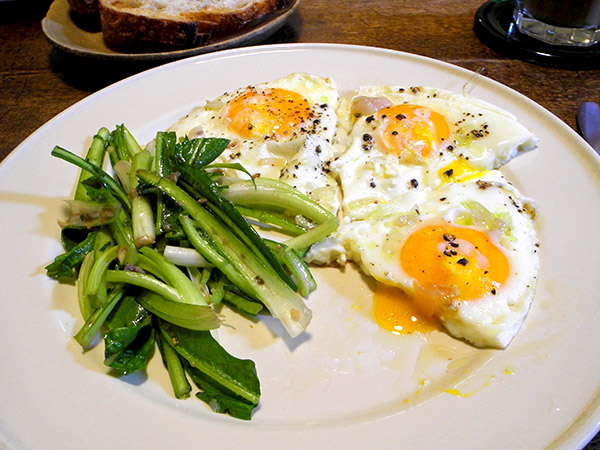
I think what I did may have been my own invention; if I can trust my invented Italian, it would be described as uova fritte con scalogni; puntarelle con acciughe [fried eggs topped with shallots cooked in butter until just tender, served with an Italian chicory dressed with anchovy, garlic, and vinegar].

  • the eggs, fried sunny side up, were from Tamarack Hollow Farm, and the shallot, cooked until softened, was from John D. Madura Farm
  • the puntarelle was from Paffenroth Gardens, prepared in the Roman manner
  • the toast was from a loaf of a sourdough bâtard from She Wolf Bakery, at the Greenmarket
  • the music was Joan Tower’s ‘Made in America’, a fantasy on the theme of  ‘America the Beautiful’

grilled: swordfish, lots of herbs; eggplant, basil

swordfish_eggplant


Note to self and to readers:  There’s usually no accounting for why some outings with a familiar recipe are more successful than the others, but we both thought that each of the elements in this entrée exceeded all earlier versions, and the reason I’d already repeated their formulas so often is that they were already so delicious (and subject to variations suggested by the availability of ingredients).


Maybe it’s because I’m very much a child of the 50s (Xiphias gladius were big way back then, very big), but I’ve always loved swordfish.  I’d like to think I’ve grown up a bit since first experiencing the magnificent critter, and I was never much taken with its likeness repeated in porcelain or metal gimcracks often perched above bulky television consoles, but swordfish have always carried some serious weight within my epicurean pantheon, even before I left the Midwest. I think it was the only item on the menu in those days that could persuade an auto baron to order anything other than steak or prime rib in a serious restaurant, like Detroit’s Joe Muer’s, or The London Chop House.

The mercury scare which appeared at some time after I left the Great Lakes environment for deeper waters bummed me out, because now, when I could develop a more intimate relationship with this noble fish, it virtually disappeared from both menus and fish markets (probably a welcome development for the swordfish themselves).

And then the scare abated, but I still couldn’t find much to appreciate about it in my restaurant experiences.  As in the case of tuna, I just assumed its unsavoriness was the fault of the fish.  It was only in the last decade or so that I learned how not to cook it, meaning, to be sure, not to cook it in the way it was cooked in the 1950s, and, in many places, long after.

This meal employed one of the two recipes I have followed for years; the other one is actually even simpler, and also comfortable with variations.

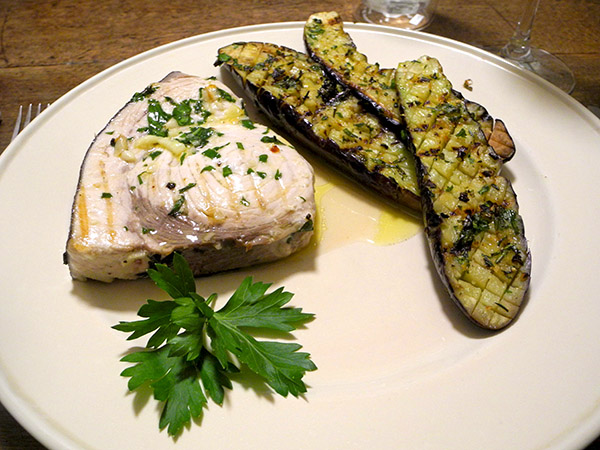
  • one 15-ounce swordfish steak from Blue Moon Fish Company, halved, rubbed with a mixture of herbs (savory, lovage, chives, parsley, rosemary, and thyme), which had been chopped together with sea salt, then mixed with some freshly-ground pepper, minced garlic and the zest from an only-slightly-tart lemon from Trader Joe’s, moistened with a bit of olive oil, then pan-grilled and finished with a squeeze of lemon and a drizzle of more olive oil
  • three small-ish Japanese eggplant from Bodhitree Farm, split lengthwise, scored, brushed with a mixture of oil, finely-chopped organic garlic from Trader Joe’s, and finely-chopped basil from Keith’s Farm, seasoned with salt and pepper, and then pan-grilled, turning once
  • the wine was a Spanish white, Finca Os Cobatos Godello Monterrei 2013
  • the music was Francesco Cavalli, ‘La Didone’, performed by Europa Gallant, Fabio Biondi conducting


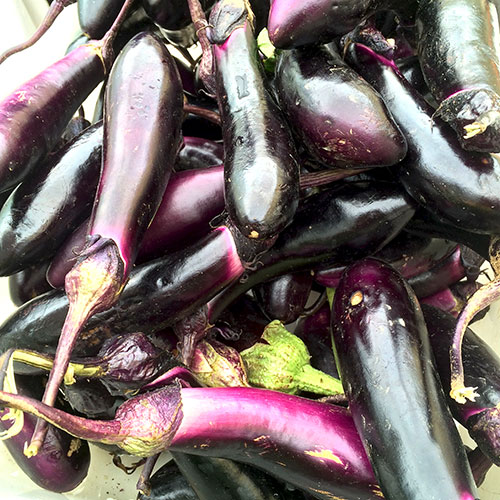
This is what Bodhitree’s box of eggplant looked like in the Greenmarket on Wednesday:

Japanese_eggplant

grilled tuna, fennel seed; squash and squash stems

tuna_squash_stems

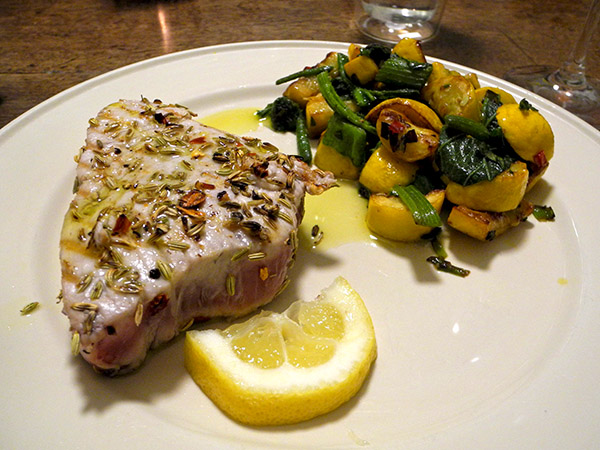
Last night I brought to the table two aspects from two different summer squash, purchased on two different days, from two separate farmers.  Oh yes, there were also pan-grilled tuna steaks.

Note:  The Sierra pepper was pretty mild, by nature, so I eventually added more of the colorful chopped morsels, but unfortunately only after snapping this picture.

  • two 7-ounce sections of tuna loin from Blue Moon Fish Company, rubbed on both top and bottom with a mixture of fennel seed and dried peperoncini, ground together, further seasoned with salt, and pepper, then pan-grilled for only a minute or so on each side, finished with a good squeeze of lemon and a drizzle of olive oil
  • a large handful of organic squash leaves, buds, and stems picked up from Zaid at Norwich Meadows farm on Monday, sautéed in olive oil with slices of one small organic garlic clove from Trader Joe’s, then reserved and later added to a broad pan in which chunks of yellow summer squash collected from Gwen Rogowski at Rogowshi Farm that day had been sautéed with another organic garlic clove from Trader Joe’s, this time just split in two, and then, just as the squash was caramelizing, three thin scallions from John D. Madura Farm, sliced, and one sierra pepper from Whole Foods, chopped, added, the vegetable finished with chopped lovage from Keith’s Farm
  • the wine was a California rosé, David Akiyoshi Sangiovese Rosé Lodi California 2014
  • the music was the two Haydn cello concertos

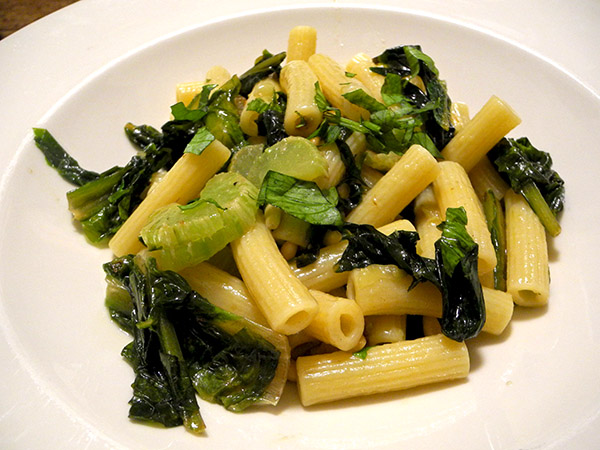
zito corto rigato, with celtuce, garlic, pinoli, lovage

celtuce_zito

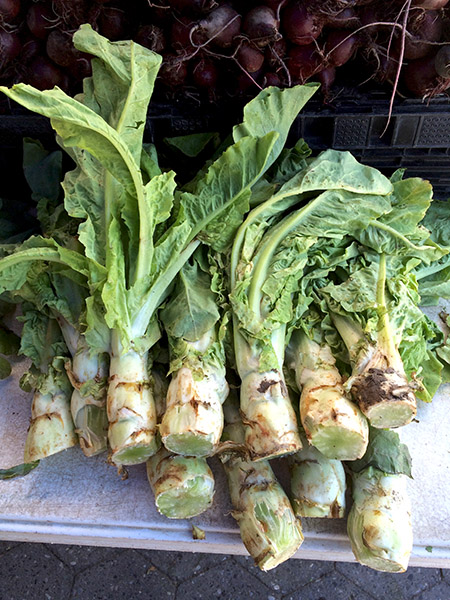
I had never heard of celtuce before visiting Zaid and Haifa’s stand in the Greenmarket on Monday, but I will say it was a revelation, for me a wonderful new vegetable (and new vegetables must be encouraged).  It was terrific.  The flavor might be described as a slightly nutty take on celery and bok choy.  I don’t really need any analogies myself; I do know that from now on I will be looking for every opportunity to enjoy it again.

After talking to Zaid about the stalks he had arrayed on a table, I went home with three of them, which turned out to be the exact number I needed for the treatment I ultimately settled upon, a dressing for a good artisanal short pasta.  After only a bit of research on line, in order to learn something more about what I had brought home, I decided I could risk going forward.  The recipe I used was entirely my own.

It was delicious, possibly the most delicious mix of greenery and pasta I had ever put together, and I think I’m something of a veteran in that kind of campaign.  The colors and the textures were a bonus.

Note: I don’t know of any reason why olive oil couldn’t be used to brown the celtuce ‘coins’, making this dish entirely vegetarian, and I don’t even know why I didn’t use it myself yesterday.

  • the top greens of three stems of celtuce from Norwich Meadows Farm, wilted in a pot along with a little olive oil in which one clove of sliced organic garlic from Trader Joe’s had been sweated, the greens then reserved while the stems themselves were prepared by being shaved from a vegetable peeler, cut into beautiful green ‘coins’ (they’ll look a bit like sliced kiwi fruit) and parboiled for about 7 or 8 minutes, after which they were drained, sautéed in a large enameled pot in a little butter, seasoned with salt and pepper, tossed with a generous handful of pine nuts which had previously been pan-roasted in a cast iron pan on the top of the range, the boiled pasta (Afeltra Ziti Corti Rigati 100% Grano Italiano) introduced into the pot at this point and stirred with the greens – and their delicious liquor – which had been reserved earlier, along with a little chopped lovage from Keith’s Farm, served in shallow bowls with more chopped lovage and a fresh drizzle of olive oil
  • the wine was an Italian white, La Cala Vermentino di Sardegna 2013
  • the music was that of Gerald Busby, our neighbor across the road in the Chelsea Hotel


celtuce_Norwich_Meadows_2

The image above is of the display of celtuce at the Norwich Meadows Farm stand on Monday.

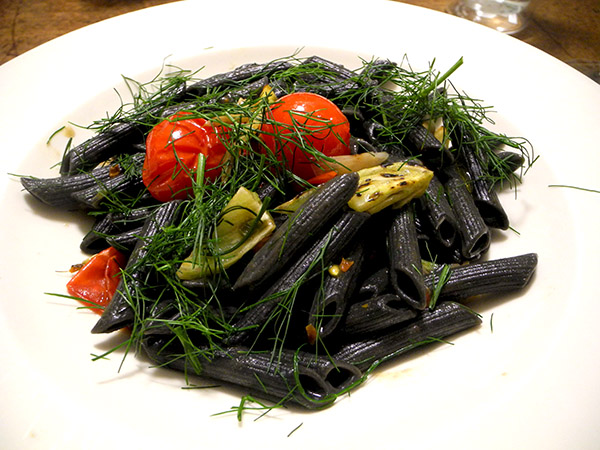
squid ink pasta with fennel, tomato, spring onion

squid_ink_pasta_2

It was not a Greenmarket day, so there was no fish in the house, and I didn’t feel like preparing meat on the first day of summer.  I always have both dry and fresh (frozen) pasta, and I did have a small baby fennel bulb, an enormous amount of fennel fronds, some cherry tomatoes, and some spring red onions, and I was fain to use these seasonal gifts before they turned [there, I did it; I used ‘fain’ in an conventional context; it’s something I always wanted to do, although I knew I’d never have the nerve to use it in speech].

As it turned out, what I didn’t have, was a simple package of penne or any other stubby pasta.  I didn’t want to use long pasta, so I reached for the squid ink penne I’d been saving for something particularly appropriate to its strengths.

it wasn’t a completely successful improvisation, but, because it looked so exotic in the picture, I decided to post it anyway

  • a few Maine cherry ‘cocktail’ tomatoes from Whole Foods, partially cooked down in olive oil, one red spring onion from Tamarak Hollow Farm, split and pan-grilled, one young fennel bulb from Bodhitree Farm, sliced, along with its root, then also pan-grilled, and some dried red pepper flakes, all tossed with boiled Penne Rigate al Nero di sepia from Rustichella d’Abruzzo SpA, and finished with a drizzle of olive oil and some chopped fennel fronds
  • the wine was an Italian white, Villa Antinori Toscana 2012

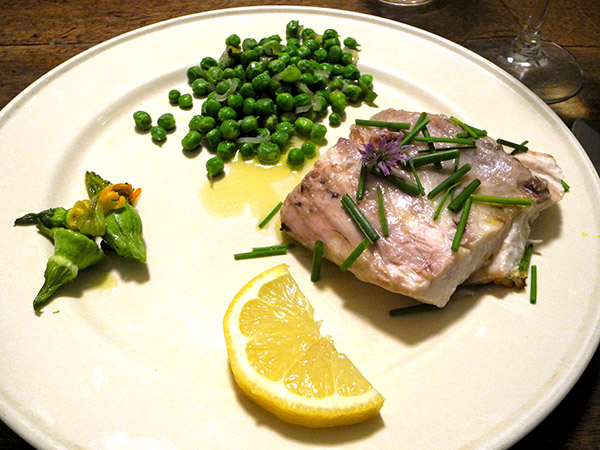
grilled striped bass; peas, spring onion; squash buds

striped_bass_peas_2

Once again last night I had the chance to appreciate why striped bass are so popular, and part of the reason why they command a somewhat premium price in the local markets.  The daily limit is still strictly controlled, on Monday my fishmonger told me it had been slightly relaxed for the size of their operation, so we may be able to enjoy a little more this year (meaning I won’t have to show up at the Greenmarket at dawn to bring home part of their catch (not that I ever have).

As for the recipe I used this time, because I had no interest in turning on the oven on a hot and humid evening, I consulted my files for a formula which could be implemented on top of the stove.  I did not however take advantage of Martha Stewart’s suggestion that the dish I ended up producing with her simple recipe could have been served at room temperature, mostly because I wanted it to relate to the temperature of the tiny fresh peas I had also picked up that day.

  • one 15-ounce striped bass fillet from P.E. & D.D. Seafood, marinated for half an hour (half of that time in the refrigerator) in a mixture of olive oil, lemon juice, thyme branches from Eckerton Hill Farm, squashed organic garlic cloves from Trader Joe’s, then removed from the marinade, and allowed it to drip dry (with the help of a paper towel) placed on an enameled grill pan on top of a medium-high flame, skin side down, seasoned with salt, grilled until skin was lightly browned and starting to crisp, before being turned and cooked through, or about 10 minutes, and garnished with chives from Lani’s Farm cut in 3/4-inch lengths (also one chive flower, prominent in the picture above) and lemon wedges.
  • thinly-sliced red spring onion bulbs from Tamarak Hollow Farm cooked in a little butter until softened, tiny shelled peas from Lani’s Farm added along with a little bit of water and simmered until tender, seasoned with salt and coarsely chopped pepper
  • a small number of flowers and buds of ‘organic green leaf squash’ (per Zaid Kurdieh’s sign at his stall) from Norwich Meadows Farm, sautéed in olive oil until softened, then seasoned with salt and pepper
  • the wine was a French white, Château la Rame, Bordeaux 2014
  • the music was Haydn’s last, and not-quite-completed, 1791 opera, ‘L’anima del filosofo, ossia Orfeo ed Euridice

duck, rosemary, lemon; broccoli greens, garlic

duck_breast_broccoli_greens

We were enjoying a beautiful foggy evening on the Hudson last night until some time after ten, part of the GORUCO (Gotham Ruby Conference) ‘Yacht Party’.  We didn’t arrive back home until 10:30, but I had promised us ahead that we would still have a good dinner at home (it wasn’t a ‘school night’, so the prospect of a late dinner was reasonable).

Duck can be pretty quick work, as can wilting some fresh greens, and that was my plan.  I had anticipated the meal when I bought a small (11-ounce) breast the day before; I was also anxious to taste an unusual find at the Greenmarket broccoli greens!  The amounts of both were modest, so we were able to enjoy a cheese course, and some more of the crusty sourdough bread from the day before.

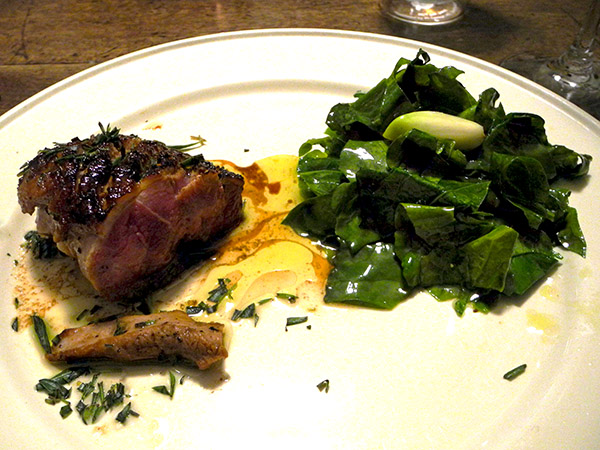
By the way, the little ‘finger’ of duck below the larger piece is one half of the tenderloin; it had been seasoned as well, and was added to the pan only for a minute at the end of the cooking.

  • one small duck breast from Pat LaFrieda at Eataly, the fatty side scored, covered with salt, pepper and a bit of turbinato sugar (which had been infused over time with a vanilla bean), then left standing for about half an hour before it was pan-fried, finished with a squeeze of lemon, chopped rosemary from Phillips Farm, and a bit of olive oil
  • broccoli greens from Tamarack Hollow Farm, wilted in a covered pan in which organic garlic from trader Joe’s had been slowly warmed in olive oil, then seasoned and drizzled with some more oil
  • thick slices of Trucio from Sullivan Street Bakery ensured that the juices wouldn’t languish on the plates

The cheese course included the same good bread, and three artisanal cheeses, in ascending order of strength:

  • Ardith Mae’s ‘Bigelow’ goat cheese; Consider Bardwell’s ‘Danby’; and also their ‘Slyboro’

mussels with wine, heirloom tomatoes, lovage

mussels_big_mussels

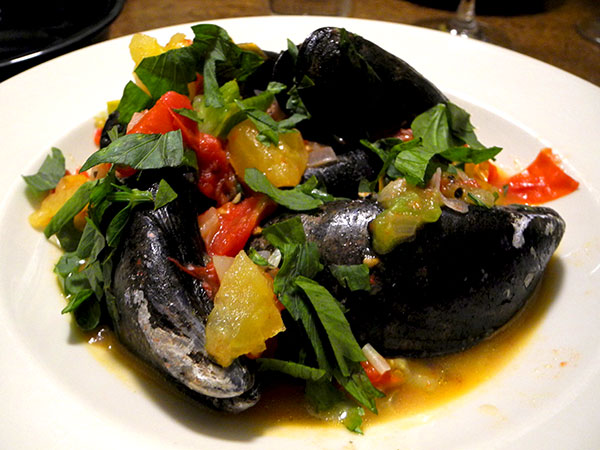
Big mussels.

Friday was  a very hot day, and I lost a few of mussels on my way back home from the Greenmarket. I ended up able to steam only about a pound and a quarter rather than the two pounds I had wanted to serve, probably because someone forgot to ask the fish seller for ice to go.  I had already diced enough heirloom tomatoes for the full recipe, but I reduced the amounts of everything else – perhaps with the exception of the wonderful bread with which we accompanied it.  We still had a an excellent entrée, one we seem to never tire of, and we didn’t even feel we had to go on to another course.

Did I say these mussels were big?  I think they were probably the largest black bivalves I’d ever put into a bowl.

  • almost enough large mussels, purchased from Pura Vida Fisheries in the Union Square Greenmarket, scrubbed and de-bearded, then combined in a large heavy enameled pot with two cups of a variety of halved heirloom tomatoes from S & S.O. Produce and Toigo Orchards, half a cup of good white wine, a few tablespoons of chopped shallot from John D. Madura Farm, three tablespoons of butter, a generous amount of freshly-ground black pepper, and some coarsely-chopped lovage, also from Berried Treasures, everything steamed over high heat for a few minutes, and served with thick slices of Trucio from Sullivan Street Bakery (a superb rustic sourdough country bread with a dark crust)
  • the wine was a Spanish white, Finca Os Cobatos Godello Monterrei 2013, from Galicia