Year: 2016

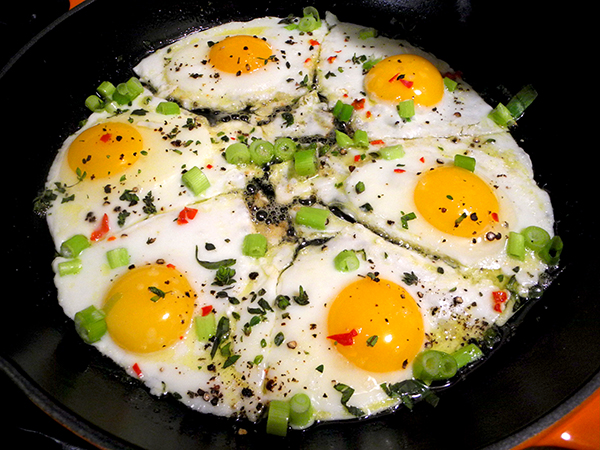
fried eggs and then some (I cannot just leave them naked)

fried_egg_pie

Aside from the fact that it looks like fried egg pie, this isn’t what most people think of when they think, ‘fried eggs’.

I just can’t leave fried eggs alone, and this morning I had an extra incentive for going a little further than even I normally do, having realized at the last minute that I didn’t have any bacon to accompany our Sunday breakfast/lunch.

The eggs looked – and tasted – so good, I forgot to add my latest favorite condiment, a terrific locally-made middle-eastern-style seasoning blend, ‘L’eKama‘.

  • the eggs were from Millport Dairy Farm, and, other than the salt and pepper, everything else was from a tub of herbs and spices not used in very recent meals (already washed and sometimes cut) which I keep in a tub in the refrigerator: the thin scallion stems from Race Farm, the finely-chopped portion of a small red Calabrian pepper from Campo Rosso Farm, the herbs from various Greenmarket farmers
  • the bread was some very-lightly-toasted slices of ‘Sesamo’, from Sullivan Bakery

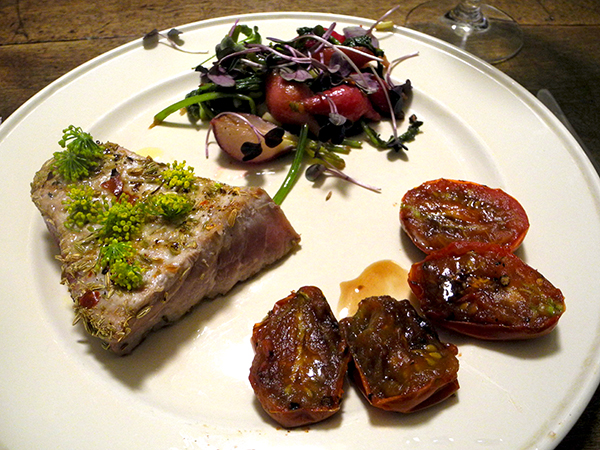
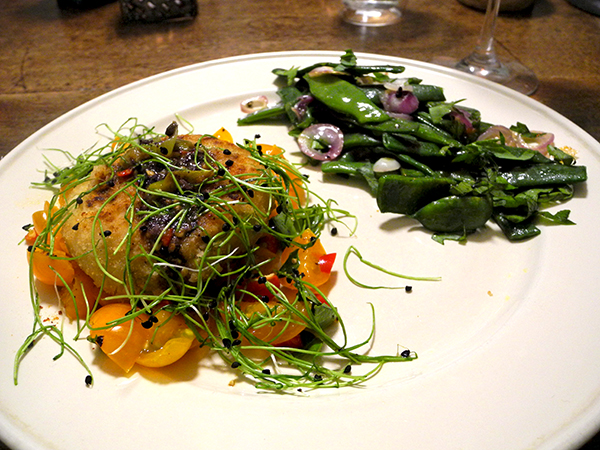
fennel-grilled tuna; grilled tomato; sautéed radish, scallion

tuna_tomato_radish

The colors, deeper than those displayed on these pages, suggest we’ve moved into late summer.

Although it’s barely worth mentioning, there’s the fact that the same herb or vegetable was used in 2 or 3 different forms in 2 of the 3 items on the plates last night. It hadn’t really been a plan, but I ended up finishing the ground-dry-fennel-covered tuna with fresh fennel flowers, and the radish roots and greens with fresh micro radish, and it worked.

radish_easter_egg

black_plum_tomatoes

In a related move, the sweet acidity of the tomato was accompanied by another sweet acid, a balsamic vinegar, but this is something I do very often.

  • one 13-ounce tuna steak, divided into 2 pieces, rubbed top and bottom with a mixture of dry Italian fennel seed and a little dried Itria-Sirissi chilis (peperoncino di Sardegna intero) from Buon Italia, first ground together in a mortar-and-pestle, the surfaces additionally seasoned with salt, and pepper, pan-grilled for only a little more than a minute or so on each side, finished with a good squeeze of organic lemon from Whole Foods, scattered with fresh fennel flowers from Ryder Farm, and drizzled with a very good olive oil
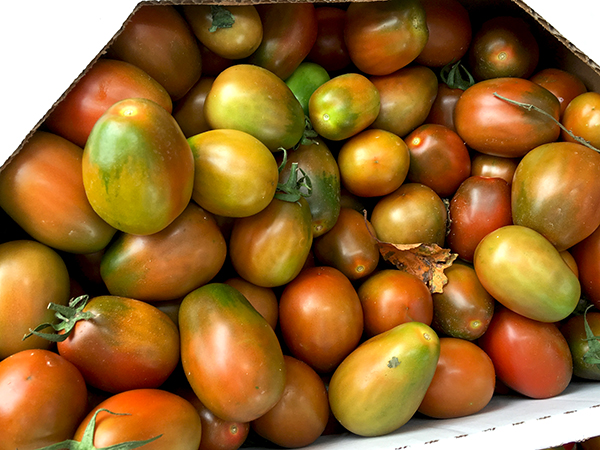
  • small seasoned pan-grilled ‘black’ (they darken as they ripen) plum tomatoes from Berried Treasures Farm, finished with a dab of olive oil and a bit of balsamic vinegar
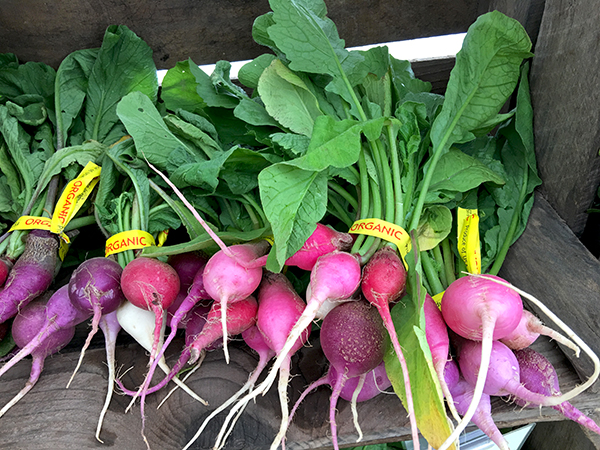
  • one small bunch of radishes (‘Easter Egg’) from Willow Wisp Farm, washed and halved, the leaves removed and set aside, sautéed in a little olive oil in a copper skillet for a few minutes, 5 small scallions from Race Farm, sliced, along with part of a finely-chopped small red Calabrian pepper from Campo Rosso Farm added near the end of the cooking, after which the radish leaves, cut into smaller pieces, were introduced into the pan, stirred, and allowed to wilt, the mix sprinkled with salt and pepper, more of the chopped scallion added at this time, and a little white wine poured in and stirred, until the liquid had evaporated
  • the wine was an Italian (Campania) white, I Vini della Sibilla Falanghina dei Campi Flegrei 2015, from Chelsea Wine Vault
  • the music was again from the excellent 4-disc album, ‘The Sons of Bach‘ this time pieces by Johann Christian Bach, ‘the London Bach’, or ‘the English Bach’

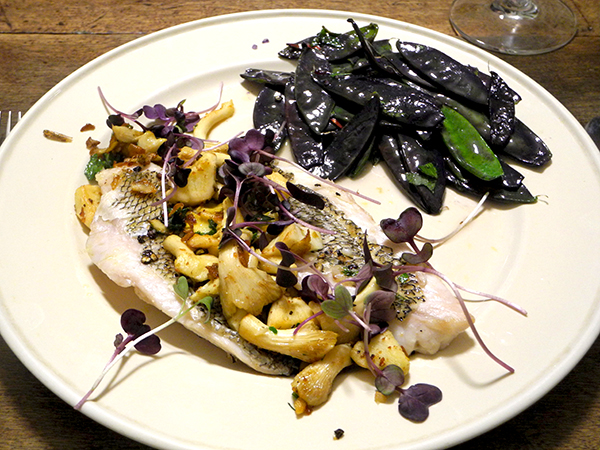
black sea bass, mushrooms, herbs; snow peas, chili, mint

bass_mushrooms_snow_peas

It was another round of fish with mushrooms, although it was different fish and different mushrooms (also different vegetable). It was, almost, the same simple, excellent recipe, and it was at least as delicious as the first time up.


golden_oyster_mushrooms

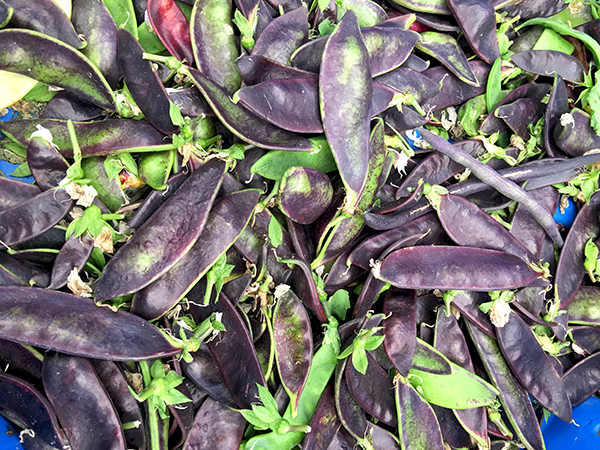
purple_snow_peas

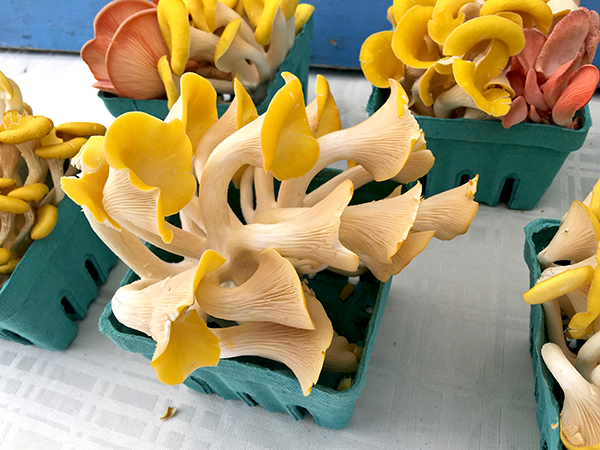
  • four 3-ounce black sea bass fillets from Pura Vida Fisheries, seasoned on both sides with salt and pepper, sautéed over a fairly brisk flame with butter and a little olive oil inside a large, thick oval copper pan, skin side down, then turned after about 2-3 minutes and the other side cooked for about the same length of time, removed to 2 plates when done, covered at least a little to keep warm, a tablespoon or more butter added to the pan, and 4 ounces of mushrooms (golden oyster [pleurotus citrinopileatus], from Blue Oyster Cultivation, cut into large-ish pieces, sautéed, stirring, until lightly cooked, seasoned with salt, pepper, a couple tablespoons of chopped lovage and chopped parsley, both from Keith’s Farm, and a tablespoon of lemon juice, or a little more, the mushrooms stirred some more before they and the juices were spooned on top of the fish, which was finished with micro purple radish greens from Two Guys From Woodbridge
  • purple snow peas from Norwich Meadows Farm, sautéed in olive oil along with a little more than one finely-diced small red Calabrian pepper from Campo Rosso Farm, tossed with spearmint from Stokes Farm, seasoned with salt and pepper
  • the wine was a California (Central Coast, Santa Ynez Valley) white,  Rick Boyer Central Coast White Blend 2015
  • the music was that of Johann Christoph Friedrich Bach, the master’s fifth son, the ‘Bückeburg Bach’, and once again from the excellent 4-disc album, ‘The Sons of Bach

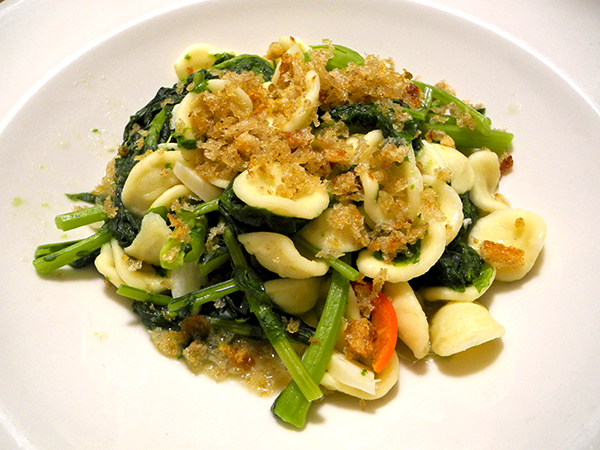
orecchiette, rapini, garlic, red chili, anchovy, breadcrumbs

orecchiette_broccoli_rabe

It’s a classic, and also very simple, which means it’s doubly difficult to fool around with the formula. But then, there really is absolutely no reason to want to do so.

Okay, the chili chosen will vary, even as to whether it is fresh or dry, the rabe will taste differently at different times of the year, the bread used will also change, as will the pasta chosen, but basically the recipe won’t stray from its origins, and it shouldn’t.

It’s perfect; all the experimenting that got it there was done long ago.

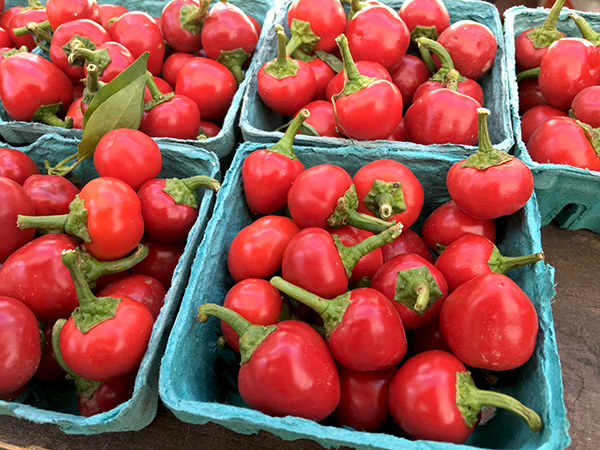
Calabrian_peppers

  • half of a pound of an excellent artisanal Puglian pasta,‘I Tipici’ Orecchiette Agricola del Sole, from Eataly, and half a pound of young, tender broccoli rabe (rapini) from Willow Wisp Farm, the bottom stems removed and the rest of the greens roughly chopped, pasta and vegetable boiled together in a large pot of salted water until the pasta was barely al dente, a cup of the water reserved just before the orecchiette was drained, the orecchiette and the rabe tossed into a separate heavy deep pot in which 3 garlic cloves, 3 salted anchovies (rinsed and filleted), and 2 small red Calabrian peppers (seeded and chopped finely) from Campo Rosso Farm from Oak Grove Plantation had been slowly heated until the garlic had softened and colored lightly, everything (including a judicious amount of the reserved pasta water) then tossed and stirred over a low-to-moderate flame for a couple of minutes to blend the flavors and the ingredients, served sprinkled with half of a cup of fresh homemade breadcrumbs made from a 2-day-old loaf of ‘Compagne’, a traditional sourdough from Bien Cuit Bakery via Foragers Market (browned a little earlier in a little olive oil with a pinch of salt)
  • the wine was a California (Lodi) rosé, Karen Birmingham Rosé Lodi 2015
  • the music was more works from the terrific album we listened to the night before, ‘The Sons of Bach’, performed, variously, by the Freiburg Bach Orchestra, the Freiburg Baroque Orchestra Consort, and the Freiburg Baroque Orchestra

skate, alliums, lemon, lovage, micro radish; tomato; okra

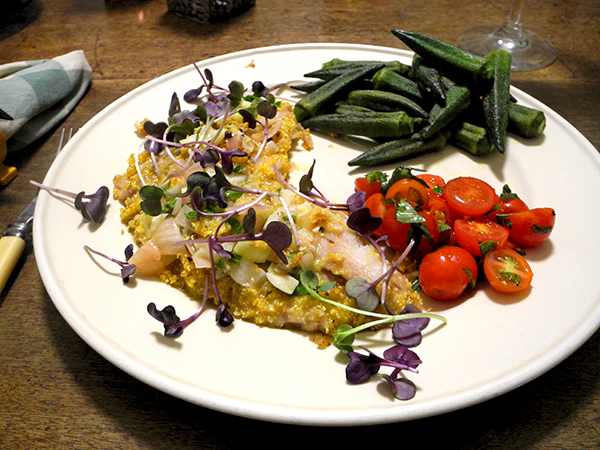
skate_tomato_okra

The skate is an excellent fish, and not unfamiliar to most people interested in eating fish, but this recipe is nothing like the one with which most are familiar (you folks know the one I mean). I’m crazy about the treatment I’ve now used a number of times: It’sdelicious, I can easily vary it, and it looks more complicated than it actually is. There’s also that thing I wrote about it 2 years back: “Dredging this extremely tender fish with polenta, rather than flour, gives it real presence while protecting its delicacy. It wasn’t my invention, but rather Mila‘s.”

The very fresh vegetables were even more simple, and as delicious as they were colorful.

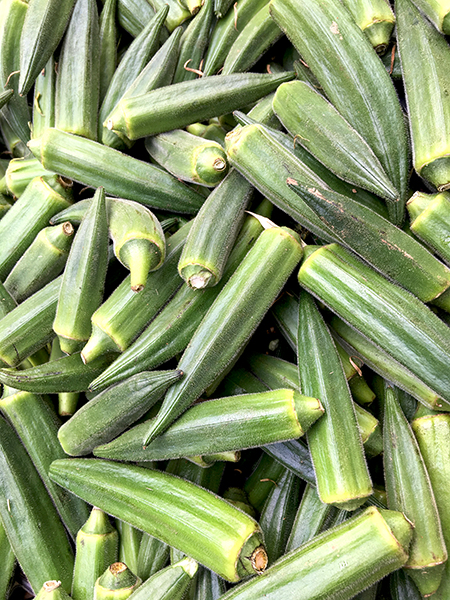
okra

  • two 7-ounce skate wings from Blue Moon Fish, coated all over with a coarse polenta seasoned with salt and pepper, sautéed in olive oil (and a bit of butter) for 3 or so minutes on each side in a heavy round copper skillet (the only difficult part of this recipe is turning them over without breaking them up, and it helps if they don’t quite fill the pan use use), removed, about 1 1/2 tablespoons of butter, one small shallot from John D. Madura Farm, 2 thin scallions from Race Farm, and 2 small cloves of garlic from Willow Wisp Farm, all sliced or chopped, introduced into it and stirred over a now-lowered flame, followed by the addition of a little more butter, the juice from half of a lemon and some chopped lovage from Keith’s Farm, and stirring for a bit, finishing on the plates with a scattering of micro purple radish greens from Two Guys From Woodbridge
  • a large handful of ‘The Best Cherry Tomatoes’ from Stokes Farm, halved, mixed with a bit of an excellent olive oil (D.O.P. Penisola Sorrentina ‘Syrenum), salt, pepper, chopped tarragon form Stokes Farm, torn basil from Campo Rosso Farm, and a dash of white balsamic vinegar
  • small okra from Kernan Farms, sautéed over a high flame in a large cast iron pan with a little olive oil and a good part of one small red Calabrian pepper from Campo Rosso Farm, seasoned with sea salt
  • the wine was a California (Sonoma) white, Scott Peterson Rumpus California Sauvignon Blanc 2015, from Naked Wines
  • the music was from an extraordinary recording of wonderful music played magnificently, ‘The Sons of Bach’, performed, variously, by the Freiburg Bach Orchestra, the Freiburg Baroque Orchestra Consort, and the Freiburg Baroque Orchestra; two pieces in particular stood out as incredibly exciting, music far more vital than I had thought the early classical era could produce: Wilhelm Friedemann Bach‘s ‘Concerto for Harpsichord in E Minor, F 43, from 1767; and Carl Philipp Emmanuel Bach‘s Sinfonia in E minor, Wq 178/H 653, from 1756

frittata with peppers, garlic, chili, red onion, herbs, tomato

yellow_pepper_herb_frittata

The frittata was pretty simple, and pretty. It was also entirely improvisatory, and as such did not need a recipe; an outline would be enough to reproduce it.

Rillettes_2nd_time

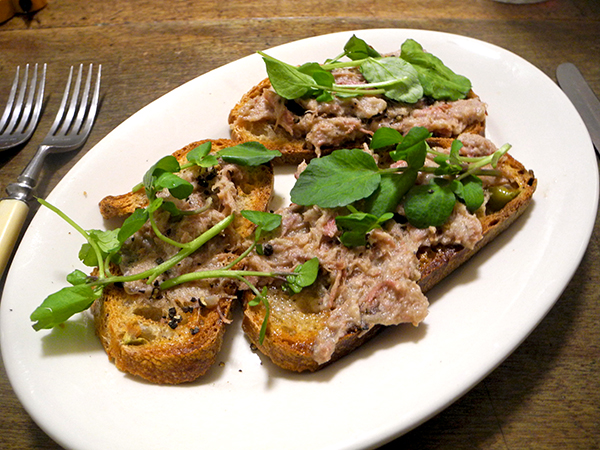
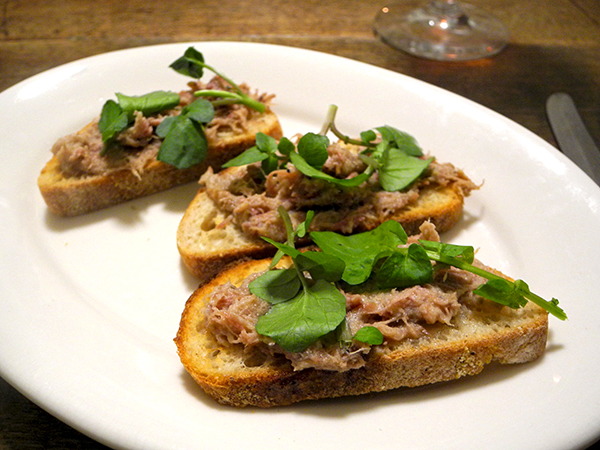
We began by revisiting the duck rillettes, watercress, and toast we had enjoyed the night before, because, for one, the frittata would not be large; two, I knew that, once opened, the pâté should be consumed earlier rather than later; and three, because once again we had some great bread for toast, A ‘Compagne’, or traditional sourdough, from Bien Cuit Bakery via Foragers Market (this time I used my trusty ‘Camp-A-Toaster‘ to make the toast, and the results were perfect).

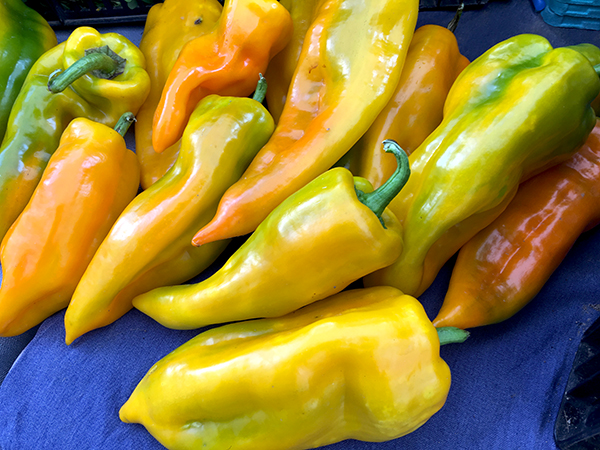
yellow-orange_peppers

The peppers, which were at the center of the frittata, were gorgeous; I didn’t want to pass up the chance of including a picture here.

  • three large sweet long yellow-orange peppers from Campo Rosso Farm, seeds and pith removed, slivered and chopped, sautéed in olive oil until soft inside a heavy, seasoned, cast iron pan, followed by some chopped garlic from Willow Wisp Farm and most of a finely-chopped small red Calabrian pepper from Campo Rosso Farm, both heated until also soft, after which 8 eggs from Millport Dairy Farm (whipped with salt, pepper, a tablespoon of milk, and more than half a dozen chopped herbs from various local farms) were poured into the pan and allowed to cook over a lowered flame for a few minutes, or until most of the egg had cooked, during which time the surface was sprinkled with a bit of homemade French Basque piment d’Espellate (which arrived in our kitchen via a farm in a small town north of Baie-Comeau, Quebec) and slices of one ripe green heirloom tomato from Stokes Farm, the frittata finished in the broiler, and served on plates where the sections were sprinkled with fennel flowers from Mountain Sweet Berry Farm
  • the wine was a California (Lodi) red, Jacqueline Bahue Cabernet Franc Lodi 2014, which is now out of stock
  • the music was Pat Muchmore’s ‘BABEL fragments’, a section of which I heard on Q2 Music streaming last week, introducing me to this composer’s work for the first time

duck rillettes; crab cakes, salsa; green beans, red onion

duck_rillettes

crag_cake_salsa_green_beans

Rupert_toast_herbs

I’ve prepared these crab cakes, according to a quick search on this site, 15 times before, so we obviously see something in them. One of those things is the fact that they can be, and always have been, pretty much reinvented each time.

This time it got a little elaborate, although thanks to flavor elements and garnishes which were either already prepared or leftover from earlier meals, it was as easy as ever.


  • two terrific crab cakes from PE & DD Seafood, as always (the ingredients are crab, egg, flour, red & green peppers, garlic, salt, pepper, breadcrumbs, mayonnaise, milk, celery, and parsley), seared/heated in a cast iron pan, 3 to 4 minutes for each side, served on 2 plates on top of a salsa composed of quartered sun gold cherry tomatoes from Berried Treasures, chopped and combined with salt, freshly-ground black pepper, a bit of homemade French Basque piment d’Espellate purchased in a small town north of Baie-Comeau, Quebec last year from the producer’s daughter, much of one small red Calabrian chili pepper from Campo Rosso Farm, and some torn fresh basil, also from Campo Rosso Farm, after which the ‘cakes’ were drizzled with a small amount of an almost garum-like sauce made from a couple tablespoons of savory tomato juices (collected over 2 previous meals) mixed into a very small amount of a black olive tapenade (already shared with 2 earlier meals), with micro scallions from Two Guys from Woodbridge scattered over both the seafood and the salsa [to anyone following this blog, it’s pretty clear that I’m mad about micro greens]
  • two small red pearl onions from Paffenroth Farms, thinly-sliced, sautéed in olive oil inside a large copper pan until softened, then lightly seasoned, followed by less than 2 handfuls of flat green pole beans from Norwich Meadows Farm (earlier halved, blanched, drained and dried), reheated with the red onions and finished with a little more salt, pepper, and some chopped lovage from Keith’s Farm


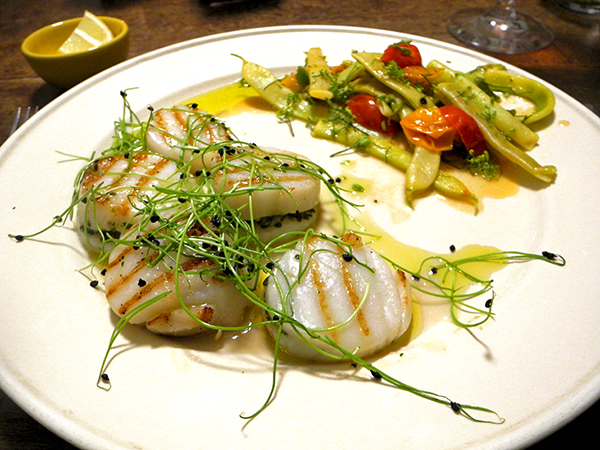
basil-stuffed scallops, micro scallion; beans, tomato, fennel

scallops_stuffed_beans_tomatoes

Once again there were some beautiful large very fresh scallops at the Greenmarket, and, especially after a summer of much smaller specimens, it was going to seem a shame if I didn’t take advantage of their size – and the fresh bouquet of basil waiting on the counter – to repeat the same savory entrée I had prepared only 10 days before.

I made last night’s preparation at least a little distinctive from earlier versions by finishing the 10 pan-grilled médaillons with a garnish as special as the perfect scallops themselves.

  • 10 thick sea scallops (12 ounces) from Seatuck Fish Company, rinsed, dried, slit horizontally with a very sharp knife almost all of the way, stuffed with a mixture of basil from Campo Rosso Farm, one medium-size clove of garlic from Willow Wisp Farm, salt, and pepper, chopped together very finely, removed to a small bowl where just enough olive oil was added to form a paste, the stuffed scallops then rolled around on a plate with a little more olive oil, drained, pan grilled about 2 or 3 minutes on each side, removed to plates, lemon juice and olive oil drizzled over the top, and garnished with some wonderful micro scallions from Two Guys From Woodbridge
  • two garlic scapes from Berried Treasures, cut into quarter-inch segments, sautéed in olive oil until tender inside a heavy copper pan, adding much of one small red Calabrian chili pepper from Campo Rosso Farm, finely chopped, near the end, after which one medium green heirloom tomato from Stokes Farm cut into thin wedges, and 8 or so small orange and red cherry tomatoes from Berried Treasures, halved, were added and cooked for a minute or so before 2 small handfuls of halved yellow flat pole beans from Norwich Meadows Farm (par-boiled, drained, and dried earlier) added to the pan and stirred briefly, heating and combining the flavors of all the vegetables, seasoned with salt and pepper, mixed with a little chopped fronds attached to stems of some fennel flowers from Willow Wisp Farm, removed to the 2 plates, and scattered with the fennel flowers themselves (tasting much like the takeaway from an Indian restaurant), roughly chopped

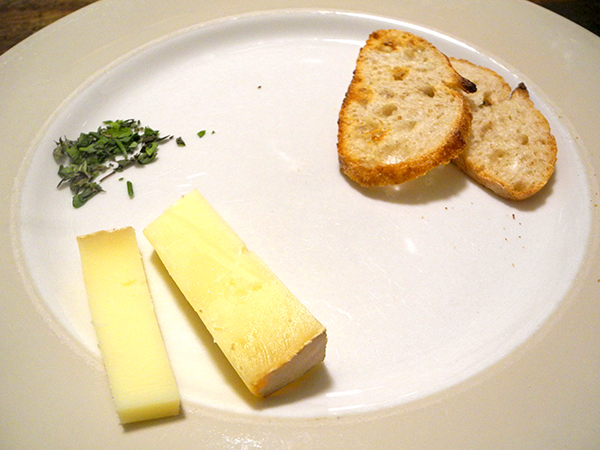
There was cheese and fruit.

  • small amounts of 2 Consider Bardwell cow cheeses, ‘Barden Blue’ and ‘Pawlet’, with toasts made from very thin slices of ‘whole wheat farm’ bread from Rock Hill Bakery, in Gansevoort, N.Y.,  served with one shared ripe, luscious satsuma plum from Phillips Farm

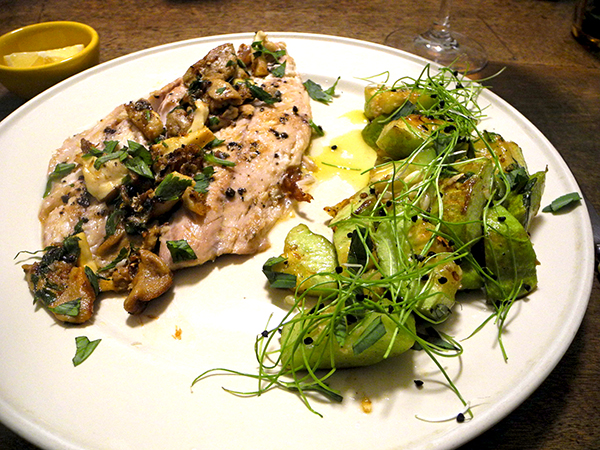
mackerel, mushrooms, herbs; cucumber, tarragon, scallion

mackerel_mushrooms_cucumber

I was at the Pura Vida fish display cases. The mackerel were beautiful, so I hardly hesitated before choosing them for our entrée on Friday night. Then Paul told me that, just 2 stalls down, Joe Rizzo had some beautiful Boletus mushrooms. I’m not an expert, but even I knew that sounded pretty special.
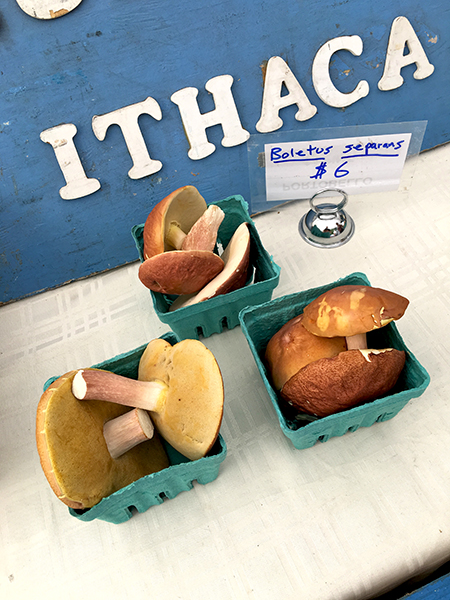
Boletus

I love mushrooms, but I’m far less familiar with these wonderful fungi than I have eventually become with fish. I was also nonplussed, because I knew mushrooms should be used on the day they’re brought home.

At least initially, to me the combination of mackerel and mushroom seemed like anything but a natural. I mentioned my doubts to Paul, but he would have none of it. I quickly checked Google on my phone, to see if anything showed up with a search under the words, words, ‘mackerel’ and ‘mushrooms’. I couldn’t find much, partly on account of the glare outside on the pavement, but I decided I’d give the combo a try, thinking I would be able to uncover something interesting on my laptop once I had returned home.

Bonanza!

I found a modest site I had never come across before, with what seemed a perfect fit. The recipe asked only for ingredients I had on hand (there were very few ingredients, in fact), and it was extremely simple (so simple I originally had my doubts about its virtues). Then, as I thought about it more, it made perfect sense, especially since the acidity of a little lemon was involved, appropriate for this rich oily fish, and I was going to be able accompany the mackerel and the mushrooms with some refreshingly juicy sautéed cucumbers.
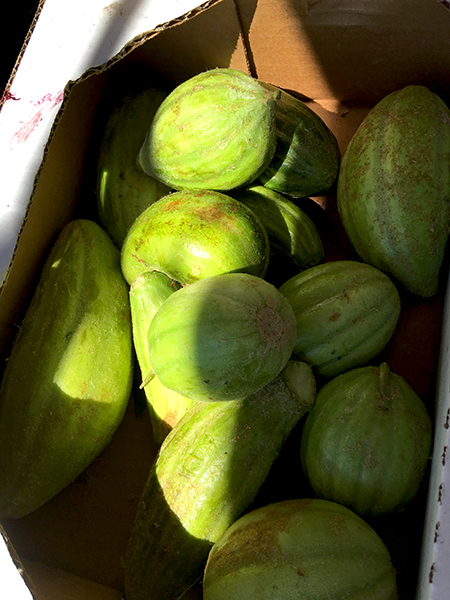
Barese_cucumbers

It turned out wonderful, and it has freed my mackerel from its long bondage with tomato salsa, not however as a substitute for that excellent classic formula, but as perhaps only the first of a number of new alternatives to it.

  • 4 Boston mackerel fillets (a total of 14 oz) from Pura Vida Fisheries, seasoned on both sides with salt and pepper, sautéed fairly gently with butter and a little olive oil inside a large, thick oval copper pan, flesh side first, turned after about 3 minutes and the other side cooked for about the same length of time, removed to 2 plates when done, covered to keep warm, a tablespoon or more butter added to the pan, and 4 ounces of mushrooms (‘Boletus Separans’) from Blue Oyster Cultivation, cut into large-ish sections, sautéed, stirring, until lightly cooked, seasoned with salt, pepper, a couple tablespoons of chopped lovage and chopped parsley, both from Keith’s Farm, and about a tablespoon of lemon juice, the mushrooms stirred some more and they and the juices spooned on top of the mackerel, which was finished with a little fresh chopped lovage and parsley
  • two luscious Barese cucumbers, from Berried Treasures, ‘hairs’ wiped off, unpeeled, cut into bite-sized segments, sautéed over a medium-hot flame in butter and a little olive oil inside a large cast iron pan until lightly browned, seasoned with salt and pepper, tossed with chopped tarragon from Stokes Farm, arranged on 2 plates and sprinkled with micro scallions from Two Guys from Woodbridge
  • the wine was a California (Central Coast) rosé, Keith Hock Central Coast Rose 2015
  • the music was Q2 Music, streaming
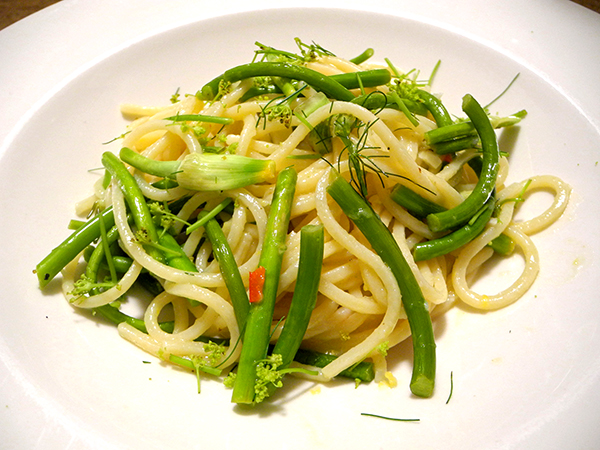
spaghetti with garlic, scapes, chili, lemon, fennel flowers

lemon_garlic_scape_pasta_2

Barry is always the capocuoco when it comes to stirring and timing the pasta, and he always brings it in al dente, as he did last night. Even if it was really no big thing in the end, on my side I let us down a bit: The garlic scapes did not end up al dente. They still tasted very good, but let’s say they were a little chewy (“fibrous”, I heard Barry say under his breath). I blame it, justifiably or not, on the fact that they were very late in their season, and that might also explain why they had a stronger flavor than usual.

But everything else was super, making it easier to ignore the chewy bits.

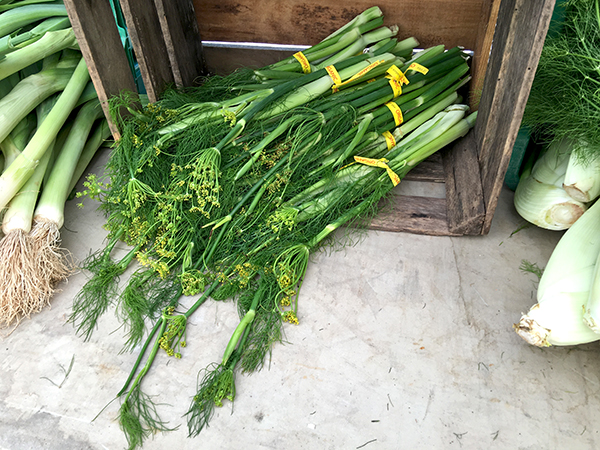
And the fennel flowers were brilliant.

fennel_flowers


  • 8 ounces from a package of Setaro spaghetti chitarra from Buon Italia, served with a simple fresh sauce which began with 3 minced cloves of garlic from Norwich Meadows Farm and 2 cups of garlic scapes from Berried Treasures Farm, cut into 2-inch lengths, sautéed in olive oil for 3-4 minutes (which turned out not to be long enough this time; see above), accompanied halfway through by parts of one ‘cherry bomb’ (or ‘red bomb’) pepper from Norwich Meadows Farm, after which a little butter, most of the juice of one lemon, and most of its zest, added to the pan, the drained pasta mixed in once the butter had melted, and all stirred over low heat, during which time some reserved cooking water was added to help emulsify it, seasoned with salt and pepper, and sprinkled with very fresh chopped fennel flowers, and some of the fronds, from Willow Wisp Farm
  • the wine was an Italian (Sicily) white, Corvo Insolia 2013, from Philippe Wine in Chelsea
  • the music was the Symphonies Nos. 3 and 5 of Ferdinand Ries, Howard Griffiths conducting the Zurich Chamber Orchestra