Year: 2016

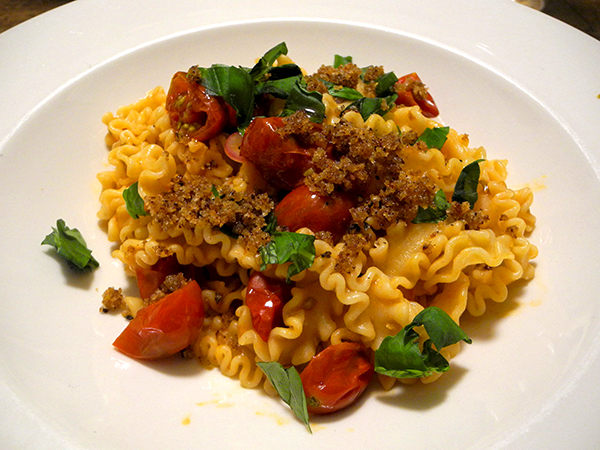
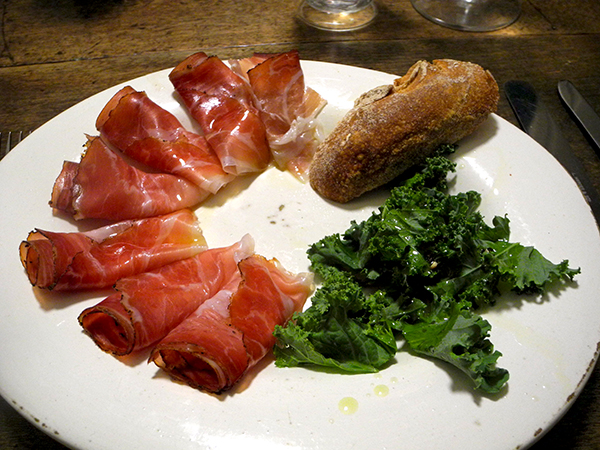
speck; mafaldine with garlic, red onion, tomatoes, basil

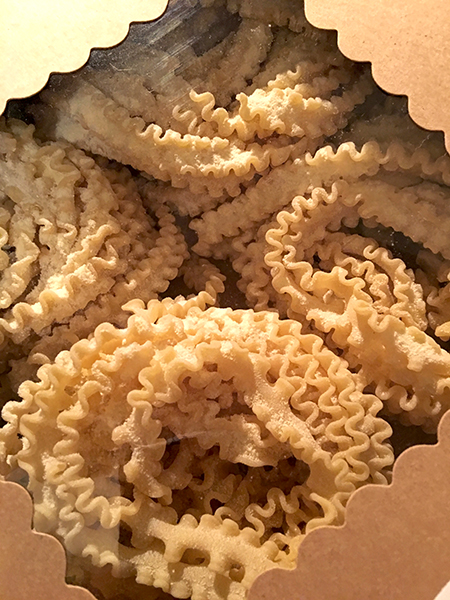
malfadine

I had just gone to Eatlay for bread yesterday, but as I was passing Luca Donofrio‘s fresh pasta counter I spotted this awesome-looking pasta. I had already decided I was going to put together a very simple meal tonight, and I immediately realized that this mafaldine would make it special even without tweaking of any kind.

I was also a little excited (also sad) about the surprisingly modern history of the name the Italians have given the pasta: the ill-fated Princess Mafalda of Savoy is the reference.
 

bresaola_kale_bread

mafaldine_tomato

We were 3 at dinner. Our friend Michelle Vaughan had come by to drop off a huge organic bounty from the gardens outside her cottage, ‘Lower Hayfields’, in Garrison, New York, north of the city, and of course we wouldn’t let her go.

We began with a course of salumi.

  • thinly-sliced Speck from the Südtirol/Alto Adige, via Eataly, drizzled with a fine olive oil, a Campania D.O.P. Penisola Sorrentina ‘Syrenum’, and served with curly kale leaves from Michelle Vaughan and Lower Hayfields, also drizzled with the olive oil, and seasoned with salt, pepper, and a few drops of white balsamic
  • the bread was a Rustico Classico from Eataly
  • the wine was a California (Lodi) rosé, Karen Birmingham Rosé Lodi 2015

The main course came together with the pasta I mentioned above, and some deep-red cherry tomatoes with the most awesome flavor. I believe they are actually an heirloom variety, ‘black cherry tomato’. It was the last of my supply of any tomatoes before it was replenished by Michelle with several kinds of cherry tomatoes; at least 4 kinds of heirloom tomatoes, including plum tomatoes; 2 kinds of sweet peppers; fingerling potatoes; and curly kale.

  • one pound of fresh Mafaldine pasta from Eataly, with a sauce made by heating in a deep, enameled cast-iron pot 2 roughly-chopped cloves of garlic from Willow Wisp Farm with one very small red pearl onion from Paffenroth Farms, and most of one small red Calabrian pepper from Campo Rosso Farm, until all were pungent and softened, tossing in a good number of halved black cherry tomatoes from Norwich Meadows Farm, stirring, some reserved pasta cooking water added to help emulsify the mix, seasoned with salt and pepper, a generous amount of torn New York CIty basil from Gotham Greens via Whole Foods mixed in, the pasta removed to 3 shallow bowls, drizzled with olive oil, sprinkled with more basil and some homemade breadcrumbs (browned a little earlier in a little olive oil with a pinch of salt)
  • the wine was an Italian (Campania) white, I Vini della Sibilla Falanghina dei Campi Flegrei 2015, from Chelsea Wine Vault

We finished with a small plate of cheese and a few very ripe black figs.

  • Consider Bardwell’s ‘Rupert’, a cow cheese; ‘Coupole’, a goat cheese from Vermont Creamery, via Foragers Market; and Bergflichte’ [‘mountain fir’], a soft washed-rind Jersey cow cheese from Canton Thurgau, in northern Switzerland, via Eataly
  • black California figs from Whole Foods
  • the wine was a California (Sonoma) white, Scott Peterson Rumpus California Sauvignon Blanc 2015, from Naked Wines
  • the music throughout the very long evening was that of our voices, eventually fortissimo, as we got into discussing politics of all things
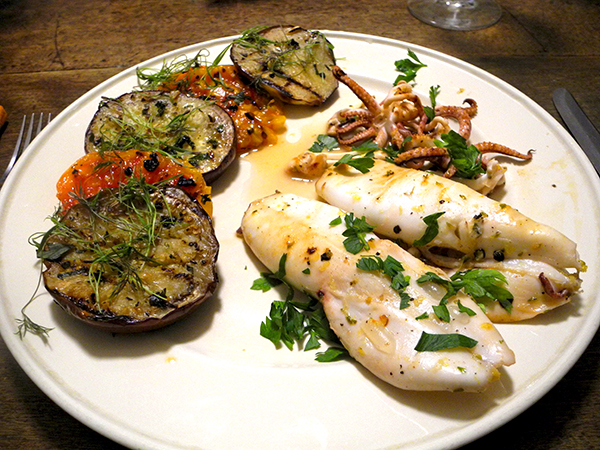
marinated, grilled squid; eggplant, tomato, garlic, mint

squid_eggplant_tomato

La Cucina Italiana.

The squid was certainly Italian, both the fact of squid and the preparation; the vegetables were also Italian, again, fact and execution (the wine however was Spanish, because, well, we didn’t have a suitable Italian on hand).

La Cucina Povera.

Nothing put onto the table last night was ‘costly’, and, except for the squid, for which I exchanged $6 with the fisherman’s family that day, it basically incorporated what was already in the kitchen or pantry.

  • twelve ounces of cleaned squid, bodies and tentacles, from P.E. & D.D. Seafood, marinated for about half an hour (half of that time in the refrigerator) in a bowl containing a mixture of the zest and juice of most of one lemon, thinly-sliced garlic from Willow Wisp Farm, olive oil, pungent dried Italian oregano from Buon Italia, some finely-chopped pieces from a red Calabrian pepper from Campo Rosso Farm, salt, and pepper, then removed from the marinade, drained, pan-grilled briefly over high heat, arranged on plates, sprinkled with fresh lemon juice and some chopped parsley from Keith’s Farm, drizzled with olive oil [the basic recipe, with more specific instructions appears here]
  • one luscious round Sicilian (heirloom?) eggplant, from Phillips Farm, sliced into 1/2-inch rounds, brushed with a mixture of olive oil, finely-chopped garlic from Willow Wisp Farm, chopped peppermint leaves from Stokes Farm, salt, and pepper, the slices pan-grilled, turning once, removed to a platter, replaced in the pan by one orange-red heirloom tomato (‘Striped German’), sliced into 1/2-inch rounds and its surfaces seasoned with salt and pepper, where it was grilled on both sides, arranged on the platter with the eggplant, sprinkled with more freshly-chopped mint leaves, drizzled with a little olive oil, some micro bronze fennel from Two Guys from Woodbridge tossed on the top, the vegetables kept at room temperature, for a short while while the squid was grilled.
  • the wine was a Spanish (Rueda) white, Naia D.O. Rueda 2014, Verdejo old vines, from Philippe Liquors
  • the music was François Francoeur, ‘Symphonies pour le Festin Royal’, Hugo Reyne conducting La Simphonie du Marais [music composed for the 1773 wedding banquet of the Comte d’Artois, later to become the last Bourbon king of France, as Charles X]

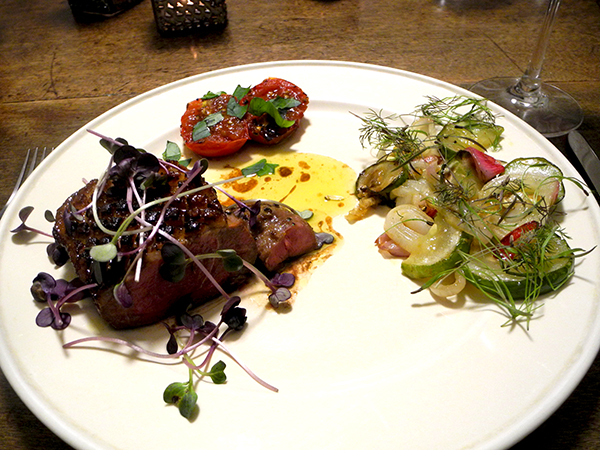
duck, purple micro radish; tomato; cucumber, onion, fennel

duck_tomato_cucumber

I’ve always gotten easily carried away with herbs, especially the less familiar varieties (and the choices continually broaden); I’m now totally addicted to micro greens, even if they aren’t always green.

  • one duck breast (13 ounces) from Hudson Valley Duck, the fatty side scored in cross hatching with a very sharp knife, the entire breast then sprinkled with a mixture of sea salt, freshly-ground pepper, and a little turbinado sugar (in our kitchen, the bowl of sugar has been infused over time with a vanilla bean), the duck left standing for about 45 minutes before it was pan-fried, first the fatty side down, in a tiny bit of olive oil, over medium heat, draining the oil part of the way through, to be strained and used in cooking later, if desired, removed when medium rare (cut into 2 portions to check that the center is medium-rare), left to sit for several minutes before finishing it with a drizzle of organic lemon and drops of a very good Campania olive oil, and scattered with purple micro radish from Two Guys from Woodbridge [NOTE: the tenderloin, removed from the breast before cooking, and also marinated, was fried very briefly near the end of the time the breast itself was cooking]
  • two small seasoned pan-grilled ‘black’ plum tomatoes (they darken as they ripen) from Berried Treasures Farm, finished with a dab of olive oil, a bit of balsamic vinegar, and sprinkled with torn leaves of New York CIty basil from Gotham Greens via Whole Foods
  • two Kirby cucumbers, from Paffenroth Gardens, unpeeled, cut into 1/4″ slices, sautéed over a medium-hot flame in a little olive oil along with two very small red pearl onions from Paffenroth Farms until lightly browned, a very small red Calabrian pepper from Campo Rosso Farm, finely chopped added most of the way through, the vegetables seasoned with salt and a little pepper, divided onto 2 plates, drizzled with a little olive oil, and sprinkled with bronze micro fennel from Two Guys from Woodbridge
  • the wine was a California (Lodi), Karen Birmingham Reserve Zinfandel 2014
  • the music was Johann Friedrich Fasch, ‘Orchestral Works Vol. 2’, perforemd by Tempesta di Mare, and the Philadelphia Baroque Orchestra

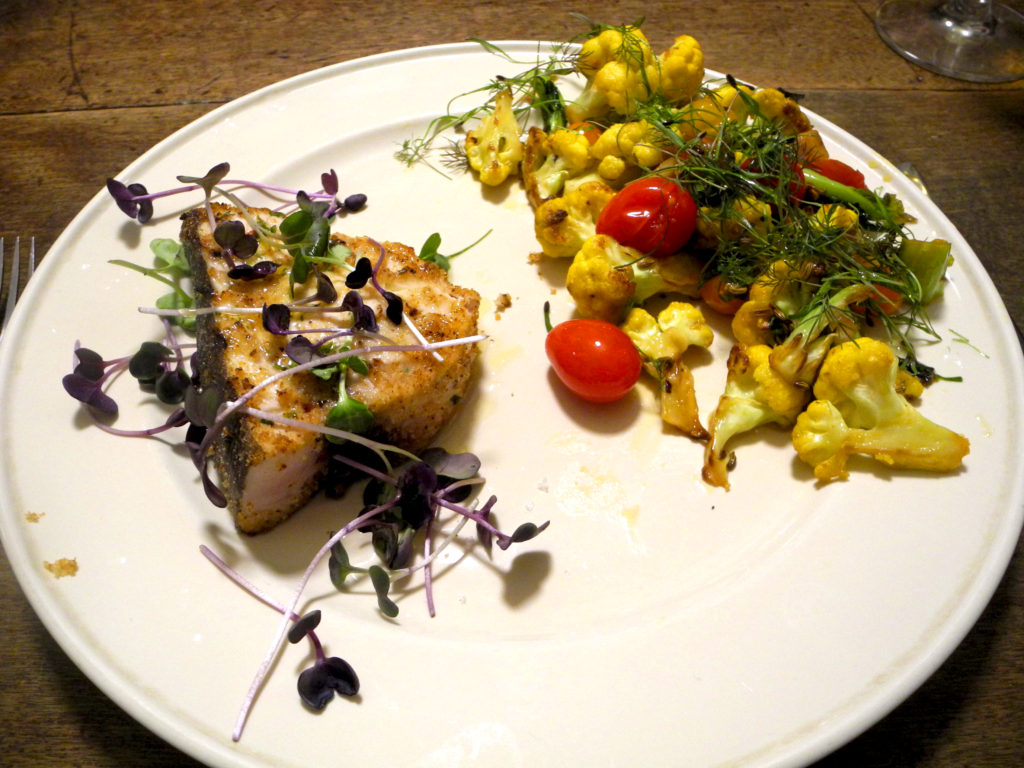
marinated swordfish, with micro radish; cauliflower, tomato

swordfish_cauliflower

There was an appetizer (insalata Caprese) , and there was excellent cheese after, both very good, but the, really extraordinary part of this meal was the main course – including a great Spanish wine.

  • one swordfish steak (12 ounces) from P.E. & D. D. Seafood, in the Union Square Greenmarket, carefully cut into 2 equal portions, marinated for about half hour in a mixture of olive oil, 4 different chilis (a very small amount of dried Itria-Sirissi chili, peperoncino di Sardegna intero from Buon Italia, part of a small red Calabrian peppers from Campo Rosso Farm, some excellent powdered Nigerian cayenne pepper, and a powdered Spanish dulce paprika ), fresh oregano buds and leaves from Stokes Farm, chopped, and some finely-chopped small red pearl onions from Paffenroth Farms, after which it was drained well and covered with a coating of homemade dry bread crumbs mixed with a little salt, pan-grilled over medium-high heat for 4 to 5 minutes on each side, removed, seasoned with salt, sprinkled with a little lemon juice, some purple micro radish from Two Guys from Woodbridge, and drizzled with olive oil before serving
  • the flowerets of a 10-ounce yellow cauliflower from Norwich Meadows Farm, sautéed in a pan in which roughly-sliced garlic cloves from Willow Wisp Farm, some crushed dried Itria-Sirissi chili and more than a teaspoon of Italian fennel seeds had been heated, braised for a few minutes, until beginning to caramelize, eventually joined by 5 ounces of parti-colored ripe cherry tomatoes from Norwich Meadows Farm, the cooking continued until the tomatoes had begun to collapse, finished by stirring in some NYC basil from Gotham Greens, via Whole Foods, and peppermint from Stokes Farm, both torn, and sprinkled with micro bronze fennel when arranged on the plates
  • the wine was a superb 16-year-old Spanish (Rioja) white, Viña Gravonia Rioja Blanco, Lopez de Heredia (ours was a 2005), from Astor Wines & Spirits
  • the music was Giulio Caccini’s opera, ‘L’Euridice’, first performed at the Pitti Palace, Florence, in December, 1602 [more information here]

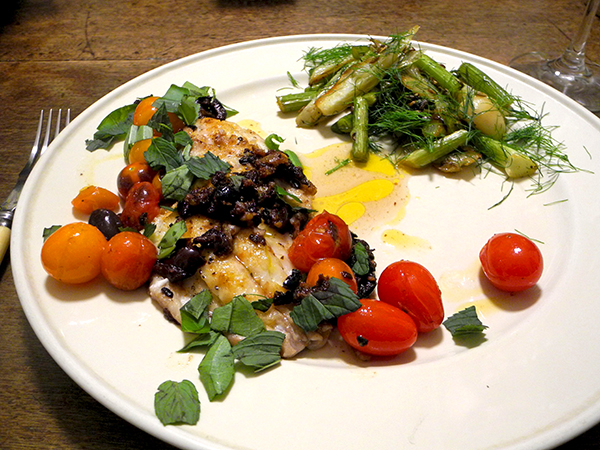
spicy tautog with olives, tomato, herbs; fennel, dill; cheeses

tautog_tomatoes-fennel

I didn’t start early enough to prepare the ‘tomato water’ which was a part of a recipe I had used for this wonderful fish last July. The other problem I had last night was that I didn’t want to turn on the oven, a step necessary for my second favorite treatment of tautog (blackfish), so I improvised.

I used the basics of Melissa Clark’s recipe, but left out the tomato water, instead I added some incredibly sweet and flavorful small, ripe cherry tomatoes (in several shades of both orange and red) I had picked up the same day.

The fish was really, really good. This new recipe will be my new first choice, at least until I need variety again.

The vegetable was serendipity and one of my favorites, for accompanying fish, meat, pasta – anything – also by itself, raw, as a terrific appetizer:  A beautiful bulb of fennel ended up on the counter last night, the gift of a friend.

  • two 6-ounce fillets of tautog, or blackfish, from Pura Vida Fisheries [prepared following a recipe by Melissa Clark published in the Times four years ago, substituting a mix of excellent cayenne pepper and a dulce paprika for Aleppo pepper], seasoned with salt, black pepper, and a few pinches of a mix of sweet Spanish paprika and Nigerian cayenne pepper, placed in a large heavy oval copper pan over a medium-low flame, a mix of a few Moroccan and Gaeta olives from Buon Italia, pitted and chopped, scattered around the fish, the fillets cooked for about 4 minutes, flipped and cooked for another 4 minutes, near the end of which time a couple handfuls of some awesome cherry tomatoes from Norwich Meadows Farm were tossed into the pan, stirred and allowed to begin to break down, the fish and the olives transferred to 2 plates, the tomatoes spooned around the fillets, and everything sprinkled with NYC basil from Gotham Greens via Whole Foods and peppermint from Stokes Farm, both torn, topped with a drizzle of good olive oil and some flaky Maldon salt
  • a small fennel bulb and its tender stems, from From Fishkill Farms, via the CSA allotment of a colleague of Barry’s, bulb cut into wedges, stems cut into segments, sautéed in a large iron pan over medium high heat with 2 whole crushed garlic cloves from Willow Wisp Farm, a small amount of crushed dried Sicilian peperoncino from Buon Italia, and some Italian fennel seeds until the fresh fennel began to color, then, with the heat lowered and the pan covered, cooked for ten more minutes, occasionally stirring, seasoned, and a generous amount of chopped fennel fronds added at the end

cheese_course

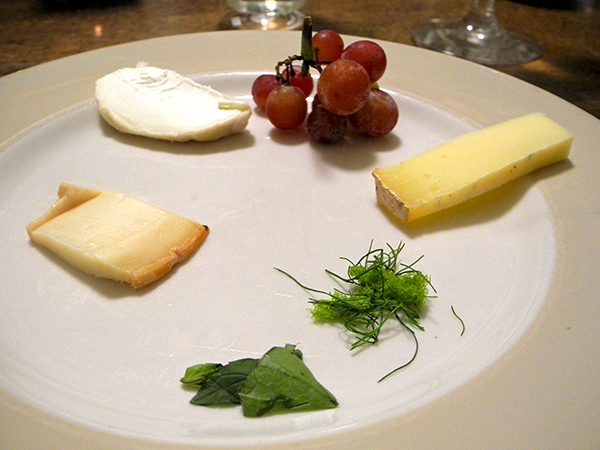
There was a very small cheese course

  • the cheeses were ‘Coupole’, a goat cheese from Vermont Creamery, via Foragers Market, and 2 cheeses from Consider Bardwell Farm, ‘Slybro’ (also goat) and Rupert (cow); the grapes were ‘champagne’, from Caradonna Farms; the herbs were a bit of basil and mint leftover from the entrée


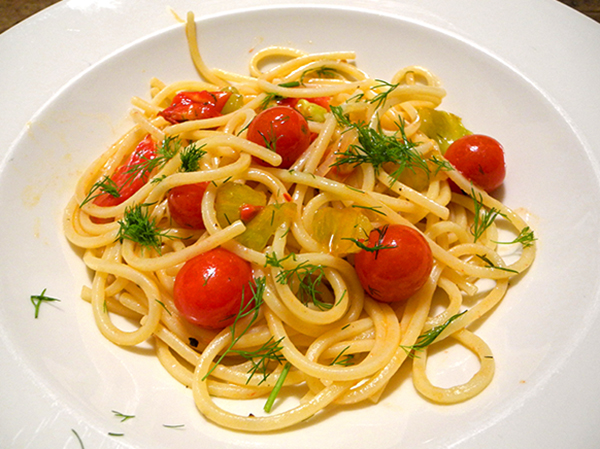
spaghetti chitarra with garlic, tomato, red chili, chopped dill

spaghetti_tomato_dill

For me it was a virtually a night off (but I still did the dishes).

  • eight ounces of Setaro spaghetti chitarra from Buon Italia, with a simple sauce which included olive oil, garlic from Willow Wisp Farm, part of a small red Calabrian pepper from Campo Rosso Farm, chopped, one red heirloom tomato from Berried Treasures Farm and one green heirloom tomato from Stokes Farm, a few very sweet, very ripe cherry tomatoes from Stokes Farm, and a sprinkling of chopped dill from Willow Wisp Farm
  • the wine was an Italian (Sardinia) white, La Cala Vermentino di Sardegna 2014
  • the music was  ‘[Johann Jacob] Froberger, Suites and Tocattas‘, played by Christophe Rousset

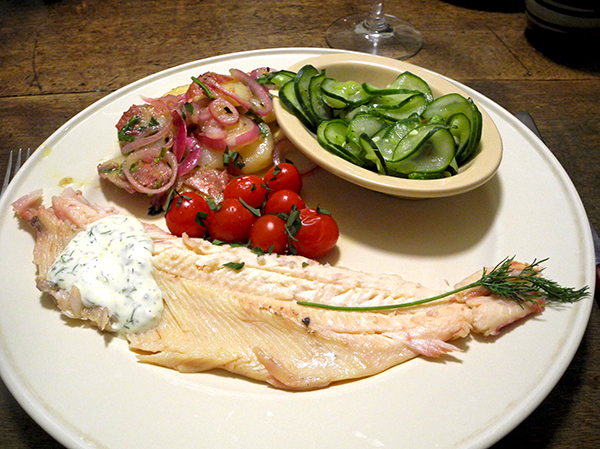
smoked trout, dill mayonaise; potato and cucumber salads

smoked_trout_potato_cucumber

We’ve been collecting a few rieslings over the last months, but hadn’t had entrées suitable for this special wine. This past week I decided it was time, so I thought of putting together a simple meal of trout accompanied by a couple of more-or-less-Germanic vegetables.

I was aiming for fresh whole trout, but this past Wednesday, the only day on which Dave Harris and his Max Creek Hatchery are in Union Square, there was, literally, a run on the market. Blue Moon, the other fish seller who would normally have also been there that day, had to cancel because Hermine had been hanging around, stirring up the waters off eastern Long Island, making it too dangerous for a boat to go out the day before.

Dave mostly doesn’t have to think about hurricanes or cyclones (he’s located very much inland, far west of Albany). He and his truck were there all set up, but not surprisingly, the fresh trout went fast. He told me he hadn’t known that he would be the only game in town that day, or he would have brought more stock down from the north. When I got there, a little past noon, there were no more fresh trout, but he still had some of the smoked, and that’s what I built that night’s meal around.

The model was pretty German, but the elements were almost entirely local. This time ‘local’ included the wine as well. The Treleaven dry riesling wasn’t just a New York state wine, but one I had purchased only a mile away, in the Union Square Greenmarket, from which almost everything else in this meal was assembled.

  • three quarters of a pound of a single smoked trout from Max Creek Hatchery, skinned, boned, divided, one side placed on each of 2 plates, served with a mix of a really good prepared mayonaise, Sir Kensington’s, plain, Classic Mayonnaise (made by ex-Brown students, with headquarters in SoHo), lemon zest and lemon juice, and chopped fresh dill from Willow Wisp Farm
  • the potato salad was about as simple as I could imagine preparing, using 12 ounces of small red new potatoes from Norwich Meadows Farm, boiled, thinly-sliced (skins left on), mixed, while still warm, with a couple tablespoons of good red wine (Chianti) vinegar into which a generous pinch of sugar had first been stirred and diluted, followed by 2 thinly-sliced small red pearl onions from Paffenroth Farms, the mix seasoned with salt and pepper, cooled to room temperature, finished with a little olive oil, chopped parsley, and lovage, both from Keith’s Farm
  • the cucumber salad was also pretty plain, by my normal standards, including no onion, only thinly-sliced cucumbers from Norwich Meadows Farm, salt, white wine (Langhe) vinegar (Cesare Giaccone aceto di vino bianco), water, sugar, a little chopped garlic, and dried cumin seed (in lieu of the dill seed I didn’t have), chilled for more than an hour
  • fourteen of ‘The Best Cherry Tomatoes‘ from Stokes Farm, rolled in a little good Campania olive oil, Malson salt, and freshly-ground pepper, sprinkled with a bit of torn basil
  • the wine was a New York (Cayuga Lake) white, Treleaven Dry Riesling 2013, from King Ferry Winery, via the winemakers’ stall in the Union Square Greenmarket
  • the music was German, Johann Friedrich Fasch, Orchestral Works, Vol. 1

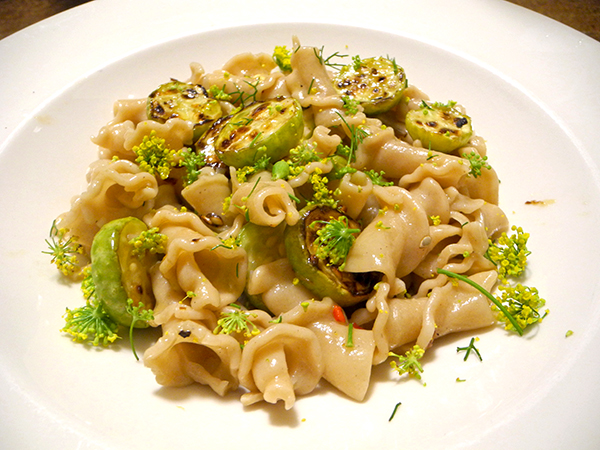
rye pasta with cucumber, scallions, fresh chili, fennel flower

cucumber_rye_pasta

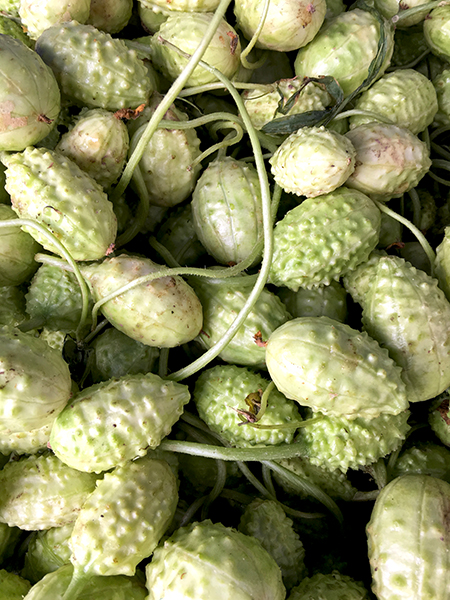
I’ve written before about how much I like Sfoglini pasta (quality, variety of forms and content, seasonal specialties, local origin, striated surfaces). On Tuesday evening I finished the second half of my package of their ‘Rye Trumpets’ (the Italians call the shape, ‘campanelle’, or bells, suggesting these), this time adding an ingredient as rare as, or more rare than that pasta: sautéed cucumbers; more exotic still, they were a variety most people have never seen, Jamaica Burr.

Jamaica_burr_cucumbers

  • Jamaica Burr cucumbers from Norwich Meadows Farm, sliced about 1/4″ thick, dried, sautéed in a little olive oil over a fairly high flame until beginning to color, and then one very small, seeded, finely-chopped red Calabrian pepper from Campo Rosso Farm and several chopped scallions added, in that order, near the end, the vegetables seasoned with salt and pepper before they were mixed with half a pound of Sfoglini rye blend ‘trumpets which were cooked seriously al dente, everything (including some of the reserved pasta water) tossed and stirred over a low-to-moderate flame for a couple of minutes to blend the flavors and the ingredients, served sprinkled with fennel flowers from Ryder Farm
  • the wine was an Italian (Alto Adige/Südtirol) white, from Chelsea Wine VaultLa Manina Manincor 2013
  • the music was Mozart divertimentos/serenades, from the 3-disc album, ‘Mozart: Complete Wind Music‘, in performances by the London Wind Soloists , directed by Jack Brymer

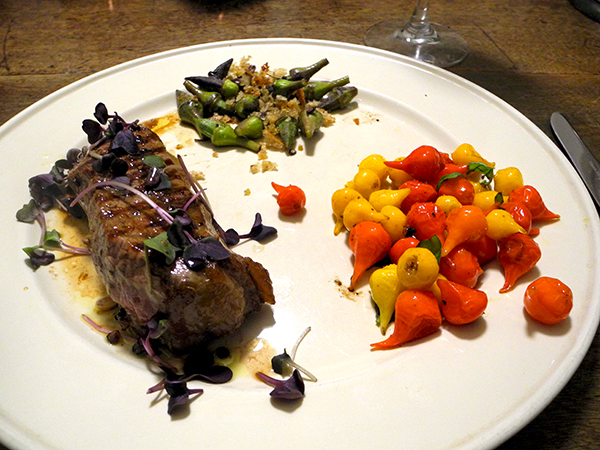
steak, micro radish; okra, chili, breadcrumbs; peppers, basil

tri-tip_tiny_peppers-tiny_okra

The steak was familiar, even to the topping, and so was the okra, even if these were the smallest I had ever cooked, or seen, for that matter. The sweet peppers looked only a little like any I had seen before, and they were definitely smaller than any I had cooked until last night.

I bought the okra because this scant handful was all that was left in the plastic basket in the farm stall; they looked lonely and they were cute.

The peppers, I was assured by the farmer, Chris Field, were not spicy; I love peppers in any form, and I decided these tiny ones could also liven up a meal with their color. I never suspected that they would have a very distinctive flavor, and that they would almost pop inside the mouth, both properties a bit like the South African ‘Peppedew‘.  While talking to Chris at his stand on Saturday, I forgot to ask what they are called, but I may have found an answer while looking on line today: the name may be ‘Little-Beak Peppers’, or ‘Pimenta Biquinho’.

I didn’t think I would be serving the little okra and peppers together (way too cute), but that’s what happened when I lined up the alternatives for 3 meals this weekend.

Yeah, it was pretty cute.

  • two very juicy tri-tip steaks (each just under 7 ounces) from Dickson’s Farmstand Meats, brought to room temperature, dried and sprinkled generously with freshly-ground tellicherry pepper on both sides, pan-grilled for a few minutes, turning twice (sprinkling them with sea salt the first and second times they were turned), removed to 2 plates, a little lemon juice squeezed on top, drizzled with olive oil, purple micro radish from Two Guy From Woodbridge sprinkled over the top
  • barely a handful of tiny okra from Norwich Meadows Farm, sautéed over a high flame in a cast iron pan with a little olive oil and a good part of one small red Calabrian pepper from Campo Rosso Farm, seasoned with sea salt, divided onto the 2 plates, scattered with homemade breadcrumbs (browned a little earlier in a little olive oil with a pinch of salt)
  • tiny red and yellow peppers (not at all spicy hot) from Campo Rosso Farm, sautéed a few minutes inside a copper skillet with a little olive oil, ending with a very small amount of balsamic vinegar, seasoned with salt and pepper, torn basil leaves mixed in, as they finished cooking
  • the wine was a California (Clarksburg) red, Karen Birmingham Petite Sirah Clarksburg 2014
  • the music was that of Hanns Eisler and Paul Dessau, from the album, ‘Nova – Sinfonik In Der Ddr – East German Symphonies’, the day being American ‘Labor Day’, and, although “..officially held in highest esteem, [these 2 East German composers] both challenged the regime artistically.” [excerpted from the album notes – Ed.]

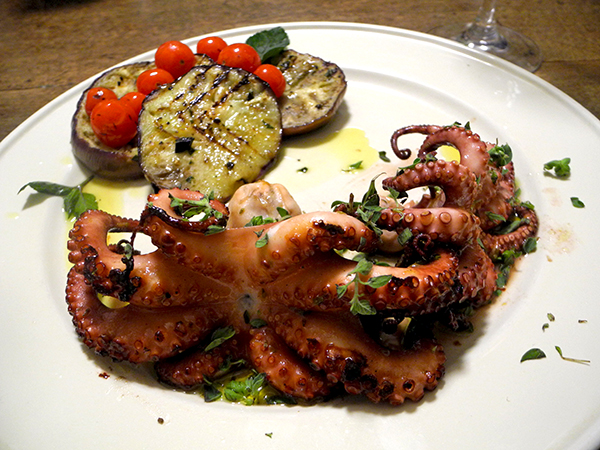
insalata caprese; grilled octopus; eggplant, mint, tomatoes

octopus_eggplant

I know that the pleasure of eating octopus, to say nothing of an interest in preparing it, isn’t something many people share with me, but I’m both really fond of the taste, and continually excited about how incredibly easy it is to prepare.

I also love the color.

Octopus can be found on almost every coast on earth, except our own, the northern western Atlantic. I would love to bring home a local catch, but for the ones we enjoyed Sunday night, I had to travel to Spain (by way of lobster Place) once again.

While these baby cephalopods came from Iberia, polipetti is in fact very Italian, and virtually everything about this meal was also Italian, in fact southern Italian (and much of it really was from Italy): the cheese, the various tomatoes, the bread, the basil, the olive oil, the oregano (fresh and dried), the lemon, the dried chilis, the eggplant, the mint, and the dinner wine itself.

eggplant_platter

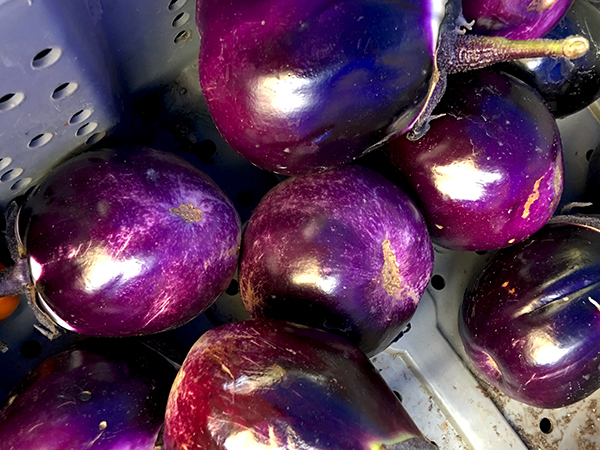
eggplant_Prosperosa

I prepared the grilled heirloom eggplant and cherry tomatoes ahead of time, even prior to assembling the the first course, serving both at room temperature, in Italian tradition, after arranging them on this platter.


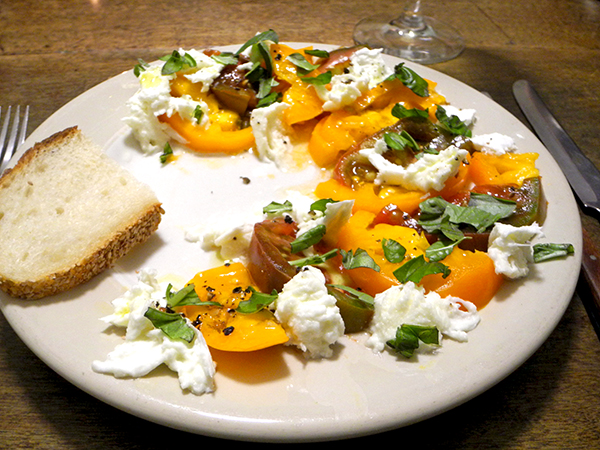
The meal actually began with an insalata Caprese.

tomato_Caprese

  • one red and one orange heirloom tomato from Berried Treasures Farm, sliced into bit-size pieces, arranged on 2 plates, bits of Italian Mozzarella di Bufala Campania from Buon Italia tucked in between the slices, drizzled with a Campania olive oil, Syrenum D.O.P. Peninsula Sorrentina, sprinkled with Maldon salt and coarsely-ground Tellicherry pepper, torn leaves of basil from Lucky Dog Organic Farm sprinkled on top
  • the bread was ‘Sesamo’, from Sullivan Street Bakery

The second course was incredibly simple, because the vegetable had already been prepared and the octopus had only to be removed from a marinade begun in leisure 3 hours earlier, then placed on a grill pan for a few minutes before being finished with lemon, oregano, and oil.

This gorgeous eggplant, a variety totally new to me, was incredibly delicious, and really juicy (since I’m talking about eggplant, I’ll add, “jucy in the very best way”).

  • four baby octopus (a total of about 12 ounces) from Lobster place, marinated in the refrigerator, covered, for 3 hours (although as little as one hour would be acceptable) in a mixture of 1/4 cup olive oil; one teaspoon of dried Italian oregano from the Madonie Mountains in Sicily; the zest and juice of half of a lemon; 1/4 teaspoon of crushed dried Sicilian peperoncino from Buon Italia; 1 1/2 teaspoons of salt; and 2 finely-chopped small garlic cloves from Willow Wisp Farm, the octopus removed from the mix and brought to room temperature, pan-grilled on high heat for 3 to 5 minutes, depending on size, on each ‘side’ (that is, in the case of this creature, mouth/beak down, then lying down on a side), served drizzled with olive oil, a squeeze of lemon, and chopped fresh oregano from Stokes Farm
  • one round Italian heirloom eggplant, ‘Prosperosa’, from Franca at Berried Treasures Farm, sliced into 1/2-inch rounds, brushed with a mixture of olive oil, finely-chopped garlic from Willow Wisp Farm, chopped peppermint leaves from Stokes Farm, salt, and pepper, the slices pan-grilled, turning once, and just before they were done, joined by 16 of ‘The Best Cherry Tomatoes’ from Stokes Farm, the eggplant and the tomatoes arranged on an oval platter, garnished with mint leaves (although, admittedly, ‘garnishing’ is not an Italian gesture at all) and kept at room temperature until the octopus had been cooked
  • the wine was an Italian (Campania) white, Falanghina Feudi di San Gregorio 2014
  • the music was from the album, ‘Comedie et Tragedie – Lully, Marais, Rebel’ (early 18th-century music by Jean-Baptiste Lully, Jean-Féry Rebel, and Marin Marais, performances by Tempesta di Mare)