Author: james

New England 4th: oysters; cod on braised kale

Wellfleet_oysters

one of our favorite things, and very little prep required


A New England Fourth of July, and a remembrance


We decided on a piscatorial 4th of July, if only because it was a Friday, and I almost always buy fish if it’s a Greenmarket day.  As it turned out, there were few stalls in Union Square on the holiday almost everyone celebrates in some way, and there were no fishers.

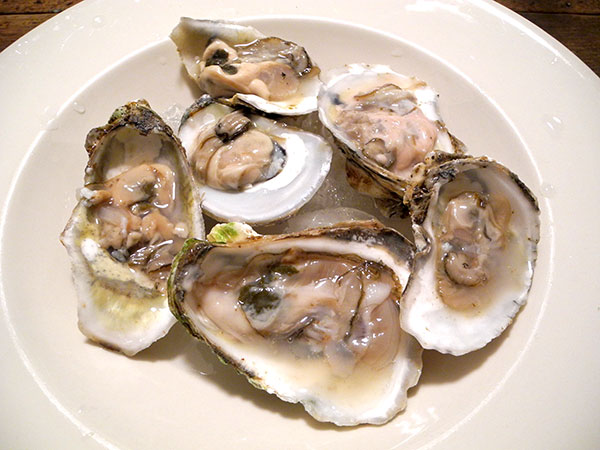
I headed to Citarella, only blocks away (we’re so blessed in our location, for at least some things), and picked up local seafood stars for two courses, 12 Wellfleet oysters*, and a local-waters cod fillet weighing just under a pound.

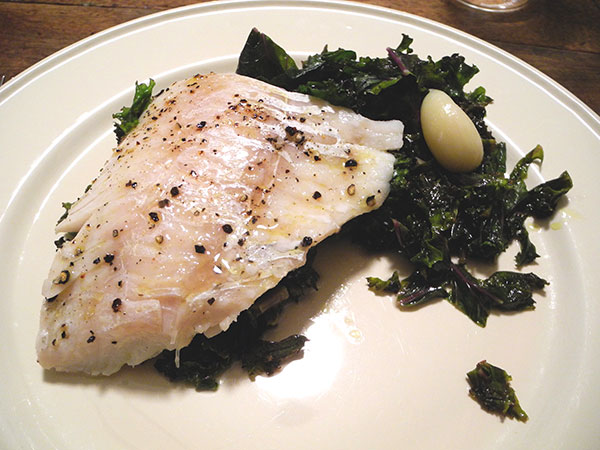
Neither of us adds anything to the perfect simplicity of raw oysters, and I already had some red kale from Phillips Farms, so when planning the meal that evening I decided to keep both courses very simple,  preparing one of our favorite dishes, Mark Bittman’s “Steamed fish on kale”.  Incidentally, it’s an inspired recipe, both for its ease and for its adaptability:  Any white fish can be substituted for cod, and almost any fresh, tender cooking greens can be substituted for the kale used here.  I used olive oil this time, although I don’t know why, other than the fact that most of my cooking is done with the fruit of that tree, but I agree with Bittman that in this case butter is better.

We accompanied both courses with a Muscadet Sèvre et Maine Stéphane Orieux 2013,  from Appellation Wine and Spirits.


cod_on_kale

also a great favorite of ours, with only a little more work


* I believe it must have been briny Wellfleet oysters that were the comestible stars of my romantic  introduction to raw seafood in 1965.   It occurred under the tutorage of a very preppy, impossibly-handsome, older (I was 24, he was 33) Rhode Island gentleman with whom I had just begun my first affair.  The time was a glorious summer afternoon like this one, and the venue was Boston’s Union Oyster House; we sat next to each other on stools at the ancient raw bar.

May Steve be resting in peace, with his ‘drinky-poo’ – maybe  a Mount Gay and tonic – in his hand.  Note to self, and to all:  Barry was not yet born at the time.

cauliflower frittata, tomato/cucumber salad

cauliflower_frittata_tom_salad

only using the oven early in the day


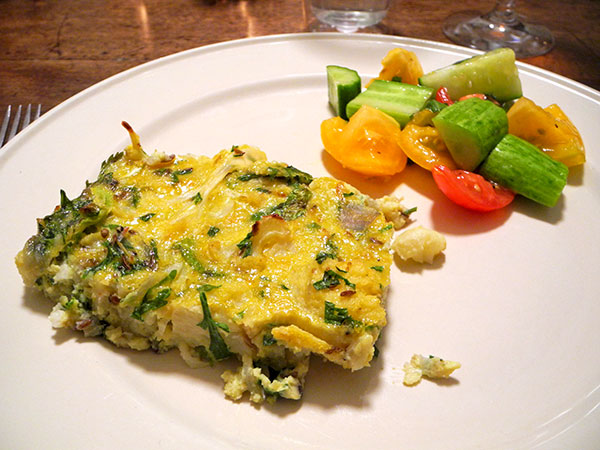
This is another warm-weather entrée, although this one does require some heating, of both the range and the oven, early in the day (or, possibly even better, the day before).  The recipe is based loosely on Martha Rose Shulman’s “Tunisian Style Baked Cauliflower Frittata“, printed in the New York Times last year (in the winter).  It’s a fairly casual formula which would seem to welcome many variations, including, among others, the choice of hot sauce.

I added a salad of ripe summer vegetables, cucumber and tomatoes I had on hand, dressed with oil and white wine vinegar, a pinch of sugar (a nod toward the Maghreb?), and some torn basil and mint.

I served it at room temperature, which is generally ideal for any frittata.

We picked a Sicilian rosé to accompany the meal, Di Giovanna Gerbino Nerello Mascalese Rosato, from Chelsea Wine vault.

smoked trout, potato and cucumber salads

five_cucumbers

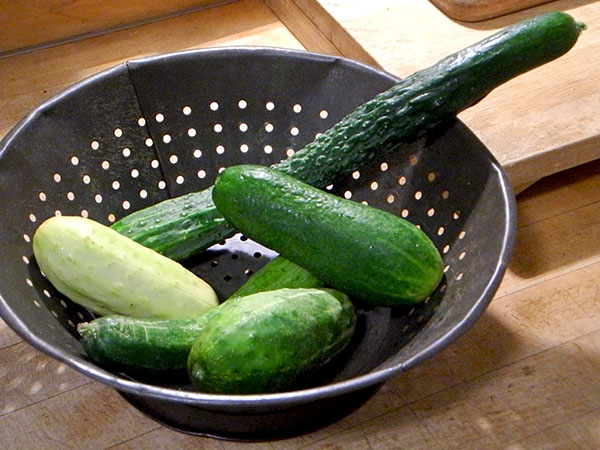
 five different cucumber cultivars


Last Wednesday, thinking to avoid a hot kitchen when we sat down to dinner, and craving a meal which would show off a good German-isch wine, I decided to assemble a meal of smoked trout with classical accompaniments, all of which could be served at room temperature. I headed for the Union Square Greenmarket to land the trout and to pick the vegetables and herbs I’d need for cold potato and cucumber salads.

Finding the trout was easy:  David Harris of Max Creek Hatchery brings some wonderful whole Rainbow and Brook (both fresh and applewood-smoked) into our town every Wednesday.  I already had some red-skin new potatoes at home, purchased  only days before from Eckerton Hill Farms, but, needing cucumbers, I returned to their stand and spotted some beauties in – as I soon found out – five varieties. I asked the cheerful vender which of them might be best for a German cucumber salad in particular; without any hesitation, she suggested I should use a mix (That would probably never have occurred to me;  I’m so literal when it comes to traditional cookery).  I picked one of each, but that evening, in the interest of portion control, our salad included only a mix of three.  They nevertheless made for a complex mix of flavors and textures in a Gurkensalat as good or or better as any I’ve ever tasted.

The relatively simple recipes for the cucumber and potato salads came from my trusty old copy of Mimi Sheraton’s classic “German Cookbook”.   I added lovage to the cucumbers (my innovation this time, because I had it, and because it too is one of my favorite things), then parsley and chive to the potatoes.  All the herbs came from the Greenmarket.   In addition to the fresh herbs, the cucumber salad involved white wine vinegar, white pepper, and  bit of sugar, while the potato salad included shallot (in lieu of onion, which I strangely didn’t have), beef stock, white wine vinegar, and white pepper there too.

The condiment for the trout was my own improvisation: I used softened cream cheese, a bit of softened butter and a small amount of @ronnybrookfarm‘s terrific plain yoghurt, together with grated horseradish from John D. Madura Farm (that stuff keeps forever in the crisper), a taste of L’ekama, which had shown up in a ‘goody bag’ a while back, to spice it up. some ground white pepper, and dill. I also sprinkled chopped dill directly on the trout fillet itself.

The wine?  We lingered long over this meal, partly because we didn’t have to worry about the food getting cold (or, of course, warm), so we were able to sample a bit from two very different bottles.  The first was a very pleasant Sylvaner/Riesling blend from Rheinland-Pfalz, an der Nahe, produced by Weingut Rapp;  the second was an outstanding Niederösterreich Grüner Veltliner from Landhaus Mayer.

We expect to be eating with a German accent more often.


smoked_trout_cukes_pot_salad

very cool on a hot night

redfish fillets en papillote, summer squash

presentation


I’ve really neglected this blog for some time, having been seduced by the ease and speed of Twitter, but sometimes 140 characters are more inadequate than usual for describing a really good meal (or almost anything else for that matter).

On Friday I came back from the Union Square Greenmarket with what the Pura Vida stand described as Redfish fillets.  They had stood out from the rest of the huge iced selection because they were not something I had cooked recently (actually, I’d not cooked them ever), because they looked beautiful, and  because the price was more than reasonable (I paid a little over $10 for two filets of about 6 ounces each).  Not familiar with the name (and fish names are notoriously imprecise), I asked what Redfish might be compared to.  I was told Red Snapper would be a fair equivalent, and that they were a mild-tasting fish.

Back home I went through my files of notes and recipe cutouts and eventually opened up Mark Bittman’s “Fish“.  One of his suggestions, “Red Snapper Fillets En Papillote“, almost jumped off the page.  It was fairly simple and uncomplicated, and I had all of the ingredients, fresh (all from the Greenmarket) and otherwise, already in the kitchen.   Bittman offered it as a basic recipe, to which he provided five variations.  I may find one or more of them useful another time, but I was amused by his suggestion, “Its sometimes interesting to make several different combinations at the same meal, so each serving is a surprise”.  There were only two of us for dinner, and it was still summer, so I absolutely had to go with the basic recipe, which allowed me to use more of the luscious heirloom tomatoes I had bought from Berried Treasures that day.


The procedure involved placing each fillet on a piece of parchment (large enough to enclose it once the other ingredients were added), then layering them with thin red potato slices (from Keith’s Farm) and thicker slices of red and  yellow tomato, sprinkling them with salt & pepper and shredded basil (from Stokes Farm), then drizzling them with oil.  The sealed packages were placed in a pan and baked at 450˚ for about 20 minutes (I think I removed it when I smelled the aromas) .

I had also picked up a few beautiful small zucchini and yellow squash from Sycamore Farms at the Greenmarket that day.  Thinking that my paper-wrapped entrée might not be quite enough for a meal without a first course, I started thinking about what I might do with them as a side dish.   In a hurry for ideas, I went to the internet and  quickly came up with a 1997 recipe from Gourmet magazine, “Grilled Zucchini With Black Olives And Mint“.   Great!  I had the Kalamata olives, some lemon, and a bunch of mint bought from Franca at Berried Treasures in the Greenmarket that day.  I pan-grilled diagonal slices of both the yellow and green squash, for color, before baking the fish packages, and kept them warm in a bowl on top of the oven (which is, handily, next to the burners on my 1931 Magic Chef.

We drank a bottle of Bourgogne Aligoté, which I believe we had purchased at Pasanella.  Terrific.

It was one of those meals where everything comes together perfectly.  It was totally delicious, with everything complimenting everything else.   And it was all so easy.  As the cook I also appreciated that I had nothing to do for twenty minutes after placing the entrée in the oven except sip on a Martini and nibble a few thin breadsticks.  I’m now totally sold on the en Papillote thing, for the rest period it affords, for everything being cooked á point, for the flavors having ended both blended and subtly distinguishable, and for the fact that everything was wickedly juicy.  I was also surprised that the seasoning needed no adjustment whatsoever.

Also, to tell the truth, I thought the meal looked awesome, no small matter for me.

Two more bonuses of the en papillotte technique:   First, it was amazing to find that while we were enjoying the fish at a very leisurely pace, it stayed warm throughout (not an easy thing to arrange when cooking fish). Second, the parchment-wrapped fish with its vegetables completed (in fact, more than dominated) the plate all by itself (I served the squash on a side plate), and so gave the impression of a much more luxurious portion than it was, although we did not feel the least bit deprived.

Finally, I only thought about it when I began to consider this post, but it was definitely satisfying to realize that the ingredients for the entire meal were pretty inexpensive.  Of course, as always, there’s real economy (of  both cost and time) in cooking regularly.


remains
 

garlic scapes


There was no way I was going to leave Bill Maxwell’s farmstand in the Union Square Greenmarket yesterday without some of these beauties.  Garlic scapes are the curling stalks, or ‘scapes’ of conventional garlic when it first appears in the spring.   They are removed by the farmer in order to encourage the growth of the bulb below.  They have a mild, fresh aromatic taste and hardly need any cooking.  I use them in any way I can;  tonight they will grace a simple dish of pasta.

Minutina, Erba Stella, or Bucks Horn

“Minutina”, or “Erba Stella”, or “Bucks Horn”, take your pick.

I snapped this picture with my phone at the Bodhitree Farm stall at the Greenmarket last week, to remind myself to learn more about this very beautiful “herb”, and how it might best be used.  While I bought some equally gorgeous tatsoi that day, which I served as a side dish for Wienerschnitzel, I’m now anxious to snap up a bunch of Minutia, or Erba Stella, the very next chance I get.  Looking at this picture I totally understand the star reference in one of its names.  Oh, it’s also called “Bucks Horn”, the name by which it was known here in the colonial period, for the slightly ragged or pointed edges of its leaves.

I was delighted to learn that it’s also very much an Italian thing, a cold weather salad green (and in fact a succulent) with a mild nutty flavour and slightly crunchy texture.   Best when it’s young, it can be used in salads, where it contributes its own virtues in a crowd (not least its leaf shape and texture).  I’m actually likely to use it more often wilted with a bit of olive oil (with or without garlic) as a side or garnish for a meat or fish entrée, or as a bed for fish, meat, cooked vegetables, or – perhaps an inspiration here – eggs.

For the gardeners out there, it seems it’s incredibly easy to grow, that new growth follows after harvesting, and that it’s pretty hardy to boot.


lamb shanks, polenta, baby collards

dinner, March 24, 2013

I recently seized what may have been my last chance to enjoy a seasonal rich meal like this (it would definitely have felt out of sync with the warmer weather surely now just around the corner).

While on one of my regular visits to the Union Square Greenmarket the other day I learned that the shepherds of 3-Corner Field Farm, who offer their wonderful meats and cheeses – and more – there most of the year round, would be away from the local scene for a while (it’s lambing season).  I had just bought two beautiful rainbow trout from Dave at Max Creek Fishery, so I was stopping by their stall only to pick up a round of their incredible Shushan Snow cheese.  When I learned this would be my last chance to buy anything from them for a while, I decided to take home some chops, and two small (10 ounce) shanks as well, both for freezing.

We had already enjoyed the delicious chops, incredibly quick and easy to prepare, but my favorite recipe for slow-cooked shanks seemed a delightful way to perfume the apartment with cooking odors on a Sunday evening when we weren’t going to be going anywhere.   I was encouraged by the thought that the very fresh, and very sweet baby collards I had once again picked up from Rogowsky Farm (also in the Greenmarket) the day before would be a perfect foil for the rich flavors of the meat and its (virtually inevitable) accompaniment, polenta.

My standby recipe is taken straight from the first of the terrific Gray and Rogers cookery tomes, “Rogers Gray Italian Country Cook Book“;  this is my broad description of how I dealt with its details:

  • I first dipped the shanks in flour and browned them in a heavy oval enameled cast iron pan.
  • I removed the meat while preparing the remaining ingredients of the dish in the same pan, first sautéing two very-thinly-sliced red onions until they were soft and slightly brown, then adding a small handful of chopped fresh rosemary leaves and chopped garlic.
  • I continued to cook the mix, but only briefly.
  • Finally I added a quarter cup of balsamic vinegar and almost half of a cup of good red wine (Cabernet Franc, this time), and turned up the heat for a few minutes to reduce the liquid a bit.
  • The lamb went back into the pan, and I covered everything with a sheet of wet parchment which I had cut to reproduce its shape.  I reduced the heat, covered the pan, and placed it in the oven to cook slowly for two and a quarter hours, basting occasionally, and adding more wine when the onion mixture looked dry.

I finished the coarsely-ground polenta (yes, with a pretty generous amount of butter) by seasoning it and mixing in some grated Parmesan cheese and chopped fresh marjoram.

I sauteéd the collards lightly in a pan in which I had briefly sweated two bruised garlic cloves.

The wine we accompanied it with was stunning, a Cannonau Di Sardegna D.O.C.  20008, the pairing Barry’s inspired choice.

Pike sauteed/baked, parsley potatoes

dinner, early October, 2012

the Northern Pike (Esox lucius)


Fillet of fresh, wild West Virginia Pike from The Lobster Place, cooked auf Badische Art (although modified a bit), that is, seasoned, floured, and quickly-sauteed, then placed in a moderate oven after being sprinkled with guanciale cubes which were replaced after a few minutes, in consecutive stages, by diced onion and dill sprigs and finally by dots of butter, the fish finished in a very hot oven until the skin became crispy; accompanied by boiled parsley potatoes (Norland Red) finished with butter;  and a small lightly-dressed salad of cress, along with one sliced red heirloom tomato, on a dish to the side.

The recipe was modified from that in “Culinaria Germany”.

The wine was Franken, Hans Wirsching Iphofer Kronsberg Silvaner trocken 2010 (in a Bocksbeutel)


[image from the Wikipedia entry for Northern Pike, where it was isolated from the coat of arms of the Lower Saxon town of Gimte; the copyright holder has released the work into the public domain]


Kassler Rippchen and/in sauerkraut

dinner, 3/9/12

My ancient copy of Mimi Sheraton’s The German Cookbook comes to the table again:  I had brought home two beautiful smoked pork chops (Kassler Rippchen) from John of  Lancaster County’s Millport Dairy stall at the Union Square Greenmarket two days before, and the contents of our larder at home pointed me to how I should serve them.  I already had a bag of sauerkraut, some great potatoes, a medium onion and one green-ish apple (all but the cabbage picked up on earlier trips to the Greenmarket), so the solution seemed obvious.  It would be Kassler Rippchen and sauerkraut.  The only question would be what wine to accompany it, and the Austrian light-to-medium red we had on hand was an excellent, if perhaps unusual choice.

  • Kassler Rippchen, in this case meaning two excellent smoked pork chops from Lancaster County’s Millport Dairy, seared very quickly over a very hot flame, then placed in a 375º oven, near the end of the 45-minute cooking time for its other contents (the pork, smoked and ripened in a salt brine, does not have to be ‘cooked’ any further itself), inside a covered casserole which had begun with a mixture one chopped Gold Rush apple from Phillips Farm and one chopped onion, lightly-sautéed, half a pound of rinsed sauerkraut, also briefly-sautéed after the apple and onion, and in the same pot, and half a pound of small thickly-sliced (un-peeledBintje potatoes from Mountain Sweet Berry Farm, the mix moistened with a bit of good chicken stock and a bit of dry white wine
  • wine:  Austrian, Rose Schuster Zweigelt Classic 2009 Burgenland from Astor Wines