Author: james

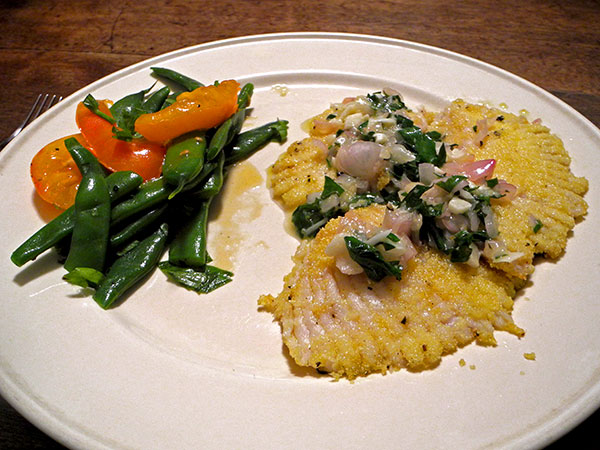
skate with shallots, flat beans with tomato

skate_flat_beans_and_tomato

  • skate from Pura Vida, ‘breaded’ with seasoned polenta flour, pan-fried until golden and removed to plates, shallots and garlic quickly added to the wiped pan with a bit a bit of butter, where they sweated a bit, the heat then turned off , lemon juice and chopped parsley introduced, the simple sauce then spooned over the skate
  • flat green or Romano beans from Berried Treasures, par-boiled, drained, dried, and reheated in a bit of olive oil, then combined with chopped orange heirloom tomato from Central Valley Farm
  • the wine was a Southwest France rosé, Côtes de Duras “La Pie Collette,” Mouthes le Bihan – 2013

I originally found the recipe on the Kisscook site.


oregano/lemon grilled squid, yellow beans, lovage

squid_-yellow_flat_beans


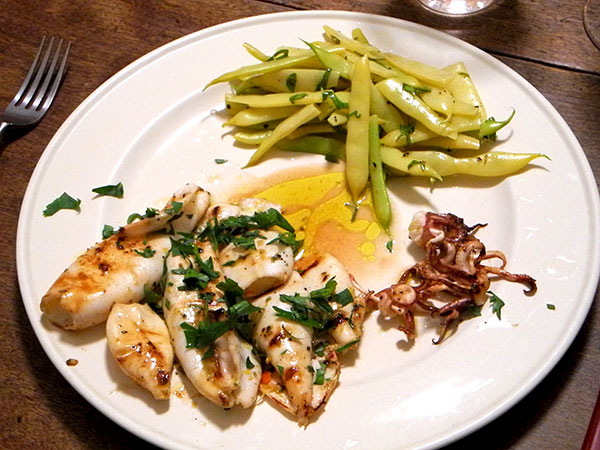
Once again, the fact that I didn’t want to use the oven on a warm evening was something of the mother of invention, or perhaps this time only the mother of an impetus for borrowing.  My favorite recipe for squid involves a very hot oven, however briefly, so I knew I’d want to come up with something else two nights ago.  This dish is a fairly close working of a recipe created by two people I hadn’t heard of (we really never see TV here at Chelsy acres), Dan Smith and Steve McDonagh, found on line while I was searching for ‘squid’ and ‘grilled’.  It seemed easier, and actually looked better than another I had seen by Lidia Bastianich (I have heard of Lidia.  If  you know her, don’t tell her what I said).

It was delicious, and it’s definitely going to stay in the repertory.

  • squid bodies and tentacles (this time not enough, to my taste) from Blue Moon Fish, marinated for about half an hour in lemon zest and lemon juice – here using exactly half a lemon for each (I love that home economy thing) – garlic, oil, dried oregano, salt and pepper, then removed from the marinade and pan-grilled briefly over high heat, sprinkled with lemon juice, and chopped parsley from Paffenrath Gardens
  • flat yellow pole beans from Bodhitree Farm, parboiled, drained, dried, later re-heated briefly with olive oil, seasoned and sprinkled with lovage from Mountain Sweet Berry Farm
  • the wine was a Spanish white which uses Verdejo grapes, one which we’ve been enjoying frequently lately, Shaya Rueda 2012 

Pimientos de Padrón; scallops, salsa verde, trifolati


scallops_trifolati

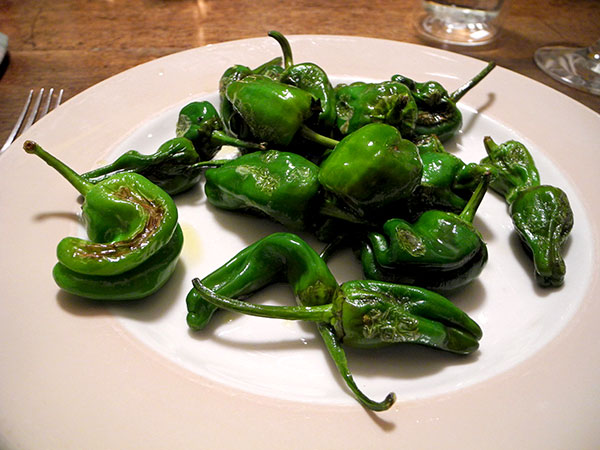
  • a first course of sautéed pimiento de padrón, from Lani’s Farm, finished with a sprinkling of flaky Maldon salt, followed by
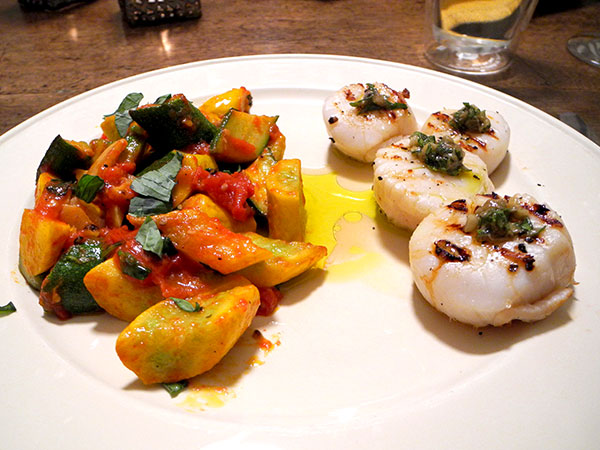
  • pan-grilled scallops from PE & DD, finished with a drizzle of lemon, olive oil, and a dollop of salsa verde (chopped parsley and mint, olive oil, garlic, capers, anchovy, dijon, red wine vinegar), accompanied by
  • zucchini and yellow squash trifolati, here including San Marzano tomatoes from Mountain Sweet Berry Farm, finished with basil and allowed to sit for a half hour or so, after a recipe in “Italian Too Easy“.  The small, very sweet zucchini were from Berried Treasures, their yellow counterparts from Stoke’s Farm, and the Gotham Greens (Brooklyn rooftop-grown) basil was from Whole Foods
  • the wine was a Spanish white, Naia 2013 D.O.C. Rueda, from Verdejo old vines

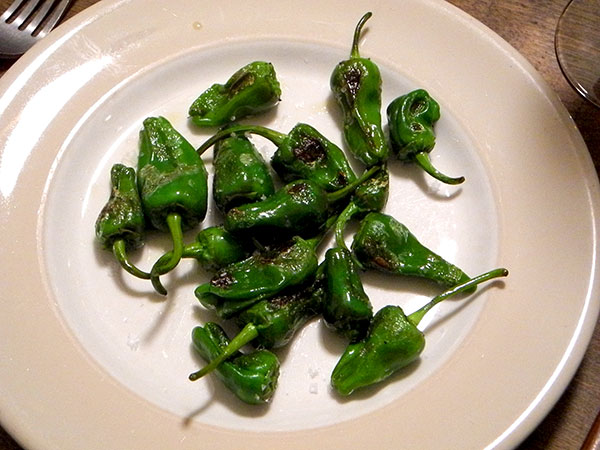
The last time we enjoyed Pimiento de Padrón was as the first course of  a meal which followed with steak;  this time it preceded a seafood entrée.  The only other difference, aside from two the separate farm origins, lay in their Scoville reading.  In our experience with this second meal the little green peppers far exceeded the ratio usually attached to their reputation (a one-in-ten chance of hotness), and the ‘heat’ itself was the most extreme either of us had ever experienced. I’ve since done some checking on line, and in conversation as well:   While it seems that ultimately there’s no general agreement about the cause, the figures for their randomness, or their varying intensity, I’m guessing (after some sensible input from a Greenmarket farmer) that the little green ones might get pretty fiery if denied a lot of water while maturing in the sun.   In any event, I have to say that they’re unbelievably delicious when you can actually taste them.  Salto Mortale.  I’m not sure the Spanish Salto Mortal suggests the same thing, so I’ll just go with, “Los pimientos de padrón, unos pican y otros no”.  An image of the plated hotties appears below.

pimientos_Lanis

nasello dorato, yellow pole beans, grilled tomatoes

hake_yellow_flat_beans_tomato

I was so taken with the look of the hake fillet at PE & DD in the Greenmarket today that I didn’t think about what I would do with it when I got home.  Only when I had gotten there did I remember that all of the recipes I have used with hake involved a hot oven.  While the temperature outside was as remarkably moderate today, I had no interest in spoiling the coolness of the evening by stoking a 400º stove.    But hake is very similar to cod, and eventually I remembered a simple and delicious recipe which I’ve used with cod fillet:  merluzzo dorato.    I believe the hake version would be called nasello dorato in Italy, but, in any event, I can say for certain that it was a wonderful surprise:  It was the most delicious hake entrée I’ve ever had.

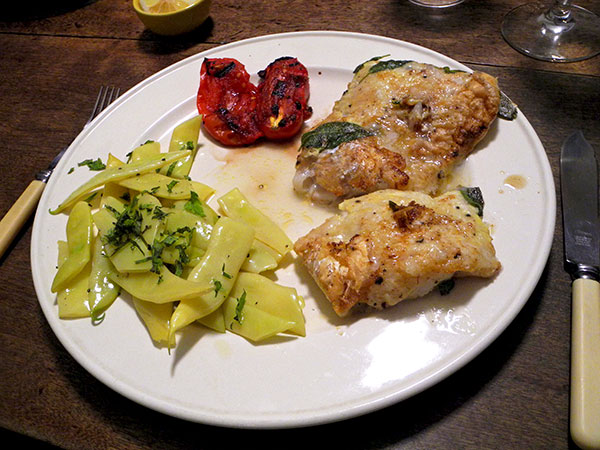
  • hake fillets from PE & DD, dredged in seasoned flour and dipped in a beaten egg from 3-Corner Field Farm, sautéed in butter along with a handful of sage leaves from Keith’s Farm, then sprinkled with lemon juice and the pan juices that remained.
  • small seasoned pan-grilled San Marzano tomatoes from Mountain Sweet Berry Farm, finished with a dab of olive oil and a bit of balsamic vinegar
  • flat yellow pole beans from Norwich Meadows Farm, blanched, then reheated later in a bit of olive oil, seasoned and finished with chopped lovage from Keith’s Farm
  • the wine was one of our favorite Spanish whites, Naia 2013 D.O.C. Rueda, from Verdejo old vines.

grilled halibut & salsa verde, eggplant with oregano

halibut_Japanese_eggplant


For a very long time I’ve been thinking of halibut as a kind of holy grail.   I think it’s because it’s so minimal and because it’s a beautiful piece of fish, either as a fillet or as a double steak.   I also know how delicious it is, and I know how easy to prepare – and how versatile – it is.   It’s also because I don’t see it in the Greenmarket (does it ever show up here?), and because it’s almost always very expensive in New York City.  There’s also that tantalizing picture I see almost every time I open my copy of the “Italian Two Easy” London River Cafe cookbook.  The image is appears on page 194, across from a very simple recipe for “Halibut on the Bone” (on the bone, because the taste of fish, just as with meat, gains from being cooked with the bone).

I wanted to serve fish last night, but I had been unable to get to the Union Square Greenmarket because we had to be ready for a photo shoot inside the apartment.  When we emerged from that stimulating experience hours later, I headed down the block to our local Whole Foods to pick up something which wouldn’t require much time or assembly.  I can usually count on finding a good piece of wild salmon there, but even before I had gotten all the way to the counter I spotted it:   a display of double steaks of halibut, looking exactly like those featured in the Gray and Rogers book, except that they still needed the attentions of a cook.  The price per pound was exactly half of what I’ve been seeing around town for months, so I didn’t hesitate a second.  Besides, the halibut was taken from waters just north of our own temperate Atlantic  shores (somewhere off eastern Canada), and had probably not been frozen, while the salmon would have had  to swim all the way from Alaska, and certainly had been frozen somewhere along the way.  The price of wild fish, including salmon and halibut especially, can fluctuate dramatically;  I try to take advantage of the best market opportunities.

It was delicious, it was easy (and that includes the very good  – and itself very versatile – salsa verde which can be finished even before heating a pan), and I’m going to keep looking for it in the Greenmarket.

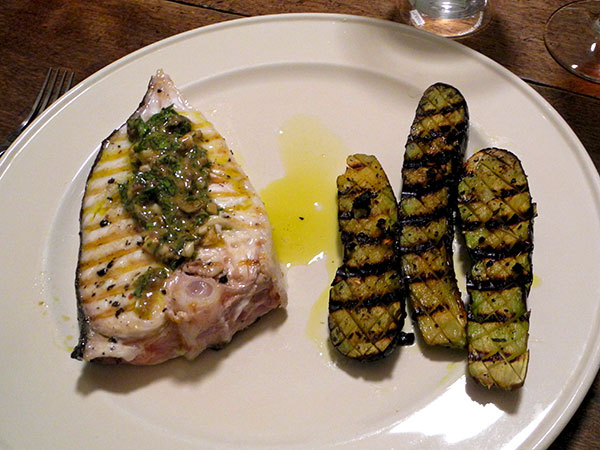
  • double halibut steak, cut into two servings, seasoned lightly, brushed with olive oil, grilled for a couple of minutes on each side, then finished with a squeeze of lemon and served with green salsa
  • salsa verde, or green salsa, of chopped flat-leaf parsley and mint leaves covered with olive oil, combined with minced garlic, capers, anchovy fillets, dijon mustard and red wine vinegar
  • eggplant based on Mario Batali’s “”Thousand Ridges Japanese Eggplant”, meaning cutting the vegetables in half, carefully scoring them and spreading a mixture of olive oil, garlic and dried oregano on the cut side, seasoning each, then placing them on a hot ribbed iron pan for a few minutes, turning over once.
  • the wine was an Italian rosé, Il Conventino Rosato del Conventino 2013 Toscana
fennel seed-grilled tuna, bell peppers, radish greens

tuna_bell_peppers_radish_greens

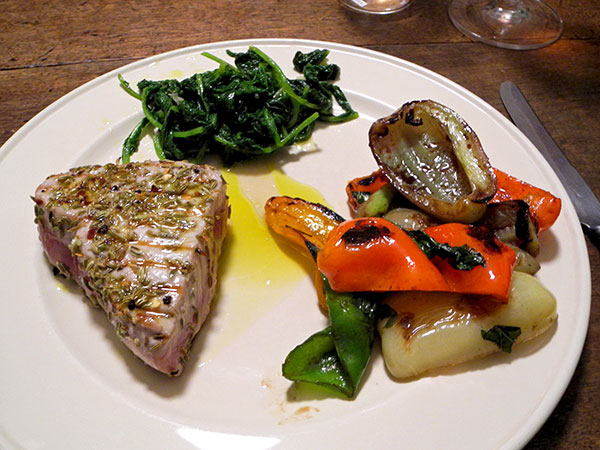
  • tuna steak from Blue Moon Fish, covered with a mixture of fennel seed and crushed dried chile pepper ground together, seasoned, then pan-grilled and finished with a bit of lemon and olive oil
  • small parti-colored peppers from Norwich Meadow Farms, sautéed above a high flame until slightly caramelized, the heat then turned down, torn basil and a splash of balsamic vinegar added
  • radish greens from Bodhitree Farm sautéed  in a bit of oil in which a chopped scallion from John D. Madura Farms had previously been softened, finished with salt & pepper and a splash of oil
  • the wine was an Austrian rosé, Markowitsch Pinot Noir Rosé Carnuntum 2013

sautéed pollock, salsa fresca, slow-cooked fennel

sauteed_fennel_London

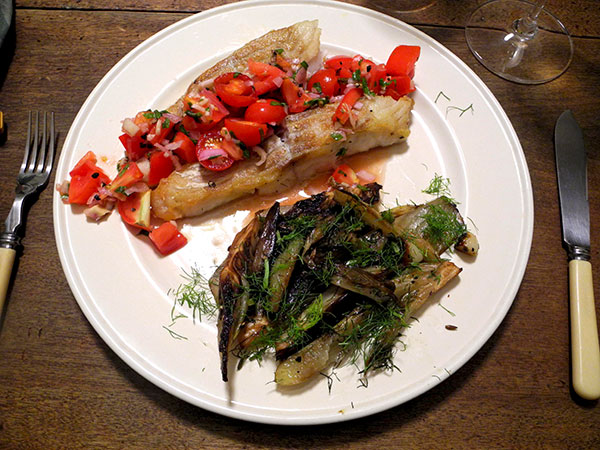
This was an incredibly delicious meal which incorporated several much-too-under-appreciated foods, including pollock, lovage, fennel, fennel seeds – and fennel fronds!  Did I say that the Pollock was really, really good, and that it tasted nothing at all like fish fingers or fake crab meat?  In fact, with its somewhat crispy edges, even without skin, the taste and the textures reminded me of the freshwater perch I enjoyed so much decades ago in the Midwest;  so maybe it was the flour?

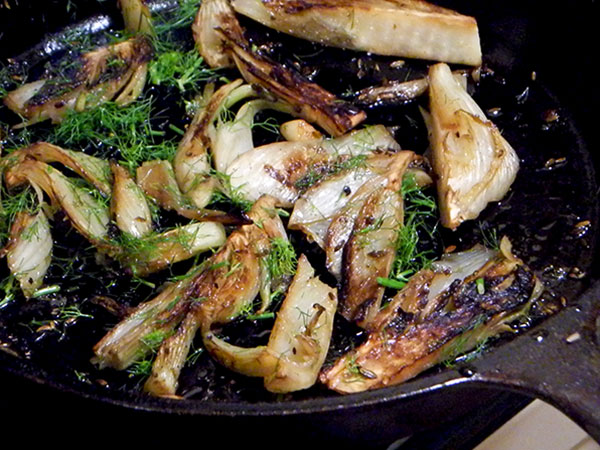
  • a one-pound pollock fillet from PE & DD Seafood, cut into four sections, dredged in seasoned flour, sautéed in olive oil over a fairly high flame, served with a salsa fresca (assembled just before the fish was begun) of chopped plum tomatoes from Phillips Farm  and halved cherry tomatoes from Keith’s Farm, minced garlic and shallot, chopped lovage from Keith’s Farm, a tiny bit of a very hot fresh pepper, sherry vinegar, salt, and pepper [basic recipe from Mark Bittman’s “Fish Complete Guide to Buying and Cooking”];   the vegetable proper was a separated bulb of fennel from Norwich Meadow Farms sautéed over medium high heat with garlic, chiles, and fennel seeds in a large iron pan until the fennel began to color, then, with the heat lowered and the pan covered, cooked for ten minutes, a generous amount of chopped fennel fronds added at the end [recipe from “Italian Easy: Recipes from the London River Cafe”].
  • the wine was a Spanish white, Shaya Rueda 2012 

pollock_tom_salsa_fennel

spinach/ricotta ravioli, tomato, basil, parmesan

spin_rav_tom_basil_parm


This is pretty much the extent of our  fast food practice, except for the nights when we have a good pizza delivered.

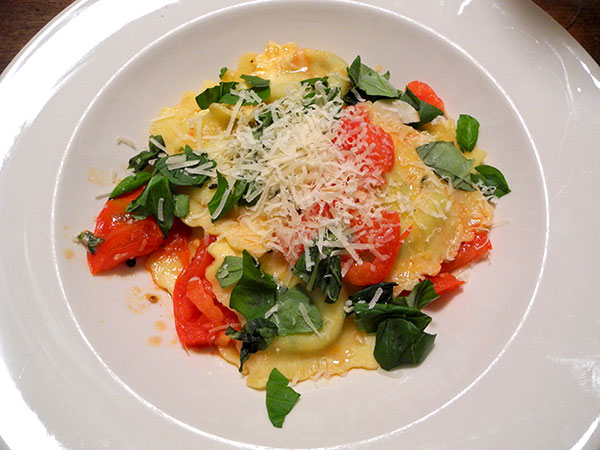
  • the makings for this and similar meals are usually already in the apartment, at least in summer and early fall.  This time it began with a package of frozen Rana spinach-and-ricotta-filled ravioli, which I only had to cook for about three minutes, once a generous amount of salted water had come to a boil.  Prior to adding the pasta to the water I had warmed slivers of garlic with some chiles in a pan, turned off the heat, waited a bit, then added some quartered slices of a sturdy, perfectly-ripe one-pound tomato from Norwich Meadow Farms.  I drained the pasta, added it to the pan, and gently shuffled all the elements with a narrow wooden spatula.  The ravioli mix was served in bowls, finished with torn basil and shaved Parmesan cheese.
  • the wine was an Italian rosé, Il Conventino Rosato del Conventino 2013 Toscana


cod in green sauce, zucchini-tomato-basil trifolati

zucchini_teenagers


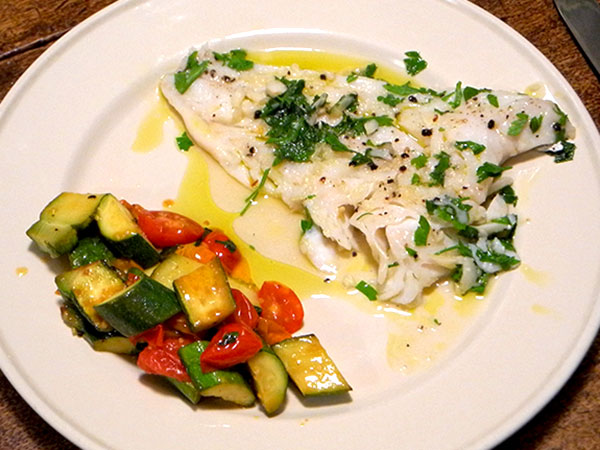
  • cod fillet from PE & DD Seafood, slowly sautéed for a few minutes along with a minced clove of garlic which had been begun to color in the oil, then flipped, with a generous amount of chopped parsley from Keith’s Farm added to the pan, and cooked  a few more minutes until done.  The recipe is described by Mark Bittman, in “Fish”, as a ‘Basque staple’. It’s as simple as it is delicious.
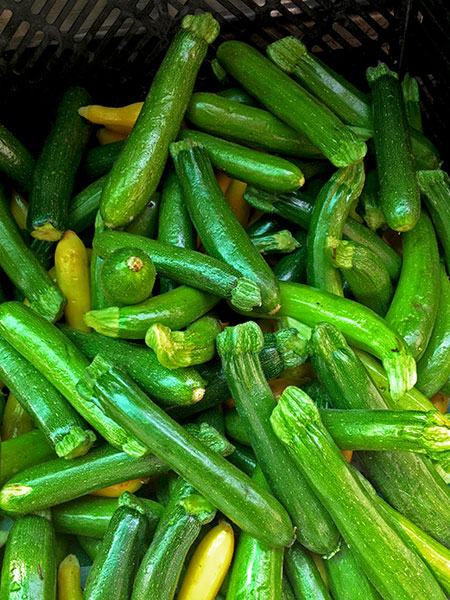
  • zucchini trifolati, with two kinds of cherry tomatoes and chiles, finished with basil and allowed to sit for ten minutes or so, after a recipe in “Italian Too Easy“.  The sweet teenaged zucchini were from Berried Treasures, the Sun Gold tomatoes from Tamarack Hollow Farm, the red the cherry tomatoes from Keith’s Farm, and the Gotham Greens basil from Whole Foods.
  • slices of crusty Truccio Saré from Sullivan Street Bakery down the street.
  • the wine was a Spanish white, Naia 2013 D.O.C. Rueda, from Verdejo old vines.

cod_zuc_tom_trif

pimiento de padron, ribeye, radicchio, okra, greens

pimiento_de_padron

There were two courses in the meal we enjoyed last night.  The appetizer was a serving of sautéed pimiento de padron from Bodhitree Farm, finished with a sprinkling of flaky Maldon salt.

ribeye_okra_radicchio_radish_greens

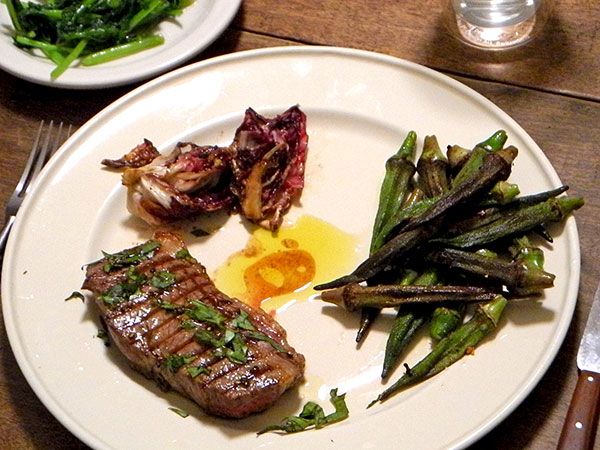
The main course consisted of two really terrific 5-ounce ribeye steaks from Dixon Farmstand Meats, pan-grilled and finished with lemon, lovage (from Keith’s Farm), and oil.  They were accompanied by both green and purple okra (from Bodhitree Farm, like the pimiento), sautéed with red pepper flakes.  There was also a little radicchio, from Tamarack Hollow Farm, which was quartered, dipped in oil, a bit of balsamic vinegar, and minced garlic, pan-grilled, sprinkled with salt, and finally dressed with some of the reserved balsamic mixture.  The other contorno was a small plate of radish greens from Norwich Meadow Farms, sautéed in oil in which a garlic clove had been softened.

The wine with both courses was a Castilla-La Mancha Tempranillo, Venta Morales 2012