Author: james

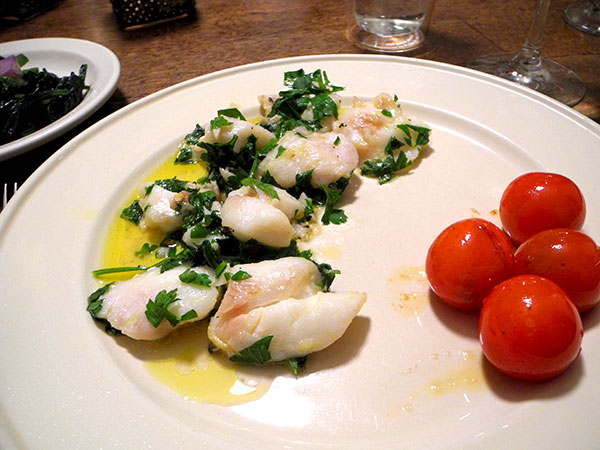
cod cheeks with green sauce; tomatoes; greens

cod_cheeks_mustard_greens


‘Cod cheeks’?  Well, yeah, I had heard of them, but even though I lived in Rhode Island and Massachusetts for 21 years, I had never tasted them, and I had certainly always thought it unlikely I’d have the chance to prepare them.   Then I spotted the rarity (at least commercial) displayed at our local super fishmonger, Lobster Place, while I was picking up some wild Alaska salmon on a non-Greenmarket day.  I asked the very smiling guy if he would kindly put back the fillet I had just ordered, and which he had already wrapped, and would he please give me some cheek?  I got the cheek, with good humor, but I also got the cod cheeks.

I thought I’d find some fantastic recipes when I searched my sources at home, but I was surprised to find nothing in my books or my own files (clippings, mostly).  Even the internet wasn’t really much help, since I wanted to keep the preparation pretty simple so I ended up improvising, almost as I went along.

I do think I’ll try flouring or breading them next time, as I imagine that a bit of crunch is one of the few pleasures missing from the recipe I assembled.  Or  maybe next time I should just think, ‘scallops’.

  • cod cheeks from  from Lobster Place in Chelsea Market, introduced into a pan with lots of olive oil in which minced garlic from Berried Treasures and a thinly-sliced Thai pepper from Norwich Meadows Farm had been heated, the flame turned down so that they were literally ‘poached’ in the oil for a couple of minutes until springy to the touch, the oil then poured into a cooled bowl, the heat now turned very low below the pan, and the oil slowly re-introduced, along with a generous amount of chopped parsley from Paffenroth Gardens
  • cherry tomatoes from Berried Treasures, punctured and heated in olive oil until almost bursting, seasoned
  • dark purple/green mustard from Lani’s Farm, braised with a little garlic from Berried Treasures, finished with olive oil
  • the wine was a white Portuguese, Aveleda Douro D.O.C. 2012
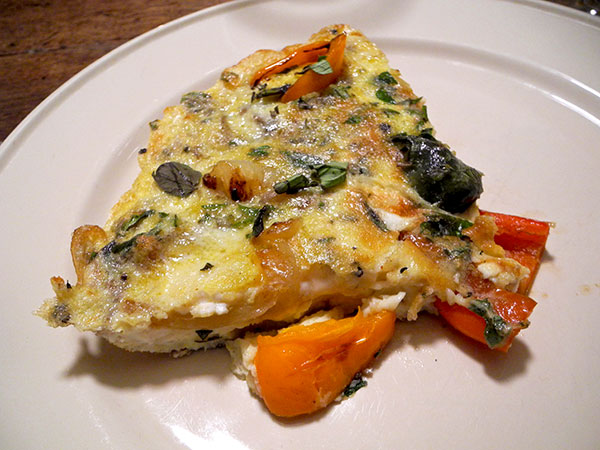
frittata: sweet & hot peppers, garlic, shallot, oregano

caramelized_sweet_pepper-_frittata


This entrée was an improvisation.  I had the ingredients on hand, I had a lot of confidence in their quality, and I wanted to use them while they were still fresh.

I should explain that the image should have represented a proper wedge (one quarter of the very juicy frittata), but it managed to attract some of the vegetables belonging to it neighbors.

  • small multi-colored bell peppers from Norwich Meadows Farm, sliced to form large (ish) pieces, sautéed  in a large cast-iron pan until partially caramelized, with one sliced shallot from Phillips Farm, some sliced garlic from Berried Treasures, and one small, finely-chopped Thai pepper (also from Norwich Meadows Farm) added near the end, then 10 small pullet eggs from Norwich Meadows Farm, seasoned and fork-whipped, poured to the pan, everything sprinkled with chopped fresh oregano from Central Valley Farm, the frittata finished under the broiler once the eggs had begun to set halfway to the center
  • the wine was a Spanish red, Flavium Crianza Bierzo 2006, a Leon, from from Phillipe Wine

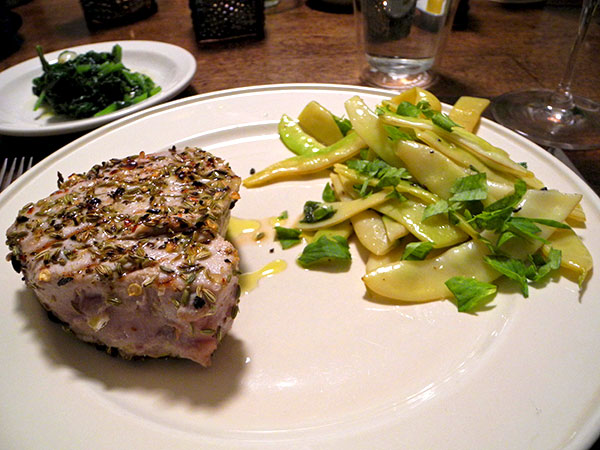
tuna with fennel seeds; yellow Romano; greens

tuna_fennel_Romano_greens

The tuna preparation here is another of my absolute favorite recipes, definitely a classic, very, very easy, and, like so many others, it’s from one of the series of London River Cafe cookbooks. in this case, “Italian Easy“.

  • tuna steaks from PE & DD Seafood, seasoned, then covered with a mixture of fennel seeds and chiles crushed together in a mortar, pan-grilled over a fairly high flame for only a minute or two on each side, then finished with a generous squeeze of lemon and some olive oil
  • yellow Romano beans from Norwich Meadows Farm, briefly parboiled, then finished with lovage from Windfall Farms
  • radish greens from Bodhitree Farm, braised with garlic from Berried Treasures, seasoned, then finished with olive oil
  • the wine was a French rosé, Olga Raffault Chinon Rosé 2013

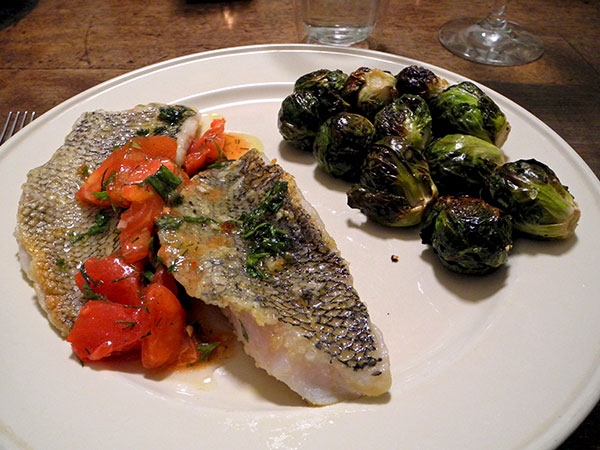
sea bass, tomato vinaigrette; roast Brussels sprouts

sea_bass_salsa_brussels_sprouts

This meal really came together only after Franca pressed a gorgeous, very ripe red tomato into my hand just as I was leaving the Greenmarket yesterday.  Already the night before I had planned to buy a firm white-fleshed fish fillet, or fillets, in Union Square and accompany them with some Brussels sprouts which were waiting in the crisper drawer for their opportunity to shine.   The next day I was delighted to find that Pura Vida still had sea bass when I finally arrived at their stall some time around one o’clock in the afternoon.  That and the sprouts were pretty much going to be it for my entrée (except for some lovage or wood sorrel topping the fillets), until I passed Franca’s Berried Treasures stand.

Now I realized I had an opportunity to really open up the meal, and add some additional glorious color as well.   Uncharacteristically for me, it was only when I removed the bass from the refrigerator that I started to plan how it might introduce it to the tomato.  I don’t know whether my improvisation was a “salsa” or a “vinaigrette” (“salsa” fit in the headline here), but the marriage was a success.

One of the reasons I began this blog was to record such small triumphs, in order to be able to look back and possibly repeat them;  this was one of them, so here it is.

  • sea bass fillets from Pura Vida, dipped in egg from Norwich Meadows Farm whipped with parsley from Lani’s Farm, dredged in seasoned flour, sautéed briefly, removed from the pan and sprinkled with a bit of lemon, then dressed with pan juices mixed with more parsley; the fish was accompanied by a salsa of:
  • heirloom tomato from Berried Treasures, chopped, mixed with a chopped scallion from Migliorelli Farm, most of a small, finely-chopped red Thai pepper from Norwich Meadows Farm, basil from Gotham Greens, parsley, and lovage from Windfall Farms, all chopped as well, some lemon juice and olive oil, salt and pepper
  • Brussels sprouts from Race Farm, tossed with olive oil, salt and pepper, then roasted in a hot oven until browned and crisp on the outside (when they will taste surprisingly sweet and a bit nutty)
  • the wine was a French white, Domaine du Salvard Sauvignon Blanc ‘Unique’ 2013

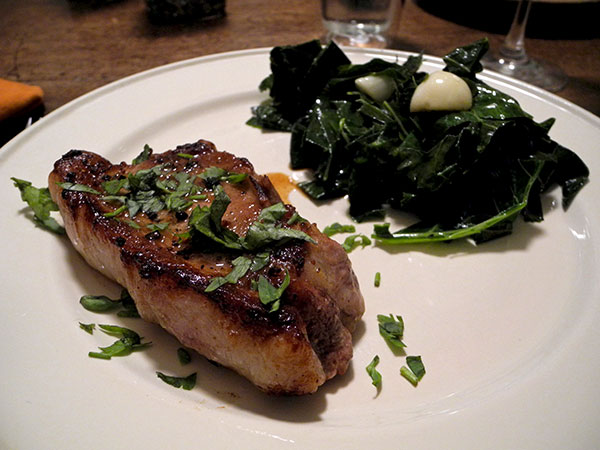
pork chops, seared, roasted with lemon; collards

pork_chop_with_lemon_collards

This simple approach to cooking pork chops is one of my favorites; in fact it’s one of my favorite recipes period.  It’s foolproof, and the pork ends up incredibly juicy each time, and it takes a total of only about 20-25 minutes, most of it unattended.  It’s from the “Italian Two Easy” London River Cafe cookbook, and I like to share it at every opportunity I get. This is my own, slightly-altered version of the recipe for the chops:

Pork Chops with Lemon

2 pork chops, cut 1 inch thick (if 1 1/2 inches, increase each of the suggested 8 minute cooking times to about 10 minutes)

1/2 lemon

Heat an enameled cast-iron pan* until very hot.  Heat the oven to 400ºF.
Thoroughly dry and season each chop, put them in the pan and sear quickly on each side. Remove the pan from the heat.
Squeeze the lemon juice over the chops, and place the squeezed lemon half in the pan along with the chops. Roast in the oven for about 8 minutes. Press the lemon half onto the chops and baste with the juice. Roast for another 8 minutes or until firm to the touch (think, checking for the doneness of a steak).

OPTIONAL: Finish with a sprinkling of a chopped herb or herbs, or perhaps some topped with warmed cherry tomato halves and/or the herb(s).

* If no enameled cast-iron pan is available, the chops can be seared in one that is not, then transferred to an oven-proof ceramic or glass pan before being out into the oven, perhaps adjusting for the cooking time because the oven pan will not have been heated before being put into the oven.


This simple approach to cooking pork chops is one of my favorites; in fact it’s one of my favorite recipes, period!  It’s foolproof, and the pork ends up incredibly juicy each time, and it takes a total of only about 20-25 minutes, most of it unattended.  It’s from the “Italian Two Easy” London River Cafe cookbook, and I like to share it at every opportunity I get. This is my own, slightly-altered version of the recipe for the chops:

Pork Chops with Lemon

2 pork chops, cut 1 inch thick (if 1 1/2 inches, increase each of the suggested 8 minute cooking times to about 10 minutes)

1/2 lemon

Heat an enameled cast-iron pan* until very hot.  Heat the oven to 400ºF.
Thoroughly dry and season each chop, put them in the pan and sear quickly on each side. Remove the pan from the heat.
Squeeze the lemon juice over the chops, and place the squeezed lemon half in the pan along with the chops. Roast in the oven for about 7-8 minutes. Press the lemon half onto the chops and baste with the juice. Roast for another 7-8 minutes or until firm to the touch (think of using your finger to check for the doneness of a steak).

OPTIONAL: Finish with a sprinkling of a chopped herb or herbs, or perhaps some topped with warmed cherry tomato halves and/or the herb(s).

* If no enameled cast-iron pan is available, the chops can be seared in one that is not, then transferred to an oven-proof ceramic or glass pan before being put into the oven, adjusting for the cooking time because the second pan will not have been heated before being put into the oven.

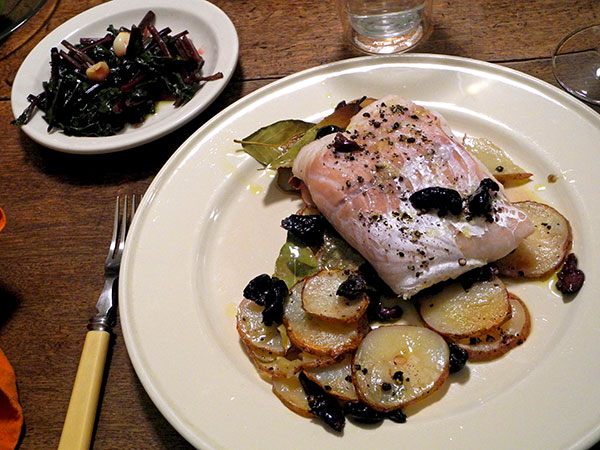
hake on a bed of potatoes, laurel, olives; greens

hake_potatoes_olives_bay

I discovered this recipe years ago through Mark Bittman, although, like so much else that works well in the kitchen it may actually be pretty ancient.  It’s a treasure, regardless of its pedigree, and it’s extremely adaptable.  I used hake this time, but it can also show off cod, monkfish, sea bass and a number of other choices.

By the way, the amount of oil called for in the recipe published in the Times might be reduced somewhat without compromising either the texture or taste of the potatoes, but what seems to be an outlandish amount of bay leaf and black olives turns out to be just about right.

  • a little over a pound of hake fillet from Pura Vida, cooked for ten minutes in a hot oven in a ceramic pan on top of thinly-sliced red-skin ‘new potatoes’ which had already been baking for twenty minutes in a generous amount of olive oil before they were covered with a dozen bay (or laurel) leaves and nearly a cup of pitted black olives (half of them Kalamata, the other half Moroccan, because that was all I had)
  • the last of some beet greens from Race Farm, braised with halved cloves of garlic from Berried Treasures
  • the wine was a white Sardinian, La Cala Vermentino di Sardegna 2013 

meatballs, braised beet greens; roasted fingerlings

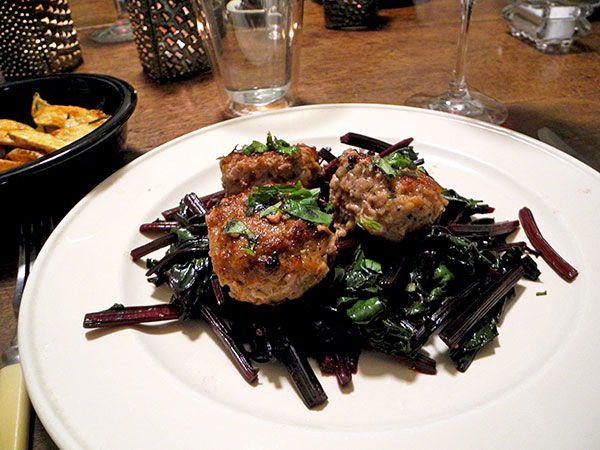
meatballs_beet_greens_2

If you’re paying attention, you had probably already anticipated there would be beet greens somewhere in this meal.  The beetroot was a big star two days back, so it was only a matter of time before the greens would show up. In fact, right now there are still some left in the crisper drawer.  There are also still more meatballs waiting in the freezer.

  • rose veal meatballs from Gaia’s Breath Farm via Summers End Orchard in Unadilla, New York (a boon found at New Amsterdam Market this summer), defrosted overnight, lightly floured, cooked in oil and nestled in a bed of beet greens from Race Farm which were braised with split garlic cloves from Berried Treasures and water remaining from their rinsing, the meatballs finished with pan juices, chopped oregano, and a bit of oil
  • Austrian Crescent potatoes from S & SO Produce, split lengthwise and tossed with a bit of oil, rosemary from Stokes Farm, and salt, then roasted, and served in this instance as a contorno
  • the wine was an Austrian white, Weingut Stadlmann Pinot Noir Classic Traiskirchen 2012

roasted bluefish with tomatoes; wilted radish greens

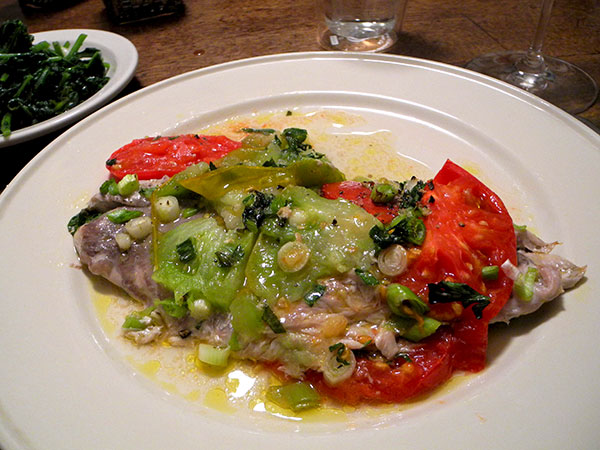
bluefish_with_tomatoes_radish_greens

Don’t be afraid of Pomatomus Saltatrix.   I used to be, but over the last few years I’ve become very fond of bluefish (once I had learned how to prepare it).

I think I first encountered it while living in Newport, fresh off the dock in the harbor (the fish, that is).   I had heard its virtues sung locally, but didn’t realize that some of the songs were those of  Rhode Island sport fishermen, and the others assumed one could hear the lyrics describing how to prepare it.  I wasn’t a fisherman, and I’ve generally been deaf to song lyrics, so while I was pulled in by the sirens, I didn’t know what to do with rich fillets when I tried preparing them myself.  I think it must have involved poaching, and it’s possible some wine was involved, but the results told me bluefish just wasn’t for me.  That was an ancient time, before modern cookbooks, before the magic of the internet, and before the ministrations of the good Union Square Greenmarket fishmongers.

This time I pulled out a recipe which I had enjoyed several times in the past;  it’s from Mark Bittman’s “Fish: The Complete Guide to Buying and Cooking“.

  • bluefish flllets from Blue Moon Fish, baked in a glazed ceramic pan at 450º along with one green and one red heirloom tomato from Central Valley Farm, some chopped scallions from Migliorelli Farm, more than a little olive oil, plus some chopped parsley from Lani’s Farm and Brooklyn basil from Gotham Greens at Whole Foods, then finished with more chopped parsley [which I forgot to add to the plate until after this photograph was taken, so use your imagination]
  • intensely fresh radish greens from Paffenroth Gardens, wilted in oil which had been seasoned with split garlic cloves from Lani’s Farm, finished with salt and pepper and a bit of olive oil
  • the wine was a Sicilian white, Tenuta Rapitalà Terre Siciliane Piano Maltese 2012


‘spaghetti with rubies’ (spaghetti con rubini)

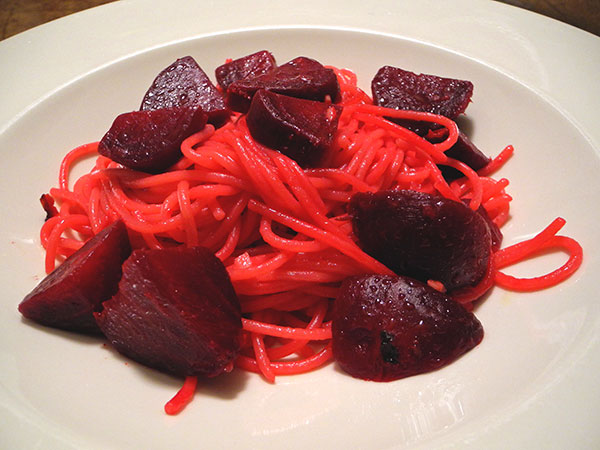
spaghetti_with_rubies

Those hues are real.  This meal clearly screams color even more than yesterday’s, even if it is completely monochromatic.  Michele Scicolone‘s “Spaghetti with Rubies” makes one of the most spectacular presentations I’ve come across anywhere, and it’s really very easy to put together.

Characteristically, Scicilone takes no credit for the original recipe.   In her “A Fresh Taste of Italy” she describes her delight in seeing a waiter in a lively Adriatic beachtown restaurant walk past her with “steaming bowls of vivid red spaghetti”.   The cover photo featuring this dish was alone enough to get me to buy the book years ago, but not long after I ran into the warm and generous author herself in the Union Square Greenmarket and I feel like we’re friends and gustatory conspirators every time I prepare this dish.

  • Afeltra spaghetti, from Buon Italia in Chelsea Market, mixed with beetroot from Race Farm which had first been roasted and peeled, cooled, then roughly chopped and mixed with some chopped garlic from Phillips Farm and a generous pinch of dried peperoncini from Buon Italia, both warmed in olive oil until fragrant, the whole then warmed along with some of the pasta cooking water
  • the wine was a northern Italian white, Cascina dei Ronchi (Giordano Lombardo), Gavi 2012

pan-grilled Weakfish and braised purple cauliflower

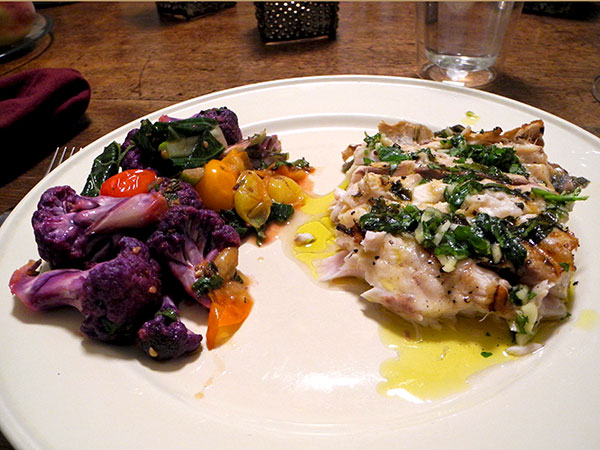
weakfish_purple_cauliflower

Color is also a part of good cookery.

  • Weakfish, from PE & DD, brushed with oil, seasoned, pan-grilled over a bed of basil leaves, and finished with a mixture of chopped basil, garlic, oil, and a bit of white wine vinegar
  • a braise of purple cauliflower from Norwich Meadows Farm, sliced garlic from Berried Treasures, a mix of colorful cherry tomatoes from Central Valley Farm, one dried Peperoncino, crumbled, and some bruised fennel seeds, finished with chopped oregano from Central Valley Farm
  • the wine was a Côtes du Rhône rosé, Parallèle 45