Author: james

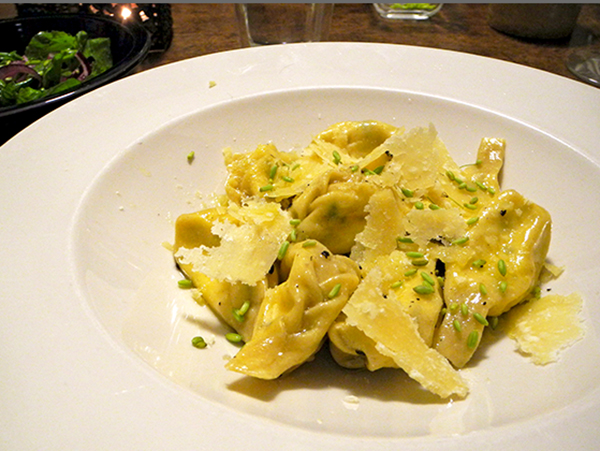
tortelli piacentini, butter, fresh fennel seed; arugula

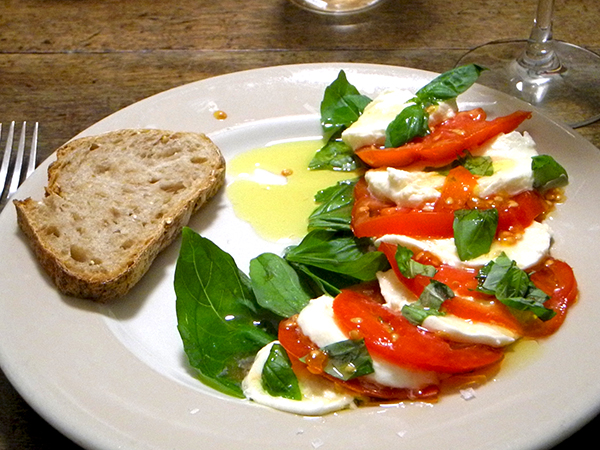
caprese

tortelli_piacentini_arugula

I went down the street to Eataly this afternoon to fetch a good fresh pasta.  We had planned to entertain some friends earlier in the evening, so I knew in advance that there wouldn’t be much time to put together even a modestly ambitious meal. I had a number of ingredients at home which could grace an interesting form of noodle, but not really anything that would stand on its own.

I was delighted to find a very special filled pasta inside the glass display case when I arrived, the Emilia-Romagna tortelli piacentini, an intricately-folded, slightly-braided egg pasta filled with ricotta, mascarpone, chard, grana padano, salt, and pepper.  I asked Luca Donofrio, Eataly’s pastaio, who was working there inside the assembly area, how it should be sauced, and he said it would go well with the region’s classic ragú.  When I demurred at his suggestion (not having the time to cook the sauce, but also, as usual, reluctant to disguise the taste of a good filled pasta), he added that it would also welcome a simple sauce of butter, with perhaps, as I suggested in reply, the addition of some special herb.  That’s how I approached this very special artisanal creation when I got home, adding, in the end, some shaved parmesan.

As the pasta course was to be pretty small in size, I included an antipasto, a classic insalata caprese, and an improvised light green salad on the side.

  • one ripe heirloom tomato from Lani’s Farm, sliced and allowed to sit for almost an hour with some Maldon sea salt sprinkled on top, then layered with some very fresh ‘mozzarella classica’ from Eatlay, a number of leaves of Gotham Greens Brooklyn rooftop basil from Whole Foods, the tomato juices returned to the slices, along with an excellent olive oil, then served with slices of Seven Grain Bread from Eataly
  • twelve ounces of fresh tortelli piacentini from Eataly, sauced with a toss of melted unsalted butter, salt, and pepper, served with freshly-shaved parmesan cheese on top, and scattered with the magic fresh fennel seeds I still had in reserve
  • a salad of arugula from John D Madura Farm, tossed with slices of a small red onion from John D. Madura Farm, good olive oil, a touch of white balsamic vinegar, salt, pepper, and more fresh fennel seeds
  • the wine was an Italian (Sardinia) white, La Cala Vermentino di Sardegna 2013
  • the music was streamed on Q2, and was a part of the station’s 24-hour ‘Her Music’ marathon of  women composers

bluefish, tomatoes, leek, basil, parsley; cavolo nero

bluefish_tomates_cavolo_nero

I suppose it should not really be surprising, but every time I prepare this dish, using pretty much the same recipe, it both looks and tastes differently than it ever did before.  This one may have been the best yet.

Oh yes, I have to say again how sorry I am that some people haven’t learned to appreciate the (possibly acquired) full-flavored taste of this extraordinary fish.

  • one 15-ounce bluefish fillet from Blue Moon Fish, baked (more or less along the lines of this recipe) in a glazed ceramic pan at 450º for about 20-25 minutes above and below a variety of sliced heirloom tomatoes from Lani’s Farm, two sliced young leeks (rather than the scallions specified in the recipe) from Ryder Farm, more than a little olive oil, some torn Gotham Greens Brooklyn rooftop basil from Whole Foods, removed from the oven and placed on two plates, finished with chopped parsley from Paffenroth Farms, the pan juices drizzled on top of the now-divided fillet
  • cavolo nero, or black kale, from Bodhitree Farm, briefly wilted with olive oil and two halved Rocambole garlic cloves from Keith’s Farm, which had first been heated in the oil
  • the wine was an Italian (Marche) white, Saladini Pilastri Falerio 2014, from Phillippe Wines
  • the music was Haydn’s ‘8 Nocturnes

husk cherries, fennel; salmon, herbs; sweet peppers

husk_cherry_arugula_fennel_seed_salad

salmon_peppers_husk_cherries

Note to self: All elements combined to make this a terrific meal, and it looked dazzling as well.


I’m not really trying to serve fish almost every night, but I find that, for me at this time, having at least a small portion of either seafood or meat makes it easier to build a good vegetable accompaniment (it’s an ‘accompaniment’, so it has to accompany something), and meat just doesn’t interest me as much as fish does right now.  I also still think that it’s very often more interesting to serve wine with an entrée which includes something other than just vegetables, although that too may change for me.

On my way uptown to a recital early this evening I thought about the fact that I hadn’t really planned what I was going to prepare for dinner, and the fact that that seemed to have been a conscious decision.  Then I quickly made the connection between the subway route we would be taking home and the fact that the Whole Foods on the corner of 24th and 7th always has wild northwestern salmon, and it’s often on sale.  Barry had mentioned that we had a larger supply of good pinot noir on hand than usual, and I thought of the dill flowers in the refrigerator door, and the bag of Corno di Toro sweet peppers in the crisper which I was anxious to try.  Salmon sounded absolutely right.

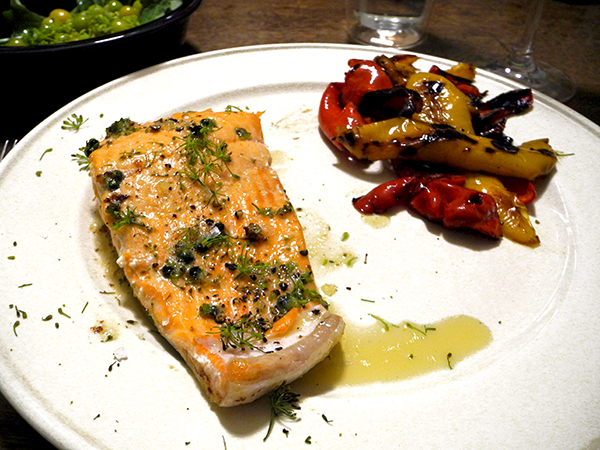
  • one 12-and-a-half-ounce fillet of wild Coho salmon from Whole foods, cut into two servings, placed in an oval, enameled cast iron pan in which about two tablespoons of unsalted butter had been allowed to heat until the foam began to recede, but not introduced before a small handful of slightly-crushed ramp fruit from Berried Treasures had been warmed in it, the pan with the salmon then placed in a 450º oven for about 7 minutes, the fillets flipped a little more than half way through, removed when barely cooked through, arranged on plates, sprinkled with Maldon salt, freshly-ground Tellicherry pepper, and – most importantly – some fresh dill flowers from Crock & Jar/Rise & Root, in the Union Square Greenmarket, where almost everything else mentioned in these ‘pages’ has been found
  • delicious Corno di Toro long sweet frying peppers (red and yellow) from Campo Rosso Farm, stemmed, split, seeded, the piths remove, sliced lengthwise once or twice, fried in olive oil pressed under a weighted pan, first skin side down until blistered, then turned and fried, again under a weighted pan, for another 30 seconds or so, a small handful of washed and dried whole basil leaves and a splash of (medium quality) balsamic vinegar added to the pan, stirring for a few seconds until the herb is wilted and the vinegar has sort of exploded in the heated oil, which was then removed from the heat and the vegetable served
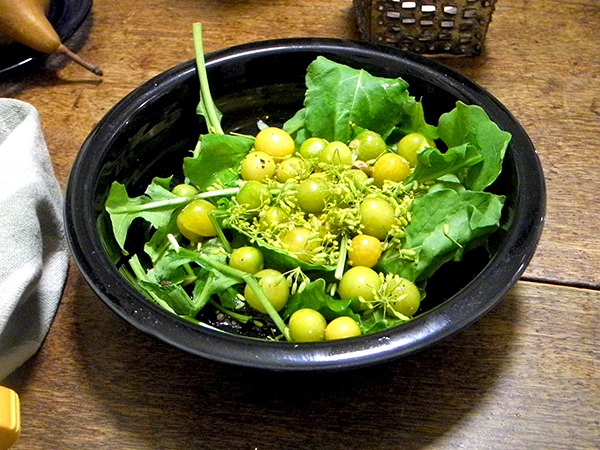
  • a salad of husk cherries from Oak Grove Plantation, arugula from Phillips Farm, and a generous amount of fresh fennel seed – and pollen – from Lani’s Farm, dressed with good olive oil, lemon juice, Maldon salt, and freshly-ground Tellicherry pepper [the only quibble I have with the entire meal is that, while the husk cherries look great whole, they’re very difficult to pick up with a fork;  next time I’ll try to remember to slice them in two before adding them to the greens]
  • the wine was an Oregon red, Elk Cove Vineyards ‘La Sirene’ Willamette Valley Pinot Noir 2011, the gift of a friend
  • the music was Haydn, Symphonies No, 20 and 21, performed by the Austro-Hungarian Haydn Orchestra under Adám Fischer

grilled squid, oregano, lemon; lima beans with mint

squid_lima_beans_2

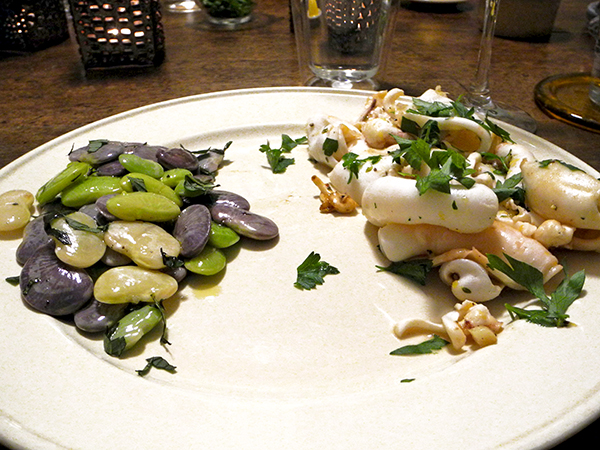
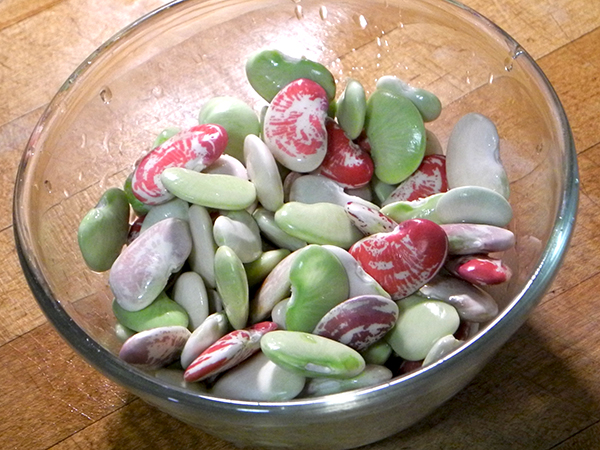
I actually was a little disappointed that the lima beans didn’t retain the hues they showed when they first came out of their pods (see below), but the earth and woodsy tones of their river stone disguises pretty much made up for it.

I was new to cooking this ancient South American vegetable as a fresh ingredient, having limited myself until now almost exclusively to working with its frozen form, and that was decades ago.  When I picked them up at the Union Square Greenmarket I thought preparation would be a cinch, but once home I found almost nothing about limas (or butter beans, an alternative name for the legumes) in any of my cookbooks and, as I was interested in something minimal, almost nothing useful on line.  To illustrate my dilemma, one site outlined at least three major steps for extracting the bean, and a cooking process that would have stretched on far beyond an hour’s time.  It was only when I turned to my half-century-old copy of  Craig Claiborne‘s classic opus, ‘The New York Times Cookbook’ [$25 new here; $10 to $15 here, at Strand], that I was finally reassured about both the ease and the simplicity with which these delicious beans could be prepared.

Both peas and beans can vary in size, tenderness, and freshness, so it may not always be easy to prescribe cooking times or amounts to buy (especially when they are being purchased in the shell or pod), and there is also the question of individual tastes. Claiborne’s short entry reads, simply, “Place the [shelled] beans in a small amount of boiling water, cover and boil rapidly until tender, about twenty to thirty minutes.” [Note: I checked the beans while they were boiling, and ended draining them after something closer to fifteen minutes]  He advised allowing two pounds – or more – for four servings.  I bought a pound of unshelled beans, and that would have been more than enough for the two of us, except that they were so good; even as little as half of a pound might have been enough if there were another vegetable on the plate.

I decided to do little to interfere with their natural flavor, but, in addition to some olive oil, I did go for the addition of some chopped mint (Claiborne had suggested butter and thyme), and, naturally, a squeeze of lemon, perhaps thinking the three might convert the very American lima bean into an Italian dish.

One more thing.  Squid remains one of the least expensive of any seafood available today;  the cost of two generous servings was far less than the cost of this excellent vegetable (a price I was totally happy to pay, even before their goodness had been fully confirmed and enjoyed).

  • tiny squid bodies and tentacles from P.E. & D.D. Seafood, marinated for about half an hour (half of that time in the refrigerator) in a mixture of lemon zest and lemon juice, thinly-sliced garlic from Keith’s Farm, olive oil, pungent dried Italian oregano from Buon Italia, salt, and pepper, then removed from the marinade and pan-grilled briefly over high heat, arranged on plates, sprinkled with fresh lemon juice and some chopped parsley from Stokes Farm  [a recipe for the squid, with more specific instructions appears here]
  • fresh organic lima beans from Norwich Meadows Farm (Im tasted one at the stand, and was immediately sold on them, although I had not cooked these particular legumes in many years, parboiled until tender (about 15 minutes here), drained, dried in the same glass pan, then mixed with olive oil, salt, pepper, and peppermint from Phillips Farm
  • the wine was an Italian (Campania) white, Falanghina Feudi di San Gregorio 2014
  • the music was excerpts from the album, ‘Steven M. Miller: Between Noise And Silence


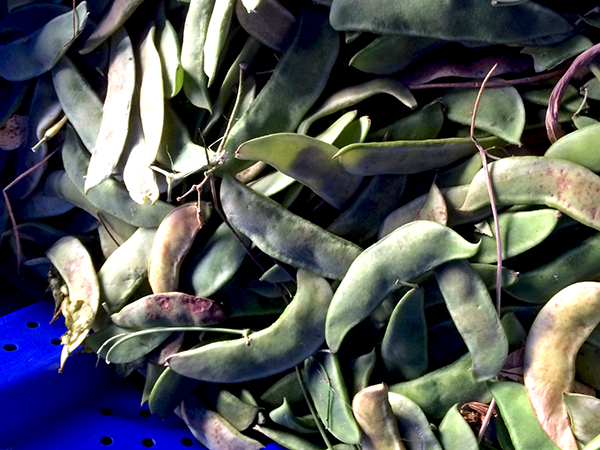
The pictures below show the beans as they appeared at the Greenmarket, and then as they looked after podding and before cooking.

lima_beans_Greenmarket

lima_beans_shelled

lamb chop, ramp fruit; yellow pole beans; tomatoes

lamb_chop_yelloe_pole_beans_tomato

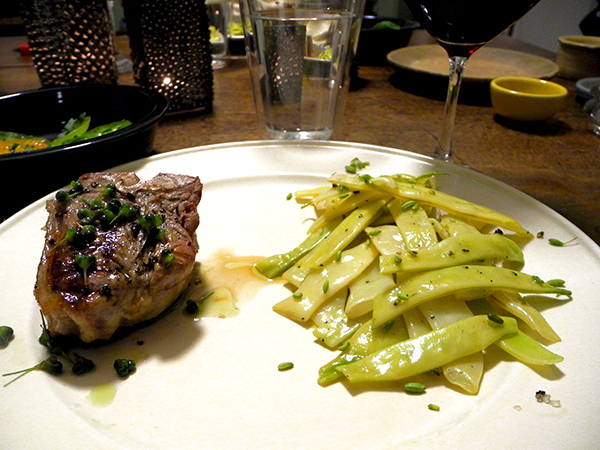
It was a pretty colorful meal, and a tasty one, but, while enjoying the herbs – and the savory buds – I could not help thinking of all that I will miss once this summer is past.


  • two thick loin lamb chops from 3-Corner Field Farm (two servings), thoroughly dried, cooked on a very hot enameled cast iron grill pan for about 4 minutes on each side, seasoned only after having been seared, then removed from the pan and each topped with about a dozen slightly-crushed ramp fruit from Berried Treasures, the ‘buds’ having been heated earlier in a bit of olive oil, the chops finished with a squeeze of lemon and a drizzle of olive oil

  • yellow flat pole beans from Norwich Meadows Farm, blanched, drained and dried, then reheated in oil, finished with salt, pepper, and fresh fennel seed from Lani’s Farm

  • orange and green (two kinds) heirloom tomatoes from Berried Treasures, sliced thinly and arranged in low bowls with a bit of good olive oil, white balsamic vinegar, salt, pepper, and torn local (Brooklyn) basil leaves, Gotham Greens Rooftop packaged basil, from Whole Foods

  • the wine was a luscious super California red, ROX Scott Peterson All Blacks Sonoma County 2013, which includes five different black grapes from Sonoma; when I tasted it I thought that it almost certainly included some Zinfandel, but not in the usual heavy, scary California form which is incompatible with almost any food, and I just learned on line, from Scott Peterson, the maker, that it’s close to these percentages: 34 % Sonoma Coast Syrah; 
44% Old Vine Zinfandel Russian River/Dry Creek Sonoma County;
 11% Petite Sirah Dry Creek Sonoma County; 
6% Grenache
; 5% Mourvedre

  • the music was from the 2015 Nordic Affect album, ‘Clockworking

Prior to the meat course, there was a primi, a revisit of a pasta from three days earlier boasting the addition of some fresh herbs (spearmint from Lani’s Farm and summer savory and lovage, both from Keith’s Farm) and a drizzle of good olive oil.

There was also a cheese course, which included two cheeses from Consider Bardwell, ‘Manchester’ and ‘Slybro’, both made from goat milk, served with some very, very thin slices of ‘Integrale’ bread from Eataly, toasted in our McGraw Electric Toastmaster (introduced in 1936, the year our apartment building was completed).

cauliflower frittata, with cayenne, parmesan, tomato

cauliflower_Frittata

It was a cauliflower, frittata, and we both love anything cauliflower, including this dish.  Apparently not everyone shares our enthusiasm, because, in his description of this primi, which I used as my rough guide, Kyle Phillips tells us that the great Italian cookbook author Pellegrino Artusi definitely did not think much of the vegetable, writing in an introduction to his nineteenth-century recipe, “You will need to know the quantities if you are to make a good frittata with a vegetable as insipid as this.”

  • one 21-ounce head of golden cauliflower from Norwich Meadows Farm, separated into flowerettes, sautéed in butter and olive oil in a 12-inch cast iron pan until beginning to carbonize, seasoned with salt and pepper, some of the torn green pointed leaves which enclose the head added near the end, then, once the vegetable had begun to color, eight small-ish eggs from Millport Dairy beaten with a bit of grated Parmesan cheese from Eataly, seasoned with salt, pepper, and some very good cayenne from Spices and Tease in Chelsea Market poured into the pan, followed by the addition of thin slices of one ripe red heirloom tomato from Norwich Meadows Farm placed on top, the mix allowed to cook, unflipped, on top of the range until done
  • the wine was an Australian sparkling rosé, Taltarni Taché 2011, a blend of Chardonnay, Pinot Noir, and Pinot Meunier, from southeastern Australia
  • the music was the second half of Vivaldi’s ‘Atenaide’, in a performance by Modo Antiquo, conducted by Federico Maria Sardelli

tuna; tomato; cucumber/arugula/husk cherries

tuna_tomato_cucumber_arugula_2

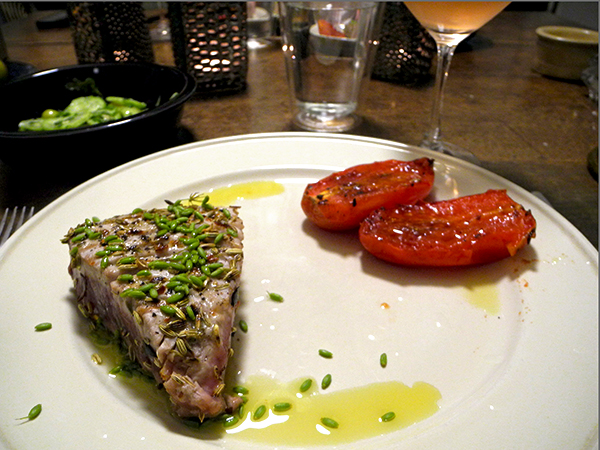
I thought, if dry fennel seed is great on a tuna steak, why not fresh?  And then I thought, maybe fresh fennel seeds would be spoiled with as much direct heat as I need to grill the surface, so I ended up sprinkling them over the steaks after they were grilled, and just before finishing them with a drizzle of olive oil.  I now think I’ll try replacing dry for fresh altogether the next time I have them available.

  • one 13-ounce tuna steak from Pura Vida Fisheries, rubbed with a mixture of fennel seed and one dried peperoncini, ground together, additionally seasoned with salt and pepper, then pan-grilled for only a minute or so on each side, finished with a good squeeze of lemon and sprinkling of fresh fennel seed from Lani’s farm and a drizzle of olive oil
  • two Pozzano plum tomatoes from Norwich Meadows Farm, sliced in half, placed face down on a plate spread with salt and pepper, dried somewhat before placed on a hot grill pan, turned once, removed, finished with a bit of olive oil and balsamic vinegar
  • a handful of Jamaican Burr Gherkins from Norwich Meadows Farm, sliced very thinly and tossed with small farmed ‘wild’ arugula from Eckerton Hill Farm along with ten or twelve husk cherries from Oak Hill Plantation, dressed with salt, pepper, good olive oil, and fresh lemon juice
  • the wine was a New York Cabernet Franc rosé, Schneider & Bieler Rosé “le breton” 2014 from the Fingerlakes region
  • the music was Vivaldi’s ‘Atenaide’, in a performance by Modo Antiquo, conducted by Federico Maria Sardelli

pasta, fennel pollen/seed, tomato, hot pepper, mint

bucatini_tomato_hot_pepper_fennel_mint

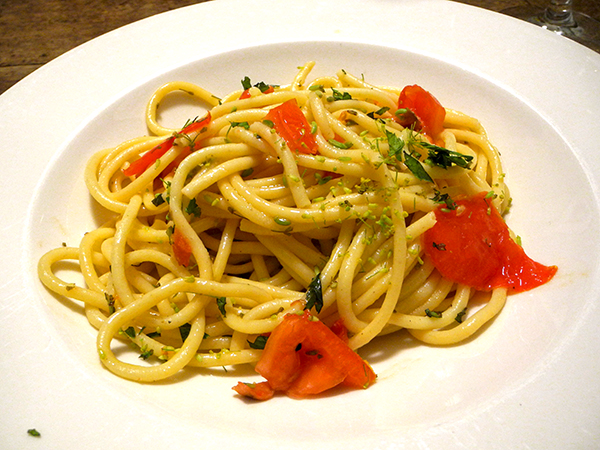
I never thought I’d find the elusive ingredient, fresh fennel pollen, in my kitchen, but one of our creative local farmers made it possible this week. For more on the delights and the use of this extraordinary, very Italian seasoning, see this Honest-Food.net discussion of fennel in high summer.

As I write this I can still taste what the Wall Street Journal food writer called culinary ‘fairy dust’.

  • fresh bucatini pasta from Eataly (they’re sold in neat 1/3-pound ‘nests’, and it seemed to me that two of them would be inadequate if the dish was not going to include any other substantial ingredient, and that the three which I purchased might be too much; I was right, so we ended up with enough to visit this aromatic primi on another day), served with a simple sauce of olive oil heated slightly with one pretty seriously hot, but still described as Italian, pepper (unusual in its maroon color), from Oak Grove Plantation, then combined with one sliced red heirloom tomato from Berried Treasures, both fresh fennel seeds and fresh fennel pollen (from a generous-size bouquet of fennel flowers I had purchased from Lani’s Farm this week), and a bit of torn spearmint, also from Lani’s Farm
  • the wine was an Italian (Umbria) white, Orvieto Classico Superiore Castagnolo Barberani 2014
  • the music was Morton Subotnik’s ‘The Wild Bull’

pepper frittata, beet juices, garlic, shallot, oregano

bell_pepper_frittata

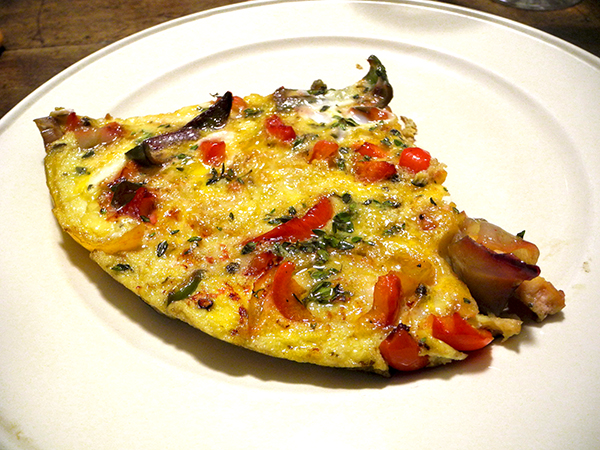
This is the revisit of a frittata I had put together about a year ago.  What might have made it stand out a little this time, aside from an expected variation in the peppers I chose to incorporate in it, was the fact that I also included some beet juices which remained from a salad a part of a meal prepared a few days back.  The deep red liquor meant a subtle tweaking in both the taste and the color of this otherwise very Italian ‘omelette’.

  • small multi-colored bell peppers, plus one Hungarian sweet pepper (light yellow-green in color), all from Lani’s Farm, sliced, sautéed  in a large cast-iron pan until partially caramelized, along with one sliced shallot from Phillips Farm, some sliced garlic from Berried Treasures, and half of one pretty seriously hot, but still supposedly Italian, pepper (although unusual in being maroon in color), from Oak Grove Plantation, added near the end, then 10 small-ish eggs from Millport Dairy, seasoned and fork-whipped, poured into the pan, everything sprinkled with chopped fresh oregano from Stokes Farm, then cooked on a medium flame until the eggs had begun to set halfway into the center depths of the frittata, finished under the broiler and let stand for a few minutes before serving
  • the wine was a French (Provence) rosé, Château Saint Baillon 2014 Côtes de Provence
  • the music was Mahler’s Symphony Number 5, performed by the Philadelphia orchestra under James Levine


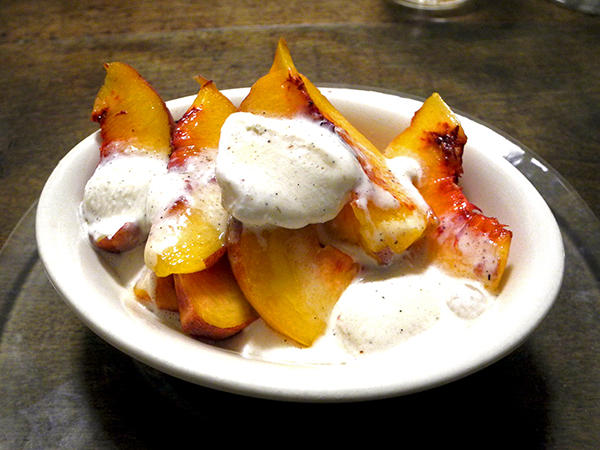
We rarely have a dessert course, unless we count cheese, but this evening we enjoyed a favorite, and quite simple, treat, fresh peaches and a great gelato, for the second time in four days (yup, the little spots in the ‘ice cream’ are from the really excellent vanilla)


peach_and_gelato

sea robin, tapenade; haricots verts; tomatoes

sea_robin_2_tapenade_haricots_tomatoes

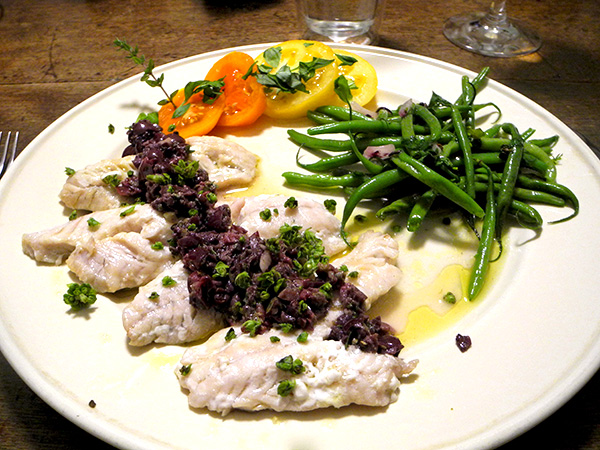
Note to self: This was my second outing with sea robin, and the result was even more delicious than the last time.


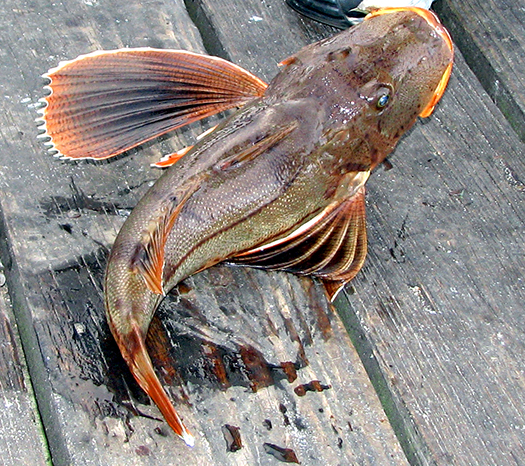
I absolutely do not understand the fact that this fish is still so unappreciated.  My memory of sea robin goes back to my first and only experience of fishing in Atlantic waters.  It was over 25 years ago, a company outing, a day trip, on a small party boat running off Long Island, and while we were hoping to haul in fluke, we were just as likely to hook a sea robin.  Sadly, or not, I think these fascinating little ‘winged’ creatures were all returned to the sea that day.  I took home the fluke.

I’m not even going to dwell on the fact that a generous serving for two will set you back little more than $5, or the fact that it is one of the easiest fish to prepare.  I’m thinking of the taste and the texture, and, as always, the aesthetics of its appearance on a plate.

My next assignment is to come up with alternative preparations for this delicious fish, since I’m certain we will be enjoying it again and again.

Oh, the thyme branch sticking up out of one of the tomato slices? A momentary absence of mind as I rushed from counter to table, since it had nothing to do with the tomatoes, and everything to do with the tapenade, where it should properly have been planted.

  • eight quite small sea robin ‘tails’ from P.E. & D.D. Seafood, rinsed, pat dry, then placed in a pan of sizzling olive oil and sautéed over medium-high heat for barely 2 minutes on each side, transferred to two plates, a little lemon squeezed on top and a bit of a tapenade sauce spread over the fillets, which were then garnished with fresh buds of basil plants given to us by a friend with a garden in Garrison, New York [the tapenade was prepared by hand rather than a blender, chopping the ingredients, which included Gaeta olives from Buon Italia, a little Rocambole garlic from Keith’s Farm, one rinsed chopped anchovy, also from Buon Italia, salted rinsed capers from Buon Italia, ground black pepper, olive oil, and fresh thyme from Phillips Farm]
  • tiny, very tender haricots verts from Norwich Meadows Farm, blanched in salted water, dried and reheated in butter which had warmed a little bit of chopped shallot from Keith’s Farm, some ramp fruits from Berried Treasures, dill flowers from Crock & Jar/Rise & Root, and parsley from Paffenroth Farms
  • two heirloom tomatoes from Berried Treasures, sliced, drizzled with good olive oil, sprinkled with Maldon salt, and tossed with some torn basil leaves clipped from a Full Bloom Market Garden plant in a south window, which had originated in Massachusetts and arrived in our rooms via Whole Foods
  • slices of a small sourdough baguette from Barbara Olson of Buon Pane
  • the wine was a New Zealand white, Tablelands Sauvignon Blanc Martinborough 2014
  • the music was the symphonies Number 2 and 4 of Robert Schumann, conducted by Roger Norrrington


SeaRobin_LongIslandSound1


the sea robin, out of water, “Caught in New Haven Harbor”


[the image at the bottom is from Wikimedia Commons]