Author: james

swordfish, fennel seed; tomato; cucumber, olives

swordfish_tomato_cucumber

The  swordfish was on sale. I love swordfish. I love herbs. I always have a number of fresh ones on hand. I like trying out different treatments. I sometimes make the wrong call.  Now I know that fresh fennel seed just doesn’t have oregano’s ooomph.

But it was still all good.

  • a one pound swordfish steak, more than an inch thick, from Blue Moon Fish Company in the Union Square Greenmarket, cut into two pieces, marinated briefly in a mixture of olive oil and fresh fennel seed from Lani’s Farm, then drained well and covered with a coating of dried homemade bread crumbs, fried in a hot cast iron pan for about 4-5 minutes on each side, removed, salted, sprinkled with a little lemon juice, and drizzled with olive oil before serving
  • three heirloom tomatoes from Norwich Meadows Farm, sliced in half, placed face-down on a plate scattered with salt and freshly ground pepper, pan-grilled above a medium-hot flame, removed, drizzled with olive oil
  • kirby cucumbers from Stokes Farm, washed, halved lengthwise, then sliced into one-centimeter sections [hey, my inspiration was Jamie Oliver, and the British, like the rest of the world speak metric], mixed in a bowl with pitted Gaeta olives from Buon Italia in Chelsea Market, one very small young leek from Ryder Farm, sliced into very small sections, a bit of balsamic vinegar, some olive oil and lemon juice, a pinch of freshly-ground black pepper, and most of a fresh red Italian ‘roaster pepper’, chopped, from Oak Grove Plantation (for color and some fine-tuning), finished with torn leaves of peppermint from Phillips Farm
  • the wine was an Italian (Sicily) white, from Manley’s Wine & Spirits, L’Isola dei Profumi Catattatto – Grecanico 2014
  • the music was several pieces by Johanna Magdalena Beyer

baked eggs, prosciutto, arugula, tomato, chiles

baked_eggs_prosciutto_tomato


This dish incorporates virtually every food group, except wine, and it’s potentially infinitely variable.

Among those variations, to improve the chances for getting the eggs cooked just right, I’d suggest using ceramic dishes, or a single one, with a larger diameter than the six inches I had available.


  • inside each of two lightly-oiled cazuelas, a small amount of Fage Greek plain yoghurt (because I had no cream on hand), followed by layers of Applegate Naturals prosciutto from Whole Foods, slices of heirloom tomatoes from Norwich Meadows Farm, torn leaves of arugula from John D. Madura Farm, three eggs cracked open on the top, from Millport Dairy, and including along the way part of a crushed peperoncino, salt, freshly-ground black pepper, the dishes placed inside a 375º oven for about 20-25 minutes until the whites were almost opaque and the yolks (ideally) still runny, since the dish will continue to cook after leaving the oven, then allowed to cool a bit in order to better appreciate the combined flavors
  • slices of Trucio Sare, from Sullivan Street Bakery
  • the wine was a California (Mendocino) red, Derek Rohlffs 99 Barrels Pinot Noir Anderson Valley 2013
  • the music was ‘Silent City‘, an album by the New York-based string quartet, Brooklyn Rider and Iranian Musician Kayhan Kalhor

pike with Speck, onion, fennel; potato; yellow beans

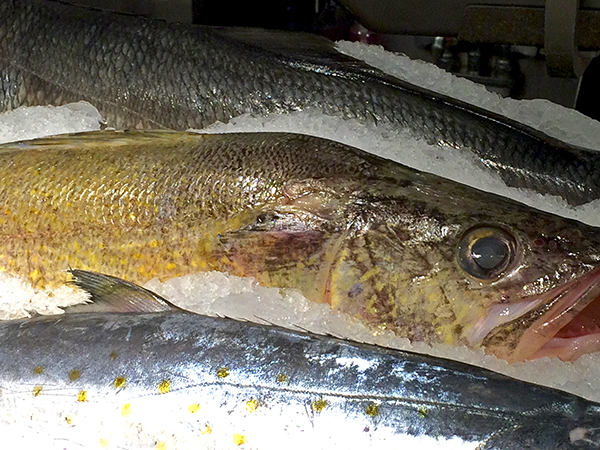
pike_on_ice

it’s called a ‘walleye’ (they also sell it whole, here Spanish mackerel below, bluefish above);
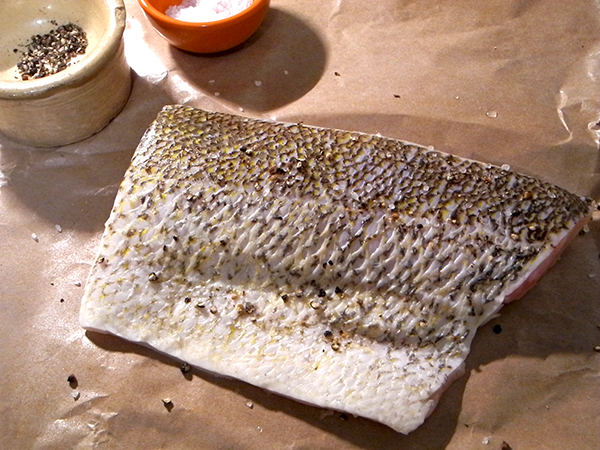
pike_fillet_seasoned

on our kitchen counter, seasoned, ready to be floured;
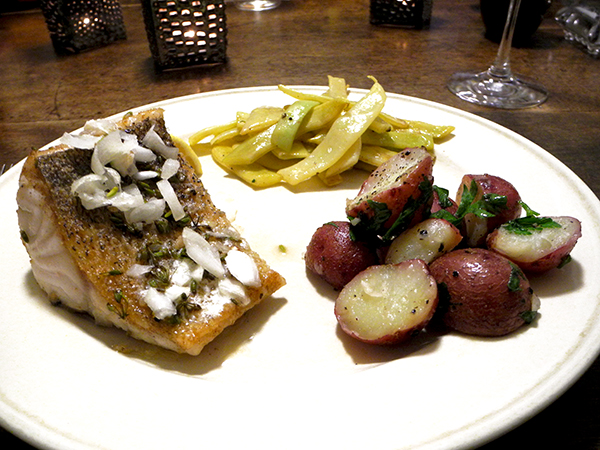
pike_potato_yellow_beans

and on the plate.


It’s a wonderful fish.

While growing up in Michigan and Wisconsin, I thought of the walleye, or ‘walleyed-pike’, or just ‘pickerel, as a very big thing, virtually the subject of fable, and not just because Algonac, where our turn-of-the-20th-century porched cottage sat on the St. Claire River, is the home of the nonpareil Algonac Pickerel Tournament  [slideshow of 1949 parade here].  To tell the truth, I was actually always much more excited by the scary Muskellunge, or ‘Muskie’.  It was a catch which might have been more elusive, but their angry bared-teeth heads were everywhere, mount-it-yourself trophies hung above the garage doors (or in dens) of successful pursuers, much like the antlers which land hunters, who also sought out size (numbers of ‘points’ on ‘racks’), still display to invite the admiration of their peers.

But me, I stuck with perch and sunfish.

That’s the background for my excitement five years ago when I found, while visiting The Lobster Place, a small sign for and display of beautiful white fillets of ‘pike’, specifically, ‘wild West Virginia pike’.

Looking on line, I’ve just learned that the Chain Pickerel [Esox Niger], so named because of its scale figuration, is an eastern variant of the pickerel, found in all kinds of  waters, in West Virginia probably most notably in the main channel of the Ohio River.  It seems that it was this pike that I first took home from The Lobster Place.

Lately the Chelsea Market shop has been showing pike labelled, ‘wild: Great Lakes’.  The fish guy told me he thought it came from Wisconsin waters, but he wasn’t certain.  For sure I can go with Wisconsin; it’s where my parents’ families have lived for nearly 200 years, and Grandfather Wagner’s farm there bordered Lake Michigan; it’s also where I spent parts of many summer vacations (when we were not in Algonac),

The American pike is very close to the European ‘zander‘, or ‘pike-perch’, which we’ve enjoyed as very special treats in Germany.

Last night we enjoyed it at home in Chelsea.

  • pike fillet from The Lobster Place, prepared more or less as Badischer Grashecht mit Speck gebraten (Baden Zander with Speck), a recipe I found, described in “Culinaria Germany”  It asks for the fish (whole, in the book) to be seasoned and lightly-floured, sauteéed on both sides at high heat in clarified butter (I used olive oil and butter in combination), removed to a buttered pan and placed in a 350º oven for 10 minutes covered by thin slices of ‘streaky bacon’ (I substituted Guanciale from Buon Italia), followed for another 10 minutes with the addition of a small finely-chopped yellow onion from a friend with a garden in Garrison, New York, sprigs of thyme (I substituted fresh fennel seed this time) and white wine, after that the “bacon” is removed and the fish dotted w/butter, returned to the oven until the skin is crispy, and served with the cooking juices spooned over the fillet
  • small boiled Norland Red new potatoes from Berried Treasures Farm in the Union Square Greenmarket, finished with butter and parsley from Keith’s Farm
  • yellow flat pole beans from Norwich Meadows Farm, blanched, drained and dried, then reheated in a little butter, seasoned with salt and freshly-ground black pepper
  • the wine was a German (Pfalz) white, Becker Family Pinot Blanc, 2013, which Appellation Wines was kind enough to special order for us when we asked, having enjoyed it very much at our local excellent ‘Swiss brasserie’, Trestle on Tenth
  • the music was Mahler’s 6th symphony, Valery Gergiev conducting the London Symphony Orchestra
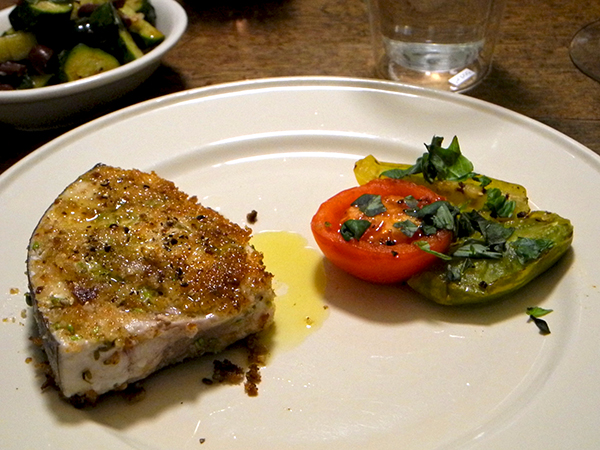
spaghetti, tomatoes, garlic, basil, fresh fennel seed

heirloom_tomato_spaghetti


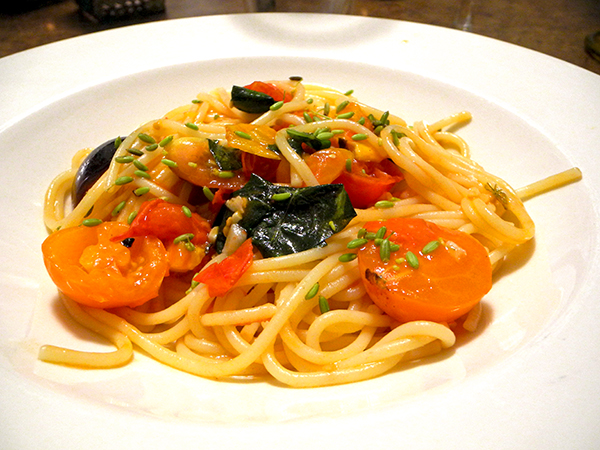
More than just a vehicle for some wonderful late-season tomatoes, this simple pasta dish paraded every one of its ingredients.

  • Setaro spaghetti from Buon Italia, mixed with a sauce of garlic, from John D. Madura Farm, heated in a large non-reactive pot with olive oil over medium heat until fragrant, about one quarter of a cup of roughly-torn Gotham Greens Brooklyn rooftop basil from Whole Foods added, the drained pasta introduced to the pan, along with a little over a pound of multi-colored heirloom and orange and red cherry tomatoes [also heirloom?] from Norwich Meadows Farm (diced as fairly large pieces), freshly-ground pepper, one small, crushed dry peperoncino, the mix stirred briefly over very low heat with some of the reserved pasta cooking liquid until it had emulsified, then blended with another quarter of a cup of basil and some fresh fennel seeds from Lani’s Farm, once the pot was removed from the range
  • the wine was an Italian (Sardinia) white, La Cala Vermentino di Sardegna 2013
  • the music was Anton Bruckner’s Symphony No. 8, performed by the New York Philharmonic, conducted by Alan Gilbert 

tuna, 2 fennel seed forms; turnip greens; tomato

tuna_turnip_greens_tomato

I wasn’t even going to buy tuna on Friday, but I was sort of taken by the rich color of the Albacore steaks at the fish stand in the Greenmarket. I decided to try it, because it was new for me.  I was I also interested in learning how it would differ from Yellowfin, which I think is what has always been the ingredient in one of my favorite dishes.  I looked on line and found that opinions about tuna species were all over the map;  after trying it myself, my thoughts, our thoughts, at least as respects searing the steaks is concerned, was that Yellowfin is better, for its taste and, even more, for its firmer texture.

I had also brought home lots of tomatoes on Saturday, so some of them were destined to end up on the same plate, and a bunch of turnips (Hakurei) which I had selected mostly for the beauty of their greens.  The turnips roots themselves will show up here soon.

  • two 7-ounce tuna steaks from Pura Vida Fisheries, rubbed with a mixture of dry fennel seed and one dried pepperoncino, ground together, additionally seasoned with salt and pepper, then pan-grilled for only a little more than a minute or so on each side, finished with a good squeeze of lemon, a sprinkling of fresh fennel seed from Lani’s farm and a drizzle of olive oil
  • six red grape tomatoes, slow-roasted with dried Italian oregano from Buon Italia, olive oil, and garlic cloves, halved lengthwise, from John D. Madura Farm
  • turnip greens from Norwich Meadows Farm, wilted in olive oil along with one halved garlic clove from John D. Madura Farm which had been lightly-browned in the oil earlier
  • the wine was a French rosé, Côtes du Rhone Parallèle 45 Rosé 2014
  • the music was, among other work by other composers, Franz Anton Hoffmeister’s Symphony in C Major, which was likely composed around 1780

sardines, tomato and olives; grilled zucchini, mint

sardines_zucchini2

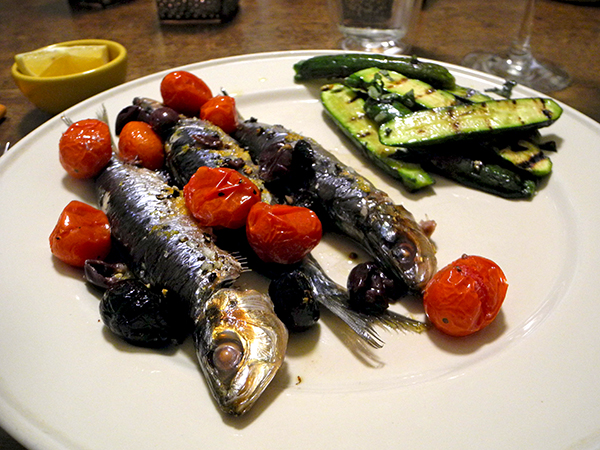
We feel particularly virtuous about our dinner choice tonight. Sardines are (without question) very good for us all; they are also among the most sustainable  seafood species; they require a minimum of preparation and a fairly modest amount of cooking time; [The recipe, found in Rose Gray and Ruth Rogers’ ‘Italian Easy: Recipes from the London River Cafe‘, is very simple.]; and last, but not the least considerations, they are very beautiful on the table and are absolutely delicious.

Grilled zucchini, especially when prepared as plainly as this, are a perfect accompaniment to such virtue.

  • six very fresh whole Maine sardines, cleaned by the staff at The Lobster Place, seasoned, placed inside an oiled ceramic dish exactly the size for accommodating them in one layer, sprinkled with organic lemon zest, a combination of both Gaeta and black oil-cured olives from Buon Italia, pitted, and a handful of Costa Rica grape tomatoes from Manhattan Fruit Exchange (I had forgotten to bring home local tomatoes from the Greenmarket the day before) which were first pricked then baked beforehand for 15 minutes at 400º, the assembled dish drizzled with more olive oil, baked for 10 minutes in a 400º oven, served with a slight drizzle of olive oil and organic lemon segments
  • very small zucchini from Berried Treasures Farm, sliced in half lengthwise, tossed with olive oil, minced garlic from John D, Madura Farm, salt, and pepper, then pan grilled and finished with chopped peppermint from Phillips Farm
  • the wine was an Italian (Sicily) white, Corvo Insolia 2013 from Philippe Wine in Chelsea, which is located on our corner
  • the music was Josep Soler’s Violin Sonata No, 2 and Alban Berg’s Piano Sonata, which is an amazing album

soppressata, minutina; artichoke ravioli, tomato

tomato_solar_system

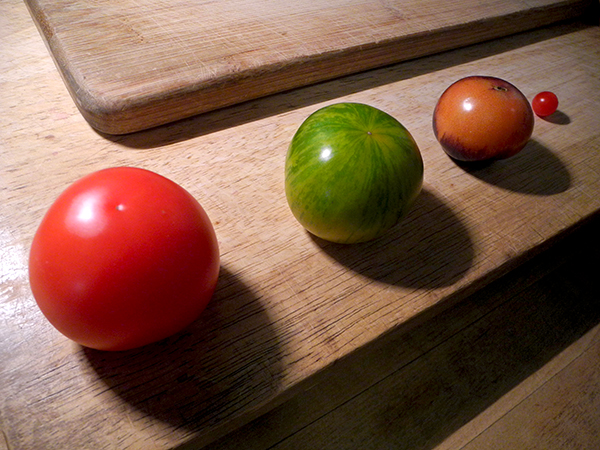
tomato solar system of sorts


soppressata_minutina_bread

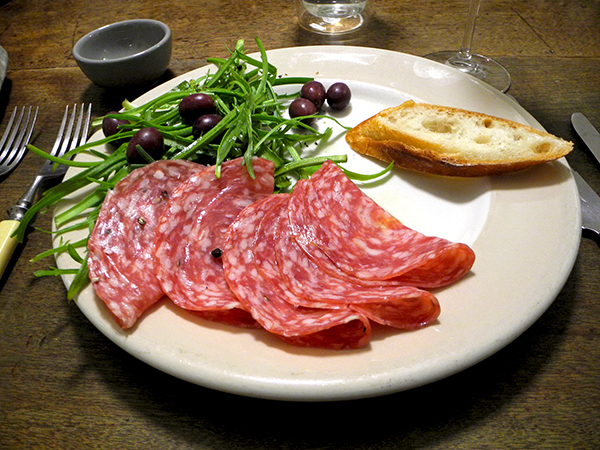
antipasto


ravioli_artichoke__tomato_fennel_seed

pasta


Simple again.

I started with a package of Colamecos’ uncured soppressata which had been lying in the refrigerator, waiting, and I was once again reminded of how good this product is, and how well it keeps until called to introduce a meal.  The minutina, from Norwich Meadows Farm, was what remained from yesterday’s dinner, the pasta had been lying in the freezer (and in fact didn’t have to be defrosted at all).  The tomatoes, from Berried Treasures Farm, had been on the windowsill, and the fresh fennel seeds, from Lani’s Farm, were what remained from a bunch of fennel branches I had ‘harvested’ for a meal two days earlier.

It wasn’t fast food, but it wasn’t really slow, and it was good.

NOTE:  I have to be honest about the first picture at the top:  While I had intended to use all four of those tomatoes, I ended up slicing only the first, second, and fourth from the left. For those who might be interested, the smallest tomato, a single Mexico ‘midget’, had escaped my eye when I was rounding up the rest of its kind for last night’s meal.

  • The soppressata came from Whole Foods; the minutina, drizzled with good olive oil and a squeeze of lemon, was from Norwich Meadows Farm, and was combined with some unpitted Gaeta olives from Buon Italia; the baguette was from Balthazar’s, via the Whole Foods bakery counter
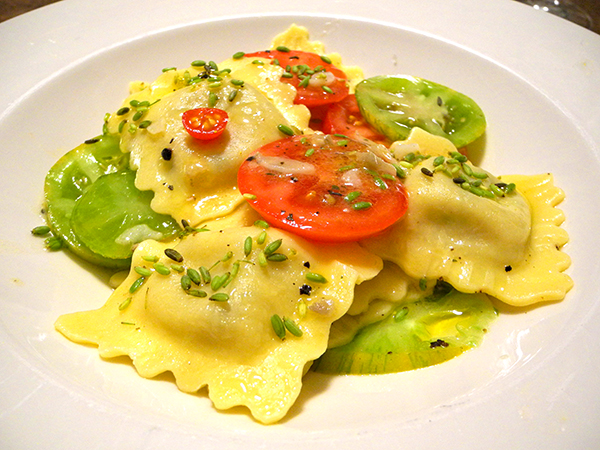
  • the Rana artichoke- and ricotta-filled ravioli was from Eataly, the tomatoes were from Berried Treasures Farm; they were sauced with one clove of John D. Madura Farm garlic, sliced, which had been heated in olive oil, and freshly-ground black pepper; some pasta cooking water was added to the mix while it was warming up on top of the stove, and the plates were sprinkled with fresh fennel seeds from Lani’s Farm
  • the wine was an Italian (Vicenza) sparkling, Prosecco Brut Primaterra NV Montorso Vicentino I
  • the music was Bruckner Symphony No 2, the Berlin Philharmonic conducted by Daniel Barenboim

shishito, lemon; cod, parsley, tomato; minutina

shishito_oil_lemon_salts

cod_en_persillade_tomato_minutina

In preparing of each of the elements of this meal I departed a bit from my usual treatment, but not always intentionally.

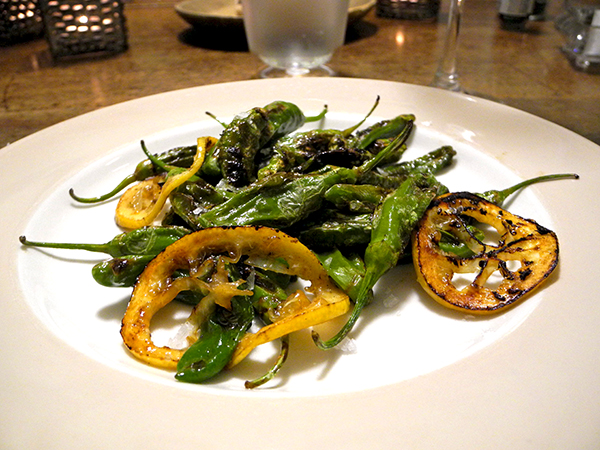
  • I prepared the peppers, small shishito from Lani’s Farm just a little more elaborately than usual, but there’s not a lot to be gained in repeating the same formula over and over again, at least when it comes to cookery; I added thin slices of lemon towards the end of the peppers’ time blistering in the pan, and served them on the table with a choice of three salts (two of them flavored) plain, classic Maldon, smoked alderwood from The Filling Station, and ‘Sel Magique‘ (I had forgotten that I also had my own lemon-caper salt sitting in the cupboard as well)
  • the wine was a California white, Hanging Vine Chardonnay Parcel 4 Lodi 2014


The main course would already have been a variation on a classic Thomas Keller recipe, but I altered it even further, in this case inadvertently. This is how my own version of the recipe for the cod was supposed to go:

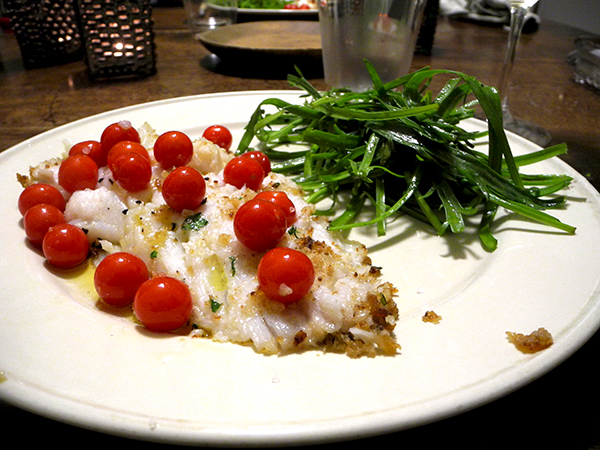
two cod fillets from P.E. & D.D. Seafood, brought to room temperature and seasoned with salt on both sides, the top of each piece brushed with a little real dijon mustard mixed with a very little water, that side then dipped in a mixture of homemade breadcrumbs and finely-chopped parsley from Keith’s Farm, browned briefly, breadcrumb side down, in a heavy enameled cast iron pan with olive oil, transferred to a 325º oven and cooked until the fish begins to flake, near the end of the cooking adding tiny ‘Mexico Midget’ vine tomatoes from Berried Treasures, arranging them on the cod after it was filleted

But, probably because I was tired, and a little distracted, I forgot to bread the two fillets, so, as soon as I had had put them into the pan, I removed them and dipped them in the breadcrumb mixture I had placed in a bowl on the counter, and then, in returning them to the pan, I neglected to return them with the breaded sides down; finally, I almost forgot to toss the tomatoes into the pan before the cod was finished cooking.

I was surprised that everything turned out okay, and in the end the fish didn’t even look messy. More importantly, it was delicious, probably meaning it was a good recipe – and surely a keeper.

  • As for the minutina, from Norwich Meadows Farm, this was the first time I had served it totally raw, as a salad, which is the way I think virtually everyone does serve it. I’ve decided it will probably be the last time:  Although it may be tricky to get this delicious green to the perfect wilt, without seeing it virtually disappear in the pan, I think it’s worth the effort, for the contribution it makes both to taming the roughage and improving the flavor
  • the wine with the fish was an Italian (Umbria) white, Orvieto
  • the music was several of Haydn’s divertimenti

lamb chops, fresh fennel seed; cavolo nero; tomato

lamb_chop_tomato_cavolo_nero

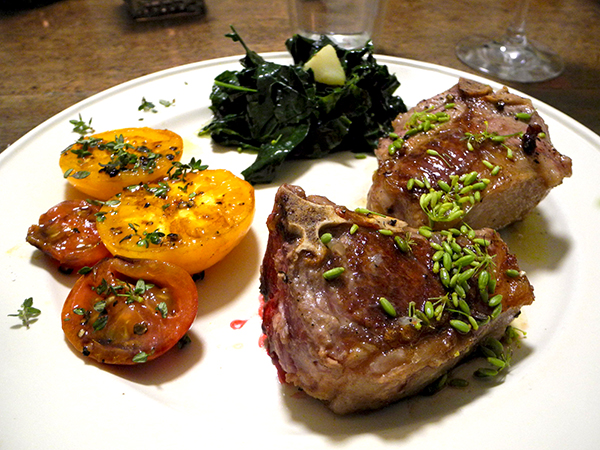
  • four small loin lamb chops from 3-Corner Field Farm, cooked on a very hot grill pan for about 4 minutes on each side, finished with lemon, fresh fennel seed from Lani’s Farm, and olive oil
  • cavolo nero, or black kale, from Bodhitree Farm, briefly wilted with olive oil and two halved Rocambole garlic cloves from Keith’s Farm, which had first been heated in the oil
  • several heirloom tomatoes (two orange and two small red-ish) from Lani’s Farm and Berried Treasures Farm, halved, sprinkled with salt and pepper, then briefly added to the grill pan as the lamb chops were removed, sprinkled with fresh oregano from Stokes Farm, and drizzled with olive oil and a little balsamic vinegar
  • the wine was a California red which uses Spanish grape varieties, Sin Fronteras El Mechon California 2013
  • the music was portions of the album, Debussy: Preludes For Piano, Books 1 & 2 played by Paul Jacobs

basil-stuffed monkfish on arugula; peppers, tomato

monkfish_basil_arugula_peppers_tomato

  • two monkfish tails from Pura Vida Seafood, cut into medallions roughly the size of sea scallops, slit horizontally most of the way through, sprinkled with salt and pepper, each ‘scallop’ stuffed with a single leaf out of a package of Gotham Greens Rooftop basil from Whole Foods, very briefly sautéed in oil along with a smashed clove of garlic from John D. Madura Farm, removed and arranged on two plates on top of beds of washed and dried arugula from John D Madura Farm, while a couple tablespoons of lemon juice were added to the pan, off heat, stirred for ten seconds, then drizzled over the medallions, the greens augmented by a little bit of olive oil
  • a small handful of yellow Grenada peppers from Eckerton Hill Farm, halved or quartered, sautéed over high heat until slightly caramelized, tossed with some really tiny red cherry tomatoes from Berried Treasures, pierced with a fork to avoid really tiny explosions at the table, finished with chopped fresh oregano from Stokes Farm and a light splash of balsamic vinegar
  • the wine was a California white, Hanging Vine Chardonnay Parcel 4 Lodi 2014
  • the music was Anna Thorvaldsdottir’s ‘Rhízōma’