Year: 2016

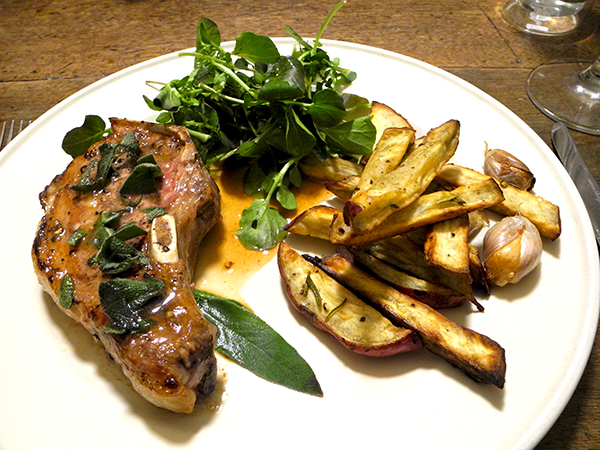
lemon-roasted pork chop, sage; sweet potato ‘frites’; cress

pork_chops_sweet-potatoes_cress2

I say something like this every time I serve this dish: The recipe for this incredibly-simple lemon-roasted pork chop is perfection.  More details here.

  • two 9-ounce rib pork chops from Flying Pigs Farm, thoroughly dried, seasoned with salt and pepper, seared quickly in a heavy enameled cast-iron pan before half of an organic lemon was squeezed over them, the lemon left in the pan, then roasted in a 400º oven for about 14-16 minutes (flipped halfway through and the lemon squeezed over them once again), removed from the oven, topped with chopped sage from  , the pan juices spooned over the top
  • Japanese sweet potatoes from Race Farm, cut as frites, tossed with olive oil, rosemary leaves, salt, and pepper, placed in an unglazed ceramic pan with some whole, unpeeled garlic from John D. Madera Farm, and roasted at 400º for about half an hour
  • cultivated upland cress from Alewife Farm, dressed only with a very good olive oil
  • the wine was an Argentine (Mendoza) red, Susana Balbo Crios Torrontés 2014
  • the music was that of Antoine Forqueray (1671-1745, performed by Atsushi Sakai, Christophe Rousset and Marion Martineau

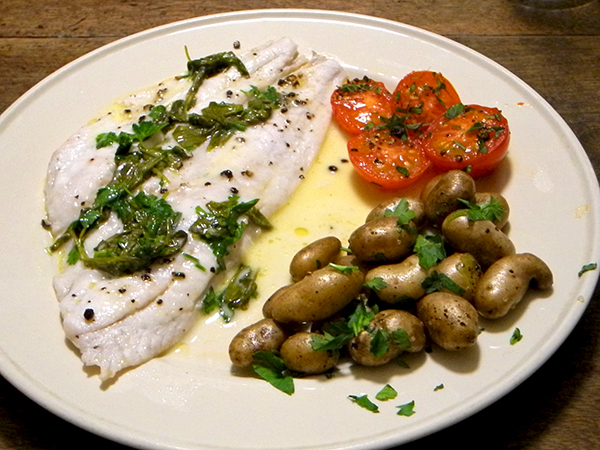
flounder with sorrel sauce; boiled potatoes; sautéed tomato

flounder_sorrel_tomato_potato

While the fish was delicious, once again the sauce did not thicken as it should: I’m assuming it was because I had forgotten about, or was chary of, quickly boiling the mix of pan juices and Crème fraîche (but only until slightly thickened).

  • two flounder fillets from American Seafood, placed in a tinned copper au gratin pan skin side down, seasoned with sea salt and freshly-ground pepper, dotted with 2 tablespoons of butter, a modest amount (less than 1/4 cup) of white wine poured over the top, placed in a 375º oven for 10 minutes, removed onto 2 plates, some of the juices introduced into a separate small pan containing about a fourth of a cup of a good room-temperature Crème fraîche, then boiled quickly until slightly reduced [or should have been boiled, and not just heated, as I did this time], a handful of baby sorrel from Windfall Farms and some chopped parsley from Eataly stirred into the pan (the parsley to ensure that the sauce would not be only the olive drab color of sorrel once it’s been cooked), the sauce spooned over the fish
  • tiny La Ratte potatoes from Berried Treasures, scrubbed, boiled in salt water, drained, dried in the pan, rolled in a little butter, seasoned with salt and pepper, sprinkled with parsley from Eataly
  • four Backyard Farms Maine ‘cocktail tomatoes’ from Whole Foods, halved and heated in a small tinned copper pan, seasoned with salt and pepper, sprinkled with chopped fresh oregano from Stokes Farm
  • the wine was a California white, David Akiyoshi Reserve Chardonnay Clarksburg 2014from Naked Wines
  • the music was Pfitzner’s sublime opera masterpiece, ‘Palestrina’ (incidentally, never performed in the US), Kirill Petrenko conducting the Frankfurt Opera And Museum Orchestra*, with Richard Cox, Frank van Aken, Johannes Martin Kränzle, and Claudia Mahnke


*a historical note, from the orchestra’s site: “Oper Frankfurt’s orchestra came into being towards     the end of the 18th century. It received its unusual name because it was also the orchestra that gave concerts for the “Frankfurter Museum”, an institution founded by culturally minded people in Frankfurt in 1808, when Louis Spohr was chief conductor of the, still young, orchestra.”


mushroom ravioli, herbs, treviso, balsamic, parmesan

mushroom_ravioli_treviso_parmesan

I had only a small window through which I might put together a dinner on Tuesday, so I assembled a simple sauce for a filled pasta I had been keeping in our small freezer compartment. Variations of this filled pasta dish are one of my most common recourses in such circumstances.

  • a 12-ounce package of Rana mushroom ravioli (portobello and porcini) from Eataly, boiled, drained and mixed with a sauce of olive oil, salt, pepper, chopped thyme from Foragers Market, chopped parsley from Eataly, plus one small treviso from Eataly which had been quartered and roasted along with olive oil, salt, and pepper, and finishing with a little balsamic vinegar, while the pasta water was coming to a boil, the ravioli and sauce divided into shallow bowls, finished with a small handful of pine nuts which had been heated in a cast iron pan until they had begun to brown, some olive oil and grated ‘Parmigiano Reggiano Bonat 3’ from Buon Italia, and topped with slivers of the same cheese
  • the wine was an Italian (Marche) red, Fattoria Laila Rosso Piceno Nero Scuro 2014 [Note: that link is to the 2013]
  • the music was that of David Matthews, his ‘Sonata for Piano’ opus 47, and other works by him, from this album;  before dinner we had watched a DVD of the George Benjamin opera, ‘Written on the Skin’, which I described tonight in a tweet as “the most intense opera I’ve ever seen”

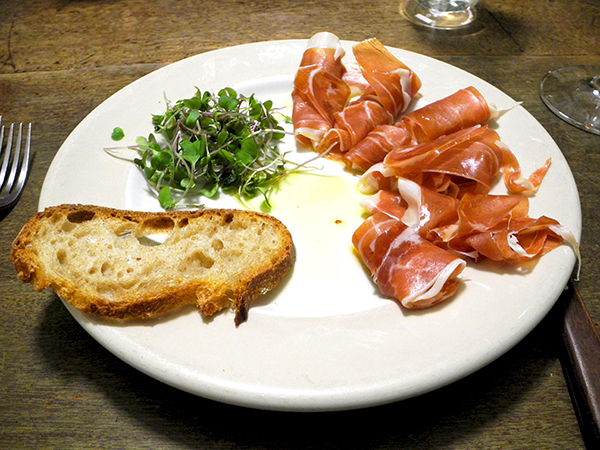
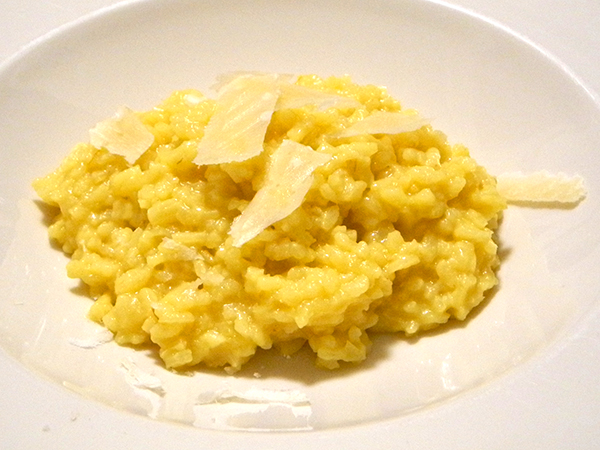
speck, kale micro greens; saffron risotto with parmesan

speck_kale_micro_greens

The cold kept the fish out of the Greenmarket on Monday, so I had to come up with an alternative for dinner.  I didn’t want it to be meat or a pasta, both of which we had enjoyed very recently, so I turned to a couple old favorites, salumi and risotto, to be served in succeeding courses.

So, yes, this was a northern Italian meal, including the a contribution from the most northern, formerly Austrian province.

Risotto means standing over a pot almost continuously for nearly half an hour, and it shouldn’t really sit around afterward, so there was a significant interval between courses (good conversation, music, and wine continued)

  • La Quercia Speck Americano, described as ‘applewood-smoked prosciuto’ (3 ounces), from Foragers Market, drizzled with a little a good Umbrian olive oil (Luciana Cerbini Casa Gola) from Buon Italia, served with some kale micro greens from Lucky Dog Organic Farm and slices of a Bien Cuit sourdough ‘Campagne’, also from Foragers
  • the wine was the last of the sparkling rosé we enjoyed the day before (the simple magic clutch cap from the Argyle vineyard we’ve had for decades maintains the fizz very well), a super Spanish (Penedès) sparkling rosé, Castellroig Cava Brut Rosat


saffron_risotto_with_parmesan


octopus, micro greens; steak, tiny potatoes, kale; hearts

octopus_carpaccio2

Even if it weren’t St. Valentine’s day, it might have been possible to spot a theme running through this meal. I don’t want to go into an analogy of its physical elements, to protect the squeamish, but the color red – and hearts shapes – were important parts of the conceit.

The meal began with one of my favorite things, from the sea, another of those treats which I suppose I could put together myself, with a great deal of labor, and perhaps an occasional success, but which I enjoy prepared by experts.

  • octopus carpaccio (sliced, pressed octopus), less than 3 ounces altogether, from The Lobster Place, drizzled with a little juice from a tiny lemon-lime grown locally by David of Fantastic Gardens of Long Island, and a little very good olive oil
  • micro kale greens from Lucky Dog Organic Farm
  • slices of a small Bien Cuit baguette from Forager’s Market
  • the wine was a really super Spanish (Penedès) sparkling rosé (it was Valentine’s Day!), Castellroig Cava Brut Rosat


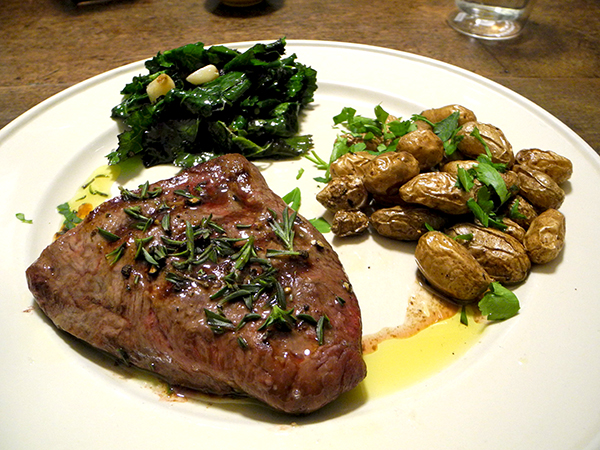
flatiron_steak_la_Ratte_kale

Avoiding the subject of hearts for a moment, and looking at this entrée, I’m thinking I might have figured out why this is called a ‘flatiron steak’ (a new, increasingly-prized, and quite singular shoulder cut of beef which is sliced by the butcher into 2 flat steaks, to remove the heavy connective tissue) , except that its companion was definitely not shaped like an antique iron.

It seems that I’m not the only one to have speculated about the name; others have tried to track down the story, including this sleuth, but I think with less than full success.

I chose the 2 steaks at Dickson’s Farmstand Meats, for their perfect size, and at the suggestion of Philip, one of the shop’s knowledgeable butchers. They were delicious, more tasty than more familiar, and pricier cuts that are often preferred for their ability to melt in your mouth (not a feature that compels me).

  • two flat iron steaks (totaling 14 ounces) from Dickson’s Farmstand, brought to room temperature, dried with paper towels, scattered with a little sea salt, pan-grilled for about 4 minutes on each side, a little more salt and freshly-ground telicherry pepper added to both sides after each had been cooked, removed to warm plates, drizzled with a little juice from another local tiny lemon-lime, sprinkled with chopped winter savory from Stokes Farm, and a little olive oil
  • about half a pound of tiny La Ratte potatoes (the size of small-ish olives) from Berried Treasures Farm, scrubbed, dried, tossed with olive oil, thyme sprigs from Forager’s, salt, and pepper, scattered on a seasoned, medium-size Pampered Chef oven pan in a 375º-400º oven for about 20 minutes, removed, arranged on the plates and tossed with chopped parsley from Eataly
  • some beautiful kale from Alewife Farm, sautéed in olive oil in which 3 split medium cloves of garlic from Keith’s Farm had first been allowed to sweat for a few minutes and begun to brown, seasoned with salt, pepper, and a dash of olive oil
  • the wine with the steak was a magnificent, middle-age Spanish (Rioja) red, Viña Ardanza Reserva La Rioja DOC Alta S.A. 2005 [that link is to the producer’s site discussing the 2007 vintage; we’ve had our 2005 for years, and Alta S.A. may now consider it extinct]


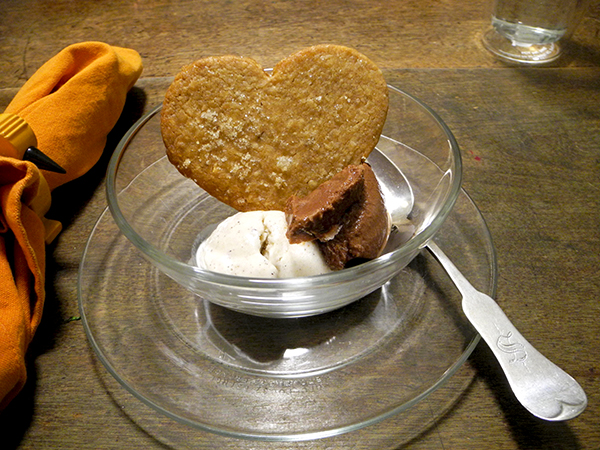
pine_nut_and_hazelnut_cookie_gelato

It’s not red, but it is in the shape of a heart, and its totally ‘nutty’ (specifically, pine nuts and hazelnuts).


  • the music before and then throughout a part of the meal was Mozart’s ‘The Rake Punished, or Don Giovanni’, Yannick Nézet-Séguin conducting the Mahler Chamber Orchestra, with Ildebrando D’Arcangelo, Luca Pisaroni, Diana Damrau, Joyce DiDonato, Rolando Villazón, Mojca Erdmann, and Vocalensemble Rastatt
  • when the opera had finished, well before we had, I suggested one Valentine’s Day tale be followed with another, the wonderful Stravinsky-Auden-Kallman collaboration, ‘The Rake’s Progress‘, like the Mozart-Da Ponte work, a dramma giocoso, or opera buffa, in the composer’s mid-20th-century neo-classical style, which brought it even closer to the neo-classical age of the eighteenth (and they both have sassy upbeat epilogues!); we heard John Eliot Gardner’s production, with the London Symphony Orchestra, Bryn Terfel, Ian Bostridge, Anne Sofie von Otter, Deborah York, and The Monteverdi Choir

braised sweetbreads; roasted carrots; sautéed cabbage

sweetbreads_carrots_cabbage

I thought it would be so easy to come up with a rather simple modern recipe for sweetbreads, but I was surprised at how few resources there were, and none of those I found looked interesting, or as uncomplicated as I wanted, at least in the time I had allotted myself.

Apparently these innards themselves haven’t been considered modern, at least until recently.  I’m probably not the only one who’s been afraid to cook ris de veau, although not for lack of an appreciation of their culinary pleasures I attacked them in my own kitchen once, many years ago, working with the very elaborate and very precise instructions supplied by Julia Child.  I didn’t get lost in the process, and they were delicious, but I must have thought they just weren’t worth the trouble (as with the time I made tripe, also by her formula).

Maybe I had just forgotten about them, since they aren’t found next to the chops and cutlets in the neighborhood meat case (to be fair, sweetbreads are very perishable, and so would generally have to be ordered, if available at all.

I do order them, in good restaurants, almost every time I see sweetbreads on a menu.  For the record, it’s been one of the few appetizer or entrée ‘centerpieces’ I don’t hesitate to order when eating out, since I don’t expect to be preparing it myself (oh, the hardships of an active, and at least somewhat adventurous home cook – and his perfect muse).

Then last night I found myself searching everywhere for sweetbread recipes, in my files, book shelves, and on line. After a while I noticed that a couple of hours had flown by, and I now didn’t have much time left to maneuver.

I ended up going with what seemed to me the simplest and least constructed recipe of the few I had come across. I was surprised that it turned out to be probably the most old-fashioned one. It was from my half-century-old copy of  Craig Claiborne‘s ‘The New York Times Cookbook’ [$25 new here; $10 to $15 here, at Strand]. Years after I had bought it, as I moved into other styles of cooking, and thinking Claiborne was a bit, well, ‘old-fashioned’, I had relegated it to the top shelf in the kitchen, where it was both out of sight and out of mind, only returning it to the company of its ‘colleagues’ when I had a new, large bookcase built in another room.

Lately I have found the 700-page volume surprisingly useful, for its catholicity (including dishes now obscure), and for its tendency to cut to the chase, omitting a lot of the baggage which accompanies many more contemporary recipes (like, I suppose, what I’m writing now).

The offal was good (love how that sounds), very good, and I’m now not going to be timid about initiating a future acquaintance with this wonderful cut – and with new recipes.

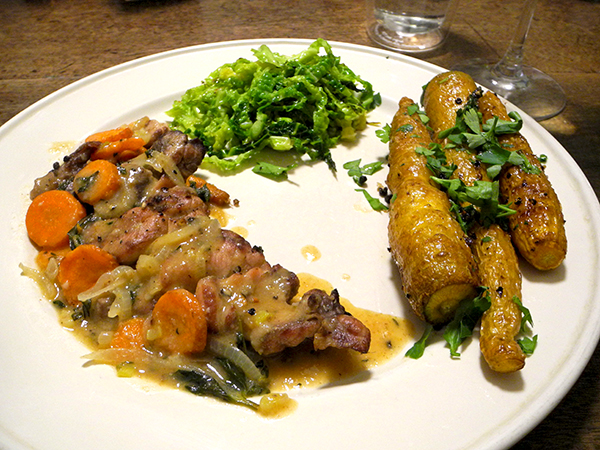
  • one pair of sweetbreads (approximately 9 ounces) from Consider Bardwell Farm, soaked in ice water for almost two hours, drained, placed in boiling water to cover, adding a little lemon juice, the heat lowered, simmered 10 minutes, drained and immediately cooled in fresh ice water, then all connective tissue and covering tissues carefully removed, the oven preheated to 350º while one small-to-medium scraped carrot (from Whole Foods) and one smallish yellow onion (from Norwich Meadows Farm), sliced, were added to 1 1/2 tablespoons of butter in an oval copper au gratin pan, along with one small fresh bay leaf from Westside Market, one sprig of parsley from Whole Foods, and a sprig of thyme from Foragers Market, cooked slowly until the onion was softened and golden, 1 teaspoon of flour sprinkled over the pan, the sweetbreads added on top of the vegetables and herbs, along with 3 tablespoons of white wine, 1/3 of a cup of good chicken stock, salt, pepper, heated until simmering, covered and placed in the (350º) oven, baked 20 minutes, uncovered and baked another 10 minutes, the sweetbreads transferred to 2 plates, 1 tablespoon of fino sherry stirred into the pan, the sauce served over and beside the meat [Claiborne writes, from the posture of classic French cuisine, that the sauce should be strained, meaning it would be only a liquid, but I don’t always feel like abandoning the vegetables, especially when they haven’t really been overly cooked]
  • medium carrots from Alewife Farm, simply scrubbed, then rolled in olive oil, salt, and ground pepper on a small ceramic oven pan, roasted at 400º for about half an hour, or until tender, sprinkled with chopped parsley from Phillips Farm
  • Savoy cabbage from Hoeffner Farms, many of its outer leaves layered together on a board and sliced very thinly, tossed with salt, pepper, and three flattened juniper berries, sautéed in a little butter over medium high heat, stirring occasionally, until the leaves were tender and had begun to brown and (hopefully) crisp slightly at the edges
  • the wine was a great French (Alsace) white, Pierre Sparr Pinot Blanc Alsace 201the music was Bellini’s ‘La Sonnambula’, a gorgeous recording with Cecilia Bartoli, Juan DiegoFlórez, Ildebrando D’Arcangelo, the Orchestra La Scintilla conducted by Alessandro De Marchi
  • the music was Bellini’s ‘La Sonnambula’, a gorgeous recording with Cecilia Bartoli, Juan Diego Flórez, Ildebrando D’Arcangelo, the Orchestra La Scintilla conducted by Alessandro De Marchi
radicchio speck ricotta beet ravioli, butter sage poppyseed

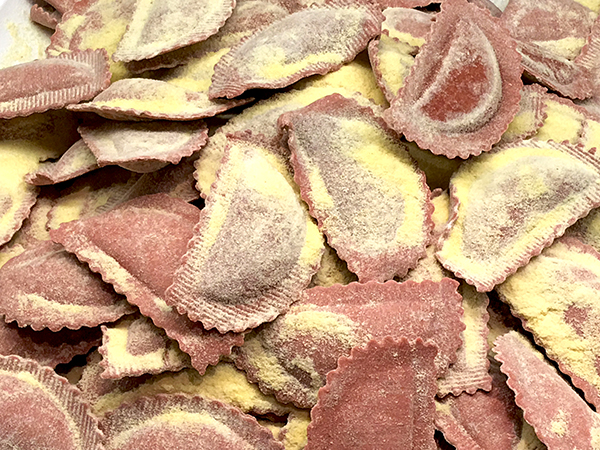
Casunziei_in_case

Over in the fresh pasta department at Eataly on Friday, it seemed that Luca Donofrio was getting a head start on Valentine’s day by featuring a red pasta. I was seduced.

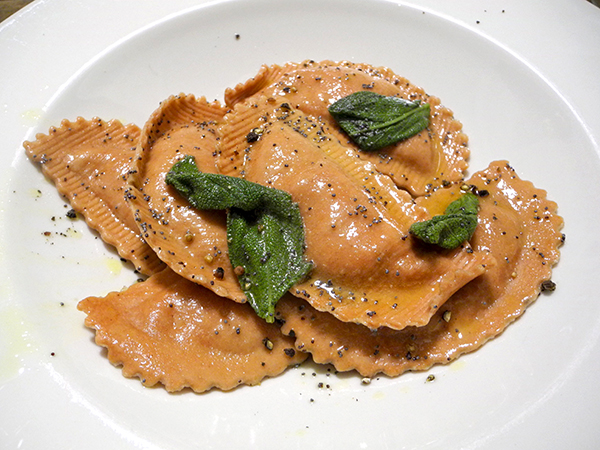
casunziei_sage_butter_poppy_seed

Once it had been cooked however, the gorgeous pasta, Casunziei, lost some of its color, but it was still rather valentine-ish in its loveliness, and especially the loveliness of its taste.

The pockets are a Piedmontese specialty similar to pierogis.  These were half-circle dough pouches, in this case I believe beet ravioli, with a filling of radicchio, Speck, and ricotta.

  • I boiled them gently and briefly, then moved them around in the simplest of sauces, some rich ‘Kerrygold Pure Irish Butter‘ heated with some fresh sage leaves, also from Eataly, and a sprinkling of poppyseeds

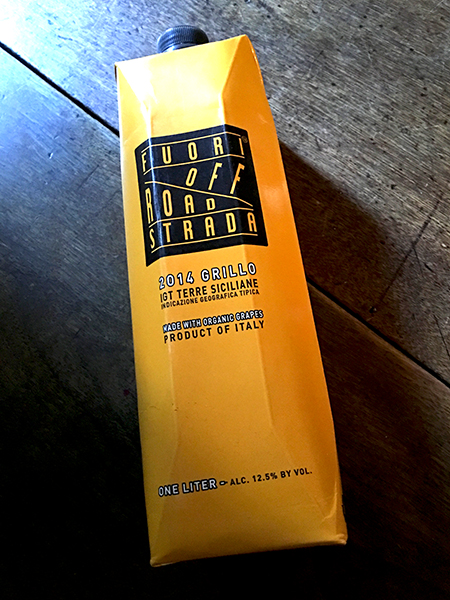
Fuori_Grillo

whiting baked with leeks, bacon, sage; roasted fingerlings

King_whiting_leaks_fingerlings2_

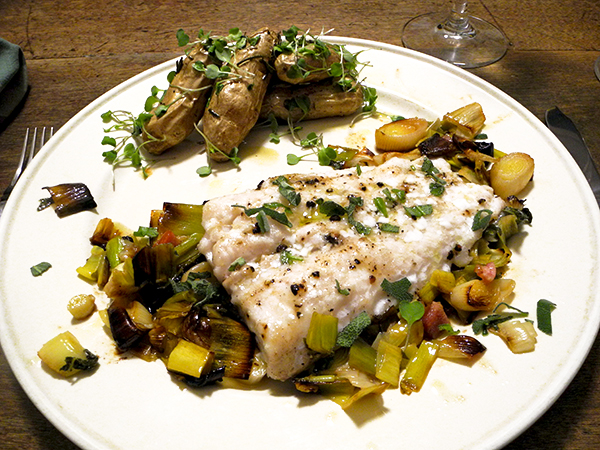
Winter fish: Delicious, and an excellent accompaniment to a cold February evening, this meal felt and looked custom-ordered for the very cold weather outside, but the fish was actually the only ingredient that wasn’t already waiting inside the kitchen.

  • two sliced leeks from Eataly and one ounce of chopped bacon from Millport Dairy tossed with a third of a cup of olive oil, placed in a non-reactive pan and roasted for 10 minutes before a teaspoon or more of chopped sage, also from Eataly, was added [thyme is an alternative, and in fact the herb specified in the original recipe] along with 1/4 of a cup of white wine, the pan returned to the oven for 20 more minutes, before the leek mixture was topped by two halves of a nearly one-pound fillet of King Whiting (Silver Hake) from Pura Vida, which was drizzled with a tablespoon or so of olive oil, the pan again returned to the oven and left there until the fish was cooked (about 10 more minutes), when it was removed and garnished with more chopped sage (or thyme, if using)
  • red fingerling potatoes from Berried Treasures roasted with rosemary from Stokes Farm, tossed with a small amount of micro arugula greens from Lucky Dog Organic
  • the wine was a California (Sonoma) white, ROX Scott Peterson Sonoma Coast Chardonnay 2014 
  • the music was Telemann’s ‘Flavius Bertaridus’, with the Academia Montis Regalis conducted by Alessandro De Marchi
bacon, eggs, thyme, tomatoes, oregano, micro kale, toast

bacon_eggs_tomato_micro_kale

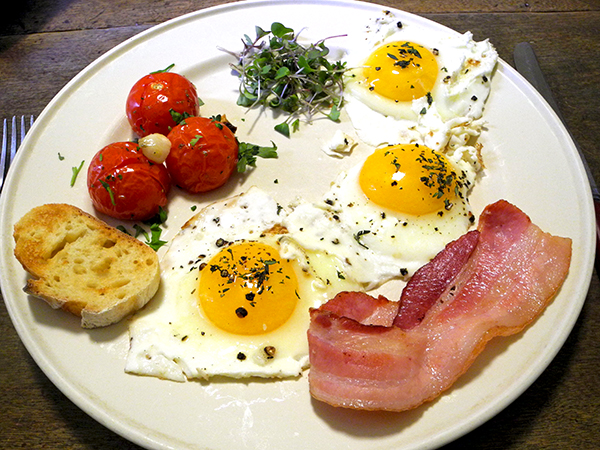
It was Valentine’s day, so I included a little deep red on the side.

This was our breakfast-but-also-lunch on this rather sweet holiday.  We don’t have bacon and eggs every Sunday, and tomatoes are rarely a part of it when we do, but this fast-breaker was put onto the table even later in the day than usual, and therefore it was lunch as well as breakfast.  I also thought the bright red fruit would be a somewhat electric reminder of the holiday just beginning.

The bottom line was that I think tomatoes and eggs are just about as natural a pairing as bacon and eggs, and including all three in an early afternoon meal made it something of a feast betimes.

Once I had sat down and was well into its enjoyment, I thought to myself, and told Barry, I felt it was one of those meals you want to go on, and on. I suspect every element of it had addictive properties.

  • the eggs, topped with chopped thyme from Foragers Market, Maldon salt, and good telicherry pepper, freshly ground, were from Millport Dairy Farm, as was the double-thick smoked bacon in whose residual fat they were fried; the tomatoes were Backyard Farms Maine ‘cocktail tomatoes’ from Whole Foods, slow-roasted with garlic from Keith’s Farm and abundant pungent dried Italian oregano from Buon Italia, finished with chopped parsley from Eataly; the kale micro greens, undressed, were from Lucky Dog Organic Farm; the toast was from three different breads, a small amount of each: the heels of one days-old sourdough loaf from Rock Hill Bakery and a two-day-old semolina loaf from Eataly, and a fresh Bien Cuit baguette from Forager’s Market baked, well, today

baked cod with potatoes, micro radish greens; kale, garlic

cod_potatoes_kale

Mark Bittman called this recipe, ‘Ligurian fish and potatoes‘; it was the basis for the one I’ve been using for years.  It’s a classic, or at least I think so, for its ability to showcase, mostly unadorned, the taste of a superb wild fish, as well as for the ease with which it can be prepared.

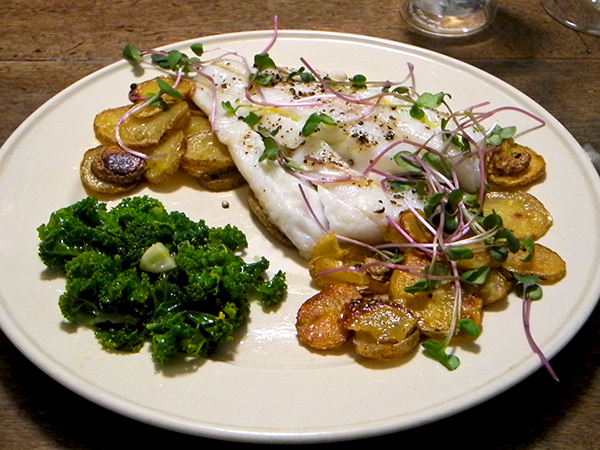
This time I added some rather flashy micro greens in lieu of the parsley specified in Bittman’s original recipe.

  • one 13- or 14-ounce cod fillet from American Seafood Company at the Union Square Greenmarket, prepared along the lines of a recipe from Mark Bittman which I came across almost 12 years ago: I cut the fillet into two pieces and laid them both on a bed of coarse sea salt and completely covered them with more salt, before setting them aside while I sliced, to a thickness of less than 1/4 inch about 12 ounces of small German Butterball potatoes from Tamarack Hollow Farm, scattered them in a baking pan with a scant tablespoon of olive oil, salt, and pepper, and cooked them for 30 minutes or so in a 400º oven, or until tender, meanwhile thoroughly immersing the cod in several changes of water and drying the two pieces before placing them in the pan on top of the potatoes with a little oil drizzled on top and some freshly-ground pepper scattered over them as well, the pan returned to the oven for 8 to 12 minutes (depending on the thickness of the cod), garnished with ‘Hong Vit‘ micro Asian radish greens from Windfall Farms
  • a handful of the very last of the curly winter kale from Tamarack Hollow farm, sautéed in olive oil in which one medium clove of garlic from Keith’s Farm, split, had first been allowed to sweat for a few minutes
  • the wine was a French (Languedoc/Pays d’Oc) white, Demoiselles de Castelnau Cuvée L’Etang Picpoul de Pinet 2014
  • the music was David Matthews’ Piano Concerto Opus 111