Year: 2016

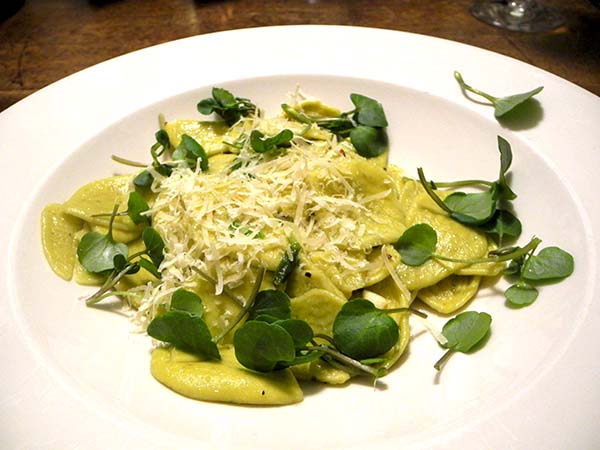
artichoke pasta with spring scallion, chile, cress, parmesan

Foglie_al)Carciofo

We had just come back from a staggeringly beautiful performance of Heiner Goebbels’ production of Louis Andriessen’s ‘De Materie’, and it was about 10:30, so dinner had to be quick. I also thought that it had to be minimal (that would have seemed advisable tonight even if we had all the time in the world).

Also, Barry loves artichokes in any form.

The music choice was a cinch: Bach, and, arguably, at his most minimal, a performance of ‘The Well-Tempered Clavier’.

breaded swordfish, oregano, wild garlic; greens; tomatoes

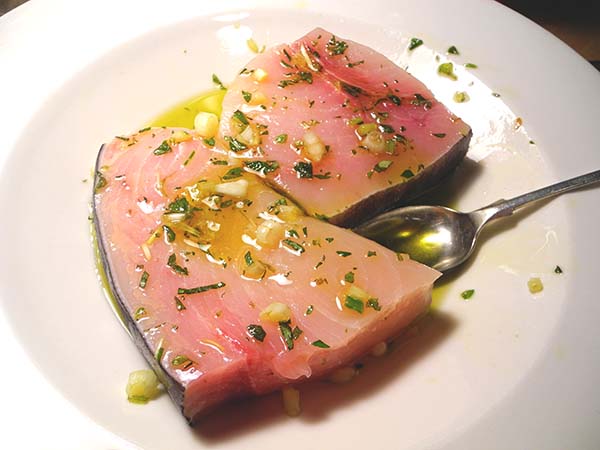
swordfish_in_marinade

the swordfish steak sections marinating


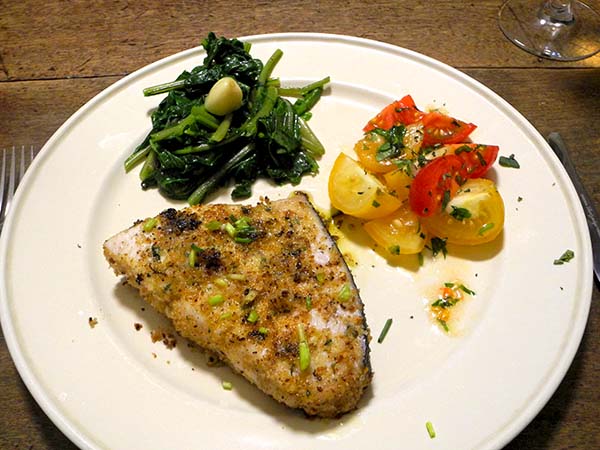
swordfish_tomaotes_radish_greens

and on the plate with the vegetables


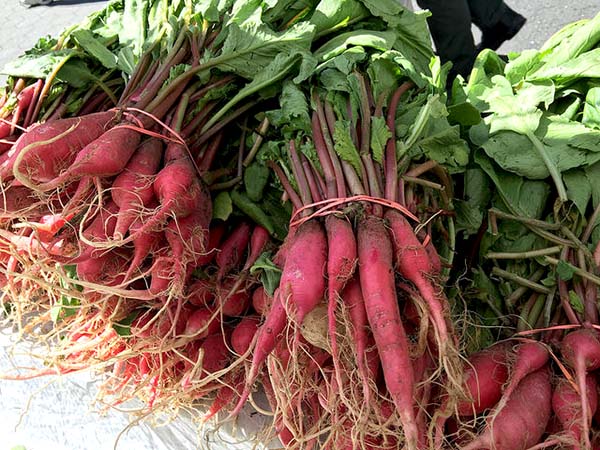
Shunkyo_radish

which included the greens from one of these radish bunches


I had intended to roast both radishes and radish greens as the vegetable for this meal, but the mild weather gave me second thoughts: I was not anxious to have the oven heat up the kitchen, so I ended up cooking only (some of) the greens, braising them on top of the stove (reserving the remainder for another time). I substituted some colorful fresh (hydroponic) tomatoes, in the form of a salad, for the radish roots, which will be a part of another meal.

  • one swordfish steak (off of Scott Rucky’s fishing vessel, ‘Dakota’, out of East Islip, Long Island), from American Seafood Company in the Union Square Greenmarket), trimmed at the stand by the vendor’s owner, Glenn, cut into two pieces at home, marinated for about half an hour in a mixture of olive oil, chopped fresh oregano from Stokes Farm, and finely-chopped wild garlic from Lani’s Farm, drained well and covered with a coating of dried homemade bread crumbs, pan-grilled above a fairly high flame for about 3-4 minutes on each side, removed, seasoned with salt and pepper, sprinkled with a little local lemon juice from Fantastic Gardens of Long Island, a little more wild garlic, then drizzled with olive oil before serving
  • a few quartered Backyard Farms Maine ‘cocktail tomatoes’ from Whole Foods and two larger quarterd (or maybe ‘sixth-ed’) yellow tomatoes from Shushan Valley Hydro Farm, mixed with a good Umbrian olive oil (Luciana Cerbini Casa Gola) from Buon Italia, a squeeze of Lisbon lemon, also from from Fantastic Gardens of Long Island, and a little chopped lovage from Two Guys from Woodbridge
  • radish greens from a large bunch of Shunkyo radishes from Lani’s Farm wilted in a large cast iron enameled pan in olive oil in which one large halved garlic clove from Whole Foods had begun to color, seasoned with salt and pepper
  • the wine was an Italian (Sicily) white, Corvo Insolia 2013 from Philippe Wine in Chelsea, located about 50 yards from our front door
  • the music was various concertos by Antonin Reichenauer

emmer reginetti with cabbage, garlic, anchovy, chile, bay

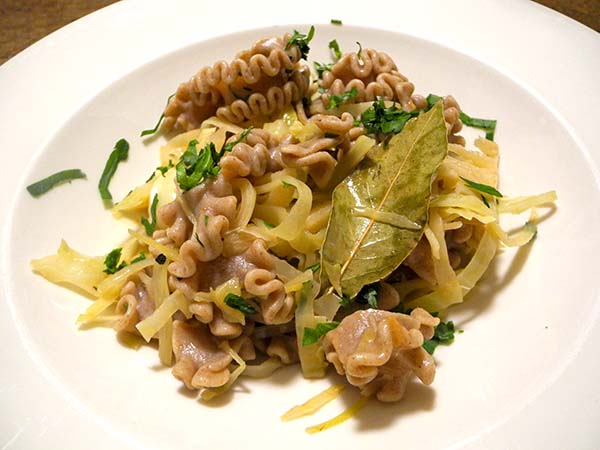
emmer_reginetti_cabbage

a fantastic dish, and assembling it could hardly have been easier; try it!


When I manage to put together a meal as delicious – and as simple to duplicate – as this one, I want to broadcast it as well as I can. Mark Bittman’s ‘Pasta with Savoy Cabbage’ recipe is brilliant to begin with, but I was very lucky to have a very special local pasta (with local grains) on hand to substitute for his suggested, and more familiar, “dried pasta, like spaghetti.”

My secret was a package of New York’s own artisanal pasta, by Sfoglini Pasta Shop, specifically, their ‘Emmer Reginetti‘, which I had picked up somewhere recently, although I’m not certain where. For more on the fascinating story of emmer (aka farro), start here.

It was a perfect match for a rather cold evening on one of the first days of spring, especially because the other principal ingredient was a fresh cabbage which had presumably been harvested on one of the last days of autumn, at least 3 months ago.

The miracle of cabbage: It’s what kept many of the poorer folk in northern European climes alive throughout long winters without supermarkets or central heating – or animals or vegetables that were still alive.  But this isn’t our grandmother’s pungent crucifer, as attested by the recipe’s origin in the northern reaches of the Italian peninsula. The presence of bay leaf, anchovy, garlic, chile, and wine produced an aroma – and a flavor – which would awaken the most indifferent eater and please the most fussy gastronome.

I followed Bittman’s recipe pretty much to the letter, except that I used only 75% of its proportions, used a very different pasta, and finished it with a combination of parsley and lovage.

  • my ingredients included the Sfoglini Emmer Reginetti, garlic from Whole Foods, canned salted anchovies from Buon Italia, dried Itria-Sirissi chili (peperoncino di Sardegna intero) from Buon Italia, Italian bay leaves from Buon Italia, a white cabbage from Phillips Farm, parsley from Eataly, and lovage from Two Guys from Woodbridge
  • the wine was an Italian (Südtirol/Alta Adige) white, Alois Lageder Pinot Grigio Dolomiti 2014
  • the music was an album of compositions from composers associated with Venice in the baroque era,  Uri Rom, Antonio Vivaldi, Alessandro Marcello, Giovanni Porta

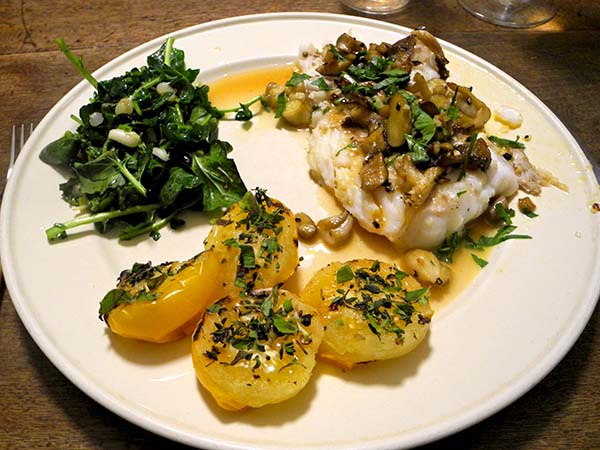
cod with mushrooms; cress with wild garlic; yellow tomato

cod_mushrooms_tomato_cress

‘Pan-Seared Cod with Mushrooms’: It’s a fascinating recipe, but I have to append a bold note to my copy: ‘do not try this again unless you really do have low-sodium stock.’ I can’t say I wasn’t warned, since the instructions had made it very clear; it’s just that I haven’t yet been able to locate a [good] vegetable stock described as low sodium.

I’ve made 2 adjustments to the original recipe: First, I used a quarter of the amount of mushrooms it suggests, as once before; and second, I used lovage rather than the parsley or chives indicated.  I also could have gotten away with maybe half the stock specified, since I included far fewer mushrooms than the site had instructed.

Once served, at least initially, the cod was more salty than either of us would prefer, but a squeeze of lemon and some good fresh bread (‘rustic classic’ from Eataly, sliced) allowed us to appreciate the food, and the wine, and in the end the salinity seemed to have disappeared.

I’ll still say it’s a good recipe, and not just because it’s something of a novelty, but it probably has to be used with some caution.

  • two cod fillets (totalling 15 oz) from P.E. & D.D. Seafood, prepared roughly along the lines of this recipe, with the changes noted above, using oyster mushrooms from Blue Oyster Cultivation, flakes of dried Itria-Sirissi chili (peperoncino di Sardegna intero) from Buon Italia, vegetable broth made from a concentrate manufactured by Better Than Bullion, ‘Kerrygold Pure Irish Butter‘ from Whole Foods, juice from a delicious, rather sweet lemon grown locally by Fantastic Gardens of Long Island, and lovage from Two Guys from Woodbridge
  • four yellow tomatoes (hydroponic) from Shushan Valley Hydro Farm, halved, seasoned with salt and pepper, pan grilled, then sprinkled with chopped thyme from Forager’s and chopped oregano from Stokes Farm
  • some very peppery wild cress from Lani’s Farm, wilted a bit with olive oil over a medium flame together with finely-chopped wild garlic, also from Lani’s Farm, then seasoned with salt and pepper, and finished with a drizzle of olive oil
  • the wine was an Oregon (Willamette Valley) white, Underwood Pinot Gris 2014
  • the music was Georg Phillip Teleman’s ‘Orpheus’, René Jacobs directing the Academy for Ancient Music Berlin and the Berlin RIAS Chamber Chorus, with Ruth Ziesak, Werner Güra, Maria Cristina Kiehr, Isabelle Poulenard, Axel Köhler, Hanno Müller-Brachmann, Dorothea Röschmann, and Roman Trekel

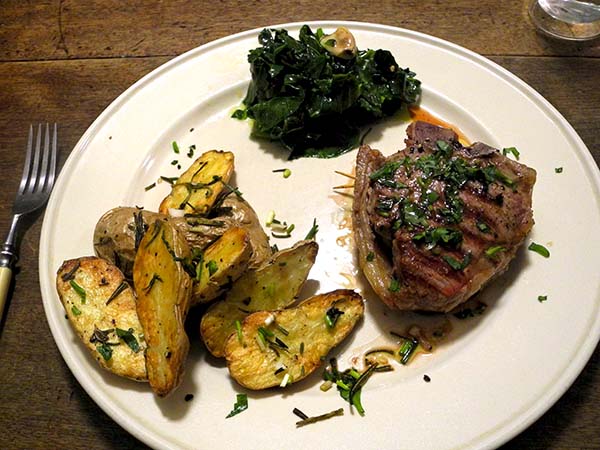
lamb chop, lovage; ozettes, rosemary, wild garlic; collards

lamb_chop_ozette_potatoes_collards

After a certain amount of experience in various cities – and countries – including both good and less good experience with the meats available at local farmers’ markets, I’ve come to the conclusion that the amount of satisfaction that comes from cooking any cut of meat depends very much on the excellence of the butcher. These particular two chops were as beautiful to look at – both before and after grilling – as they were delicious to eat.


  • 2 thick lamb loin chops, produced by Van Well Family Farms, in Watertown, SD, from Eataly, cooked on a very hot grill pan for about 6 minutes on each side, seasoned with salt and pepper after they were first turned over, finished with lemon, chopped lovage from Two Guys from Woodbridge
  • nutty ozette potatoes from Mountain Sweet Berry Farm, halved lengthwise, with a bit of olive oil, salt, pepper, and rosemary leaves from Phillips Farm, roasted at 450º for about 20-25 minutes, sprinkled, as soon as they emerged from the oven, with wild garlic from Lani’s Farm, and then some chopped parsley from Eataly
  • tender collard greens from Norwich Meadows Farm, washed, drained, and braised very lightly in a heavy pot in which one halved garlic clove from Norwich Meadows Farm had been allowed to sweat in some olive oil, the dish finished with salt, pepper, and a drizzle of olive oil
  • the wine was a California (North Coast) red, Fleur de California North Coast Petite Sirah 2013
  • the music was from the album,  ‘[Johann Heinrich] Schmelzer, [Johann Joseph] Fux: [Barok] Music at the Habsburg Court‘ (great fun)

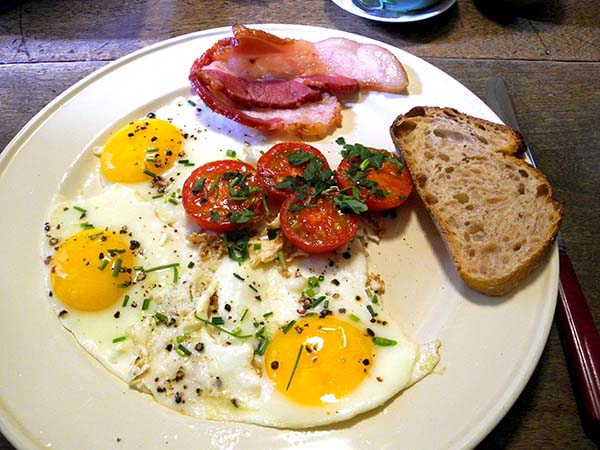
bacon, eggs, tomato, wild garlic, herbs, spices, toast

bacon_eggs_tomato_etc

Since we would be heading out to the Jewish Museum afterward, I suppose this hearty Sunday breakfast could be called ‘unorthodox’, in light of the title of the museum’s current show of that title.  That same afternoon we were also able to visit some of the rooms of the permanent exhibition, which I can heartily recommend to anyone.

  • the thick bacon from the Amish farmers in Pennsylvania, Millport Dairy was fried very slowly over a very low flame
  • the eggs were also from Millport Dairy, fried in the bit of fat rendered earlier by the bacon, but only after a little butter had been added to the pan, then enriched with condiments which included, Maldon salt, some ground highly-pungent ‘India Special Extra Bold’ Tellicherry peppercorns, wild garlic from Lani’s Farm, a bit of dried Itria-Sirissi chili (peperoncino di Sardegna intero) from Buon Italia, and, after the photo above was taken, a very wonderful aromatic seasoning blend called L’eKama
  • the tomatoes were halved Backyard Farms Maine ‘cocktail tomatoes’ from Whole Foods, briefly sautéed in the pan in which the bacon and eggs had cooked, then sprinkled with Maldon salt, with fresh oregano from Stokes Farm which I had been keeping alive since last fall [yup.]
  • the bread for the toast was ‘rustic classic’ from Eataly

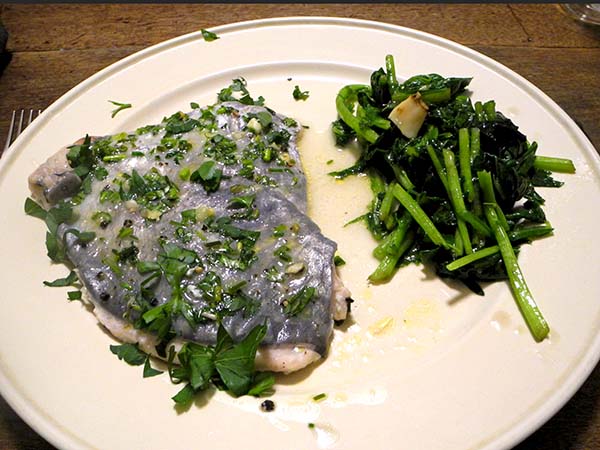
John Dory, lemon, wild garlic, lovage; mustard greens mix

John_Dory_mustards2

looking a bit like emeralds mounted on silver, but much more rewarding


I’ve prepared John Dory, which I’ve described as “aka le Poisson de St.Pierre, Pesce San Pietro, Petersfisch, Heringskőnig, Zeus Faber, or ‘the-funny-shiny-one with-the-sourpuss-face'”, at least 3 times since initiating this blog. Each time I assembled it a little differently, but the fish itself has always retained its distinctive flavor and texture, a flavor and texture quite unlike other white fish.

And it’s delicious.

This time, as always, the formula was adjusted for the season, and for what I had on hand.

  • John Dory fillets from Pura Vida Fisheries, arranged in a lightly-buttered copper au gratin pan, sprinkled with a few (3?) tablespoons of lemon juice, seasoned with salt, and pepper, the skin side spread with half of a mixture of 1-2 tablespoons of softened ‘Kerrygold Pure Irish Butter‘, chopped lovage from Two Guys from Woodbridge and finely-chopped wild garlic from Lani’s Farm, baked in a 350º oven, skin-side down for 5 minutes, turned over, the other side spread with the remaining mixture and the pan returned to the oven for another 10 minutes, served with both chopped lovage and parsley sprigs from Eataly (this is the recipe, except for my substitution of the herbs it suggests) [the smooth silver skin can be eaten or easily removed, and I’ve done both]
  • a mix of greens, mostly mustard, from Norwich Meadows Farm, wilted in a little oil which had already warmed one halved clove of bruised garlic from John D. Madura Farm, seasoned with salt and pepper, finished with a drizzle of oil
  • the wine was an Austrian (Kemptal) white, Schlosskellerei Gobelsburg Kamptal Grüner Veltliner 2014
  • the music was Peter Maxwell Davies, Symphony No. 2, the BBC Philharmonic conducted by Maxwell Davies

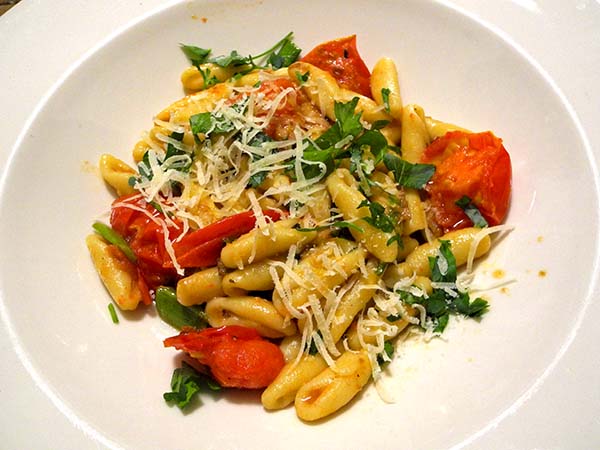
cavatelli with spring garlic, tomatoes, anchovies, parsley

Cavatelli_spring_garlic_tomato_anchovy

The pasta itself was the star here. It was fresh cavatelli, from Eataly, where its making was overseen by Luca Donofrio, Eataly’s pastaio.

The recipe for the sauce, in this combination a rich and complex complement to a surprisingly earthy plain pasta, was a slight re-imagining of Mark Bittman’s ‘Pasta With Garlic, Tomatoes and Anchovies‘.

  • two roughly-chopped spring garlic from Norwich Meadows Farm placed in a copper skillet over medium heat along with some dried Itria-Sirissi chili (peperoncino di Sardegna intero) from Buon Italia, cooked until the garlic was somewhat tender, 2 small serrano peppers from Forager’s and 7 salted anchovies from Buon Italia, filleted, added and heated until the anchovies had fallen apart, followed by over a cup of halved Backyard Farms Maine ‘cocktail tomatoes’ from Whole Foods, and then the chopped green sections of the fresh garlic, everything cooked until the mix had become ‘saucy’ (about 5 minutes), salt and pepper added, tossed with 12 ounces of just-boiled hand-made fresh cavatelli from Eataly, and served with grated ‘Organic Parmigiana Reggiani Hombre’, from Whole Foods, and chopped parsley, also from Whole Foods
  • the wine was an Italian (Sardinia) white, La Cala Vermentino di Sardegna 2013
  • the music was Peter Maxwell Davies’ “..sprawling, elemental work, ..wind-swept and rain-lashed..” Symphony No. 3, the composer conducting the BBC Philharmonic

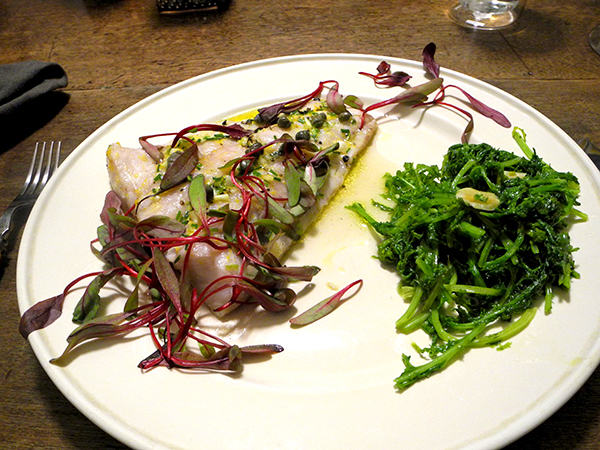
pollock, wild garlic, capers, beet greens; mustard greens

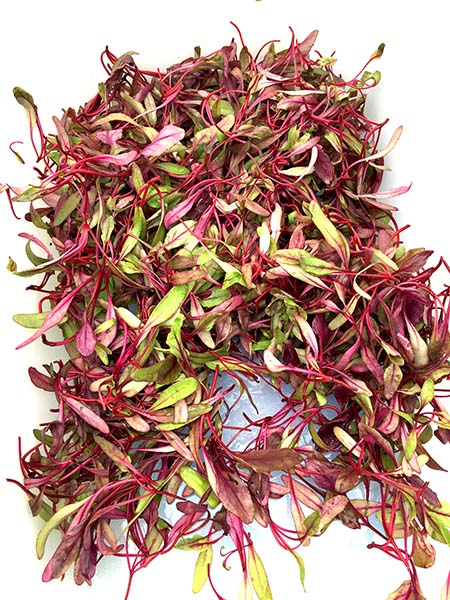
beet_greens_micro2

I could say the meal was all about micro ‘Bull’s Blood’ beet greens, but that wouldn’t be quite accurate.


pollock_frisee_mustard

In fact I had decided on the two pollock fillets first, and then I spotted the purple ‘greens’ across the way.


Whatever. But the plate sure was pretty.

  • two 8-ounce pollock fillets from from American Seafood, seasoned on both sides with salt and pepper, placed in a buttered copper au gratin pan, spread with a mixture of soft butter, zest from a local Lemon grown by Fantastic Gardens of Long Island, and some finely-scissored tiny wild garlic bulbs and stems from Lani’s Farm, baked 12 to 15 minutes at 350º, removed to 2 plates, drizzled with the cooking juices, sprinkled with a small number of salted capers which had been rinsed, drained, dried, and briefly heated in a little hot olive oil (the oil in that pan also drizzled over the fish), finished with micro ‘Bull’s Blood’ beet greens from Windfall Farms
  • frisée-like mustard greens from Lani’s Farm, wilted in a little oil which had already warmed a halved clove of bruised garlic from John D. Madura Farm, seasoned with salt and pepper, finished with a drizzle of oil
  • the wine was an Oregon (Willamette) white, Kings Ridge Oregon Pinot Gris 2014
  • the music was early Peter Maxwell-Davies chamber works, from this album

Mrs. Nic’s sauce again, and the San Marzano tomato story

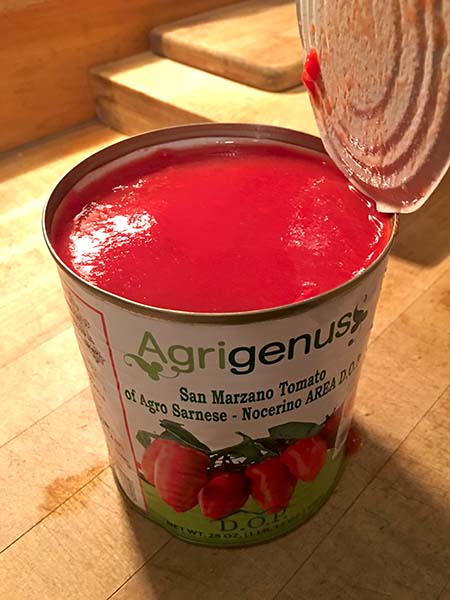
San_Marzano

pedigree: San Marzano, Italian San Marzano, Italian San Marzano D.O.C.


Gorgeous.

I love tomatoes, in any form, and I think I know what to do with them, in any form, but what do I know about the competing claims of the many serious (read, ‘high-end’) producers of tomatoes canned for cooking? I’m beginning to think that I may really only be able to say what tastes good.

I used to think I knew what was the very best canned tomato, based on my discussions with Nic Soccodato long ago, and my experience with the cans he sold out of the back of his barber shop. It was the San Marzano, and only the San Marzano which originated in and grew in his own paese, the Valle del Sarno.  After he retired however I may have inadvertently strayed from what he would have considered the genuine San Marzano, and recently I became aware that one of the brands I had been using for some time, and had always found very good, while described as San Marzano tomatoes, did not actually include fruit from Italy. Apostasy, or victory for locavores?

The problem has been further complicated by the fact that products of the same producers are not found in all markets, and the name, ‘San Marzano’, might not be found on any label in a given market, on a given day.

The can of peeled tomatoes shown in the image above, produced by Agrigenus, is what I used last Wednesday, in my last tomato sauce outing; it had all of the credentials. On Friday however, when I was at Eataly for another reason, and remembered I should replace it, the one brand I found was Mutti.  The label asserted, ‘Only Italian tomatoes. GMO Free’, but, while I looked everywhere, the words ‘San Marzano’ were nowhere to be found. I’ve really liked this brand in the past, often picking it up when my first choice was not available. Its exclusive presence in the store seemed to carry the recommendation of Batali and the Bastianich family, so I bought one.

I now don’t know what my experience means to the claims for San Marzano tomatoes from the Agro Nocerino, but I’ll probably continue to seek out the original.