Year: 2017

Kassler, Senf, Bierkraut; Saltzkartoffeln; Zwei Rauchbiere

It was a snow day. It felt like a holiday. It was also pretty cold outside (and we still haven’t turned on the heat inside), so a warm kitchen felt right. I had all the makings for a traditional German entrée inside the apartment, and we also had some terrific beer.

We had a terrific, traditional German dinner. Also, nearly everything in it came from farms in the area (our area, not Germany, which somehow makes it even more special).

We usually drink wine with our meals at home, partly because we both much prefer draught beer to bottled, but two of the beers we spotted at Schaller & Weber last week were very special to us: These Rauchbiere are from the area of Northern Bavaria from which my mother’s family emigrated to Wisconsin almost 175 years ago. In addition, both unusual and quite rare, we had thoroughly enjoyed them at Schankerla, the beautiful Brauereiausschank of the brewery itself, 5 years ago, with Barry’s mother, and we had never forgotten those pleasures. With some of the entrées however, we also had enjoyed good Franken wine, in a Bocksbeutel.

Smoked bier is not a gimmick, but an ancient tradition which continues today, and from our own experience alone, with good reason. Five years ago Barry described his first taste, “Nice and smoky like bacon in a glass.”

My maternal great-great-grandparents, who were from Franconia, but not Bamberg itself, may never have had Rauchbier. If they had, they might never have left.

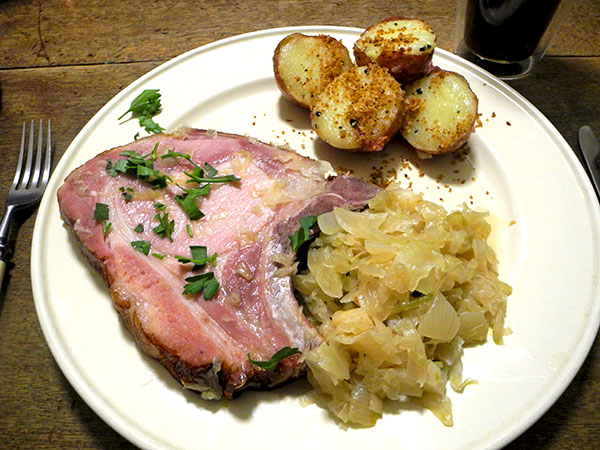
  • one 16-ounce glass jar of sauerkraut (simply cabbage and salt) from Millport Dairy Farm, drained and very well-rinsed in several changes of cold water, drained again and placed in a large enameled cast iron pot with one chopped onion from Tamarack Hollow Farm, one chopped parsley root (in lieu of the more traditional carrot) from Norwich Meadow Farm, half a dozen whole allspice berries and an equal number of Tellicherry peppercorns, a little salt, 2 Sicilian bay leaves from Buon Italia, about 8 ounces of beer (a bottle of Peroni, which had already been opened and kept in the refrigerator, some of it having been used in an earlier meal), a little water as needed, and a tablespoon of olive oil, all brought to a boil and then simmered over a low flame, stirring occasionally, for about half an hour, covered, and then uncovered for 20 or 30 minutes more before two 9-ounce smoked pork chops from Schaller & Weber, having first been briefly seared on both sides inside a dry cast iron pan, were buried in the sauerkraut, heated for about 20 minutes, the chops and sauerkraut arranged on 2 plates and sprinkled with chopped fresh parsley from Eataly
  • a small pot of some pretty good ‘Organic German Mustard’ from Whole Foods served on the side
  • two Dark Red Norland potatoes from Norwich Meadows Farm, scrubbed, boiled unpeeled in heavily-salted water until barely cooked through, drained, halved, dried in the still-warm vintage Corning Pyrex Flameware blue-glass pot in which they had cooked, a couple tablespoons of rich Kerrygold Pure Irish Butter [with 12 grams of fat per 14 grams, or each tablespoon of butter; American butter almost always has only 11 grams, which makes a surprising difference in taste and texture], the Saltzkartoffeln arranged on the plates with the chops and the sauerkraut, and sprinkled with homemade breadcrumbs which had first been browned in a little butter
  • the beer was from Germany (Franconia), two different versions of a very special Bamberg Rauchbier (smoked bier), Aecht Schlenkerla Rauchbier Märzen, and Aecht Schlenkerla Eiche Dopper Bock, from Schlenkerla, in Bamberg, both purchased at Schaller & Weber here on 2nd Avenue
  • the music was, no surprise, Georg Solti’s 1959 recording of Wagner’s 1854 opera, ‘Das Rheingold’, with the Vienna Philharmonic
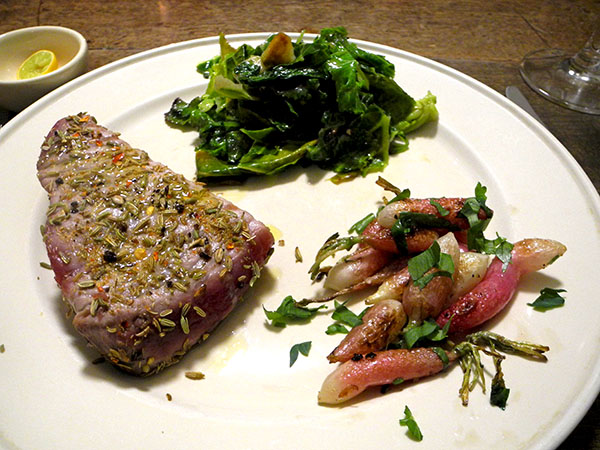
fennel-grilled tuna; sautéed radish; collard, radish greens

I have no idea how professional chefs manage to reproduce the same dishes over and over again; I’ve used this same tuna recipe more often than I can count, and it turns out at least a little different each time, even without half trying.

But then, reproducing the same dinner happens to be exactly what I’m never trying to do at home.

As for an accompaniment to the tuna, I had realized early on that I didn’t really have enough collard greens left from a bunch whose largest portion had been put into service for a previous meal, so I decided to add a second vegetable, some radishes I had almost forgotten were in the crisper, and to add their greens to the collards, or at least those that had still retained their freshness.

The fruits of this improvisation – and good home economy – were delicious, and colorful as well.

  • one 12-ounce tuna steak from American Seafood Company in the Union Square Greenmarket (caught on Scott Rucky’s fishing vessel, ‘Dakota’), cut into 2 triangular pieces, tops and bottoms rubbed with a mixture of a tablespoon or so of dry Sicilian fennel seed from Buon Italia and a little crushed dried Itria-Sirissi chili (peperoncino di Sardegna intero), also from Buon Italia, the two having been ground together with mortar and pestle, the surfaces also seasoned with salt and freshly-ground pepper, before they were pan-grilled for only a little more than a minute or so on each side and finished with both a good squeeze of the juice of some tiny local lemons from Fantastic Gardens of New Jersey and a drizzle of olive oil
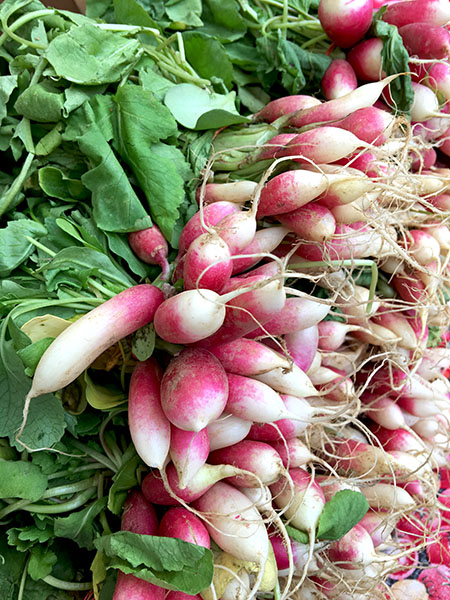
  • a small bunch of ‘French breakfast’ radishes from Eckerton Hill Farm, cleaned and scrubbed, some of the stem retained, sautéed over medium-high heat in a little olive oil inside a heavy tin-lined copper skillet until they had begun to soften and color, seasoned with salt and pepper, sprinkled with fresh lovage from Two Guys from Woodbridge
  • a modest amount of tender collard greens from Phillips Farm, stripped of most of their stems, torn into small sections, washed several times and drained, transferred to a smaller bowl very quickly, in order to retain as much of the water clinging to them as possible, braised inside a heavy oval enameled cast iron pot in which one large quartered clove of garlic from Tamarack Hollow Farm had first been allowed to sweat in some olive oil, the collards joined halfway through by some of the greens of the radish roots, adding a little of the reserved water along the way as necessary, finished with salt, pepper, a little of the same crushed dried Sardinian pepperoncino from Buon Italia, and a drizzle of olive oil
  • the wine was a Spanish (Galicia) white, Martin Codax Rias Baixas Albarino Burgans 2015, from Philippe Wines
  • the music was Roger Reynolds, the pretty awesome, ‘Odyssey’ (1989-92, for 2 singers, ensemble, and computer sound), from ‘The Paris Pieces’

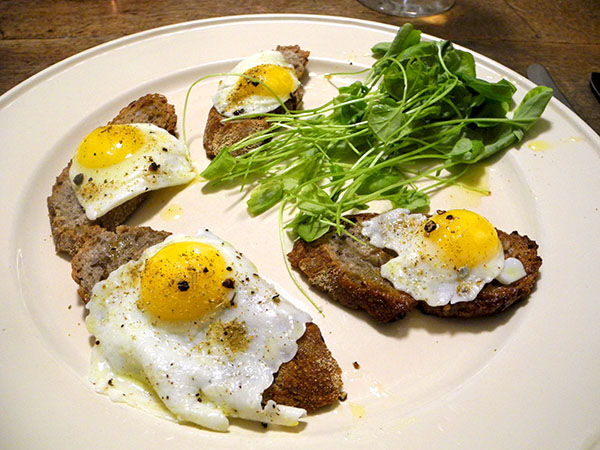
quail eggs on toast; beet fusilli, brown butter, pinoli, cheese

Yeah, pretty snazzy, yet still down to earth, I’d say.

I couldn’t resist these little ones.  We love quail itself, but, while I’ve had many opportunities to bring home quail eggs, there was never the kind of imperative I felt looking at the beautiful clear plastic (yeah, well..) package of 15 while at the Union Square Greenmarket on Saturday:  They were local and they were organic-fed. That, and the opportunity of preparing something I hadn’t before was more than good enough for me this time.

But I had no idea what I was going to do with them.

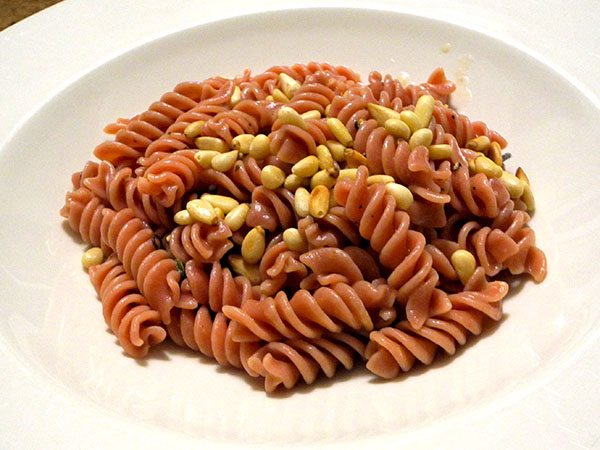
My assumption was that they would a part of a first course, the second being a simple good pasta. Last night I put those two concepts together: The appetizer became a dish of fried quail eggs on toast and the main course a beet pasta with a browned-butter sage sauce which I embroidered only slightly.

  • eight quail eggs from Violet Hill Farm, fried in a heavy tin-lined copper skillet, seasoned with Maldon salt and freshly-ground Tellicherry pepper, sprinkled with organic Sicilian dried wild fennel flowers from Buon Italia, slid onto 8 slices, cut on the diagonal, of a really wonderful, sturdy ‘baguette sarasin’ (buckwheat flour bread) from Eric Kayser, which were toasted on top of the stove, then served with a little upland cress from Two Guys from Woodbridge, the little greens drizzled with a bit of very good Campania olive oil, from the Sannio region, and seasoned with salt and pepper
  • eight ounces of Sfoglini beet fusilli with a brown butter sage sauce composed of 2 tablespoons of ‘Kerrygold Pure Irish Butter‘ melted in a heavy, high-sided tin-lined copper sauté pan and heated until golden brown, after which a number of sage leaves from Keith’s Farm were tossed in and stirred with the butter, the pan was removed from the heat and juice from almost half of a local lemon (Fantastic Gardens of Long Island) added, the sauce set aside until the pasta had been cooked and drained (some of the pasta water retained), when it was added to the brown butter, heated gently and stirred, a good part of a cup of the reserved pasta liquid added, 2 or 3 tablespoons of grated Parmigiano-Reggiano Vache Rosse from Eataly tossed in and mixed with the pasta, which was then divided into 2 shallow bowls and scattered with a small handful of toasted pine nuts from Whole Foods Market
  • the wine was a California (Lodi) white, Karen Birmingham Sauvignon Blanc Lodi 2015
  • the music was Jordi Savall’s album, ‘Music for the Spanish Kings’ (of the 15th century), with his ensemble, Hespèrion XX

gray sole, ‘tomato butter’; cavalo nero; super new cheese

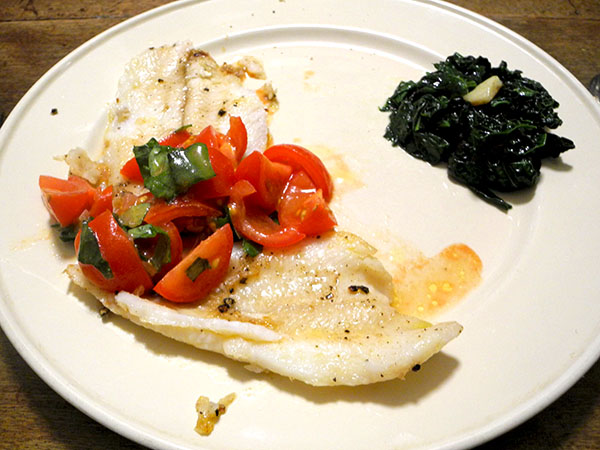
The gray sole, whose name is almost always spelled elsewhere in the English-speaking world, ‘grey sole’, is a beautiful fish, delicate and mild in flavor.  “It’s barely even fish” is a description I just came across on a site advising people new to cooking or eating fish. It also had a very gentle, I’ll even say ‘perfect’, texture (something to which even the finest Schnitzel could never aspire).

I forgot to add that it’s delicious.  It doesn’t taste like chicken, but, like chicken, it may seem to be asking to be loaded down with additional flavor ingredients. I’m usually careful to avoid the temptation.

I try not to disguise any of the virtues I’ve described above, and last night I introduced almost nothing between the fish, simply seasoned and fried in butter and olive oil, and our taste buds, making sure that in the placement of the ‘tomato butter’, so perfect a compliment, it would remain just that, and would not smother the fillets, physically or tastewise.

I had picked up barely two-thirds of a pound of fish that morning, but I wasn’t worried that the entrée would be too small for us: I wanted to be sure we would be interested in a second course, one which would include a new local cheese I had been looking forward to checking out.

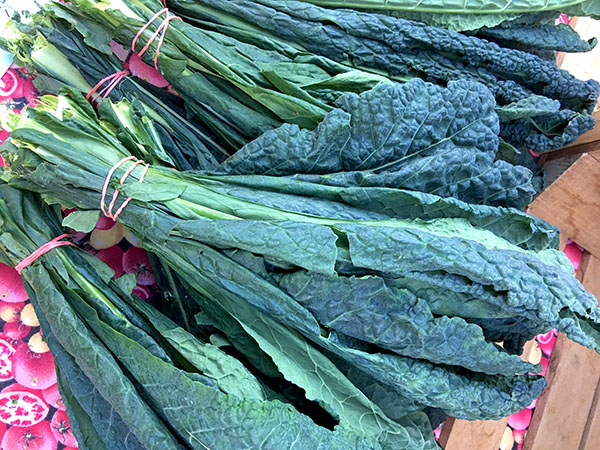
On the other hand, the little bit of Tuscan kale (aka cavalo nerolacinato, or black kale) with which I had decided to accompany the sole seemed to grow smaller and smaller as the cooking process advanced; I ended up slicing some excellent hearty bread, with the excuse that something would be needed to soak up the juices.

  • Four small Gray sole fillets, roughly 2-and-a-half-ounces each, from P.E. & D.D. Seafood, cooked in a heavy tin-lined copper pan over medium-to-high heat for little more than a minute, turning, and cooking for another minute, or until done, placed on warm plates, some ‘tomato butter’ arranged on each plate between the fillets [the butter had been composed a few minutes earlier by melting some ‘Kerrygold Pure Irish Butter‘, then adding half of one small shallot from Norwich Meadows Farm, finely diced, cooking the onion until softened and fragrant, removing the shallot butter from the heat, allowing it to cool for 2 or 3 minutes, then tossing it with 5 Backyard Farms Maine ‘cocktail tomatoes’ from Whole Foods, each cut into 6 wedges (the tomatoes, minutes before, tossed with almost a teaspoon of torn Gotham Greens Rooftop packaged basil from Whole Foods), stirred gently, seasoned with salt, with a few drops of red wine (Chianti) vinegar stirred into the mix at the end]
  • one small bunch of cavalo nero from Eckerton Hill Farm, wilted briefly in olive oil in which one clove or garlic from Tamarack Hollow Farm had first been heated, seasoned with salt and pepper, drizzled with a little more oil

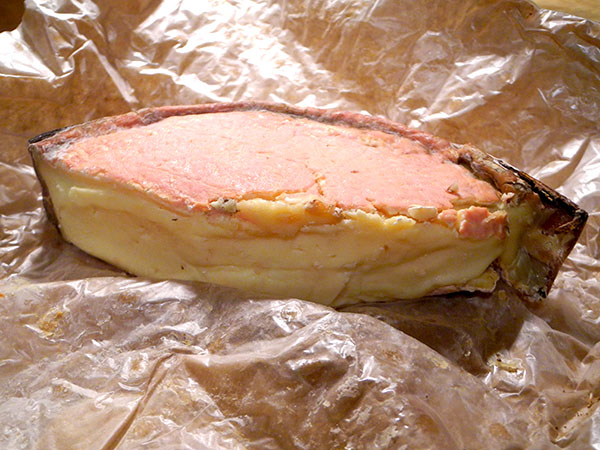
The course that followed included more of the same bread, which turned out to be a great foil for a fantastic cheese, and also a perfect spreading platform.

The picture immediately below is of an 18-ounce small wheel (I took home about half of it).

This is a glimpse of the cut side, on the counter at home, a section of cheese already having been removed and served.

  • wedges of Consider Bardwell Farm‘s very exciting new, “bloomy rind pasteurized cow cheese wrapped in spruce bark and aged in Brooklyn”, Peter’s description of Peter, while he was giving me a taste (the cheese has not yet been named), served with slices of ‘8 Grain 3 Seed’ bread from Rock Hill Bakery


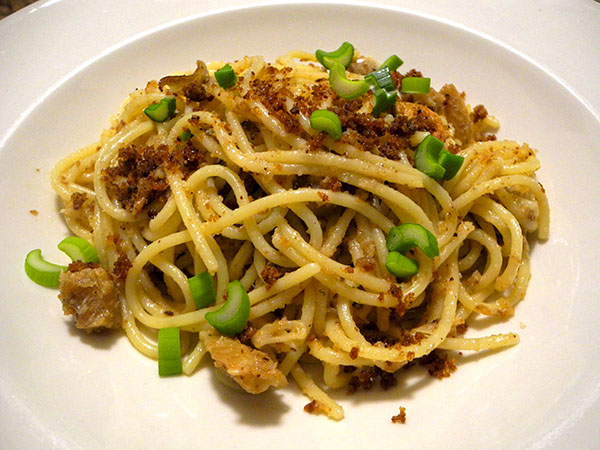
spaghetti, smoked eel, garlic, habanada, chili, pangrattato

Like all non-farmed fish, it’s essentially ‘game’, but unlike almost any other fish, it’s actually not ‘fishy’ at all.

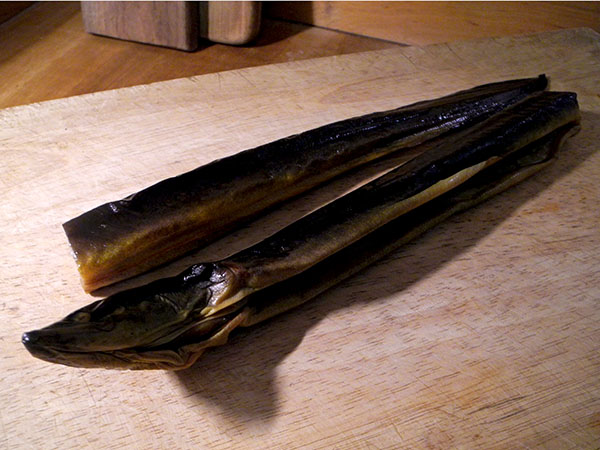
We love eel, fresh or smoked. We are therefore always very grateful to the folks who are willing to go through the, literally, heroics of cleaning these magnificent creatures. With smoked eel however, the worst of the process, removing the very slippery skin, can be skipped, the consumers themselves inheriting the responsibility, made much easier after its surfaces have been tamed in the smoke oven.

The image below is of a single one-pound smoked eastern Long Island eel, displaying a beautiful green/gold sheen on our kitchen counter, after it had been removed from the vacuum packaging where it had lain, cut crosswise for convenience.

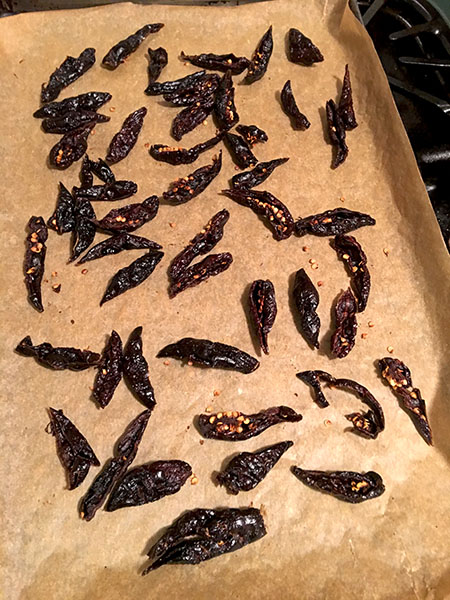
  • two large cloves of garlic from Tamarack Hollow Farm, sliced thinly, heated in a deep enameled cast iron pan over medium-high flame, along with one dried whole hot pepper, peperoncino Calabresi secchi, from Buon Italia, and a bit of crushed, dark, home-dried heatless Habanada pepper (acquired fresh from Norwich Meadows Farm last summer), until the garlic was almost starting to color, pieces of one skinned and boned smoked local eel from P.E. & D.D. Seafood added and stirred until warmed through, half of the amount of savory pangrattato* which had been prepared earlier mixed in and combined, the cooked and drained pasta (18 ounces of Afeltra Spaghetto from Eataly), added to the pan, tossed with the eel and pangrattato and stirred over low heat for a couple of minutes, adding more than a cup of the reserved pasta water while doing so to keep the mix moist, which was then served in low bowls, where it was sprinkled with more pangrattato and finished with most of one sliced spring onion from Norwich Meadows Farm

*The pangrattato was prepared by adding about a third of a cup of homemade breadcrumbs   to about a fourth of a cup of olive oil in which more thinly-sliced Tamarack Hollow garlic cloves and 3 anchovies from Buon Italia had been heated for a short while, and, after being stirred for 4 or 5 minutes, the mixture was then drained on paper toweling and brought to room temperature

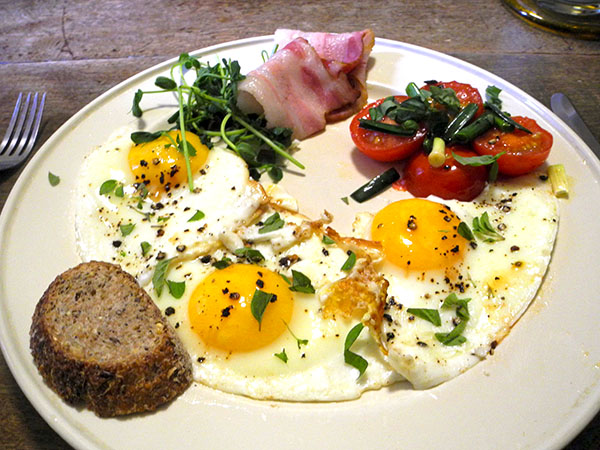
mid-afternoon breakfast

(we had enjoyed a late supper)

Of course it was effectively lunch, even if it was the meal to break our fast.

The ingredients were eggs from Millport Dairy Farm; smoked bacon from Flying Pigs Farm; Backyard Farms Maine ‘cocktail tomatoes’ from Whole Foods; Gotham Greens Rooftop packaged basil from Whole Foods; scallions from Norwich Meadows Farm; micro snow pea shoots from Windfall Farms; very-lightly-toasted ‘8 Grain 3 Seed’ bread from Rock Hill Bakehouse in Gansevoort, NY; oregano from Stokes Farm; crushed, dark, home-dried heatless Habanada pepper, acquired fresh from Norwich Meadows Farm last summer; Maldon Salt and Tellicherry pepper, both from Whole Foods

baked cod and potatoes, pea sprouts; collards, garlic, chili

At this point, having already done this basic preparation a number of times, using several kinds of fish, I don’t feel I can write anything that the picture above can’t convey pretty well on its own.

The only thing slightly out of the ordinary about the preparation was that I used 2 different potato varieties, but that was only because I didn’t have enough of the one I had wanted to use because it had been around for a while and was beginning to sprout.

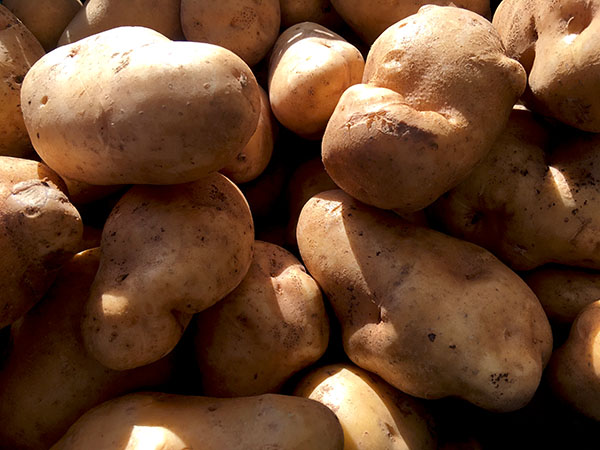
The Carola, in the Greenmarket, when first purchased, 3 weeks ago:

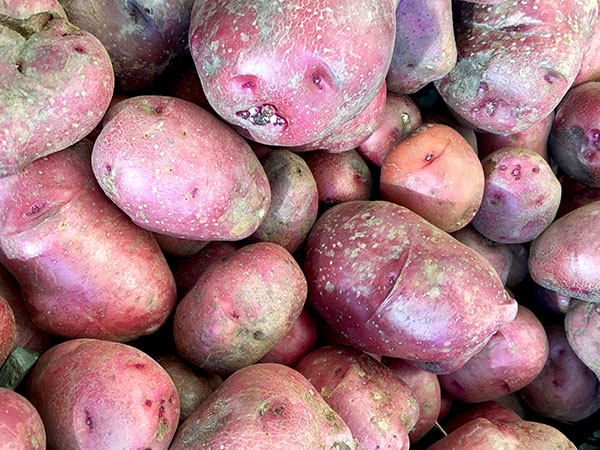
The Dark Red Norland, in the Greenmarket yesterday:

  • two 9-ounce cod fillets from Seatuck Fish Company in the Union Square Greenmarket, prepared more or less from a recipe from Mark Bittman which I originally came across almost 12 years ago: the cod washed and rinsed, placed in a platter on a bed of coarse sea salt, more added on top, until they were completely covered, set aside while preparing a bed of potatoes for them by slicing to a thickness of less than 1/4 inch, about 14 ounces of 2 kinds of potatoes, scrubbed but unpeeled, one Dark Norland Red from Norwich Meadows Farm and 2 Carola from Mountain Sweet Berry Farm, tossing them in a large bowl with olive oil, salt, pepper, and a large pinch of golden home-dried Habanada pepper [acquired fresh last fall from Norwich Meadows Farm], arranging the potatoes, overlapping, in a rectangular glazed ceramic oven pan, cooking them for 20 or 25 minutes in a 400º oven, or until they were tender when pierced, meanwhile, before the potatoes had fully cooked, the cod thoroughly immersed in many changes of water in order to bring down the saltiness (incidentally the soaking process somehow gives the fish more solidity, which can be easily felt while handling it at this point), draining and drying the two pieces before placing them inside the pan on top of the potatoes, drizzling them with a little olive oil and scattering some freshly-ground pepper over them, returning the pan to the oven for 8 to 12 minutes (the time would depend on the thickness of the cod), removing the fish with a spatula (or, much better, 2 spatulas) along with as much of the potatoes as can be brought with each piece, and arranging everything, intact if possible, onto 2 plates, returning to the pan for the remainder of the potatoes, snow pea sprouts from Windfall Farms scattered over the top


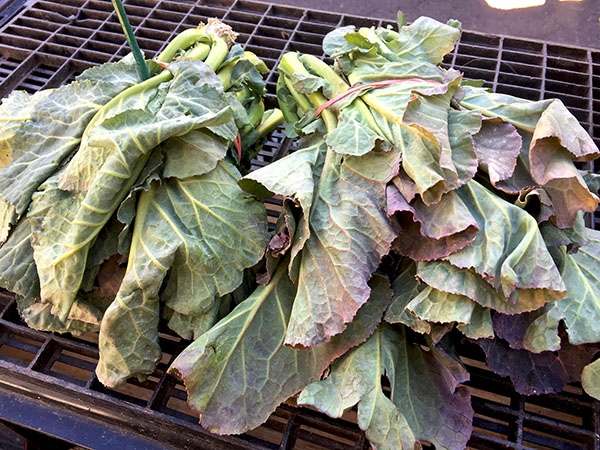
Its now early February, but I may have more green vegetables in the refrigerator crisper than I can properly handle (aside from herbs and micro greens, there’s Cavalo Nero, Savoy cabbage, radish greens, Japanese scallions, a little leek, a little celery, and collard greens). Last night I used most of a bunch of the beautiful collards I had picked up on Monday.

lemon-roasted pork chops; pea shoots; radish/parsley root

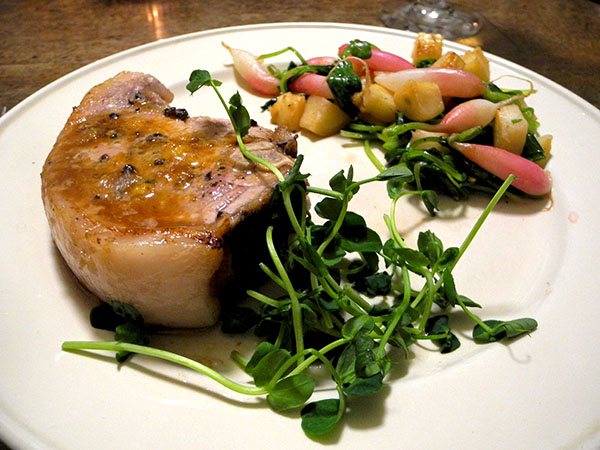
I really think the approach I used here, and have used many times before, is the best way to treat a good pork chop – or two – and, as with the best recipes, its simplicity makes it possible to invent any number of variations.

Last night however there were no twists, not even a last-minute fresh herb, really (this time I saved my futzing for the vegetables).

  • two 8-ounce bone-in loin pork chops from Flying Pig Farm, thoroughly dried, seasoned with salt and pepper and seared quickly in a heavy enameled cast-iron pan before half of a local sweet lemon from Fantastic Gardens of Long Island was squeezed over the top (which was then left in the pan between them, cut side down), the chops placed in a 425º oven for about 14 minutes (flipped halfway through, the lemon squeezed over them once again and replaced), removed from the oven and place on plates, the small amount (this time) of juices left in the pan spooned over them
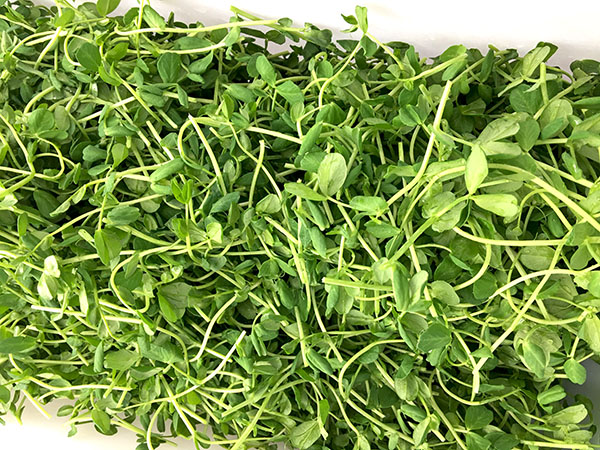
  • micro snow pea shoots from Windfall Farms arranged to the side

I had picked up a small bundle of ‘French breakfast radishes’ two days before Friday’s dinner, when I decided to serve their greens, wilted, while they were still fresh. Because I love sautéed or roasted radishes, of any kind, I didn’t look any further for a vegetable to accompany the pork. Once I had pulled the roots and greens from the crisper however I realized there wasn’t really much of either, so I added a small parsley root and a few scallions to the mix.

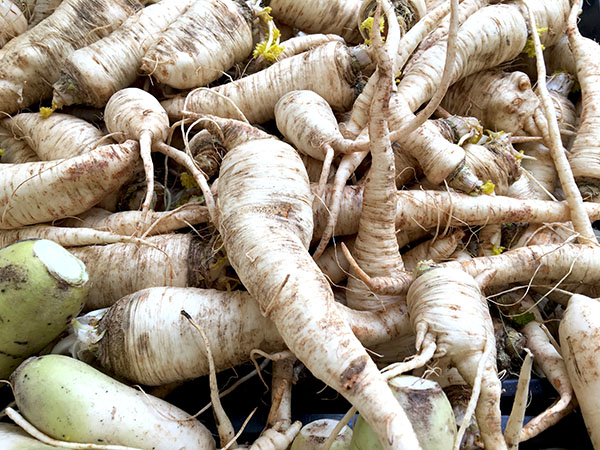
  • one small parsley root [petroselinum crispum tuberosum] from Norwich Meadow Farm, scrubbed, trimmed, and diced, sautéed in a little more than a total of a tablespoon of olive oil and butter inside a large enameled cast iron pot until almost softened, then 2 garlic cloves, halved, from Tamarack Hollow Farm and a small bunch of ‘French breakfast’ radishes from Eckerton Hill Farm, cleaned and scrubbed, added to the pot and cooked until they had softened, but just before that time 3 thin scallions from Norwich Meadows Farm, sliced, added to the mix, followed by the washed radish greens, the vegetables seasoned with salt and pepper, and a little Washington State riesling added and stirred in for a minute or two before being served
  • the wine was a Spanish (Rioja) white, Real Rubio Blanco, Rioja 2014
  • the music was the fantastic album, ‘Gisela May: Brecht Songs by Hanns Eisler and Paul Dessau

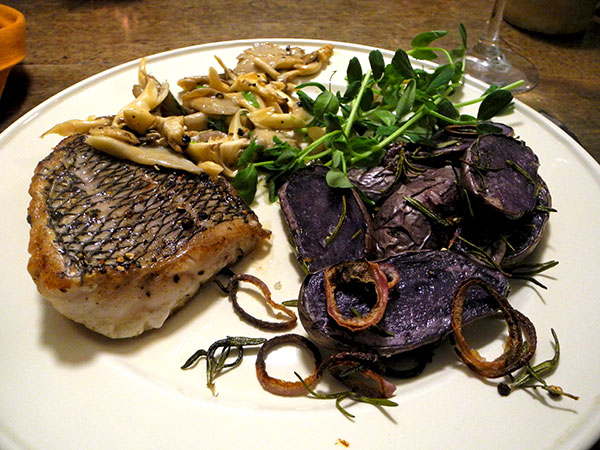
bass, oyster mushroom, parsley; purple potato; pea shoots

This was an wonderful dinner, largely because of my muse.

Otherwise, while physically it seemed to me to come out of nowhere, in fact virtually every bit of this meal had come from the Union Square Greenmarket, which means our local farmers and fishers.

Of course t hadn’t arrived on the table full-blown, but 2 or 3 hours before we sat down I still barely knew the half of what it would be. It had all started at the Greenmarket, with a beautiful bass fillet, one of only 2 remaining in the fishmonger’s stall at 1:45 that afternoon; minutes later I spotted our Wednesday mushroom farmer, where one sign jumped out at me: ‘oyster mushrooms’ (apposite for this seafood moment); then, once home and looking through my digital grocery inventory for a vegetable to accompany the mushroom-dressed fish, I read ‘Magic Molly purple potatoes’ and knew I had found it. With the addition of a micro green for color, texture, freshness, and even a little spice, the meal had at least been assembled in my mind.

  • one Black sea bass (just under 12 ounces) from American Seafood Company, washed, dried, seasoned on both sides with salt and pepper, sautéed 2-3 minutes over a fairly brisk flame with butter and a little olive oil inside a large, thick oval copper pan, skin side down, then turned and the other side cooked for about the same length of time, removed to 2 warm plates when done and covered at least a little, 2 tablespoons of butter added to the pan, and 6 ounces of oyster mushrooms [pleurotus ostreatus] from Bulich Mushroom Company, cut into large-ish pieces (in this case, mostly just detaching the lobes), sautéed, stirring, until lightly cooked, the mushrooms seasoned with salt, pepper, a couple tablespoons of chopped parsley from Eataly, and a tablespoon and a half of the juice of a sweet local lemon from Fantastic Gardens of Long Island added, the mushrooms stirred some more before they and the juices were spooned onto and at the side of the fish (I generally think the skin of the bass is too beautiful to disguise entirely)

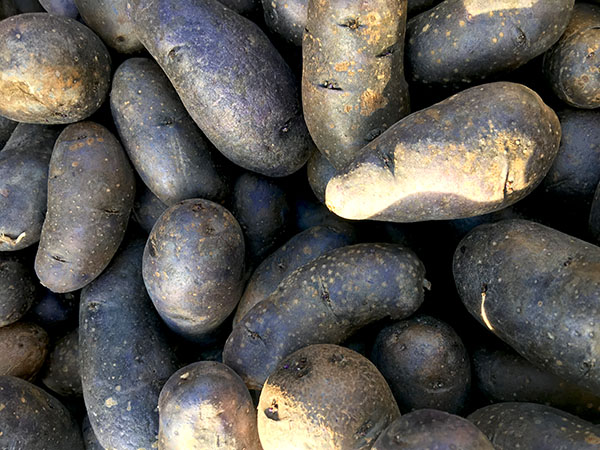
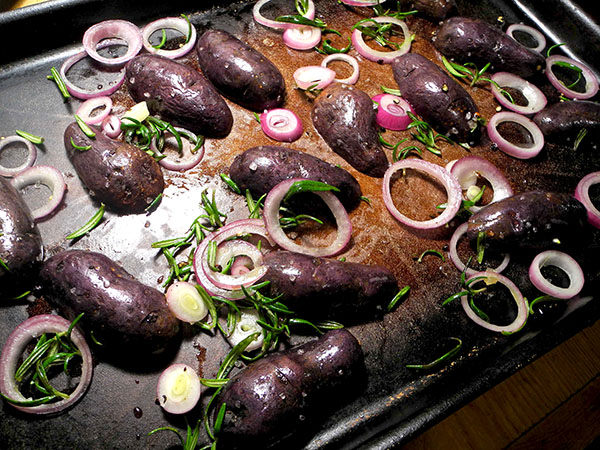
The potatoes were extraordinary (the almost-black color remained true throughout the cooking, the taste was wonderful, the texture waxy, moist, and succulent).

peppered venison, brandy; roasted turnips; red cabbage

This was at least the third dinner of venison we’ve enjoyed this winter, and preparing it this time was even easier than usual because of some leftovers and a very easy-going root vegetable purchased in the Greenmarket over a month before.

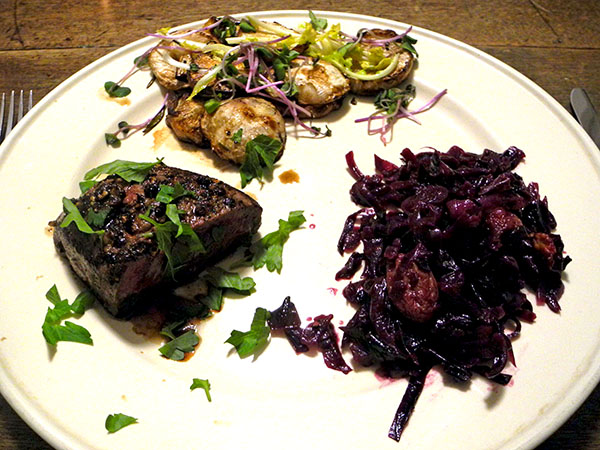
  • eight ounces of a D’Artagnan New Zealand venison ‘shortloin’, from Frank at O. Ottomanelli & Sons, that had been cut from the larger piece which we had enjoyed one month before, dried, rubbed with olive oil and a very generous coating of freshly-cracked black peppercorns, set aside for more than half an hour, after which it was placed over moderately high heat in 1 to 2 tablespoons of a combination of butter and olive oil inside an oval 11-inch enameled cast iron pan, cooked barely medium rare, which meant about 2 minutes on one side, or until juices had begun accumulating on the top, turned and cooked for another 2 minutes, cut into 2 pieces and transferred to warm plates, the bottom of the pan scraped with a wooden spatula to collect the juices, 2 tablespoons of brandy (Courvoisier V.O., as it happened) added to the pan and cooked over high heat until very much reduced [this time almost immediately!] before the sauce was poured over the meat, which was then garnished with chopped parsley from Eataly
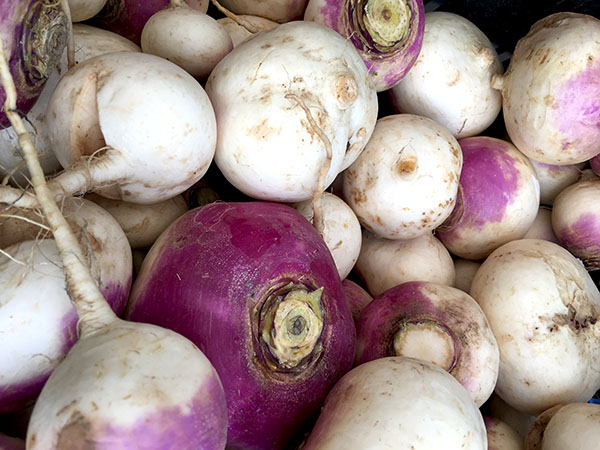
  • seven purple-topped turnips from Alewife Farm, washed, scrubbed, peeled, cut into half-inch-thick slices, tossed with olive oil, salt, pepper, and rosemary leaves from Hoeffner Farms, roasted in a large unglazed Pampered Chef ceramic pan for about 30 minutes at 425º, or until tender and beginning to carbonize, one green section of a baby leek from Lucky Dog Organic Farm, sliced in half-inch segments, added half-way through, and, once removed from the oven, the sprouting light ‘greens’ that had been trimmed from the roots, slightly wilted, added to the vegetables, which were then arranged on plates, some Hong Vit micro radish sprinkled on top
  • red cabbage, remaining from an earlier, even richer meal, reheated
  • the wine was an Austrian (Burgenland) red, Zweigelt, Rosi Schuster 2013 (St.Laurent and Blaufrankisch grapes), from Astor Wines
  • the music was that of Philip Glass, his 1983 opera, ‘Akhnaten’* Dennis Russell Davies conducting the Stuttgart State Opera Orchestra and the Stuttgart State Opera Chorus, with Milagro Vargas, Melinda Liebermann, Tero Hannula, Helmut Holzapfel , Cornelius Hauptmann, Victoria Schneider, Lynne Wilhelm-Königer, Maria Koupilová-Ticha, Paul Esswood, Geraldine Rose, Angelika Schwarz, David Warrilow, and Christina Wächtler

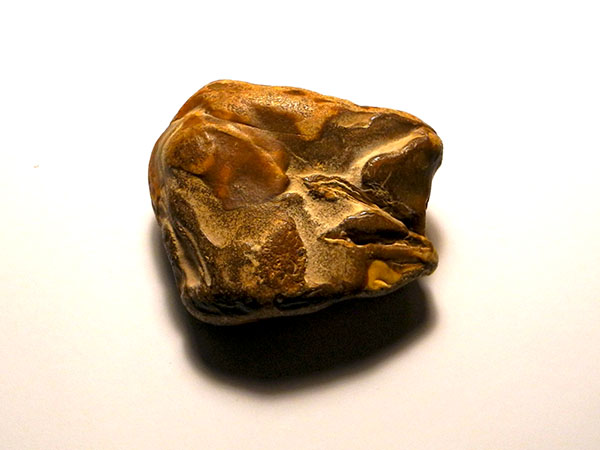
* I find ‘Akhnaten’ profoundly moving, although most critics have thought it less successful than the rest of the Glass trilogy. I think my relationship to it is independent of my experience and impressions in a trip I made to Egypt 30 years ago. I never visited el-Amarna, but I did trek through the Valley of Kings, and there I picked up several of the ordinary golden stones which compose the dry landscape. The picture below is of one of them, perhaps a piece of marl or marlstone; I found it on the trail which leads down the mountain to the Mortuary Temple of Hatshepsut. It has acquired a patina from handling it on the table where I spend much of my time, and today, if only because of its origin, it looks to me very much like a large scarab, although somewhat abstracted.