Author: james

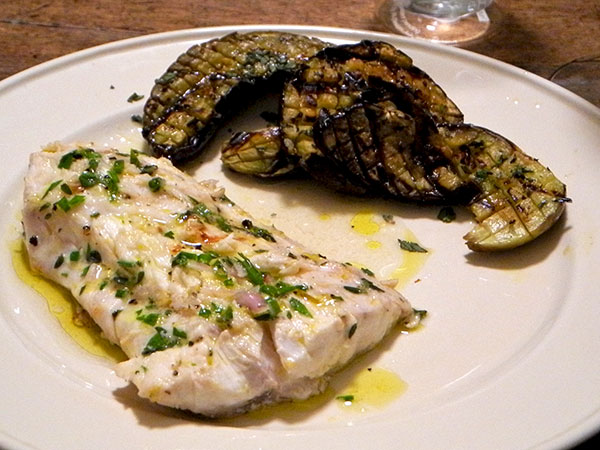
grilled herb-marinated striped bass, grilled eggplant

DSCN0015

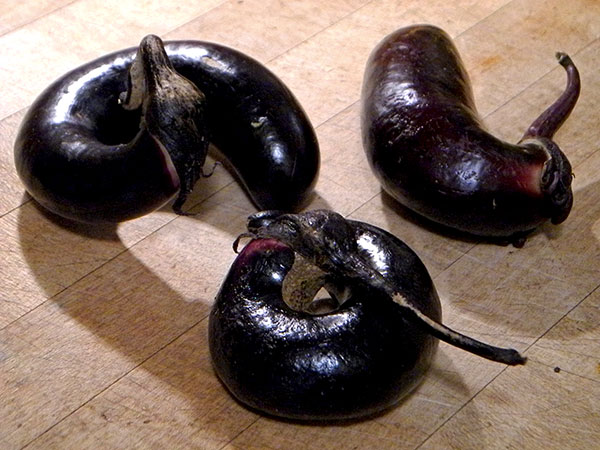
Until fairly recently, when I published food posts on this blog I preferred to use images of the food before it was prepared (and sometimes even without a meal context), for aesthetic reasons, and a few others.  I would still prefer to do these posts that way, but, if only for our own reference (much of the reason for the site in the first place) when composing new meals, a picture of the plated food can be pretty useful, if not very professional in my case.  Today, partly because I’ve become so fond of eggplant – of every kind, and in most every form – I decided I could do both, and especially since I had become enchanted by the eccentric curves of the last three in Nevia No’s stall at the Greenmarket yesterday.

Yesterday was our anniversary (our 22nd).  We would normally want to celebrate with a good lunch outside a favorite restaurant, but the weather didn’t really welcome the idea of sitting outside, and we didn’t feel like celebrating closed up inside, so we decided to do it up at home, in the evening, in front of the open window, with our roof garden beyond.  Two elements of the meal I planned required heat, but only for a relatively brief time, so the kitchen and the casual dining area adjoining it remained pretty comfortable.

In preparing the very simple meal I began by marinating a generous one-pound fillet of Striped Bass from Blue Moon Fish.  I decided to prepare the beautiful Japanese eggplant from Bodhitree, Farm ahead of time, so after I pan-grilled it I turned off the heat and set it aside in its heavy cast iron to slowly cool down.  The idea was to give us both a few minutes with a celebratory half bottle of Perrier-Joët Grand Blanc, and some elegant thin grissini.

The eggplant recipe, “”Thousand Ridges Japanese Eggplant”,  is one we have enjoyed many times.  It’s from “Mario Batali Italian Grill“.  I halved each of the screwy vegetables in the picture at the top, with not too much difficulty, then scored and spread them with a mixture of olive oil, garlic and chopped mint, then seasoned them, and placed them on a hot iron ribbed pan for a few minutes, flipping them once.  When it was almost time to move the eggplant halves to the plate with the fish, I turned the heat on under the pan, using a very low flame.

For the Striped Bass, a fish with which I was not on really familiar terms, culinary wise, and not wanting to use the oven last night, I turned to the internet.  There I found the recipe I used, from Food & Wine, only substituting the ‘sparking wine’ with white Vermouth, whose virtues are more commonly appreciated when on martini  duty (we hadn’t popped the champagne yet).  The fish, divided into two pieces, was marinated in a blend of olive oil, lemon zest, vermouth, shallots, chives, parsley, and thyme (holding back a portion of the mixture to be spread onto the fish once it was on plates).  I used a medium-hot flame to pan grill the bass until it was cooked through, turning the fillets once.  I finished them on the plate by spooning some of the herb mixture on top.

Our wine was a Côte D’Or rosé, Marsannay Rose, Domaine Bart 2013
striped_bass_grilled_eggplant

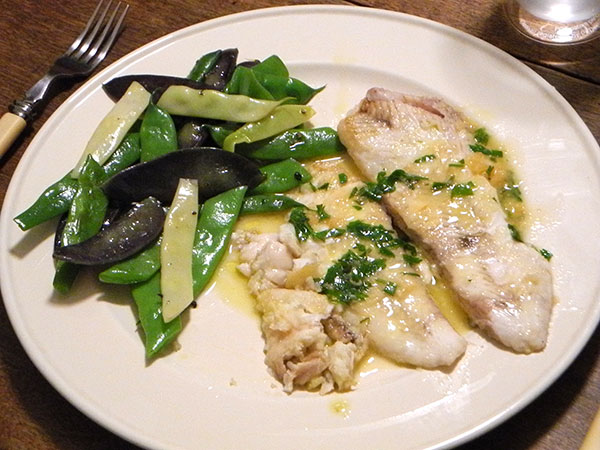
sautéed flounder, broad beans, purple snow peas

flounder_broad_beans_purple_snow_peas


This one is almost as simple as it comes, except for the multiple plates demanded by the slightly-messy business of flouring the fillets after I had brushed them with vinegar.

The flounder fillets from PE&DD, at the Greenmarket, were sprinkled with a good white wine vinegar (here Aceto Cesare Bianco) and salt, then lightly-floured, before being sautéed in oil.  When they were cooked through, I removed  them from the pan and placed them on plates. I wiped the pan with a paper towel, and and added butter and lemon juice, along with some fresh chopped parsley, quickly mixing everything while scraping the bottom of the pan, now over a very low flame.   I poured the finished sauce over the fish.

The vegetables, also purchased today, from what I have to describe as the honestly-saintly Norwich Meadows Farm of Zaid and Haifa Kurdieh (and their terrific helpers), was a delightful medley of young flat beans, both green and yellow, and tender purple snow peas. I parboiled them together, drained, and dried them, then re-heated the legumes in oil, seasoning them with salt and pepper.  They were very simply delicious, pretty much what I usually work for, and I was really happy to see the snow peas retain their color.

The wine was a French white Bordeaux, Petit Chapeau Bordeau Blanc 2013


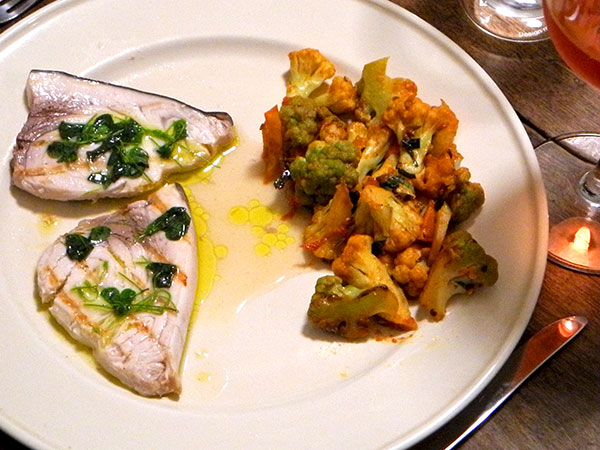
swordfish with sorrel, cauliflower with fennel seeds

swordfish_cauliflower

This was an entrée of Swordfish steaks Salmoriglio, meaning the fish (purchased from PE&DD in the Greenmarket) was first sliced into sections about half an inch thick, then quickly pan-grilled and finished with a lemon olive oil sauce, in this case incorporating fresh wood sorrel instead of the fresh or dried oregano I would normally use.  The swordfish was accompanied by florets from small heads of orange and green cauliflower (from the Greenmarket’s Tamarack Hollow Farm), which were sautéed with chiles, garlic, fennel and coriander seed, then braised with small chopped heirloom tomatoes and finished with torn basil.

The wine was a sturdy Tuscan rosé, Il Conventino Rosato del Conventino Toscana 2013


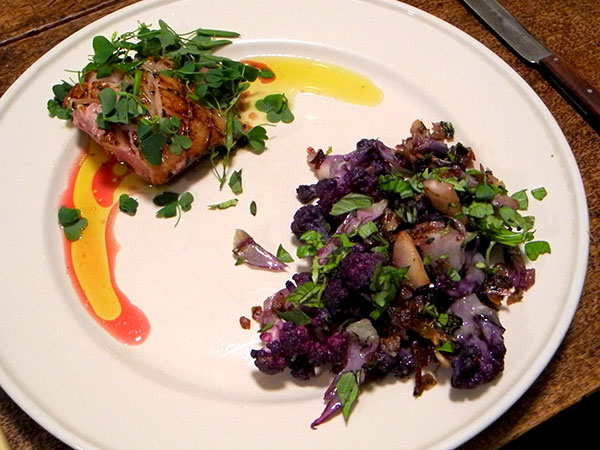
duck breast with wood sorrel, cauliflower with herbs

duck_breast_purple_cauliflower

Yesterday was Friday, and so, like good christians everywhere (actually, not including us, and, are there any left?), we had sea food – duck, to be specific. Oh yes, in the middle ages, duck, as waterfowl, if you could manage to successfully poach it from the local lord’s wetlands, was sometimes accepted as “fish” for the purpose of a proper observance of Fridays and other fast days (and this was even before the Jesuits were invented!).  Acceptable as “fish” on those days were whales and porpoises, even beaver, seals, geese, also ducks, and god only knows what else (and it seems she certainly wasn’t saying).

Nobody told me about any of this while I was laden with weekly visitations of fish sticks as a good Catholic child (also, who really knew what was in those frozen batons, although the answer may have been less outlandish 60 years ago than it is today), but the gods will surely forgive Barry and me our stretching the definition of sea food, because last night’s repast was heavenly.

After an appetizer of heirloom tomatoes and wild watercress, we shared a simple duck breast (by Pat LaFrieda, a total of .74 pounds for both of us, from Eataly) which I scored and covered in salt, pepper, and a bit of sugar, then let sit for an hour before sautéing it, finishing it with a squeeze of lemon, some terrific wood sorrel (from Bodhitree), and oil.  The accompaniment was purple cauliflower from Tamarack Hollow Farm, sautéed with red onion, garlic, and chiles, and finished with mint and basil (I hadn’t enough of the preferred mint, so I sent some basil in as reinforcements).

Largely because we still had wine left, there was a third course consisting of  very small bits of two very good cheeses, “Manchester”, a semi-hard aged raw goat milk (Oberhasli goats) “peasant tome”, from Consider Bardwell, and “Landaff”, a New England raw-milk cheese from Holstein cows, inspired by Welsh tradition, made by Landaff Creamery.  Accompanying them were thin slices of of hard-toasted Pugliese bread from Sullivan Street Bakery.

Our wine was a California Pinot Noir, Mossback Central Coast Pinot Noir 2012

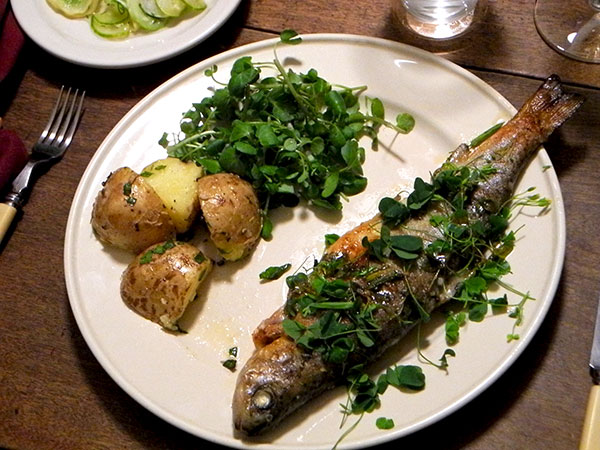
Forelle, Saltzkartoffeln, Kresse, Gurkensalat

trout_saltz_kartoffeln_cucumber

It would be Forelle Müllerin if I hadn’t overheard a discussion about (wild) wood sorrel yesterday while in the Bodhitree stall in Union Square.  Almost before I had entered the conversation, the customer talking to Nevia No and who was holding the last bunch in her hand, placed it in mine, and generously offered it to me.  I had already purchased two rainbow trout from Dave of Max Creek Hatchery;  I knew this was going to be a match made in Greenmarket heaven.  It was, and I thank you good woman.  Last night the cress stood in for the traditional parsley finish in this classic German dish.

The rest of the meal included Saltzkartoffeln, made with new Yukon Gold potatoes from Berried Treasures, finished with chopped lovage from Keith’s Farm; and a serving of lemon-and-oil-dressed wild cress (wilde Brunnenkresse), again from Max Creek.

I had salted and pressed a variety of thinly-sliced cucumbers from Lani’s Farm late in the afternoon.   After I had rinsed and drained them I added a few slices of shallots and some chopped dill (from SSO Farm), chopped parsley (excellent parsley from Eckerton Hill Farm), and a bit of sugar, before covering everything with a mixture of good vinegar and water.   This side dish/salad was a pretty good semblance of what my mother served, and she had learned it from her mother, who had learned it from her Frankish mother, who had learned it from her mother, born in 1814.  Barring the shallots substituting for a sweet onion, I think I served a pretty German Gurkensalat.

The wine was an Austrian white, Dürnberg Burggarten Weisburgunder 2011


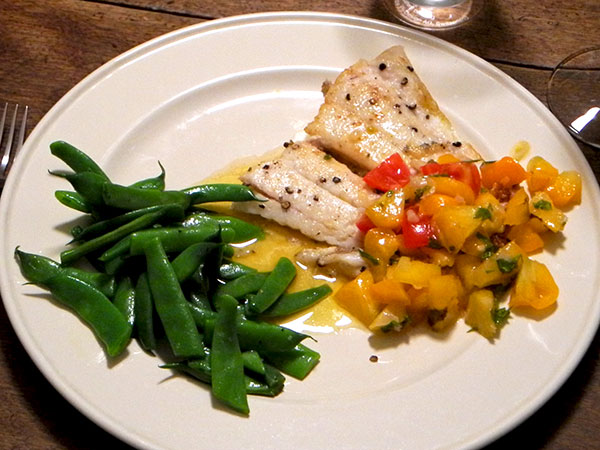
flounder with tomato lovage salsa, Roma beans

flounder_tomato_salsa_Roma_beans

Our spell of heat and humidity broke last evening, blessedly.  Before it did I spent time, more than I want to admit to, wracking my brain and a number of recipe files and books for ideas on cooking flounder which did not involve using the oven.  I also wanted to do something other than what I often have done, even though it’s delicious.  I had brought home a beautiful fillet from PE&DD at the Greenmarket earlier in the day, and I was thinking it wouldn’t really be a proper summer feast if the windows were closed.

Further to a consideration of recipes, I was becoming a little concerned about my growing – and ripening – tomato hoard, so I definitely wanted to include some of the fruit with the fish.

The solution I came up with was a slight reworking of a recipe I found on line (never underestimate the internet’s usefulness in the kitchen, no matter how large your recipe file may be).  It was described as “Petrale sole with tomato butter” on the LA Times site, but I wasn’t  scared off by the fact that my bottom feeder didn’t come from the Pacific, or by the absence of tarragon in my electric larder.  I love tarragon, but fortunately I did have some lovage, from Eckerton Hill Farm;  it’s one of my favorite seasonal herbs, one which I regularly use any excuse to add to a dish.   I also substituted for the cherry tomatoes mentioned in the recipe two ripe heirloom tomatoes from Norwich Meadows Farm, which I chopped, perhaps into pieces a little too small.

Meanwhile I had also been seduced while at the market by some beautiful and delicious Roma beans being offered by Race Farm.  I sampled them raw and they were really flavorful – actually complex in flavor!   I’ve often been disappointed by the taste and texture of Roma beans, so I asked the farmer why these were so extraordinary. He told me they picked them while young (the beans).  It seems it works.

I wasn’t certain how good the fish recipe would be, but I decided that the colors, on the same plate with the bright green of the beans, would look pretty terrific.

In fact the entire entrée turned out to be really, really good, far more delicious than I could have imagined;  I think most of the credit should go to the freshness of  all the ingredients, and the restraint of the recipes:  The fish was simply seasoned and sautéed, the beans par-boiled, rinsed, dried, and warmed a bit with oil and butter just before the fish went into the pan.  The salsa was the only relatively complex element, although not from the standpoint of preparation, since it could also be assembled somewhat at leisure, before the beans were heated and the fish cooked.

The wine with which we accompanied it, in another reminder of summer, was a Provence rose, Domaine La Colombe Coteaux Varois en Provence 2013

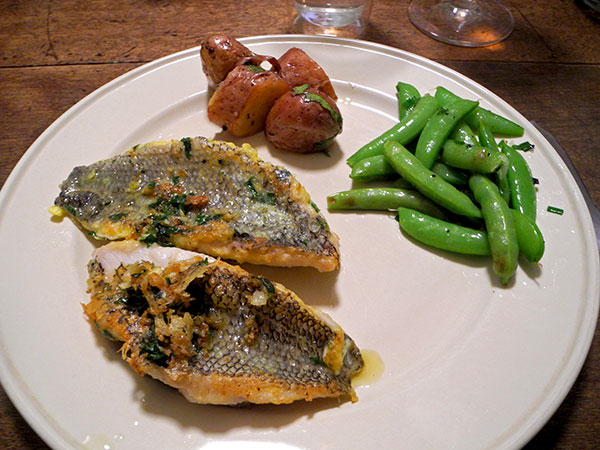
sea bass, boiled potatoes, sugar snap peas


sea_bass_potatoes_sugar_snap_peas

I cannot lie.  We turned the AC on last night, although only in the kitchen and breakfast room.

Earlier in the day I had been seduced by some fish and vegetables spotted in the Greenmarket, but by evening, when I was beginning to think about what I was going to do with them, the thermometer was still sitting in the high 80s in the area around our 1931 Magic Chef (like this one, but with a bit more elegance).  That was before I had even started making dinner; I was pretty certain it wasn’t going to drop while I worked up a proper meal, each element of which called for at least some range heat.

The fish I brought home were four 3-ounce small sea bass fillets from Blue Moon Fish.  This is how beautiful they look before cooking.  I sprinkled the four with a light coating of seasoned flower, and dipped them in an egg which had been beaten with chopped parsley.   After a quick sauté in a mixture of oil and butter, I removed them from the pan, sprinkled them with a bit of lemon, finishing them with pan juices I had mixed with some more parsley.

The accompaniments were large red fingerlings from Lucky Dog Farm, which I boiled, cut into smaller pieces then tossed with butter and lovage; and sugar snap peas from Eckerton Hill Farm, blanched for one minute, then briefly heated in a little oil and finished with chives.

Each of the herbs also came from the Greenmarket, the parsley from Queens County Farm, the lovage from Mountain Sweet Berry Farm, and the chives from S.S.&O. Farm.

The wine was an excellent Loire, Olga Raffault Cuvée Chinon rosé 2012, the gift of wonderful friends.

pasta promfumata al limone

pasta_carrots_lemon

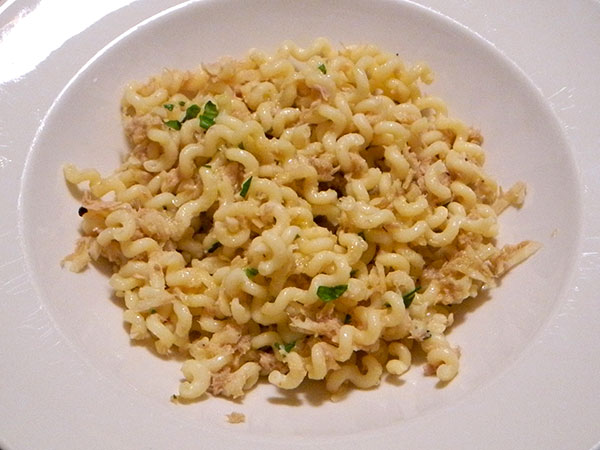
looks a little dull, and monochromatic, but the flavor is neither


This might be considered an almost perfect entrée for a hot day.  While delicious served cool, as it should be, the pasta itself of course has to be boiled. It can, and in fact it must be done long before it’s combined with the rest of the ingredients.  That means only the cook has to suffer a hot kitchen, and those fiery duties can be accomplished hours before anyone sits down at the table.

It’s Pasta Promfumata al Limone, or ‘lemon-scented pasta’.  Here it’s Afeltra fusilli con buco, combined with shredded carrots (perversely, in my interpretation, white carrots  from S.S.&O. Farm, since they are what I had on hand, although parti-colored carrots would have been spectacular), shredded tuna, garlic, lemon juice and zest, parsley, basil and lovage (my addition).   I substituted the fusilli for the recipe-specified farfalle or ‘bowties’, because I did not have the latter in my, . . . larder.

Note: Only when I began to mix the cooled pasta in with the remaining, refrigerated ingredients did I realize that it would have been better to use almost anything but a long pasta; penne would have worked fine.  Next time.

The recipe is from the late, much-missed Kyle Phillips, writing in ItalianFood years ago.

The wine served with this dish was Per Linda Trebbiano d’ Abruzzo 2013

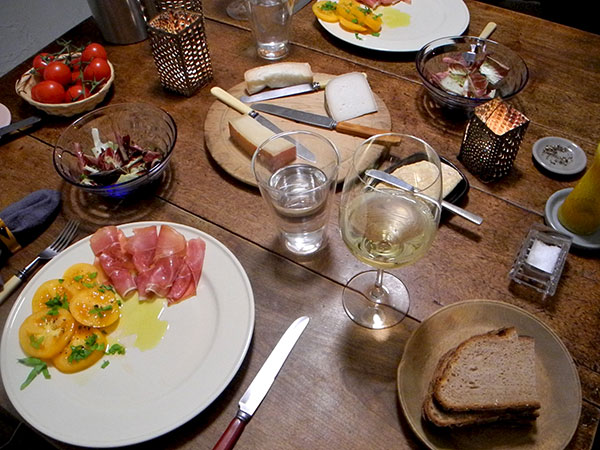
picnic at home in Chelsea summer place

picnic_July_2014

no bugs, no rain


Yes, by now it should be clear that we spent the Fourth of July in our summer place on 23rd Street, where we almost always holiday.

In the first two of the three days of the extended weekend we had a meal dominated by fish (a pretty American meal, even if, since it was in a particularly New England form, it was somewhat esoteric American).  Dinner on the second day included grilled red meat (a feast almost, but not quite of the classic American cookout sort, since lamb still doesn’t conjure up thoughts of the typical American barbecue, and because it was enjoyed indoors).  On the third day we had a simple picnic, but once again we probably missed the point of the genuine Fourth, since this picnic was indoors.  Also, there was no chicken.

I had decided to work with the warm weather, meaning I would avoid cooking altogether, so I assembled what we call a picnic, something we do on occasion to vary the kitchen routine and to enjoy an even more leisurely pace, whether before, during, or after dinner, than I can normally arrange.

All of the food was gathered from what we already had on hand, making the meal even more relaxed.  There was prosciutto (packaged, from Whole Foods, and honestly quite good); sliced yellow tomatoes from Stokes Farm, topped with Mountain Sweet Berry Farm lovage; a small simply-dressed salad (treviso from Queens County Farm, topped with chives from S & SO Produce Farms);  four cheeses (Paglierino and Salva Cremasco from Eataly, Willoughby of Cellars at Jasper Hill from the New Amsterdam Market, and Garrotxa from Citarella); and an Italian rye bread from Eataly.


The wine was an Australian, Yalumba Y Series Viognier 2013

Oh, and those red tomatoes? They were only table decor this time.

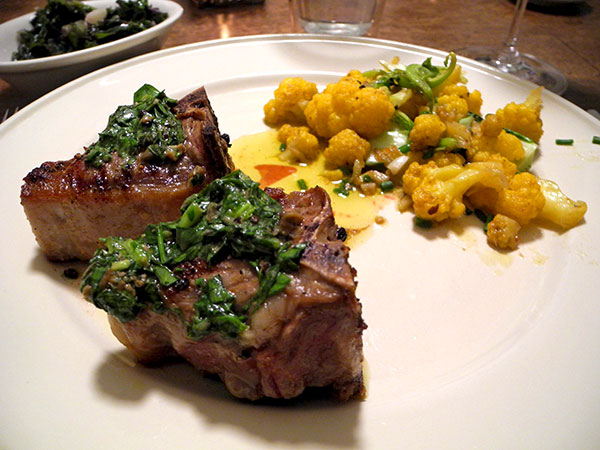
lamb chops with salsa, cauliflower with anchovy

lamb_chops_cauliflower_kale

Lamb chops from 3-Corner Field Farm, pan-grilled, then finished with a green salsa very much dominated by lovage from Mountain Sweet Berry Farm; accompanied by yellow cauliflower from Norwich Meadow Farms, pan-roasted  with garlic, anchovy fillets, and crushed chiles, then finished with chives; red kale from Phillips Farms, wilted with garlic, dressed with oil, was a contorno.

The wine was an Australian red, Wirra Wirra Vineyards’ 2012 Scrubby Rise, a blend of Shiraz, Cabernet Sauvignon, and Petit Verdot.