Year: 2016

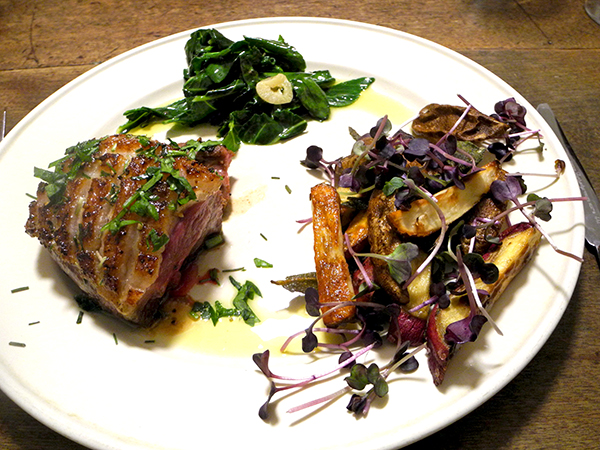
duck, wild garlic, lovage; roasted potatoes, sage; collards

duck_collards_sweet_and_white_potato

sweets


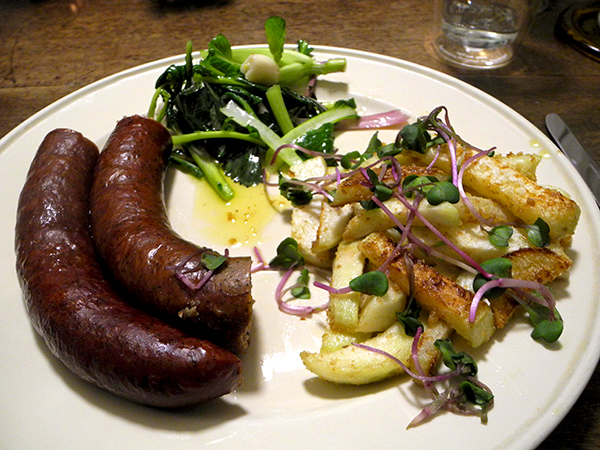
This is supposed to be a plate of savories, and I definitely don’t have a sugar tooth, but, when it comes out of the ingredients naturally, I get ‘sweet’. The dry marinade for the duck, which is itself inherently sweet, included just a pinch of natural sugar, the greens may have been the sweetest I’ve ever tasted, and the potatoes were (at least partly), well, sweet potatoes, and the micro greens were amazingly sweet.

Yum.

  • one 14-ounce duck breast from Hudson Valley Duck Farm, its fatty side scored by a very sharp knife with cross-hatching, sprinkled with a mixture of salt, crushed telicherry peppercorns, and a bit of turbinado sugar (which had been infused in over time with a vanilla bean), the breast left standing for about an hour before it was pan-fried over medium heat with a very small amount of fat which had been rendered by thick bacon from Millport Dairy, removed when medium rare (cutting it into the two portions at that time to be certain) finished with a squeeze of organic lemon, sprinkled with scissored wild garlic from Lani’s Farm, chopped lovage from Two Guys from Woodbridge, and drizzled with a bit of olive oil
  • Japanese sweet potatoes from Race Farm and russet potatoes from Keith’s Farm, about one pound altogether, all cut as frites, tossed with olive oil, salt, and a dozen rinsed and dried sage leaves from Eataly, arranged without crowding in a large pan, and roasted (no turning necessary, since it was a well-seasoned, unglazed Pampered Chef pan) at about 400º for about 25 minutes, finished with a sprinkling of some purple radish micro greens from Two Guys from Woodbridge
  • about half of the small store of tender collard greens I had picked up from Norwich Meadows Farm, washed, drained, then braised very lightly (they were very tender) in a heavy pot in which one halved garlic clove from Norwich Meadows Farm had been allowed to sweat in some olive oil, the dish finished with salt, pepper, and a drizzle of olive oil
  • the wine was a French (Languedoc) red, Domaine Ledogar La Mariole Carignan Corbières 2013 (produced by Les frères Xavier et Mathieu Ledogar)
  • the music was Yle Klassinen, streaming
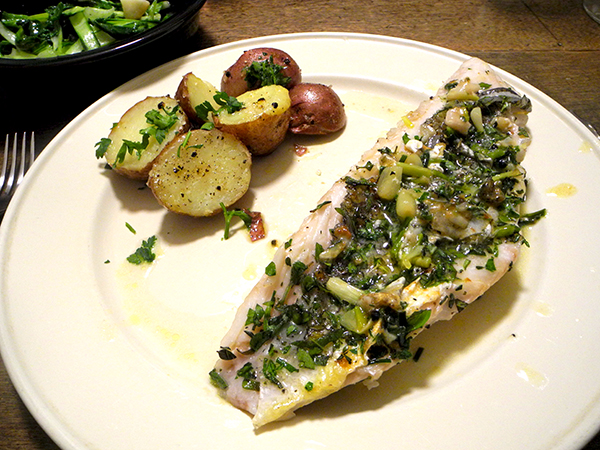
pan-seared tilefish with wild garlic, herbs; potatoes; mizuna

tilefish_potatoes_mizuna

wild garlic, a treat anytime, but in the Greenmarket, in February?


I could say that l just about built this meal around the wild garlic I had picked up at the Greenmarket on Monday, but I have to admit that my fondness for tilefish also had a lot to do with what I served that day.

  • two 9-ounce tilefish fillets from American Seafood, prepared pretty much along the lines of this Melissa Clark recipe, replacing the scallions specified in her instructions with a dozen tiny wild garlic plants (bulbs and stems) from Lani’s Farm, and, for the herbs, a combination of fresh parsley (Eataly), thyme (Forager’s), lovage (Two Guys from Woodbridge), sage (Eataly), and oregano, cooking the fish in a copper au gratin pan, aluminum foil for a cover, and both a small brush and a spoon to spread/ladle the wild garlic butter over the fish
  • absolutely the sweetest potatoes I can remember ever having tasted, 6 ‘red potatoes’ from Lucky Dog Organic Farm, scrubbed and boiled, unpeeled, halved, tossed with sweet butter, salt, pepper, and chopped parsley from Eataly
  • mizuna from Lani’s Farm, very slightly wilted in a pan in which 2 halved garlic cloves from John D. Madura Farm had first been allowed to brown slightly in a little olive oil, seasoned with salt and pepper and drizzled with a bit more oil
  • the wine was an Oregon (Willamette) white, Kings Ridge Oregon Pinot Gris 2014
  • the music was Handel’s ‘Rodelinda’,  Alan Curtis conducting the Orchestra/Ensemble, Il Complesso Barocco, with Marie-Nicole Lemieux, Simone Kermes, Marijana Mijanovic,
    Steve Davislim, Sonia Prina, and Vito Priante

kielbasa; kohlrabi ‘fries’, micro radish green; wilted mizuna

kielbasa_kohlrabi_mizuma

The meal, at least for us, combined the familiar, the not-entirely-unheard of, and the prettty new.  Kielbasa has often shown up on our table, mizuna has made a few appearances, although in different forms, but, while I’ve roasted kohlrabi, and braised its greens, I had never pan-roasted it before.

The recipe I followed for the kohlrabi came pretty straight from Martha Rose Shulman in the New York Times.

  • a one-pound link of spicy pork kielbasa from Tamarack Hollow Farm, boiled in one piece
  • three purple kohlrabi from John D. Madura Farms, cut as fries, seasoned with salt and tossed with some coarse stone-ground flour, spread onto a slightly-oiled (2-3 tablespoons) large cast-iron frying pan (in 2 batches, if necessary to avoid crowding), fried over a medium-high flame for about 5-6 minutes, or until browned, turning once, removed, dried on paper towels, tossed with ground cumin, served sprinkled with some ‘Hong Vit‘ micro Asian radish greens from Windfall Farms
  • mizuna from Lani’s Farm, very slightly wilted in a pan in which 2 halved garlic cloves from John D. Madura Farm had first been allowed to brown slightly in a little olive oil, then seasoned with salt and pepper and served drizzled with a bit more oil
  • the wine was a French (Rhône) red, the gift of a friend, Belleruche Côtes-du-Rhône 2012 (this particular vintage used 70% Grenache and 30% Syrah)
  • the music was Q2 streaming

squid, oregano, chili; roast tomatoes and wild garlic, cress

prep_squid_tomato_cress

in the beginning

squid_tomato_cress

let the waters..be gathered together unto one place, and let the dry land appear


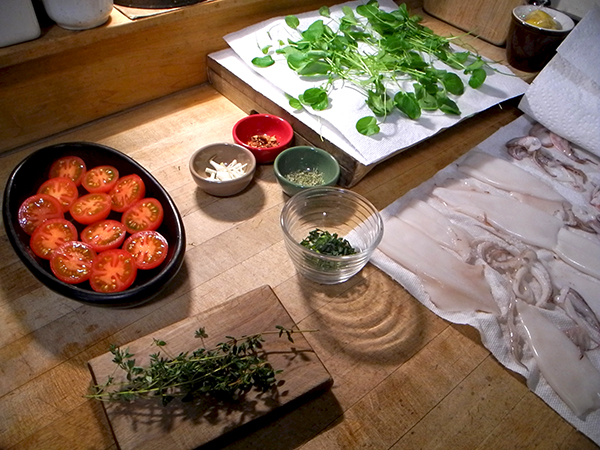
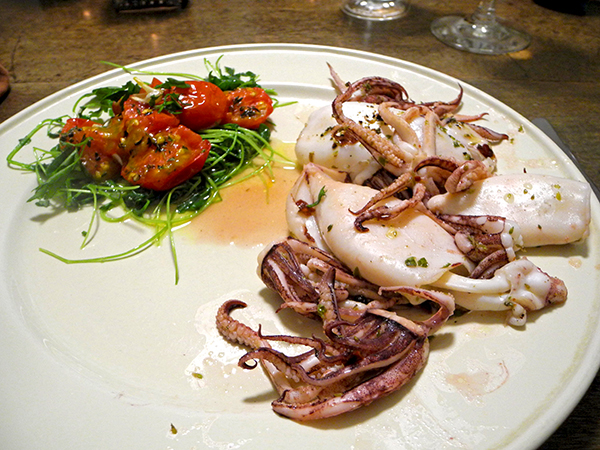
  • three quarters of a pound of small squid, bodies and tentacles, from P.E. & D.D. Seafood Company, rinsed, dried, then very quickly arranged in an enameled cast iron pan after its cooking surface had been brushed with olive oil and heated on top of the range until very hot, the cephalopods sprinkled with some super-pungent dried Italian oregano from Buon Italia and one crushed dried pepperoncino, also from Buon Italia, with a good squeeze of lemon juice and some olive oil drizzled over the top, and placed in a pre-heated 400º oven, roasted for four or five minutes
  • eight Backyard Farms Maine ‘cocktail tomatoes’ from Whole Foods, halved, combined in a small ceramic baking dish with a dozen tiny wild garlic plants (bulbs and stems) from Lani’s Farm, a little olive oil, half of a teaspoon of chopped thyme from Foragers Market, salt, and freshly-ground black pepper, placed ahead of the squid in the same 400º oven for about 20 minutes, removed, placed on a bed of slightly-wilted hydroponic watercress from Two Guys from Woodbridge, sprinkled with more thyme and some chopped parsley from Eataly
  • the wine was an Italian (Tuscany) white, Vernaccia San Gimignano Fontaleoni 2014
  • the music was from Jordi Savall’s 2-disc set, ‘Christophorus Columbus – Lost Paradises‘,  with Solistas de la Capella Reial de Catalunya, Hespèrion XXI, and Montserrat Figueras

veal tongue with a black olive-tomato-herb sauce; polenta

veal_tongue_tomato_olives

nothing green, and I had some; thought it inauthentic, but probably wrong


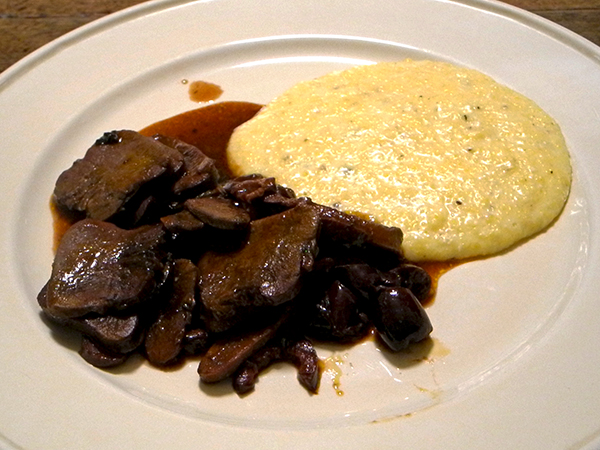
The picture pretty much describes the robust taste of this dish. Until I had actually served it, I had no idea it would be so rich. We were lucky that we had leaned toward the sturdier side of the red wine spectrum: The pairing was inspired, even if there was some luck involved.

Until the very last moment, and in fact not until I had almost finished simmering the tongue,  I had no idea how I was going to finish it.  I had found a simple and attractive formula for a sauce which involved a lot of (green) olives, a recipe characteristic of Venetian cookery, but it was described as a dish that should be served at room temperature, and that wasn’t what I was looking for that night.  I liked the idea of the olives however, so I went looking for another approach using olives.  While doing so, I accidentally found myself again in the good company of a very familiar (and very much missed) source, Kyle Phillips, with his own recipe, archived here.

I stopped looking further; it’s Kyle’s very simple and absolutely delicious approach which I adopted and describe below, along with the sources of the ingredients I used.

  • one 14-ounce veal tongue from Consider Bardwell Farm, scrubbed, simmered for about three hours in fresh water and a mix of aromatic vegetables, herbs, and spices (onion, parsley root, celery root, carrot from John D. Madura Farm, bay leaf, from Westside Market, peppercorns, and two whole spice cloves), removed, the broth strained and reserved, the meat allowed to cool somewhat before removing the skin and the tongue cut crosswise into three-quarter-inch slices, set aside while the sauce was prepared:

in a separate pan, one clove of garlic from John D. Madura Farm sautéed in a little olive oil until golden, removed and discarded, almost two tablespoons of good tomato paste added to the pan and diluted with about a cup of the broth set aside earlier, stirred over heat until mixed, then 12 ounces of pitted and roughly-chopped Kalamata olives added, along with 2 large leaves of Gotham Greens Rooftop packaged basil which I had frozen last summer, and a good pinch of wonderful dried Italian oregano from Buon Italia, salt, and pepper, and then the slices of meat, everything mixed together, the pan covered and simmered over a very low flame for about 20 minutes.

  • coarsely-ground cornmeal polenta from Buon Italia in the Chelsea Market, cooked with water and milk (in a proportion of 3 to 1), finished with butter, seasoned with salt
  • the wine was a wonderful Argentine (Patagonia) red, Amor Seco Merlot 2014
  • the music was Jordi Savall’s ‘Mare Nostrum’ (I had already initiated the long, slow simmering process of the tongue, while we were in the process of watching the second segment of Simon Schama’s ‘The Story of the Jews‘ when I had to head into the kitchen to prepare the sauce and start the polenta, so when it came to choosing our Tafelmusik, it seemed totally right to go with Savall’s album, since it deals with music of the Christian, Muslim, and Jewish cultures which were in dialog across the Mediterranean from the middle ages into the early modern era)

roast monkfish, potatoes, olives, bay, radish; tomato, cress

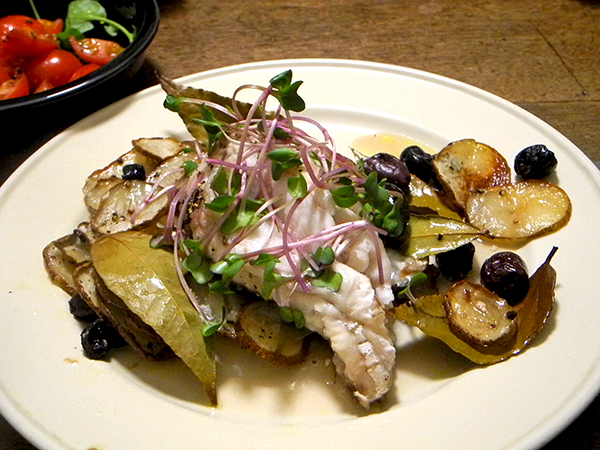
monkfish_potatoes_olives_bay

if I were asked to describe a savory fish dish, this would be it


I’ve worked with this recipe many times, and it never misses the mark. That mark includes simple, virtually foolproof preparation, ingredients likely to be on hand, ability to remain warm, singularity, and, of course, tastiness.

I think we’ve enjoyed it in warmer months, but it really comes into its own during the colder. In fact, when I texted Barry from the Greenmarket on Saturday, including a shot of the fishmonger’s menu, and asked him to pick from it, he came back almost immediately, “Monkfish, since it’s cold?”. He was describing another of its virtues: Forty or forty-five minutes in a warm oven means a cozy breakfast room with a window open a crack for fresh air.

The recipe came to me years ago, via the New York Times, from Mark Bittman, who suggests it also works with “almost any firm fish fillet”. He mentions red snapper, sea bass, pollock, among others, but I would also include hake, haddock, and cod, remembering to be careful about removing the fillets from the pan when done.

  • one 18-ounce monkfish tail from American Seafood Company, roasted with three quarters of a cup of Moroccan and Kalamata olives from Whole Foods, pits removed, on top of a bed of scrubbed, unpeeled, thinly-sliced and seasoned Russet potatoes from Keith’s Farm which had just been roasted (in a very generous amount of olive oil), with 10 or 12 (!) fresh bay leaves from West Side Market, then finished with a sprinkling of ‘Hong Vit‘ Asian radish micro greens from Windfall Farms
  • a side dish of hydroponic watercress (sold looking like a bouquet of flowers, as they are sheathed in plastic, to protect the leaves and their roots) from Two Guys from Woodbridge, and a handful of quartered Backyard Farms Maine ‘cocktail tomatoes’ from Whole Foods, dressed simply with a good olive oil and a squeeze of juice from one half of a tiny lime-like lemon (lemon-like lime?) from Fantastic Gardens of Long Island
  • the wine was a Spanish (Rueda) white, Naia D.O. Rueda 2014, from Verdejo old vines
  • the music was Handel’s ‘Giulio Cesare’, Alan Curtis conducting Il Complesso Barocco, with Gianluca Buratto, Milena Storti, Karina Gauvin, Filippo Mineccia, Johannes Weisser, Romina Basso, Emöke Barath, and Marie-Nicole Lemieux

breaded swordfish, stone crop; leek, tomato, thyme; rapini

swordfish_rapini_leek_and_tomato

somethings old and somethings new


The old was the breaded swordfish, new was the stonecrop; old was the cherry tomatoes, new was the addition of leeks; old was the rapini, new was having it in February.

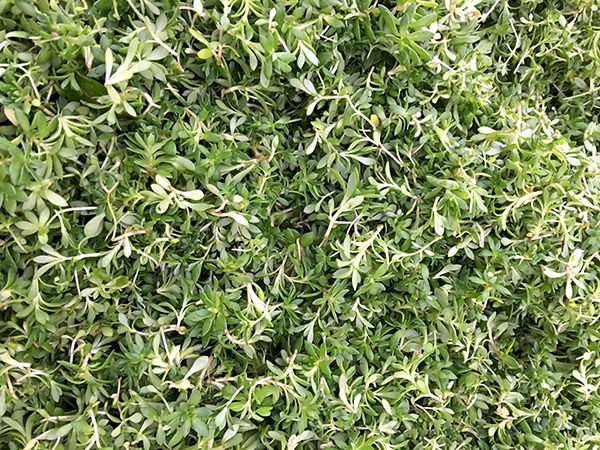
  • one swordfish steak (off of Scott Rucky’s fishing vessel, ‘Dakota’, out of East Islip, Long Island, from American Seafood Company in the Union Square Greenmarket), cut into two pieces, marinated briefly in a mixture of olive oil and fresh oregano from Stokes Farm, then drained well and covered with a coating of dried homemade bread crumbs, pan-grilled for about 4-5 minutes on each side, removed, salted, sprinkled with a little lemon juice, some beautiful stone crop (a succulent, aka orpine, aka sedum, and apparently it’s also good for creating green roofs) from Lani’s Farm scattered on and to the side, fish and herb both drizzled with olive oil before serving
  • one medium leek from S.S. & O. Farm, washed, halved lengthwise, sliced into 1-inch segments, sautéed in olive oil until wilted, 8 Backyard Farms Maine ‘cocktail tomatoes’ from Whole Food stirred into the pan and cooked until they had just begun to wrinkle and soften, when about a teaspooon of chopped thyme was added, along with salt and a small amount of turbinado sugar (which had been infused over a long period with a vanilla bean buried in the bowl), then cooked for another two minutes, and left to be served warm or at room temperature [the recipe is from Ciao Italia]
  • young, tender rapini from Lani’s Farm, wilted along with two garlic halves, from Keith’s Farm, which had previously sweated a bit in olive oil, the greens then seasoned with salt and pepper
  • the wine a Spanish (Galicia) white, Finco Arantei Albariño Rías Baixas 2013
  • the music was Händel’s ‘Imeneo’ in a performance with Rudolph Palmer conducting the Brewer Baroque Chamber Orchestra, John Ostendorf, Julianne Baird, D’Anna Fortunato, Beverly Hoch, and the Rudolph Palmer Singers


stone_crop_Lani

stone crop, as offered by Lani’s farm, at the Union Square Greenmarket

lamb shanks, red onions, balsamic; roasted roots; cabbage

lamb_shank_roots_cabbage

This meal was extremely winter-sympathetic, and the weather totally cooperated on this blustery, wet, late-February evening.

I also think this was my most successful braised lamb shank yet, maybe because I had plenty of time, and because I used all of it.

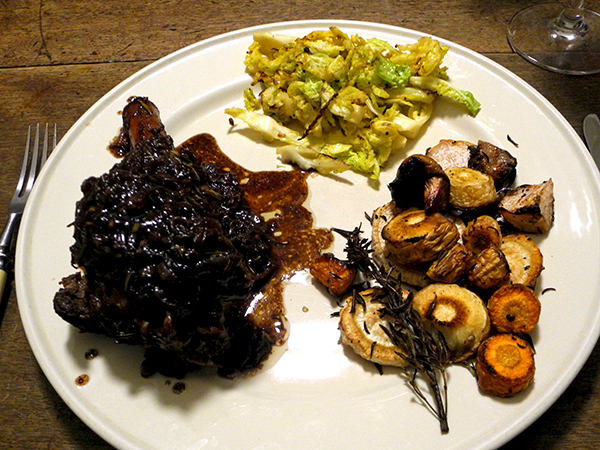
  • two 10-ounce lamb shanks from 3-Corner Field Farm, prepared, except for the accompaniments, exactly as described in this post, and this one, using red onions from Norwich Meadows Farm; the wine I cooked with was a Castello di Farnetella Chianti Colli Senesi 2012 (for reasons too complicated and uninteresting to explain, I had it in a slow-to-moderate oven for part of the time, and on the top of the stove, with the lowest flame I could manage, for the rest)
  • a mix of root vegetables, including sliced celery root and sliced parsley root, both from John D. Madura Farm, parsnips from Norwich Meadows Farm, a sliced ‘Gilfeather’ turnip from Alewife Farm, several shallots from John D. Madura Farm, all tossed with olive oil, salt, pepper, and the very last sprigs of winter savory from Stokes Farm, the herb placed on the bottom of a ceramic oven pan and the roots spread on top, everything roasted slowly at 400º until tender and golden (about 45 minutes)
  • the heart of a Savoy cabbage from Hoeffner Farms, sliced thinly, sautéed in butter along with sea salt, telicherry pepper, and 4 or 5 smashed juniper berries
  • the wine was a California (Napa Valley) red, RouteStock [sic] Route 29 Cabernet Sauvignon Napa Valley 2012
  • the music was Vivaldi’s ‘Motezuma’, performed by the ensemble, Il Complesso Barocco, conducted by Alan Curtis, with Vito Priante, Marijana Mijanovic, Inga Kalna, Roberta Invernizzi, and others

scallops, cress; roasted tomatoes, oregano; rapini, garlic

scallops_cress_tomato_rapini

I’ve not been able to find decent-size scallops at the Greenmarket this winter. On Monday however P.E. & D. D. Seafood had some that appeared larger than any I had seen since last fall, so I scooped up a few for this dinner.

Along with them we enjoyed the very last of the cultivated upland cress I had brought home from Alewife Farm a few days before; I was also very happy to have some local (well, at least local northeastern New England) tomatoes on the windowsill, and I was almost shocked to find that Lani’s Farm was back in the Greenmarket in full force on Monday, or at least in force sufficient to be able to offer what I have to believe was the first broccoli rabe of the season (even if I know it was managed with the help of a ‘high tunnel’).

Finally, sharp eyes will notice, from the evidence in the picture above, that [like my Mother] I don’t wear my ring while cooking.

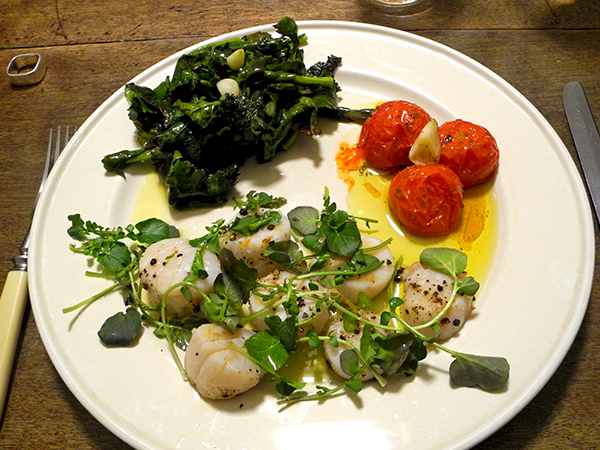
  • medium-size sea scallops from P.E. & D.D. Seafood, washed, rinsed and, ideally, very thoroughly dried (I may not have been so thorough this time, since the grill marks are faint), seasoned with salt and pepper, pan grilled for about 90 seconds on each side, finished with a squeeze of Lisbon lemon juice from Fantastic Gardens of Long Island, and a drizzle of olive oil, then scattered with the last of the cultivated upland cress from Alewife Farm we had already enjoyed in several meals [the basic recipe for this entrée, minus the cress, is included in Rose Gray and Ruth Rogers’, ‘Italian Easy: Recipes from the London River Cafe‘]
  • half a dozen Maine cherry ‘cocktail’ tomatoes from Whole Foods, slow-roasted with a generous amount of dried Italian oregano from Buon Italia, olive oil, and two halved garlic cloves from Keith’s Farm
  • young, tender, and mild rapini from Lani’s Farm, wilted with two garlic halves, from Keith’s Farm, which had previously sweated a bit in olive oil, the vegetable then seasoned with salt and pepper
  • the wine was a California (Sonoma) white, Ferrari-Carano Fumé Blanc Sauvignon Blanc 2014
  • the music was Hans Pfitzner’s Sextet Op 55, performed by the Ulf Hoelscher Ensemble, which was written in the summer of 1945, immediately after the war, by one account, “..while Pfitzner was homeless, in hospital for a broken arm and, like Richard Strauss also surveying the results of his loyalty to the Nazi regime, taking refuge in the Romanticism of the past.”; read the liner notes to the Ulf Hoelscher Ensemble recording, and also this very sad Wikipedia entry, and Paul Griffith’s 1997 piece in the Times

crab cakes, tomato salsa; boiled potatoes, parsley; cress

crab_cakes_tomato_salsa_potato

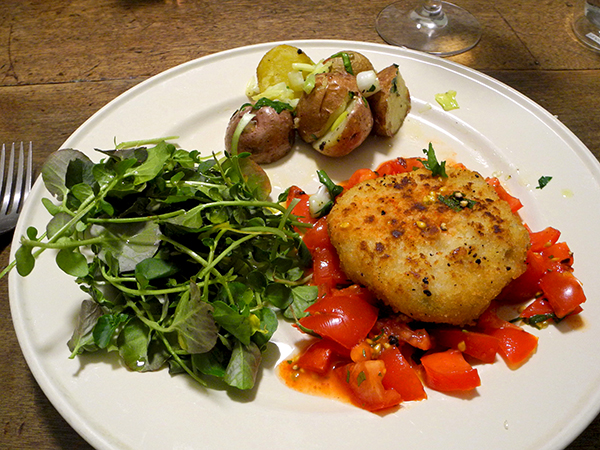
The potatoes were really sweet, mirabile dictu; the cress actually exciting, if  you can also imagine that; and the salsa had a fairly complex zing [zip?], probably because it included both a Basque paprika thing and some pepperoncino.

  • two crab cakes from PE & DD Seafood (ingredients: crab, egg, flour, red & green peppers, garlic, salt, pepper, breadcrumbs, mayonnaise, milk, celery, parsley), heated in a heavy cast iron pan, 3 to 4 minutes on each side, and served on a bed of 6 Backyard Farms Maine ‘cocktail tomatoes’ from Whole Foods, which had been chopped and combined with salt, black pepper, a bit of homemade French Basque piment d’Espellate purchased in a small town north of Baie-Comeau, Quebec last year from the producer’s daughter, some crushed dried pepperoncini, and some chopped fresh oregano leaves from Stokes Farm, the cakes finished with a drizzle of juices from the salsa
  • a total of 6 red potatoes (white flesh) from Lucky Dog Organic Farm, boiled, drained, dried in the pan, rolled in olive oil, scattered with sliced scallions and chopped parsley, both from Eataly
  • more of the very tasty and very beautiful cultivated upland cress from Alewife Farm (which we had also enjoyed the day before), washed, air-dried, and dressed only with some good olive oil
  • the wine was an Oregon (Willamette) white, Kings Ridge Oregon Pinot Gris 2014
  • the music was [the first half of] a wonderful recording of Handel’s ‘Alcina’, Alan Curtis conducting Il Complesso Barocco, with Kobie van Rensburg, Vito Priante, Joyce DiDonato, Sonia Prina, Karina Gauvin, Maité Beaumont, and Laura Cherici [make sure you read the synopsis, even if you aren’t interested in the music of queer baroque Saxon composers]