Year: 2017

marinated breaded grilled swordfish; sautéed cucumbers

I really did take pictures of this meal, including some great shots of the vegetables inside the pan both before and after they had been sautéed, but when I went to look for the images today, they had all disappeared. Either I had inadvertently deleted them, or they had been stolen by the kitchen goblins.

While each of these 3 older posts shows a swordfish steak prepared pretty much as the one I had prepared, the vegetables then were very different from what we enjoyed last night it, so I couldn’t borrow from any to find a lead image, or images, on this post.

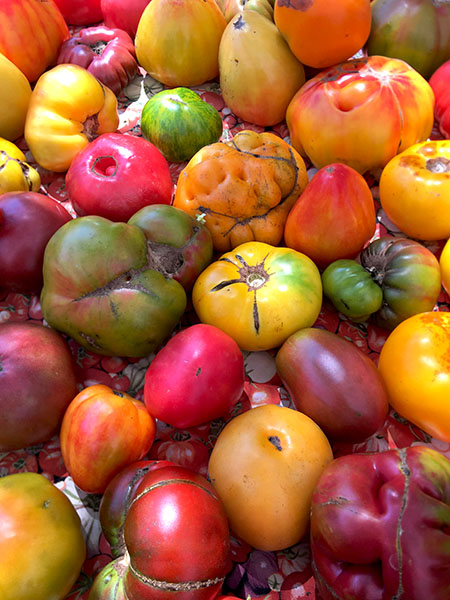
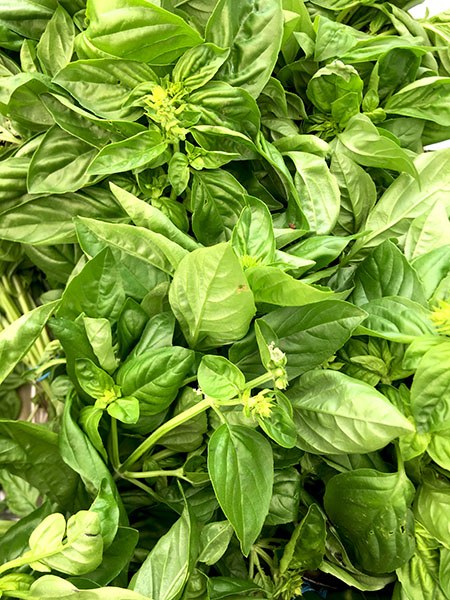
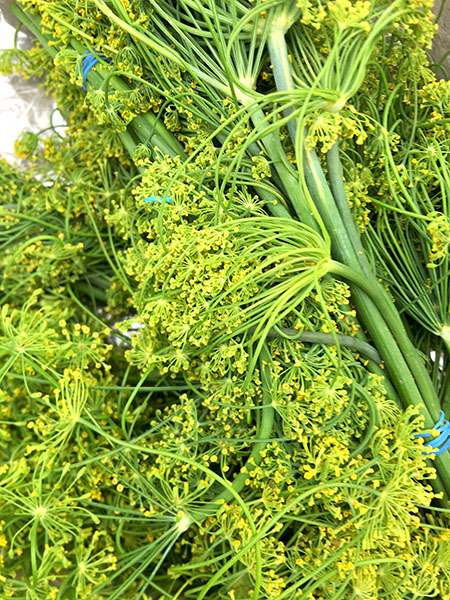
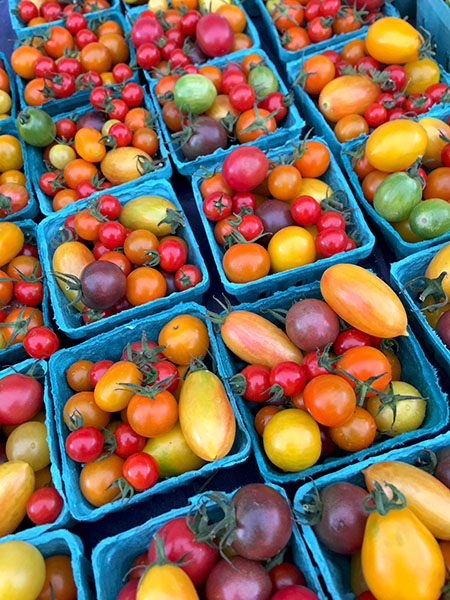
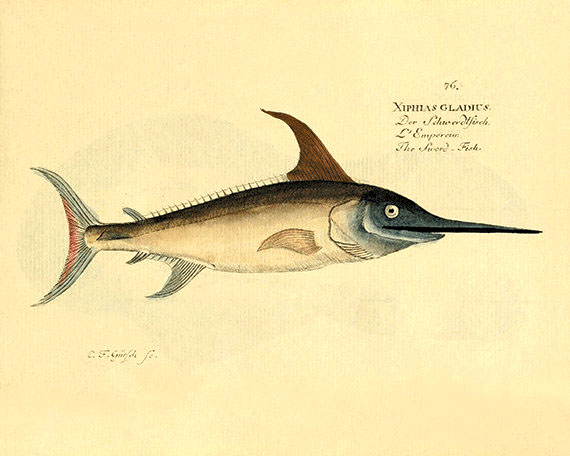
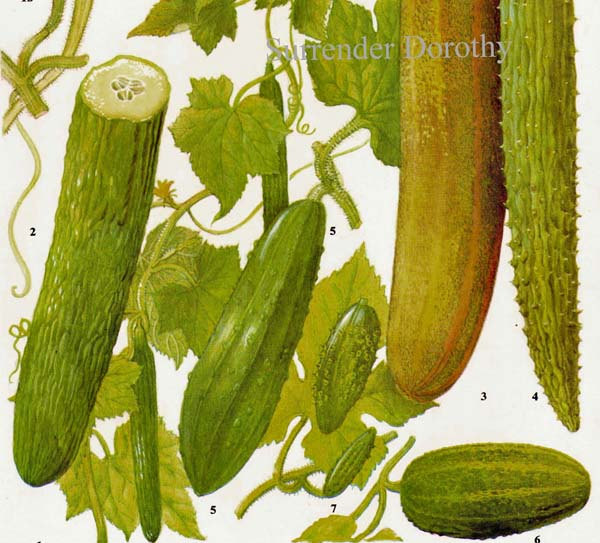
Because it was a really terrific meal, one of the best, and because I can’t stand publishing a food post without some kind of image, I looked for something related to the 2 main attractions, and came up with the vintage representations at the top.

  • one 16-ounce swordfish steak from Pure Vida Seafood, divided into 2 pieces at home, marinated for half an hour in a mixture of olive oil, 2 finely-chopped red spring shallots from Alewife Farm, some chopped fresh oregano blossoms from Norwich Meadows Farm, and a very small amount of crushed dried peperoncino Calabresi secchi from Buon Italia, drained well, coated on both sides with some homemade dried breadcrumbs, and pan-grilled over medium-high heat for 4 to 5 minutes on each side, removed to 2 plates, seasoned with Maldon salt, some of the juice of an organic lemon from Whole Foods Market squeezed on top, drizzled with a little olive oil [optionally, also a little more chopped spring shallot], and sprinkled with some purple micro radish from Two Guys from Ridgefield
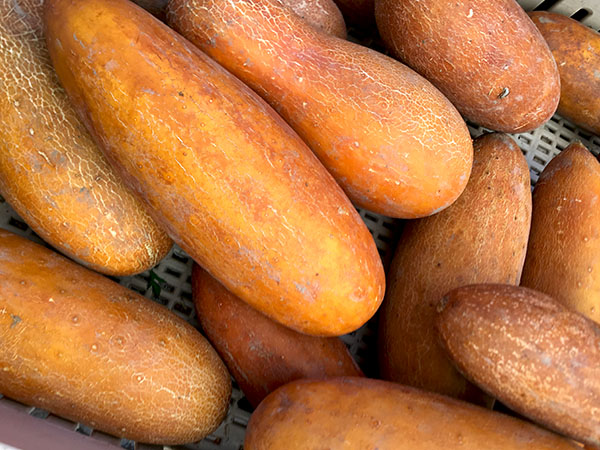
  • one Sikkim cucumber from Norwich Meadows Farm (one pound), unpeeled, sliced 2 cm thick [lately I’m finding it easier to describe something in centimeters rather than inches, if a metric measure better fits the dimension I’m describing], arranged inside a large seasoned heavy cast iron pan along with one sliced 4 cm-round spring red onion from N.J. Jersey Farm Produce, Inc. (in Chelsea’s Down to Earth Farmers Market on 23rd Street), and almost half of a dried golden orange habanada pepper, the vegetables sautéed over a medium-high flame, turning once, sprinkling the cucumbers with sea salt each time, until the cucumbers had begun to carbonize on each side successively [NOTE: the next time I will add the allium some time after beginning to cook the cucumbers, say, after they were turned, because they take far less time to reach the same cooking state], arranged on the plates, sprinkled with chopped dill flowers from Eckerton Hill Farm, and drizzled with olive oil
  • the wine was a California (Lodi) white, David Akiyoshi Reserve Chardonnay 2015, from Naked Wines
  • the music was the album, ‘Kathleen Supove: The Debussy Effect‘, one of our many purchases yesterday from Bandcamp

[the first image is a 19th-century Belgian lithograph which appears on this site; the second a print, dated incorrectly, on this one]
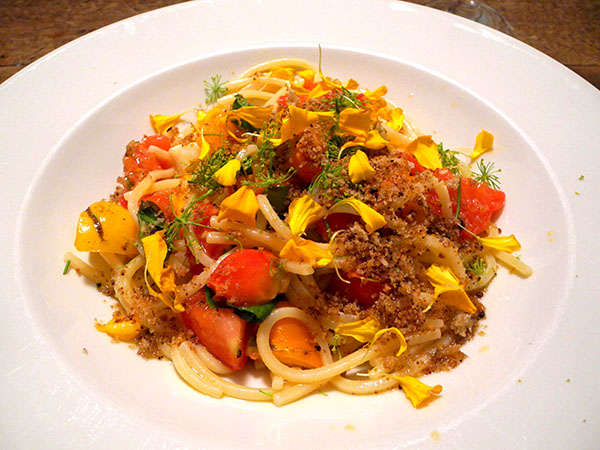
spaghetti, heirloom tomato crudo, basil, dill, nasturtium

There was pasta, but it was the only element in this dish that had to be cooked; essentially, it was all but a salad.

Interestingly, there was no salt (other than that in the pasta cooking water) or pepper. I’ve written about its simplicity before.

  • once the water for boiling 8 ounces of Setaro spaghetti chitarra from Buon Italia was heating inside a large stainless pasta pot, 4 heirloom tomatoes from Eckerton Hill Farm (approximately one pound) were cut into rough chunks, tossed in a large bowl with 3 tablespoons of olive oil, 3 lightly-crushed garlic cloves from from Norwich Meadows Farm, part of a dried peperoncino Calabresi secchi from Buon Italia, part of a golden dried habanada pepper, about half of a cup of torn basil from Alewife Farm, then stirred, allowed to sit until the spaghetti itself was ready, cooked al dente, and tossed into and mixed with the tomatoes, the mix placed in shallow bowls, a little olive oil poured around the edges of the pasta, sprinkled on top with homemade bread crumbs browned earlier in a little olive oil, finished topped with chopped dill flowers from Eckerton Hill Farm, and nasturtium flower petals from Windfall Farms
  • the wine was an Italian (Veneto) sparkling, Milleri Millesimato Prosecco 2015, a gift from friends
  • the music was the third and final act of Handel’s ‘Radamisto’, begun during dinner the night before

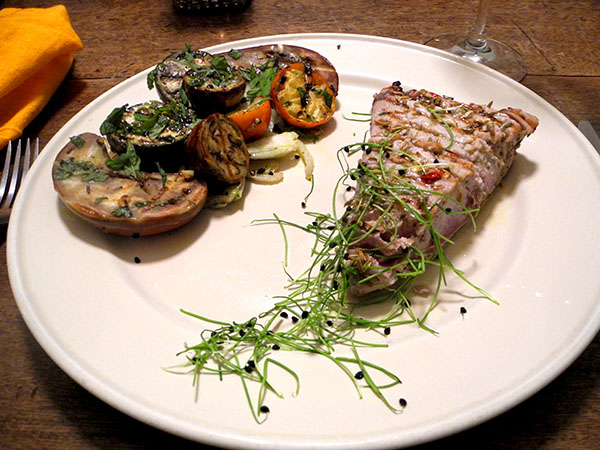
fennel seed/chili-grilled tuna; garlic/mint-grilled eggplant

It was a simple meal, and easily assembled, but very, very good.

  • one 13-ounce tuna steak from Blue Moon Seafood Company in the Union Square Greenmarket (caught on Scott Rucky’s fishing vessel, ‘Dakota’), halved, rubbed with on the tops and bottoms with a mixture of a heaping tablespoon of wonderful dry Sicilian fennel seed from Buon Italia and a little crushed dried peperoncino Calabresi secchi from Buon Italia, the two having been ground together with mortar and pestle, the tuna sections also seasoned with sea salt and freshly-ground Tellicherry pepper before they were pan-grilled (for only a little more than a minute or so on each side) and finished on the plates with a good squeeze of the juice of an organic lemon from Whole Foods Market and a bit of micro scallion from Two Guys from Woodbridge draped over the fish before, some olive oil drizzled on top
  • eight small eggplants (a round orange ‘Turkish’ variety from Norwich Meadows Farm, the others from Alewife Farm), each cut horizontally into 2 or 3 slices, mixed with a little olive oil, a 2 finely-chopped garlic cloves from Norwich Meadows Farm, sea salt, and freshly-ground Tellicherry pepper, pan-grilled on an enameled cast iron ribbed pan over a brisk flame, turning once or twice, sprinkled with chopped peppermint leaves from Norwich Meadows Farm, arranged on the two plates on top of a small amount of sliced fennel from Alewife Farm (also pan grilled), drizzled with a bit of olive oil
  • the wine was a French (Chinon) rosé, Jean-Maurice Raffault Chinon Rosé 2016, from Chelsea Wine Vault
  • the music was Handel’s 1712/1720 opera, ‘Radamisto’, Nicholaas McGegan conducting the Freiburger Barockorchester, with Juliana Gondek, Lisa Saffer, Dana Hanchard, Monica Frimmer, Michael Dean, Nicolas Cavallier, and Ralf Popken

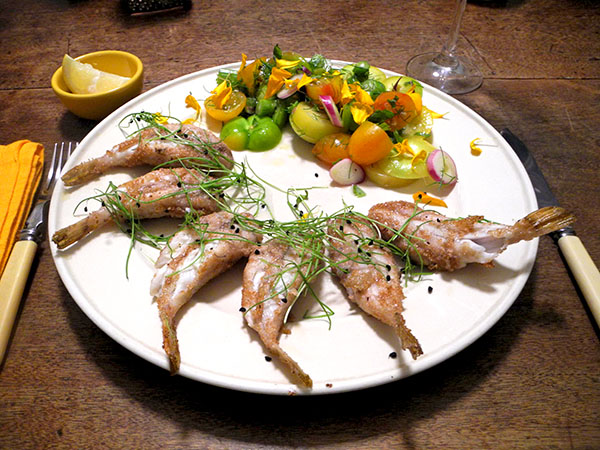
fried blowfish; tomatillo-tomato-shallot-fennel-lovage salsa

I used to be puzzled by the people who get so excited about the arrival of blowfish in the local fish market (in the big piscivore picture, their numbers may not be large, but it always seemed like I was the only one who didn’t get it).

I get it now.

As I wrote last September, they taste at least a bit “like fried perch”, and so evoke one of the best foods I remember from the midwest where I grew up.

And then there was a (cool) salsa.

The side dish was put together mixing some oddments, a few herbs, and several vegetables, each in a quantity not sufficient to use by itself. As such it was something of a mongrel, but like most mixed breeds, it turned out to be a very good mix. And the colors made a great presentation.

  • twelve blowfish tails (a total of 13 ounces) from P.E. & D.D. Seafood, dredged in about a quarter to a third of a cup of local North Country Farms Stone Ground Whole Wheat Flour seasoned with plenty of sea salt and fresh-ground Tellicherry pepper, pan-fried in olive oil (in depth, about an eighth to a quarter of an inch) inside a very large heavy cast iron pan, turning over once (cooking about 2 minutes on each side, or until they had turned golden), served with wedges of an organic lemon from Whole Foods Market, and garnished with micro scallion from Two Guys from Woodbridge,  [NOTE: the next time I make this dish I may try adding some ground mustard seed to the flour, since it had been such a great addition to this monkfish preparation]
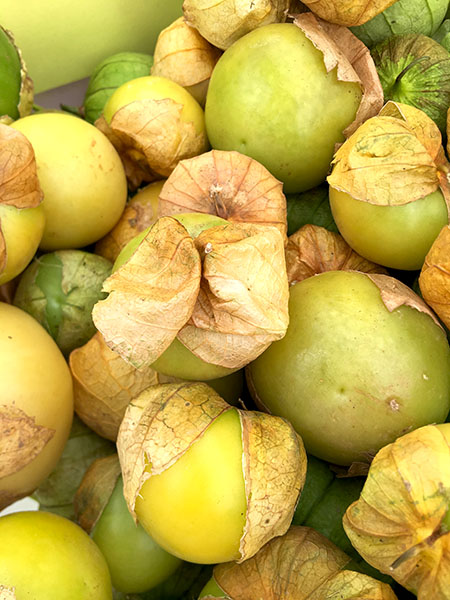
  • a bright and refreshing salsa composed of yellow tomatillo from from Oak Grove Plantation, sliced several times horizontally, one green heirloom, chopped roughly, and 6 miniature orange plum-shaped tomatoes, halved, both the heirloom and ‘cherry’ fruits from Eckerton Hill Farm, several chopped stems of a young fennel bulb – and some of the chopped fronds – from Alewife Farm, 3 small chopped spring shallots, also from Alewife Farm, chopped lovage from Keith’s Farm, a little olive oil, sea salt and freshly-ground Tellicherry pepper, lemon juice, a big pinch of dried fenugreek that I had obtained Nirmala Gupta’s ‘Bombay Emerald Chutney Company‘ at Chelsea’s Down to Earth Farmers Market on 23rd Street, the mix arranged on the plates and garnished with nasturtium blossoms from Windfall Farms
  • the wine was an American (New Mexico) sparkling, Gruet Brut
  • the music was the last act of Handel’s 1724 opera (the 1731 version),’Tamerlano’, Riccardo Minasi conducting Il Pomo d’Oro, with Xavier Sabata in the title role (we had listened to only the first two acts during a meal last week)

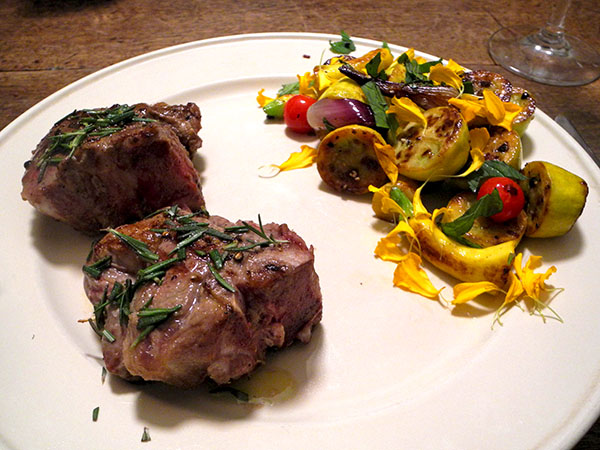
lamb chops, rosemary; crookneck squash, shallot, tomato

These excellent chops were asking for a wine just as excellent, and that’s what we all enjoyed last night.

  • four 5-ounce lamb loin chops, grass-fed and organic, from Shannon Brook Farm, located in the beautiful New York Finger Lakes, dried thoroughly, cooked on a very hot enameled cast iron grill pan for a total of 10 or 12 minutes, turning twice, seasoned with sea salt and freshly-ground Tellicherry pepper after the first time, finished with a squeeze of juice from an organic lemon from Whole Foods Market, scattered with some chopped rosemary from Keith’s Farm, and drizzled with a little olive oil

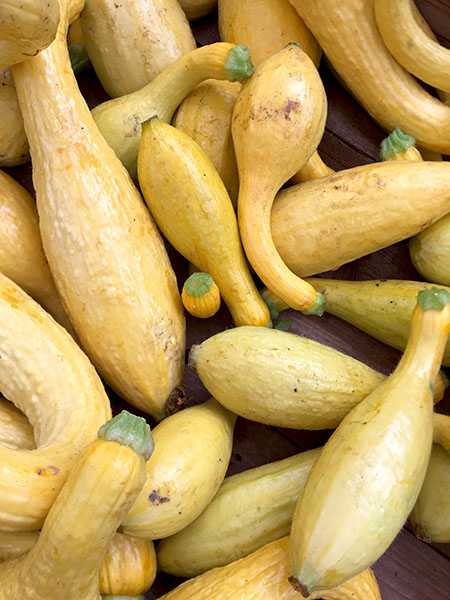
  • sweet crookneck yellow summer squash from Alewife Farm, cut into 2cm sections, sautéed in a little olive oil for a few minutes with 2 sliced garlic cloves from Norwich Meadows Farm inside a high-sided heavy tin-lined copper pan before 3 fresh spring shallots from Alewife Farm, halved lengthwise, were added, the pan removed from the flame once the vegetables had begun to caramelize, its contents seasoned with sea salt and Freshly-ground Tellicherry pepper, a very few very small red tomatoes from Eckerton Hill Farm stirred in with them until they had just begun to soften, everything arranged on the plates and garnished with nasturtium flower petals

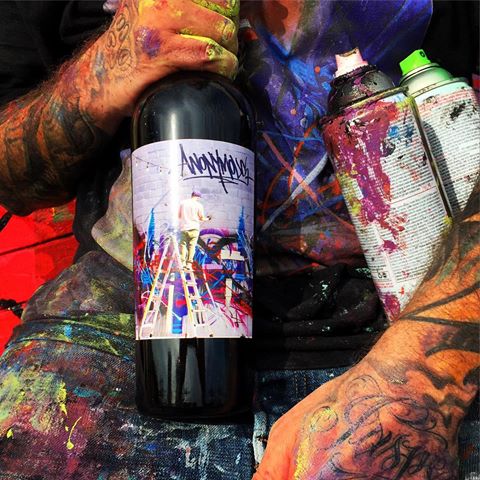
[image of Saber, holding a bottle of ‘Anonymous’ and two spray cans, from #anonymousby1849winecompany medias]

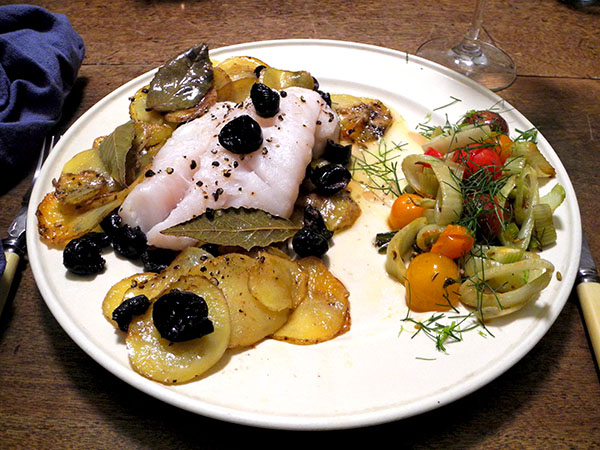
hake, potato, laurel, oil-cured olives; fennel, shallot, tomato

Normally this would not be a meal we could enjoy in the summer, although it’s a meal we always enjoy a lot. Last night the air was relatively cool, and remembering that it’s a recipe Barry likes to call ‘comfort food’, I decided to sneak it into the last week of July.

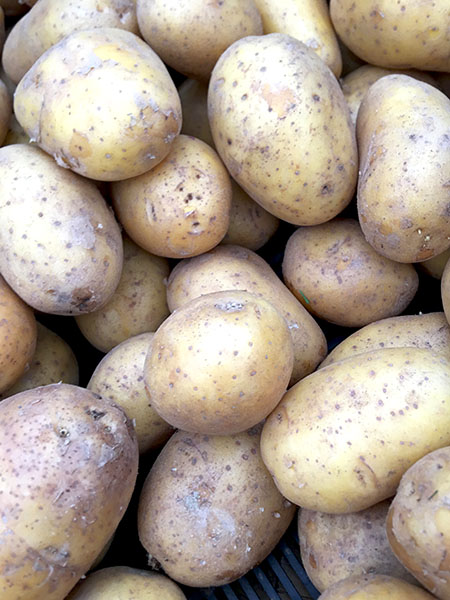
There were potatoes,

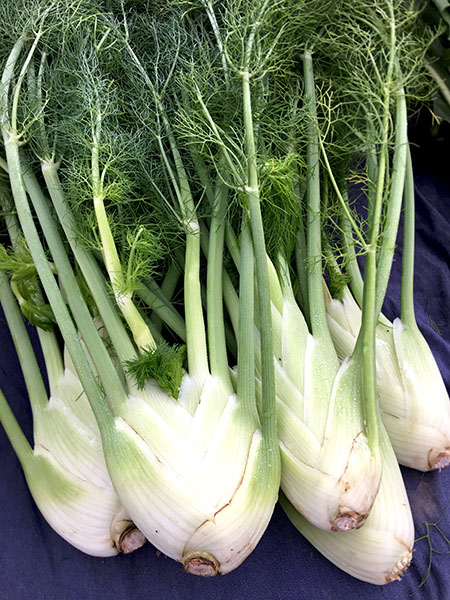
and, in a side dish more seasonal than the entrée, excellent fennel,

and some beautiful tomatoes.

  • One 15-ounce hake fillet from American Pride Seafood in Chelsea’s Down to Earth Farmers Market on 23rd Street, prepared accordingt to a Mark Bittman recipe I found in the New York Times in 1999 [although I always use only about two thirds of the amount of olive oil it suggests], last night using these other ingredients: ‘yellow potatoes from from N.J. Jersey Farm Produce, Inc., also from the 23rd Street market; black oil-cured olives and 15 Sicilian bay leaves, both from Buon Italia
  • one small fennel bulb from Alewife Farm, stems and fronds removed (the stems and most of the fronds kept for another use, some of the fronds set aside, sliced about one quarter of an inch thick crosswise, and 3 roughly-chopped fresh spring shallots, also from Alewife Farm, one crushed section of a dried golden/orange habanada pepper, and a teaspoon of Italian fennel seeds, sautéed inside a heavy high-sided tin-lined copper pan over medium high heat until the fennel had just begun to color, the heat lowered, the pan covered, the vegetables cooked for another 4 or 5 minutes, the cover removed and 7 or 8 mixed multi-colored cherry and baby plum tomatoes from Eckerton Hill Farm, halved, added, stirred, anad allowed to soften just a bit, the pan set aside until the hake was ready, divided onto the plates and garnished with the chopped fronds of the fennel
  • the wine was a California (Andrus, in the Sacramento-San Joaquin River Delta) white, Jacqueline Bahue Albarino Gomes Vineyard California 2016, from Naked Wines
  • the music was the album, ‘Henricus Isaac: Nel tempo di Lorenzo de Medici & Maximilian I‘, music from the Medici and Austrian Habsburg courts, by the late 15th-century Flemish composer, performed by Jordi Savall, La Capella Real de Catalunya, and Hesperion XXI

dogfish/palombo al vino bianco; grilled tomatoes; potatoes

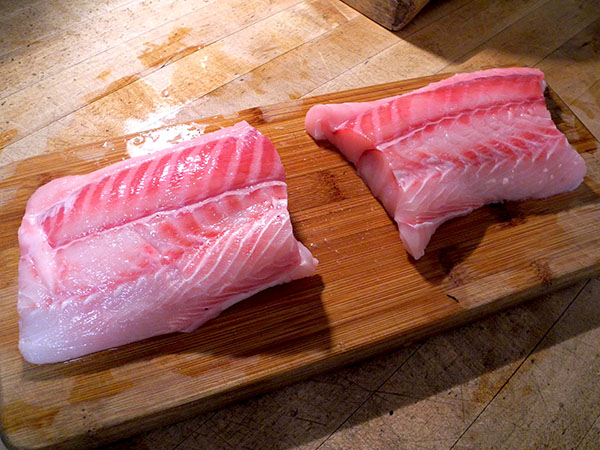
I’m leading here with the ‘before’ picture this time because I think it’s a really good illustration of how I could have been seduced by a fillet from something called a ‘dogfish’ (NOTE: the market prefers to describe it as ‘sand shark’).

The image is of a one-pound fillet, after it had been halved, lying on our kitchen counter yesterday evening.

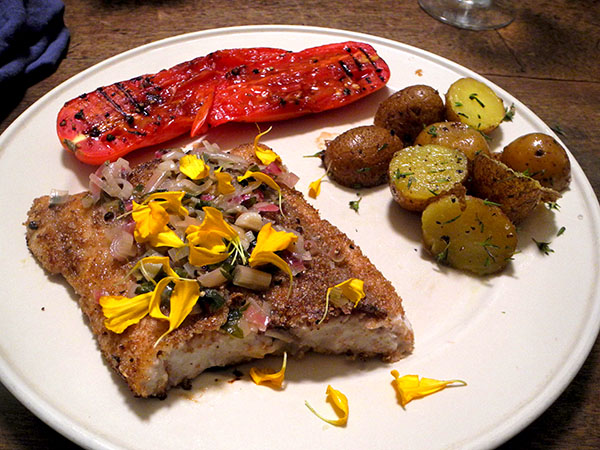
This is how it went a little later, sitting atop a round plate in an arrangement of a square, more circles, and what looks like a rectangle

I had never cooked sand shark/dogfish before (‘rock salmon’ in the UK, ‘saumonette’ in France, ‘Palombo’ in Italy). I’m not certain I had ever even eaten it, so when I came across some beautiful, very fresh fillets in a small bucket inside my fishmonger’s iced cases Friday afternoon, I decided it was time I started.

The hardest part of the operation turned out to be researching how to prepare it. I settled on a recipe, described as Italian, and with an Italian name (‘Palombo al vino bianco‘), possessing one of the great virtues of that culture’s cooking tradition: a minimum number of ingredients, to keep from disguising the flavor of the best meat, fish, or vegetables available to the cook.

We were both pretty pleased with the outcome.  Barry loved it, and I have only one reservation, about whether I had sautéed the fillet just a little too much, but the recipe, which said how long to cook it, didn’t describe the thickness of the fillet it was dealing with. Since I had absolutely no experience with this fish myself, so I couldn’t draw on my own expertise.

The only way I’m ever going to know is to cook sand shark/dogfish/ground shark/etc. again. I’m sure it’s going to happen.


  • one 17-ounce sand shark fillet from Pure Vida Seafood, brought to room temperature, halved crosswise (I’m getting very good at cutting equal halves out of even the most irregular shaped fish or meat), dusted with some local North Country Farms Stone Ground Whole Wheat Flour, shaking off the excess, sautéed in a little over one tablespoon of olive oil inside a large heavy oval tin-lined copper pan above a high flame for about 5 minutes on each side, or until browned, seasoned with sea salt and Freshly-ground Tellicherry pepper, the heat then turned off while a second copper pan was heated over a low to moderate flame with another tablespoon of oil before 2 fresh finely-chopped spring shallots from Alewife Farm were added and cooked until softened, stirring occasionally, followed by one small (or halved full-size) salted and rinsed Italian anchovy, at least a tablespoon of chopped Italian parsley from from Norwich Meadows Farm, and a half cup of Gruet Brut sparkling wine (from an opened bottle that remained from entertaining guests earlier in the evening), the heat increased and the liquid reduced almost completely, then a tablespoon of fresh water added, the sauce seasoned with a pinch each of salt and pepper and poured over the top of the fillet halves, the pan heated over a low flame for a minute or two, the fish served on the plates with a sprinkling of nasturtium flowers from Windfall Farms
  • eight German Butterball potatoes from Berried Treasures boiled, drained, dried in the pan, rolled in a little olive oil, seasoned with sea salt and frshly-ground Tellicherry pepper, tossed with chopped summery savory from Stokes Farm
  • two long heirloom tomatoes (‘Striped Roman’?) from Eckerton Hill Farm, halved lengthwise, the cut sides sprinkled with sea salt and freshly-ground Tellicherry pepper, grilled face down on an enameled cast iron grill pan for 3 minutes or so, turned over and the rounded side grilled for a little less time, removed, arranged on the plates and brushed with a little balsamic vinegar


There was a dessert.

  • small oval bowls of Lā Loos ‘Vanilla Snowflake’ goat milk ice cream from Whole Foods Market, drizzled with a sauce I had made from Wilklow Orchards gooseberries


carciofi ravioli, habanada, heirloom tomato, micro scallion

While I usually pull out a package of filled pasta because it simplifies making a meal choice, we also really enjoy them, and they still offer the possibility of individualizing them, sometimes with creative additions. This simple artichoke-filled ravioli was a good example.

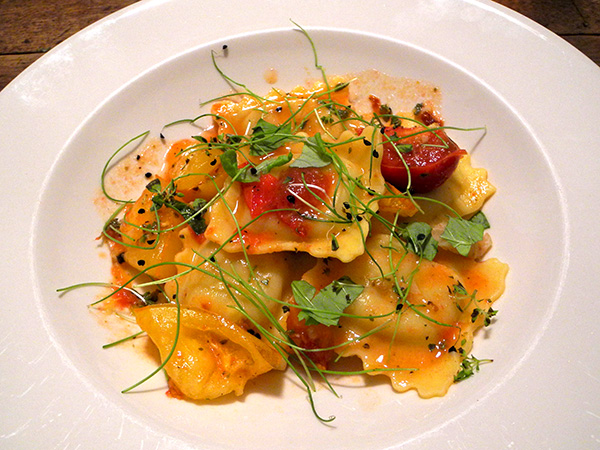
The sauce was superb, as the picture may suggest. Most of the credit has to go to the complex flavors of the habanada pepper and the excellence of the heirloom tomatoes, plus the dried Italian wild fennel flowers!

  • two chopped garlic cloves from Norwich Meadows Farm heated inside a large tin-lined high-sided copper pan in a little olive oil until pungent, most of one orange dried Habanada pepper, crushed, added to the pan and stirred over medium heat for a minute, followed by 2 heirloom tomatoes (one red, one yellow) from Stokes Farm, roughly chopped, and some chopped oregano from Norwich Meadows Farm and torn Genovese basil from Windfall Farms, then the contents of a 10-ounce package of Rana carciofi [artichoke] ravioli from Eataly (after having been boiled for barely 3 minutes) was spilled into the pan along with some of the reserved pasta cooking water, carefully mixed with the sauce over medium heat to emulsify it, sprinkled with a bit of dried Italian wild fennel flowers (more accurately, pollen) from Buon Italia, the pasta finished, once inside 2 shallow bowls, with a scattering of micro scallion from Two Guys from Woodbridge
  • the wine was a California (Lodi) rosé, Karen Birmingham Rose Lodi 2016, from Naked Wines
  • the music was the album, ‘Trionfo d’Amore e della Morte: Florentine Music for a Medici Procession’, performed by Piffaro and the Concord Ensemble

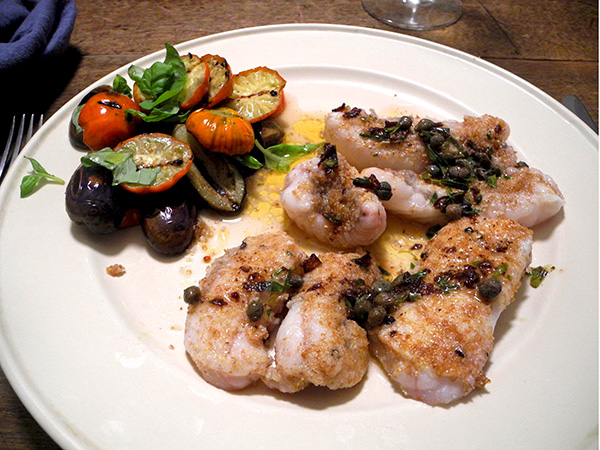
monkfish, caper butter, tarragon; pan-grilled eggplant, basil

I did it again.  I mean a recipe that was totally new to me 2 weeks ago.

The first time it was so terrific I knew I’d be back soon. I did it again on Wednesday.

I thought it turned out very well, but although I had followed all procedures pretty much the same as I had the first time, there was a suggestion within our small dinner party that I could have left the monkfish over the flame a wee bit longer.

Still, …

  • ‘monkfish with caper butter’ prepared following this great recipe, starting off with 4 monkfish tails (16 ounces total) from Blue Moon Seafood Company, sliced through once horizontally to reduce their thickness for quick cooking, and continuing with local North Country Farms Stone Ground Whole Wheat Flour seasoned with salt, pepper, and ground mustard seed; Organic Valley ‘Cultured Pasture Butter’; shallots from Trader Joe’s Market; Sicilian salted capers, thoroughly rinsed; the juice of an organic lemon from Whole Foods Market; and chopped tarragon leaves from Keith’s Farm
  • eight small orange ‘Turkish’, and an equal number of purple (aubergine) ‘Patio Baby’ eggplants, from Norwich Meadows Farm, each cut horizontally into 2 or 3 slices, mixed with a little olive oil, a little finely-chopped garlic clove from Norwich Meadows Farm, sea salt, and freshly-ground Tellicherry pepper, pan-grilled on a large iron plate over brisk flames on 2 burners, turning once, sprinkled with torn basil leaves from Stokes Farm, arranged on the plates and drizzled with a bit of olive oil
  • the wine was an Oregon (Willamette Valley) white, Scott Kelley Pinot Gris Willamette 2016, from Naked Wines
  • the music was the 2010 Earl Brown album, ‘Synergy’ 

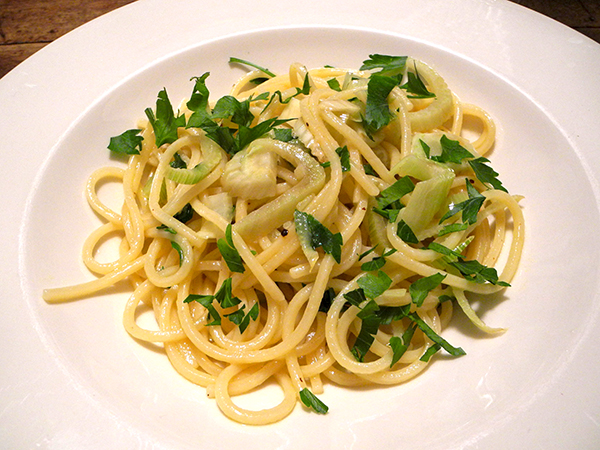
spaghetti olio e peperoni e finocchio, no acciughe

The meal was something of a break from the at least relative intensity of some of those that have appeared on our table recently; it really was a very simple, totally unstressful construction.

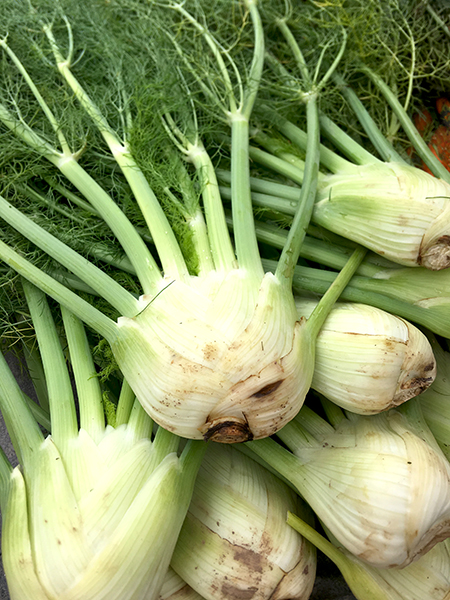
It mostly included things already in the larder, but I added a small fennel bulb, because it was there, and because I knew that it wouldn’t have gotten any fresher by the time I figured out what I might do with it otherwise.

I skipped the anchovies, which would normally be a part of this classic pasta, thinking that to do so would keep it lighter, but the dish would probably have been even more interesting if I had not.

  • while the water for boiling 8 ounces of Setaro spaghetti chitarra from Buon Italia was being readied in a large stainless pasta pot, one small fennel bulb, halved and sliced thinly crosswise, was heated with a little olive oil over a low-medium flame inside a large enameled cast iron pot until it had barely begun to soften, then 2 fat garlic cloves from Norwich Meadows Farm, coarsely-chopped, were added, along with an additional quarter cup of olive oil, the flame turned down, the garlic gently heated until it had softened and begun to turn golden, followed by part of a dried Sicilian pepperoncino from Buon Italia, crushed, a tablespoon or two of roughly-chopped parsley from Phillips Farm and about a quarter cup of the pasta cooking water, the mix then allowed to simmer and reduce slightly, while the pasta finished cooking (removed from the pot after only about 6 minutes, while still a little chewy in the center), at which time the spaghetti was drained, tossed into the pot with the sauce, and, the heat turned up slightly, cooked further, stirring, for another minute or two, then arranged in 2 shallow bowls with another tablespoon or two of parsley sprinkled on top

There was a cheese course.

  • a blue (still unnamed) goat cheese and ‘Manchester’ goat cheese from Consider Bardwell Farm
  • thin toasts of a French-style organic whole wheat and whole spelt miche from Bread Alone